Covid-19 color codes by country for Israel travelers.
Update: As of October 3rd, 2021 the travel ban to the remaining red countries will be lifted. Israelis can now travel to any destination while observing Covid-19 regulations as set out by the Ministry of Health.
The Israel Ministry of Health and the Ministry of Foreign Affairs are responsible for releasing health/travel notices and updates for Covid-19. Countries are divided into 3 color codes; yellow, orange and red. This is the latest list (as at 14.9.21).
Yellow countries
Travel is permitted
A 24 hour isolation period is required or until a negative PCR test is confirmed
Orange countries
Travel is permitted but the MOH advises against it.
All travelers from these countries are required to complete a full isolation including vaccinated or recovered travelers.
Vaccinated and recovered travelers can shorten the isolation period under specific conditions
Red countries – as of October 3rd, 2021, the red category has been removed.
Travel is banned unless approved by the Exceptions committee
All travelers from these countries are required to complete a full isolation including vaccinated or recovered travelers.
Making Aliyah and retiring in Israel during the Covid-19 Coronavirus crisis.
If you are a retiree and considering making Aliyah, planning on bringing your parents or you wish to make the move to a secure living environment, you’ve probably been asking yourself – “What about elder care in Israel during Covid?”
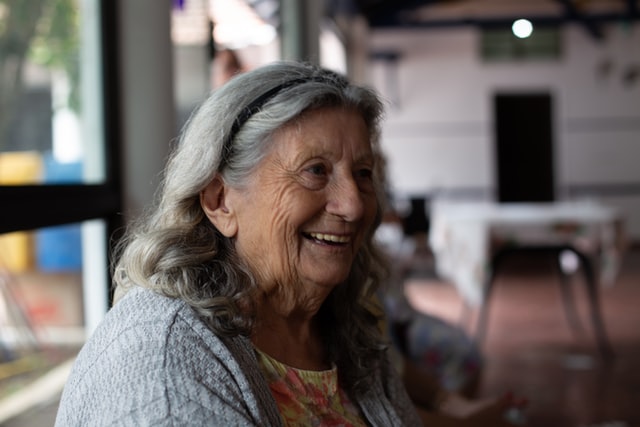
Beth Protea is a retirement facility in Herzlia with a distinctly Anglo flavour. Lyn Bach – Manager of Cultural Activities & Media at Beth Protea tells us how they are handling it.
It is hard to believe how the year 2020 commenced. All those books we had read and all those movies we had seen that seemed so far-fetched, suddenly became a frightening reality.
Where does one begin to explain how life carried on within the confines of our very special facility Beth Protea – home to approximately 150 senior citizens. Our motto has always been to ensure that our residents live their lives in total dignity and receive exactly the type of care we would give to our own parents. With this in mind, we tackled the Covid challenges facing a very threatened age group.
It became obvious very early on that we would have to close our doors to any outsiders, including family members, lecturers, musicians etc. Suggestions by other facilities similar to ours was to simply ensure the residents remain isolated in their own apartments and that all their needs would be taken care of that way. However, isolation causes all sorts of other issues and we really did not feel that this was the best solution for our residents’ emotional well-being.
If Covid taught us anything, it is the ability to think out of the box and this is exactly what we did. To ensure the safety and health of the residents we divided the building into 2 areas – those for residents and those for staff and the two did not mix. We appointed a small, limited number of staff who had physical access to the residents. In addition, we were blessed with a large number of Filipino caregivers who became our angels of mercy, and as they too were forbidden to leave the premises, they became our link to the residents. Whether it was delivering their meals, collecting and delivering their laundry or taking their garbage for disposal, they were there. We could never have managed without them. The up-side of this arrangement meant that the residents had freedom to move around the building and were not isolated alone in their apartments.
Now came the challenge of how to ensure continued cultural entertainment when no-one was allowed into the building. We approached various lecturers and requested them to prepare recorded lectures. Most were extremely obliging as they began the difficult road of learning a whole new way of presenting their material. Zoom had become really popular, but we felt Zoom lectures would not provide the residents with human interaction and would simply provide entertainment, but alone in front of their computers or televisions. This was not a solution. Instead, we began screening recorded lectures for small numbers of residents at a time in our synagogue. Maximum permitted at the time by the Ministry of Health was 10 which meant we would repeat the same screened lecture several times a day to ensure maximum number of viewers.
Life at Beth Protea
In addition, we did the same thing with movies and recordings of live concerts. Our art department prepared kits for residents to continue art projects, but without the physical presence of the art teacher during the class.
Our residents proved to be real “troopers” and despite the difficulties of not seeing their family and friends, they at least were part of a vibrant community and had mental stimulation every day to keep them busy. It worked!!!!
The real angels in this story are the incredible staff we have who went above and beyond their expected roles. The pressures were enormous. The challenges even greater. The pandemic was something so new and frightening and everyone found themselves in unfamiliar territory.
Talk and rumours were everywhere about the miracle of the expected vaccine and Beth Protea was amongst the first of the retirement facilities to receive the vaccine. What a day this was!!! We decided to make it into a true “happening” with a photo booth to record the momentous vaccine. Delectable treats, small gifts, lovely music all contributed to a hopeful future now that the vaccine had arrived. The building was buzzing with excitement. Soon after that, vaccine number 2 was received and slowly, slowly life as we had once known it, began to return to some sort of normal.
Just as we began to feel the mist finally lifting, rockets were being fired over Israel and we had to deal with another kind of lock-down. The safety and well-being of our residents being our prime concern. Staff rallied around during sirens to help direct residents from their apartments into safe areas in the building and luckily no damage occurred in the Herzlia area. But…………. A war situation is disconcerting for everyone and again the residents proved their resilience. They were a true inspiration to us all.
Sadly, reality raised its head once again as a new variant of Covid was discovered and the numbers of infected people in Israel was on the rise. However, our residents continue to prove their ability to adapt to change. We have had to re-instate some restrictions according to the Ministry of Health’s guidelines, but luckily, we have not had to close the building again like we did initially.
We all chose to see the cup as half full and have realized that we are going to have to learn to live with Covid as it appears it is not going anywhere in a hurry. So, for the time being, life continues. Days and evenings are full of activities. We have even managed an outing to the North with the residents and whenever possible, provide our shuttle service to the beach, a nearby mall or the city centre. Residents are seeing family and friends and in a nutshell – be grateful, it could be so much worse…….
Hakafot – Members of Yeshivat Har Hamor dance with the Torah scrolls around the Bimah on Simchat Torah
What are Hakafot?
Hakafot (הקפות plural)
Hakafah (הקפה singular)
Meaning “[to] circle” or “going around” in Hebrew.
Hakafot are a Jewish Minhag (custom) in which people walk or dance around a specific object, generally in a religious setting.
In Judaism, there is a custom on Sukkot to encircle the reader’s platform (bimah) with the Four Species on each of the seven days of the Sukkot holiday.
On the eve of Simchat Torah and the following morning, the custom is to take the Torah scrolls out of the Ark and to encircle the reader’s platform seven times. Worshippers celebrate throughout the synagogue with great joy, singing, and dancing.
Before the dancing commences, a set of seventeen verses, called Atah Ha’raita, is chanted three times.
It is a great honor to hold the Torah scrolls and at the commencement of each Hakafah, the honor of holding the Torah scrolls is given to a different group of men.
It is also customary to hand out flags for children to carry, supposedly reminiscent of the tribal flags under which the Israelites marched in the desert.
After the seventh hakafah, all of the Torah scrolls are returned to the Ark except for one. This Torah Scroll is returned to the reading desk on the Bimah where Torah readings are continued. When the Torah reading has been completed, the Scroll is returned to the Ark.
When attending prayer services and participating in the Hakafot, we urge you to follow latest Ministry of Health Covid-19 restrictions and directives.
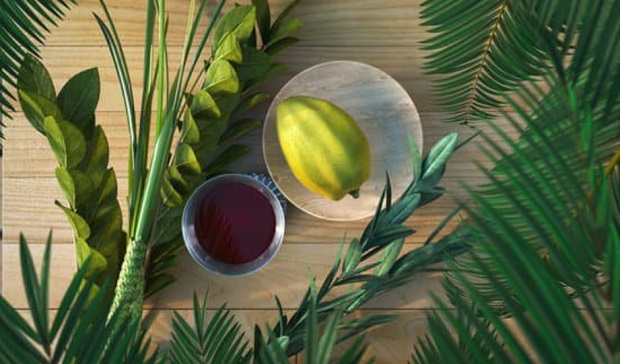
During Sukkot they are placed together in a special plaited holder and collectively are known as a as a ‘lulav’. The 4th of the four species, the citron tree or etrog, is held together with the lulav.
There are many elucidations regarding the lulav and etrog. The Midrash (Yalkut Shimoni, Vayikra 247) says that the four species of the lulav represent four different types of Jews:
The Etrog has a good taste and a good fragrance. It represents a person with both wisdom (Torah learning) and good deeds.
The Hadas (myrtle) has a good fragrance, but is inedible. It represents a person who has good deeds, but lacks wisdom.
The Lulav (date palm) is edible, but has no smell. This represents the person with wisdom, but without good deeds.
The Aravah (willow) has neither taste nor smell. It represents a person with neither good deeds nor Torah learning.
This last category disturbs us. The aravah represents the lowly simple Jew who doesn’t seem to have any virtue. Why is “he” put together with the other three categories of Jews in the Arba’at HaMinim? He doesn’t seem to be worth very much. However, we have to understand that every Jew is very precious. The Gemara (Berachos 57a) states that Klal Yisrael are compared to a Rimon (pomegranate). Even the emptiest one is full of mitzvot (good deeds) like a rimon.
According to a Midrash in Leviticus Rabbah, 83: the etrog is symbolic of Psalm 104:1: “You are clothed in glory and majesty”;
The palm is used because it is said Psalms 92:13: “The righteous bloom like date-palm”
The myrtle signifies Zechariah 1:8: “And he stood among the myrtle-trees”
The willow is significant because it is written in Psalms 68:5: “Extol Him who rides on the clouds (aravot), the Lord is His name.”
Also,
Each of the four species signifies a limb of the body and each of these limbs is a means through which man serves God.
The etrog refers to the heart
The lulav – the upright backbone
The myrtle symbolizes the eyes
The willow – the lips.
There is also a masculine-feminine theme inherent in the four species. The lulav represents masculinity, whilst the etrog is seen as feminine, in its form.
The lulav and etrog must be perfect in every way; therefore, they are chosen with extreme care.
Did you know?
Traditionally, etrogim (plural) grow in Mediterranean lands like Israel, Morocco, Greece and Italy and even as far as Yemen.
When etrogim grow out in the wild, almost all of them are scarred by foliage and animals. So, finding a citron that is evenly shaped and unblemished can be challenging. However, Israeli etrogim are specifically grown for use during Sukkot and so they grown in a controlled and protected environment.
How do I disconnect from local Israeli TV, phone and internet services?
Whether you can get a better deal elsewhere or just fed up with the service you are getting for TV, your landline, mobile phone or internet provider, disconnecting is not too difficult.
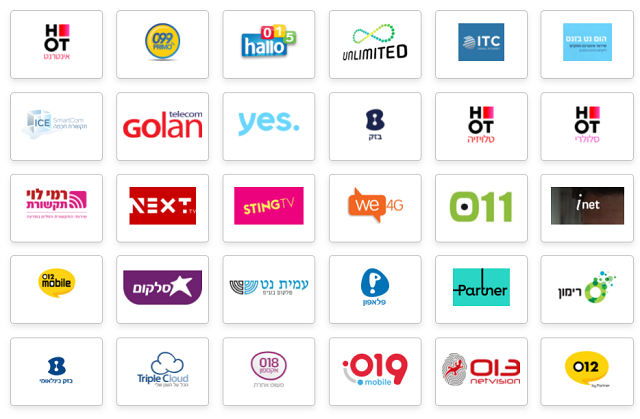
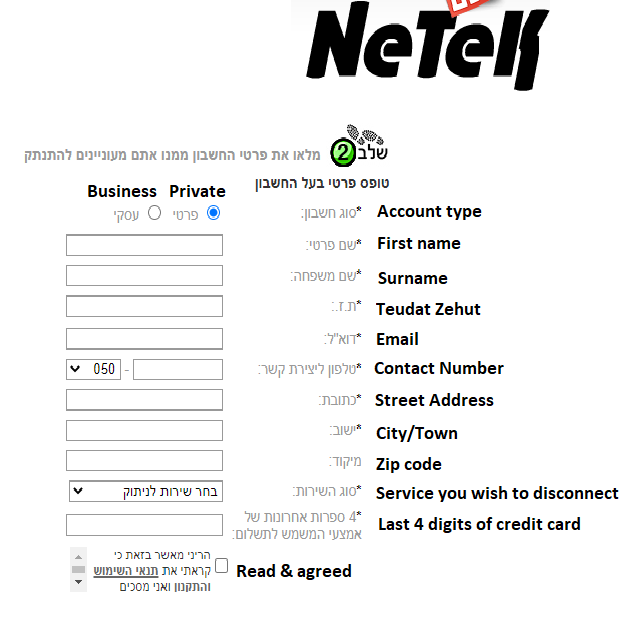
You can avoid an uncomfortable telephone conversation with your provider’s pushy customer service representative, by using a service like NatekOti or Netek.
These companies offer you the option to disconnect from your TV, phone and internet services via their websites.
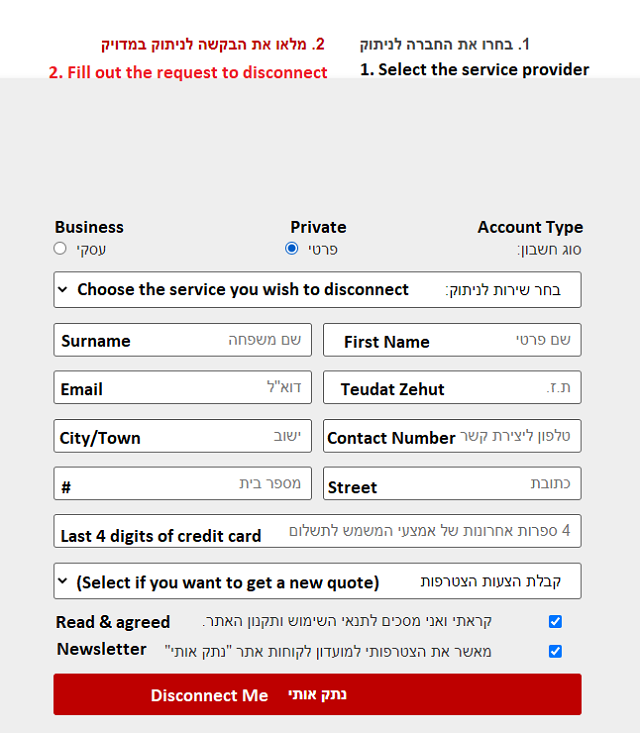
Of course, their sites are in Hebrew and so we have translated the important pages for you so that you can disconnect at your convenience.
Step Two: Fill in the form with the information as shown here:
Step Three: Once you have filled in the form (all fields are mandatory), click on the green arrow to confirm.
Following this, you will receive a confirmation message with a reference number to the email address you listed above.
But alas!
Should you not be contacted by the supplier within 24-48 hours, it’s unavoidable and you will have to call the supplier directly and make sure they received the notification. Do not wait any longer than this to do so.
The supplier does not want to lose you as a client and they will do their utmost to persuade you to stay with them. They could offer you a discount for a limited period of time, a gift voucher or a host of other incentives to make you stay.
Are you able to withstand the pressure of their marketing and sales tactics? If not, you might find yourself committing to a whole new package and set of services.
Here are a couple of sentences that could help you…
I would like to disconnect from the Internet/TV/Phone/Cable
Ani rotzeh/rotzah l’hitnatek mi sherutei haInternet / Televiziya / Telefon / Kabelim
2. No, I am serious, I want to disconnect. What don’t you understand?
Lo, ani retzini, ani rotzeh/rotzah l’hitnatek. Ma ata/at lo mevin/mevina?
What can you tell them that will convince them that you are serious? “I’ve just got a new job and my boss is now paying my bill through his company” or “I’m leaving the country on Tuesday”. Whatever it is, make sure it cannot be argued. Good luck with this!
Have you ever dreamed of swimming in crystal clear, blue waters surrounded by colorful fish? If yes, Eilat must be on your list of scuba diving and snorkeling destinations.
Snorkeling in Eilat’s clear waters, where thousands of species of colorful fish, dolphins and sea creatures unique to this ecosystem, live – is an unforgettable experience.
Eilat lies on the Red Sea and water temperatures average at 24 degrees Celsius throughout the year, even in winter!!!
The Red Sea is calm, its waters are clear and reefs grow in nature reserves very close to the shallow shore line. Get your snorkeling and scuba gear ready, your flippers and an underwater camera – and head off on a magical journey!
If Eilat had a national sport, snorkeling would be it and so we’ve decided to share two of our favorite snorkeling destinations.
Eilat Coral Beach Nature Reserve
The Coral Beach Nature Reserve reefs are the only coral reefs in Israel.
The Coral Beach Reserve offers easy access (disabled friendly) via bridges that lead visitors to the open waters.
A magical underwater world awaits you; huge varieties of corals, fish and marine creatures unique to the Red Sea marine ecosystem will hold you in awe.
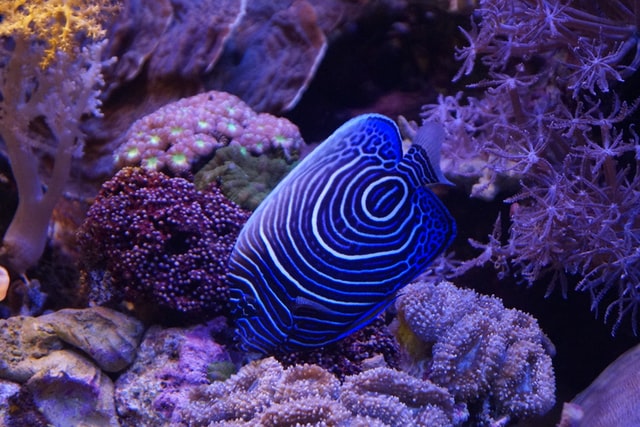
A coral reef in Eilat with an unique assortment of marine life
Walk along the beach, enjoy the lookout points while the kids paddle in pools along the way. You might want to hire a guide for a unique 30 minute, experience that includes swimming and explanations about the surrounding coral reefs.
Google Maps: Coral Beach Eilat Nature Reserve
Amenities: Toilets and showers, chairs and shade awnings, cafeteria.
Parking: There is a large parking lot near the reserve and across the road.
Entrance Fee (subject to change)
Type
price
Adult (18+)
₪ 35.00
Child
₪ 21.00
Adult in group
₪ 30.00
Child in a group
₪ 18.00
Student
₪ 30.00
Senior citizen
₪ 18.00
Resident of Eilat
₪ 12.00
Princess Beach – Israel’s southernmost beach
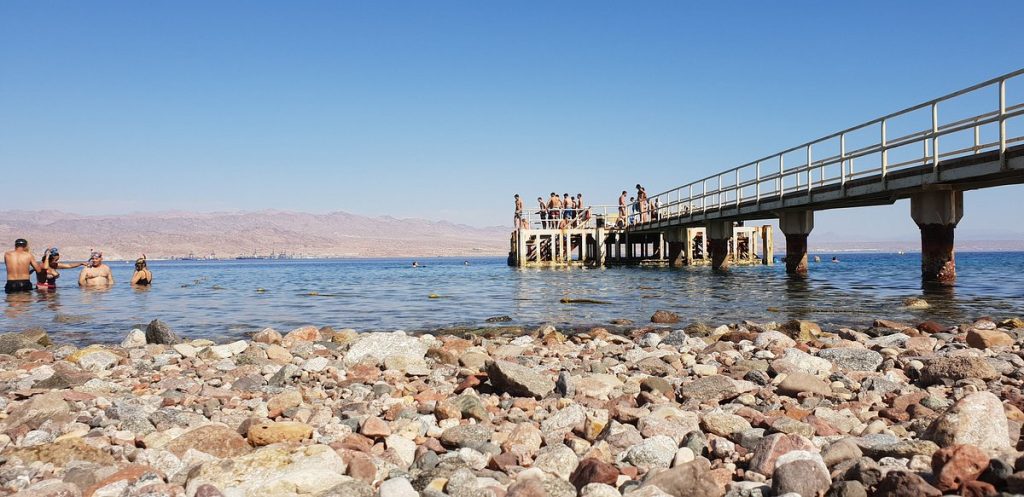
Just a short way from the Taba border crossing into the Sinai (Egypt), in front of the Princess Hotel (now under renovation), is Israel’s southernmost beach – the Princess Beach. It’s a somewhat wild beach reminiscent of beaches untouched by man, the beaches where rocks and pebbles gently and quietly kiss the water. The Princess Beach is part of the Coral Beach Strip Nature Reserve.
To enter the shallow waters you can follow the rope markings, but it is recommended to walk along the two iron bridges that lead directly into the water.
Here, hundreds of colorful fish swim peacefully alongside the coral reef. The beach is untamed and there is no shade or rescue services, nevertheless the Princess Beach offers one of the most magical and finest snorkeling experiences you’ll ever know!
Google Maps: Princess BeachEilat
Entrance fee: Free!!
Amenities: A few small restruants.
Lifegaurds: NO!!
Diving equipment for hire: No
Parking: There is a large parking lot across the road.
The first months of Aliyah can be stressful and making sure you can meet your monthly rent when you are not working is a real worry. Thankfully Olim (new immigrants) are entitled to receive a rental assistance subsidy from the Ministry of of Aliyah and Immigrant Absorption. Rental assistance is one of the benefits that Olim receive as part of the absorption basket or ‘sal klitah’.
Olim who immigrated from January 2017 onwards, receive rental assistance beginning in the 8th month from the date you received Oleh status (the date of your Aliyah)
If your Aliyah date is between May and December 2016, your assistance from the Ministry of Housing and Construction commences in the 9th month from the date of your Aliyah.
Olim who immigrated to Israel in April 2016 and earlier, receive assistance from the Ministry of Housing and Construction from month 13 of their aliyah date.
Olim generally receive assistance until the end of the 5th year from the their Aliyah date when they received Oleh status.
A single Oleh/Olah, serving in the IDF or in national service (Sherut Leumi) while in active duty, and has Lone Soldier status (from the IDF or Ministry of Absorption) is entitled to rental assistance up to 5 years after their Aliyah at a rate of 402 NIS per month while in active duty. Once demobilized, rental assistance reverts as per the table above.
Olim, living in subsidized government housing and receiving support from National Insurance payments (Bituach Leumi), are eligible for extended rental assistance.
Olim living in a Merkaz Klitah/Ulpan are NOT entitled to the rent subsidy.
Home-owners – Mazaltov! You have bought your own home. However, you are now NO longer entitled to the rent subsidy.
Traveling abroad. Don’t worry you can go back home to visit your loved ones BUT you cannot be abroad for 2 months or more. If so, your rental subsidy will be suspended. Upon your return, you must notify Ministry of Housing & Construction so that subsidy payments can be reinstated. No extensions of the period of eligibility are given, if you have traveled abroad.
Single parent Olim are eligible for assistance for 6 years from their date of Aliyah.
Olim receiving income support from Bituach Leumi (elderly Olim, single-parent families with income support etc.) are entitled to extended rental assistance on the condition that they are both recipients of these benefits from Bituach Leumi, and are defined as “without housing”.
How do I get my rental subsidy?
Your rental subsidy will be paid directly into your bank account after the 8th month in an amount as per the table above.
Changes that could affect you
Changed your bank account? You must inform the Ministry of Housing and submit details.
Got married to an Israeli or veteran oleh? Your assistance will no longer be automatic. You must let the Ministry of Housing know and they will determine the new rate accordingly. Likewise if you got divorced.
Contacting The Ministry of Housing and Construction
The Ministry of Housing and Construction can be reached via their hotline on *5442
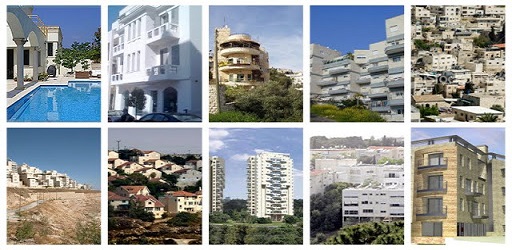
Israel: Highest increase in property prices over the last 10 years.
Israel saw a 345.7% increase in house prices over the last decade, the greatest increase in the world, according to new research by money.co.uk.
Israel’s house prices per square meter rose from 6883 NIS in 2010 to nearly 31,000 NIS in 2020, a 345.7% increase. However, average wages in the country only increased by 17.50%, whilst inflation changed by 0.92%.
A study by money.co.uk, looked at how the average property price in OECD countries has changed over the last 10 years and compared it to the difference in average wages and inflation over the same period, to discover which nations are seeing the cost of property outstrip that of earnings.
Number two on the list; In the last decade Switzerland saw and increase of 165%. In 2020 the average house price per square meter stood at just over the equivalent of 37,500NIS.
The USA was not far behind with a 153% increase in property prices over the last decade however the average price per square meter is just over an equivalent of 12,000 NIS – that’s 1/3rd of the price in Israel.
The UK has only seen a 75% increase over the last 10 years. The price per square meter in the UK is 4,318 GBP which translates to 19,138 NIS – half of the price in Israel.
Greece experienced the biggest decrease in prices per square metre (-17.9%), however, the country’s average annual wage also dropped dramatically by 16.1%.
The average price per square meter in Israel’s major cities
According to Numbeo the average purchase price, per square meter in Jerusalem’s city center, is 28,546 NIS.
Expect to pay around 42,00 NIS per square meter in Tel Aviv’s city center.
Haifa, the worker’s city, is considerably cheaper where you will pay an average of 16,300 NIS per square.
The average purchase price per square meter in Raanana is 21,200 NIS.
Olim, have you been able to afford to purchase your own home?