26 C
Jerusalem
Friday, June 19, 2026
Sample Page
Home Blog Page 124

Hikes & Nature Trails in Israel

Reading Time: 3 minutes

5 of Israel’s Best Trails & Hikes

Hebrew:  טיולים וסיורים בישראל

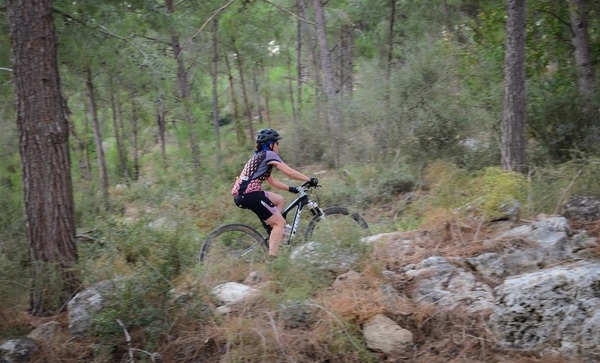
1. An adrenaline adventure in the Segev Forest

One of Israel’s best hikes and trails is only a couple of kilometers long. Set aside an entire morning for it. From route 805 take the road leading to the Yaad community village.  Park your car at the pine tree forest near the entrance. 4X4 vehicles can continue on the dirt tracks.  Your first stop is the wine-press, about 800m into the trail. About 300m along you will reach the Rosh Zayit remains and then continue on to the remains of  Beza, a village dating back to the times of King Solomon where you’ll find ancient burial caves.  A newly opened, 9km, off-road bicycle trail meanders along the perimeter of the forest.

israel hikes and trails segev
Segev Forest: Image credit KKL – JNF

2. The Ohad Trail

Near the settlement of Nofit,  The Ohad Trail is named after Ohad Zak, a Nofit resident who was killed while serving in Lebanon in December 1998.  The trail is about 2.5km and takes about 90 minutes to walk.  There are benches and look-out points along the way so you can sit down and enjoy the stunning views of Nahal Tzipori, the Galilee, and the Acre Valley to the south.  Israeli wild flowers and date, olive, pomegranate, and almond trees line the trail. Near the end of the trail you can take in a view of the Carmel, the Nesher quarry and the Haifa bay industrial zone.

Getting there: Nofit can be reached from Kiryat Tivon and the Alonim Junction, or drive along Highway 672, which branches off the Yagur-Shfaram Highway (Highway 70), about 2 km from the Yagur Junction.

3. The Lavi Pine Forest

The Lavi pine forest at Tzommet Golani is home to ruins and remains from the Roman-Byzantine period. Also known as Lubya, the name Lubya was known during the crusaders period and is also mention in the Talmud.  In addition to walking the trail, it is also recommended for experienced cyclists.  Great news!  The forest is handicapped accessible.

4. Follow the Yehudia Trail to the Hexagonal Pools

There are two trail choices; 1)  Follow a clearly marked pathway approximately 1.5km, an ideal family option or 2) Not for beginners; challenging and some may even say, hard.  Climb the rocks, walk through the natural vegetation, along the river bed with the sometimes turbulent river close by.   Either way you will eventually reach the Yehudia Canyon and the waterfall that drops 20 meters into a natural pool, surrounded by basalt rock formations know as the Hexagonal Pools.

Travel Tip: Good hiking shoes or sandals that can be used to wade in the water will come in handy – lots of algae, small stones and rocks in the pools at Yehudia. Be careful!

5. The mother of all trails! The Israel National Trail

The Israel National Trail – INT is one of the only trails of its kind in the world.  The 920 kilometer trail from the north to the south of the country, is an amazing way to see Israel.  The trail transverses forests, mountain ranges, urban areas and deserts before ending at the southern most point on the Red Sea.  Along the way it passes Arab & Jewish villages, Roman relics, Crusader ruins and Druze and Christian holy sites.

Don’t have the time to do the entire trail in one go?  Don’t be daunted! The trail can be done in stages at your leisure, a few days at a time

Israel’s Top 10 Beaches

Reading Time: 4 minutes

Summertime: Israel’s top beaches

Hebrew: החופים הכי יפים בארץ

The climate in Israel  makes it possible to bathe on one of Israel’s beaches, almost all year round.  There are 157 official beaches (unfortunately we were unable to verify how many of these beaches, have lifeguards on duty).

israel top 10 beaches

You can choose from 4 different seas; The Mediterranean, The Red Sea, The Sea of Galilee and The Dead Sea and each with its own unique water cycles, plant and marine life. Armed with suitable sun protection, sunscreen and plenty of drinking water you could visit a different beach every week, all year round.  The 10 top beaches in Israel as voted by members of our Facebook group, are:

1.  The Dolphin Reef Eilat – The Red Sea

The Dolphin Reef in Eilat offers magical views of the surrounding mountains and the opportunity to swim with, meet and observe the dolphins in their natural habitat.  Cool scuba diving too.

Entrance fee. Telephone: 08-630-0100

2.  The Coral Beach Eilat – The Red Sea

Beautiful corals, underwater gardens and a variety of brilliantly colored tropical fish make up one of the most densely populated coral reefs in the world.  With its delicate ecosystem great care is taken to maintain this balance and so visitor numbers are controlled.  Snorkeling equipment is available for hire and guided snorkeling is available for large groups.

Entrance fee.  Tel: 08 637 6829 

 3.  Hof Dor Tantura – The Mediterranean

Just a few minutes from the northern town of Zichron Yaakov, Hof Dor Tantura boasts beautiful sandy beaches, a calm and gentle sea with almost no waves.  If the family beach is too noisy you’ll find secluded spots a few hundred meters along. Basic camping facilities are also available.

Entrance fee.  Tel: 04-6399121

4. Caesarea Aqueduct Beach – The Mediterranean

Situated approximately half-way between Tel Aviv and Haifa you’ll find the town of Caesarea.  After you have roamed the archaeological ruins spend  a relaxing afternoon on the beach which is flanked by an ancient Roman aqueduct.  Great swimming and a great photo opportunity.

5.  Sironit Beach Netanya – The Mediterranean

Netanya’s main beach, Sironit Beach, is located below the Rishonim Promenade and can be accessed by the transparent sea elevator. Two breakwaters are set up opposite the beach which create tranquil bays and enable safe swimming almost all year round.

6.  Haifa – The Mediterranean

Three beaches, adjacent to one another; Carmel, Zamir and Dado are the most popular in Haifa.  The Carmel Beach is surrounded by breakwaters and this calm water is an ideal place for children to swim.  Zamir and Dado are family beaches. There are plenty of waves (but not too rough), a selection of restaurants (some kosher) and grassy areas that run along the 2km boardwalk between the two beaches. Enjoy the breathtaking views of the Carmel Mountains. Free Wi-Fi too!

7. Mineral Beach – The Dead Sea

Although the salt levels of The Dead Sea prevent marine life, the abundance of minerals and their health benefits are a huge attraction for visitors from around the world. Mineral Beach is a private beach located at the northern Dead Sea and is open all year around.  You can also take advantage of the sulfur pools, mud baths and spa treatments.  Lots of great air, wonderful views and warm sunny days.

Entrance fee.

8.  Guy Beach – Sea of Galilee (Tiberias)

Because the Sea of Galilee is actually a lake its shores are not soft and sandy.  Along the shore there are plenty of places where you can pull in and wade into the water at your own risk. You need to be careful as there are often strong winds and the water currents can be turbulent and dangerous.  If you are looking for safe place to swim and lifeguards in attendance you may want to check out Guy Beach.  For the kids there is a water slide, a wave and a regular pool. There are also large grassy, shaded areas and a restaurant.

Entrance fee.

9.  Achziv Beach – The Mediterranean

Beyond Akko, about 5km north of Nahariya, and a little before Rosh Hanikra lies Achziv.  There are a few beaches here that you may want to try. Some require paying an entrance fee and others are free.  You’ll find marine life, sea anemones, urchins and even turtles among the rocks. Treat yourself to a late afternoon visit and watch a magnificent sunset.

10.  Tel Aviv – The Mediterranean

It’s very hard to choose which one of Tel Aviv’s many beaches is the best. National Geographic and Lonely Planet rank the Tel Aviv beaches in their Top 10 List.  Whether you choose to jog, cycle, swim, surf or just do some people-watching you will enjoy the nearly 15km of beaches on the greater Tel Aviv coastline. There is capoeira at the Dolphinarium, volleyball at Gordon, separate bathing for men and women at Nordau Beach and kite surfing at Aviv Beach. Access to Tzuk Beach, Metzitzim and the Hilton are disabled friendly.

Kibbutz Living in Israel.

Reading Time: 3 minutes

Living on a kibbutz in Israel – the in’s and out’s.

Hebrew: מגורים בקיבוץ

ein hashlosha kibbutz
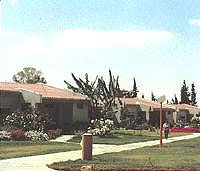
Typical Kibbutz housing and gardens at Ein Hashlosha

What is a kibbutz?

Kibbutz living appeal to you?

A kibbutz is generally an agricultural settlement.  It is a collective and cooperative community of people who work together as a group and share the rewards equally.

The name Kibbutz – Hebrew: קיבוץ – come from the Hebrew root word – קבץ Kavetz – which means to group, gather or cluster. The word Kibbutz is in the singular form and the plural form of the word is Kibbutzim – more than one kibbutz.  A person who lives on a kibbutz is called a “kibbutznik” or in the female form “kibbutznikit” or the plural form “kibbutznikim”.

The kibbutz movement

The first kibbutz in Israel, Kibbutz Degania, was founded way back in 1909.

Joseph Baratz was one of the founders of the kibbutz movement and you can read more about him in Doreen Guinsburg’s personal Aliyah story.

There was a flood of immigrants, many World War II and Holocaust survivors, to Israel at the time of independence in 1948. With relatively few possessions they where willing to work hard and do whatever it took to improve their living conditions. They  grouped together in small communities, shared the workload and all the responsibilities. Today, there are a few hundred kibbutzim in Israel.

The Kibbutz ideology

The statement of the Kibbutz Movement central body:

“The kibbutz is an original and unique Israeli creation – a multi-generation, rural settlement, characterized by its collective and cooperative community lifestyle, democratic management, responsibility for the welfare of each adult member and child, and shared ownership of its means of production and consumption.”

Types of Kibbutzim

In addition to agriculture, kibbutzim generate revenue through various types of industry, factories,  hi-tech and other ventures. Some kibbutzim are religiously orientated and others are secular. Some have strong political affiliations.  Some have large numbers of English speaking, immigrant members.

Today, some of the kibbutzim have restructured. Whereas before members would all receive equal remuneration, now there are different financial structures based on seniority and one’s personal contribution to the kibbutz. With the new restructuring, these kibbutzim may require you to pay for meals, electricity, laundry etc. This new system is called “hafrata’ – Hebrew for privatization.

Kibbutz daycare and schooling

Some kibbutzim have their own school on the premises but some join with other kibbutzim in the area and run a communal school.  Whereas members are entitled to daycare and schooling for their children, it is also possible for non-members to attend kibbutz schools and daycare by paying a regular school fee.  This is a popular trend.

Volunteering to work on a Kibbutz

Volunteer programs are available on some of the kibbutzim – a few months of work in exchange for meals and lodgings.  This is a great way for young people to experience kibbutz life and the local lifestyle.

Contact:

email: kpc @ kibbutzvolunteers dot org dot il

Attending a Kibbutz ulpan Hebrew learning program

It is also possible to attend a kibbutz ulpan on one of eight kibbutzim in Israel.  A 5 month Kibbutz Ulpan Program offers a combination of intensive Hebrew study and volunteer work in different areas on a kibbutz.  So if you are between 18 and 30 years old this could be a great option for you.

Becoming a member of a Kibbutz

Many kibbutzim today, allow members of the public to live on the kibbutz without becoming members, by paying a monthly rental.

How do I join?

We refer you to the Ministry of Foreign Affairs website, where you will find a detailed description of the various kibbutzim, a countrywide list of kibbutzim, their social structure and policies, volunteer programs as well as detailed information regarding learning Hebrew and kibbutz ulpan.

Once you have applied to become a member of a kibbutz, and after having lived there for a while, a vote will take place and your membership will be decided.

Kibbutz tourism

Some kibbutzim have guest accommodation; guest houses and hotels. Israelis enjoy taking a short break and book into a kibbutz for a weekend or a few days during the holidays.  Guest accommodation can be basic self-catering or it can be a luxurious five-star hotel.  If you would like to tour Israel and enjoy kibbutz hospitality, just Google “kibbutz hotels” for more information.

Anglo- List Advertising Element – Basic Profile.

0
Reading Time: < 1 minute

Advertise your business in the Anglo-List Business Directory.


Basic Profile

 Features


 √  Logo

 √  250 word description

 √  Direct client contact

 √  Outbound links: your website, Facebook, Twitter & Google+

 √ Keyword optimization

 √ Testimonials

 √  Geomaps & other features

 √  Upgrade – Bonus link in our Featured Business module on every page of the site


                                                                             Contact us →


Promote your business on the Anglo-List

0

Reading Time: 3 minutes

Your clients are a click away!

Anglo-List has helped small and medium sized businesses to increase their profits and we are offering you an opportunity to grow your business, reach new clients and penetrate new markets.

Customer behavior has changed forever and our advertising elements and marketing strategies match new buying behaviors.

Did you know that 88 percent of transactions start with an online search and the average consumer conducts up to 12 searches before engaging with a brand. If you can’t be found on Google then you are not in the game. A permanent online presence builds your Google rankings. Thinking that Facebook can do this, is a mistake.

Most consumers go through most of the buying process on their own and have developed their own criteria in selecting the right vendor. Today, when a client calls, it means he is ready to buy.

Tens of thousand people use Anglo-List every month. Tap into this valuable resource. If you want to be found by English speakers, you need to be where English speakers go to find information.

Choose one or a combination of advertising modules, add-ons and services. Our advertising plans are affordable and cost effective. No keyword bidding and paying overly inflated prices for online referrals.Our advertising elements reduce your cost per lead and client acquisition, improve your organic rankings and increase your revenue.

We care about your results and we will work with you and help you get the most out of your advertising campaign.  We go above and beyond to ensure our clients are well taken care of and we are focused on getting you results.

 CONTACT US TODAY TO GROW YOUR BUSINESS 

What others have to say about their experience with the Anglo-List

“The team at Anglo List is creative, supportive and patient. They have enabled us to maximize the return on our advertising budget and grow our firm.  We highly recommend you claim your place on the Anglo List platform for your business.”

Jay Hait Adv., Hait Family Law


“It is hard for me to think of Anglo-List as something separate from Suzanne Suckerman. From day one (almost 4 years ago!), Suzanne has extended her hand and heart to support me and my professional needs. She has guided me, provided feedback, made recommendations and has taken initiatives on my behalf. Anglo-List is a dynamic and invaluable resource for me and it is directly due to Suzanne.

Thanks Suzanne for your time, efforts and energy to make Anglo List such a tremendous resource and for being there for me every time I needed your help.”

Sara Jacobovici


“Over the years, we’ve been advertising our guest accommodation on the Anglo-List with fixed and rotating banners.  We get bookings, traffic and better Google rankings as a direct result.  Whenever we have a new business objective, Anglo-List has come up with workable suggestions and affordable solutions.”

Steve


“Anglo-List built my blog.  They took care of every detail from start to finish. They even trained me and also showed me how things worked.  Any site maintenance or optimization is done on a ‘per-project’ basis which saves me a fortune in monthly fees.”

Earl S.


“In addition to my business profile, I have a Featured Business listing which has increased my exposure by 5 fold.  I get referrals and new customers all the time.”

Tony S.


“I was ready to pay thousands for a new website, but when Anglo-List suggested the benefits of a site audit, it sounded logical and I was in.  I’m a one-woman business and I had no real idea of how to get the most from my site.  I implemented their suggestions and not only have I seen an improvement in my Google rankings and conversions, I saved thousands on building a new site too. It totally worked for me.”

Adi G.

 CONTACT US TODAY TO GROW YOUR BUSINESS 

Cuts of Beef – Names & Numbers

Reading Time: 2 minutes

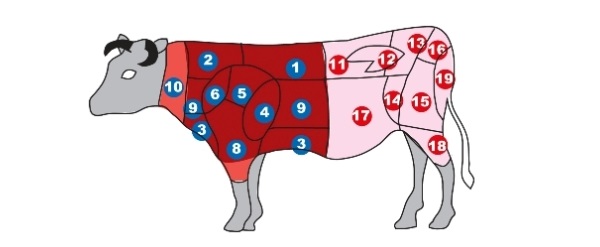
Your guide to Israel beef cuts. The Hebrew names and numbers of beef cuts and internal organs.

Hebrew: Helkay Basar –  חלקי בשר

Your first few shopping experiences in Israel might have you pulling your hair out. There are many challenges and new food choices – one of them is determining which beef cut is most suited to your favorite recipes from home.

While our parents did their best to give us the best education and when we came out of school we knew for a fact that a cow is a cow, 1 = 1 and 5 = 5, but this is Israel and seemingly logical facts are sometime absurd and the opposite is true. English is read from left to right but we read Hebrew from right to left.  In Hebrew “she” is “he” (היא) and “he” is “who” (הוא). And so it is with cuts of meat. In the diaspora the hindquarter was not considered kosher (unless specially prepared) but in Israel you can find kosher hind cuts. In Israel 1 = 10 and 10 = 18.  Enough confusion.


Did you know that Israelis eat approximately 65kg of chicken per person/year – that’s the highest per capita in the OECD?


In Israel, beef cuts are labeled differently than in many other countries. Instead of asking for “brisket” or “shoulder,” you’ll often need to know the cut number—like #3 or #5.

Frozen meat is usually more affordable than fresh, so if you’re buying frozen, these numbers become even more useful. Here’s a clear guide to help you match Israeli cuts with what you may know from abroad:

Cut # Local Name in Israel Equivalent Abroad Use
#1 Entrecote #6 Rib, Ribeye, Forerib Steak, Roast-beef
#2 Tzlaot, Rifaan #3 & #4 Chuck, Blade Slow cooking or mincing
#3 Chazeh #14 Brisket / Clod Soup or pickling
#4 Katef Mercazi #16 Silverside, Thick Rib Slow roasts, stews or mincing
#5 Tzli Katef #5 & #16 Back Rib Slow roast or stew
#6 Fillet Medumeh #16 Foreshank Slow roast or stew 
#7 Shrir, Michaseh HaTzlah Chuck cover Mincing 
#8 Shrir Hazroar #15 Shin Soup, cholent, hamin, osso bucco 
#9 Kashtit / Shpundra Short Rib Slow cooking, soup, assado 
#10 Tsavar #1 Neck Soup or mincing 
#11 Sinta #7 Sirloin Roast-beef or steak 
#12 Fillet #7 Tenderloin, Fillet Roast-beef or steak 
#13 Shaitel #8 Rump Escalope, steak, shishlik, roast-beef
#14 Katchah, Avazit Top Sirloin Slow roast, stews or mincing 
#15 Yarcha / Chuck #11 Thick Flank, Flank Steak Stews 
#16 Kaf #9 Topside, Silver-side Steak, escalopes or roasting 
#17 Pladah, Kislayim #12 Thin Flank Mincing or rolled beef
#18 Shrir Achori #10 Shank, Leg Soup or slow cooking 
#19 Rosh HaYerech (Yarcha), Weisbraten #9 Silverside, Aitchbone Slow roast or stew 

The Internal Organs – חלקי פנים

Transliteration Hebrew Name English Equivalent
Lashon לשון Tongue
Kaved כבד Liver
Kayvah קֵבָה Tripe
Mo’ach מֹחַ Brains
Shkeidim שקדים Sweetbreads
Raya רֵאָה Lung
Klaya כִּלְיָה Kidney
Ma’i מְעִי Intestine
Lavlav לַבְלַב Pancreas
Eshech אֶשֶׁךְ Testicle
Lechi לֶחִי Beef cheeks
Zanav shor זנד שור Oxtail

Consumer Report: Israel’s Meat Industry.

Reading Time: 7 minutes

Everything you need to know about  Israel’s meat industry – a consumer report.

steak

This article is based on a report which was broadcast on Israel Channel 10 Television on Monday 2nd June, 2014

The Israel Channel 10 television program – Kolbotek, presented by Rafi Ginat, it is a program that deals with and investigates consumer related issues.  Kolbotek has been running on and off, for a number of years and in the past it has looked into a number of food related topics including the tahina and olive oil industries.

The June 2nd, 2014 broadcast was based on an investigation of the meat industry in Israel.  The specific subject under discussion was the difference between fresh meat, frozen meat and processed meat.

Please note that this article is not an official translation or a word-for-word transcription of the program.   This article has been compiled as a general overview for the Israel Anglo community who may have missed the program or who do not fully understand the Hebrew language.

At its outset the program raised certain points and posed a few questions:

  1. Most of us eat meat, but do we know what we are really buying? For example if you want to purchase entrecote steak for your family, do you know if it is really fresh? 
  2. The retail price of fresh entrecote is between 120 – 160 shekels/kg.  If you are buying entrecote at 70 shekels/kg, that is a red flag.

What Israel defines as ‘fresh meat’

  1. In Israel, fresh meat is defined as meat that has no additives whatsoever; no water, chemicals or additives of any description nor has it undergone any physical or mechanical processing of any kind.  
  2. Frozen meat is defined as fresh meat (as per the definition above) that has been frozen.
  3. Processed meat refers to meat that has had water added to it.  This is a necessary part of the process in the manufacture of sausage and it is allowed in order to give shape to the end product. No other additives, dyes or chemicals are allowed.
  4. The  Hebrew term used by Kolbotek for meat not conforming to any of the above 3 categories was “ziyuf / זיוף” or fake.
  5. Meat that has been processed i.e. has had water added to it, must be clearly labeled as – “me’u’bad/מעובד“.

Fresh, frozen or processed meat

Meat and poultry in Israel is being sold as fresh meat or frozen meat when in actual fact, it has been processed and this processing goes beyond the addition of water.

Samples of meat were collected from supermarkets across the country and sent for inspection to a world renowned food laboratory in Germany.

Some meaty facts

  • In spite of the growing trend towards vegetarianism and veganism, 11 percent of our calorie intake, in Israel, still comes from meat.
  • Meat in Israel is considered to be very expensive when compared to other countries.  Most families cannot afford to eat fresh meat even once a week in Israel.
  • The climate in Israel is harsh and dry therefore growing cattle for beef is very expensive.
  • The cost of ritual slaughter and inspection for Kashrut purposes adds another 10 – 15 per cent to the price tag.
  • Poultry is much cheaper in Israel and is therefore more popular.

The per capita consumption of meat in developed countries is as follows:-

  • Argentina: 54kg/per year per person
  • Australia: 56kg/per year per person
  • USA: 41kg/per year per person
  • Uruguay: 40kg/year per person
  • Brazil: 33kg/per year per person
  • Israel: 18kg/per year per person

Meat is more than a 5 billion shekel per year industry in Israel

Most frozen meat in Israel comes from South America and Australia

Large quantities of meat are coming through to Israel from the Palestinian Authority and these are being sold to small supermarkets and restaurants.

How can we tell the difference between fresh and frozen meat?  

  • Frozen is cheaper, fresh is tastier!  
  • Frozen meat is about half the price of fresh meat.

Frozen meat used to account for 2/3rds of the meat consumption in Israel. Today the consumer prefers to buy fresh meat.  52 per cent of Israel’s population eat fresh meat while 48 per cent continue to eat frozen.

The processing of meat, in any form, affects the structure of the meat and its nutritional value i.e. chemical additives, mechanical processing, freezing and defrosting all have an effect on the meat.

The Kolbotek team went to different supermarkets and found that frozen meat was being sold as fresh meat and processed meat was also being sold as fresh meat.

A member of the Kolbotek team went undercover.  He was accepted to work at one of the large meat processing plants and this way the meat processing was filmed and parts of the report compiled.

The program then goes on to show how large chunks of meat are processed.

Phosphates, in powder form, are combined with water.  The phosphate powder (which resembles talc) is packed under the label STPP or to you and me, Sodium Tri-phosphate. 

According to Wikipedia:-

“Sodium tri-phosphate is an inorganic compound with formula Na₅P₃O₁₀. It is the sodium salt of the polyphosphate penta-anion, which is the conjugate base of triphosphoric acid.

  1. Formula: Na5P3O10
  2. Density: 2.52 g/cm³
  3. Molar mass: 367.864 g/mol
  4. Melting point: 622 °C”

Also from Wikipedia:

The use of STPP in detergents

“The majority of STPP is consumed as a component of commercial detergents. It serves as a “builder,” industrial jargon for a water softener. In hard water (water that contains high concentrations of Mg2+ and Ca2+), detergents are deactivated. Being a highly charged chelating agent, TPP5- binds to dications tightly and prevents them from interfering with the sulfonate detergents.

The use of STPP in food

“STPP is a preservative for seafood, meats, poultry, and animal feeds. It is common in food production as E number E451. In foods, STPP is used as an emulsifier and to retain moisture. Many governments regulate the quantities allowed in foods, as it can substantially increase the sale weight of seafood in particular. The United States Food and Drug Administration lists STPP as “generally recognized as safe.”


Let us be reminded here that the definition of fresh meat in Israel is that it contains no additives whatsoever and has not undergone any processing of any type including the addition of water and that the addition of water is allowed for the manufacture of sausage. Once water has been added, the meat has to be labeled as “processed”. Kolbotek again emphasize the difference in the retail price of fresh and frozen meat.

Now, back to the processing plant and the scenes filmed by the undercover reporter.

The program shows how STPP powder is mixed with water.  This mixture is connected to pump which feeds the white liquid into a machine. The machine, which looks a bit like a conveyor belt, has a head with hundreds of needles.  These needles, filled with the white liquid are repeatedly injected into the meat. This process lasts for 3 minutes.

The meat comes off the conveyor belt machine and is placed into a second machine called a tumbler.  The tumbler looks like a giant washing machine.  The tumbler is then filled with the white liquid – STPP and water – and the meat tumbles in the white liquid for some time. In this way more STPP and water are absorbed by the meat. This tumbling process is gentler than the process of injection.

Until now, most of the Kolbotek program dealt with beef.  Now the subject of poultry processing is brought up. Some parts of the de-boned chicken also undergo the tumbling process.

According to Kolbotek, STPP is not allowed to be used in the food industry however we remind you that Wikipedia states that many governments regulate the quantity of STPP when used as an additive to food and that the American Food and Drug Administration recognizes STPP as being safe for use in the food industry.  

Once the beef and poultry have been processed in the tumbler, the meat is stored in large plastic vats for some time.  These vats also contain the STPP and water mixture. In these vats the meat will absorb more STPP and water.  

Samples of beef fillet and entrecote were collected from 3 different supermarket chains.  The samples were sent under supervision and according to strict regulations to a food laboratory in Germany.  The laboratory is able to detect any additives or processing of any kind.

Test Results

  • Sample 1: The results of a sample of entrecote being sold as fresh meat for 130 shekels per kg in a supermarket, showed that it contained phosphates and Vitamin C. Vitamin C is used to preserves the freshness and color of meat.  There was more Vitamin C than normal – 65 percent more!  The Vitamin C has no other purpose as it is destroyed by heat.   
  • Sample 2: Entrecote bought for 70 shekels per kg was found to contain phosphates and excessive water.
  • Sample 3: Entrecote bought for 70 shekels from another meat manufacturer was found to contain phosphates.
  • Sample 4:  The butcher at the supermarket where sample 4 was taken from, told Kolbotek that the 70 shekel/kg piece was fresh meat.  The laboratory results showed that the meat was not fresh as the water levels were too high.
  • Samples 5 and 6: This entrecote being sold as fresh meat for 119 shekels per kg and 149 shekels per kg and it was found to contain phosphates and nitrates.
  • Sample 7: High level of phosphates and 1,650% more than normal Vitamin C levels
  • Sample 8: Water content – 15.6% and 5,800% more Vitamin C

Some Good News!

  • Sample 9: Frozen entrecote bought for 105 shekels per kg – no additives 
  • Sample 10: Fresh entrecote bought for 128 shekels per kg – no additives
  • Sample 11: Fresh entrecote bought for 149 shekels per kg – no additives

In summary

Fresh meat cannot be cheap.  Expect to pay between 90 – 160 shekels per kg for fresh meat.

Ministry of Health regulations do exist. Contravention of the laws and regulations is punishable however, real supervision does not exist. The meat industry is getting away with selling processed meat as fresh meat.

How to tell if the piece of meat I am buying is fresh?

  1. Fresh meat is usually paler in color.  Processed meat is usually darker in color.
  2. Do the finger test:
  • Push your index finger into the cut of meat
  • If the meat returns to it usual state after you have made an impression with your finger i.e. the meat bounces back, the meat is not fresh – it has been processed.
  • The impression of your finger will remain in fresh unprocessed meat.

Favorite and best Jewish jokes and humor

Reading Time: 7 minutes

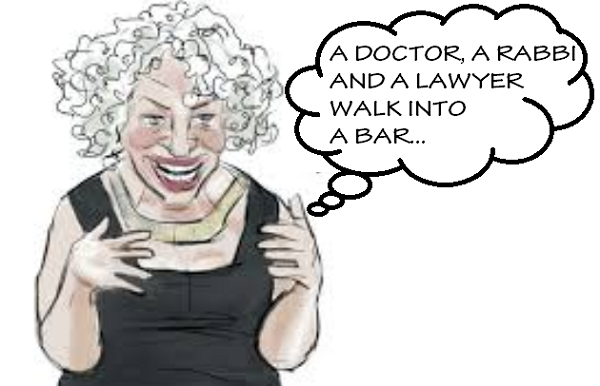
The finest collection of Jewish jokes short, funny and corny.

Hebrew: בדיחות קצרות ומצחיקת

jewish jokes full size

Some of the most famous comedians of all times are Jewish; Groucho Marx, Seinfeld, Milton Berle, Jerry Lewis to name but a few and when you need those laughs to come fast you can enjoy a giggle with us. Here are some favorite jokes. and all have a Jewish theme.  They are not intended to insult or poke fun at anyone.  Feel free to add a joke in the Comment Box below.

Must-have Jewish apps

Kiddush Buddy: Uses GPS to find kiddush events in nearby shuls and reports which are hot, which are cold and how far they are from the cell phone owner.

Kid Finder: Works with implanted chip technology to locate your child and sound alarm if he/she leaves the synagogue.

Service Length Predictor: Gives real time estimate of when the service will end. Takes into account traffic delays such as unusually long lulav lines on Sukkot.

Snooze Alert: Recognizes snoring and slumping of cell phone owner during sermon and produces a gentle vibration to wake him from his slumber.

Pledge Counter: For use by shul gabbai to enter pledges made by congregants when they are called to the Torah during services.

Page Finder: Continuously follows Chazzan’s singing and displays current page in siddur. Version available for ArtScroll, Koren and Shilo siddurim.


An oldie

There is a well known Midrash about how God offered the Law to a number of nations, which all refused it, before He offered it to the Jews at Mt. Sinai. What isn’t known very well is the inside story.

God first went to the Egyptians and asked them if they would like a commandment.

“What’s a commandment?” they asked.

“Well, one of them goes, ‘Thou shalt not commit adultery,'” replied God.

The Egyptians thought about it and then said, “No way, that would ruin our weekends.”

So then God went to the Assyrians and asked them if they would like a commandment.

They also asked, “What’s a commandment?”

“Well,” said God, “one says, ‘Thou shalt not steal.'”

The Assyrians immediately replied, “No way. That would ruin our economy.”

So finally God went to the Jews and asked them if they wanted a commandment.

They asked, “How much?”

God said, “They’re free.”

The Jews said, “Great! We’ll take ten.”


While attending a public dinner, a Rabbi was seated next to a prominent woman. Apparently attempting to impress the rabbi, the woman mentioned that one of her ancestors was present at the signing of Israel’s Declaration of Independence.

The Rabbi quickly responded, “My ancestors witnessed the giving of the Ten Commandments.”


Kosher Jewish jokes

Miriam and Moishe were in despair. Their 3 year old son David still had not learned how to talk. Not a word had escaped through those now 3-year-old lips.

One Friday night at Shabbos dinner, David took a taste of his pie, and to their utter surprise and amazement, said: “You call this matzah ball soup? It tastes like tasteless mush!”

Miriam and Moishe sat there in shock, for this was not just their son’s first sentence, but the first words he ever uttered! Once the initial shock had subsided, Moishe asked,

“Tell me David, how come you never spoke until now?”

“I never had any reason to,” explained David.

“There was nothing wrong with the soup until now.”


Dear G-d, my prayer for this year is for a fat bank account and a thin body.

Please don’t mix these up like you did last year. ……..AMEN.


At Golden Chopsticks Kosher Chinese restaurant in Toronto they have a letter posted on the wall:

The Chinese Restaurant Association of Canada thanks the Jewish people. We do not understand your dietary requirement properly but we are happy and honored that your G-d instructs you to eat our food on Xmas and new year.


Issy is walking down the road with his friend Max, when he suddenly says.

You know what, Max, I’m a walking economy”.

Whatever do you mean by that?” Asks Max.

“ Well , it’s likely this…. my hair line is in recession, my stomach is a victim of inflation and the combination of these factors is putting me into a depression!”


Any time a person goes into a delicatessen and orders pastrami on white bread instead of rye, somewhere a Jew dies.


If Adam and Eve were Chinese, we would be still in Paradise.

Why?

Because they would have eaten the snake instead of the apple!


No one leaves a Jewish wedding hungry; but then again, no one leaves with a hangover either.


Why spoil a good meal with a big tip.


If you don’t eat, it will kill your mother and grandmother.


Prune Danish is an acquired taste.


Never leave a restaurant empty-handed.


According to Jewish dietary law, pork and shellfish may be eaten only in Chinese restaurants.


No meal is complete without leftovers.


Virtually all Jewish wisdom is somehow related to food.


On Pesach there is nothing to eat,

On Sukkot there is nowhere to eat,

On Rosh Hashanah there is no time to eat,

On Yom Kippur we are not allowed to eat,

On Purim we are too drunk to eat,

Hannukah – it’s all too fattening to eat,

Shavuot – we are too tired to eat,

And when TuB’Shvat comes around, the food is all dried up!


More Jewish humor

A man goes to his rabbi and asks, “Rabbi, why do you always answer a question with another question?” The rabbi replies, “Why shouldn’t I?”

Yankel from Williamsburg puts up a sign that says “Boat for sale”

Yoily, his friend says, “But Yankel you only own a house and a car”

“Dat’s right” Yankel responded “And dey are boat for sale”


Does anyone need an ark? I Noah guy!


“If G-d had intended Jewish women to exercise, he’d have put diamonds on the floor.”


What is the definition of chutzpah – it’s when someone is being treated for a multi-personality disorder and wants a……..group discount 🙂


Whats a Jewish girls favorite wine?  I want to go to Florida!


An elderly Jewish fisherman wrote to a mail order house the following:

“Please send me one of those gasoline engines for my boat you show on page 438,and if it’s any good, I’ll send you a check.”

In a short time he received the following reply: “Please send check. If it’s any good, we’ll send the engine.”


The Rabbi was teaching his 6 year old students.

He asked one of them to give him one of the Ten Commandments……

Easy said Shmuel … “Thou shall not admit adultery”


An elderly Jewish man is knocked down by a car and is brought to
the local hospital.

A pretty nurse tucks him into bed and says, “Mr. Cohen, are you comfortable?”

“I make a living….” he replies.


Signs on Synagogue Bulletin Boards:

· Under the same management for over 5,780 years.

· Don’t give up. Moses was once a basket case.

· What part of “Thou shalt not” don’t you understand?

· Shul committees should be made up of three members, two of whom should be absent at every meeting.


Twenty percent off is a bargain; fifty percent off is a mitzvah.


The High Holidays have absolutely nothing to do with marijuana.


Anything worth saying is worth repeating a thousand times.


If you’re going to whisper at the movies, make sure it’s loud enough for everyone else to hear.


Laugh now, but one day you’ll be driving a big Cadillac and eating dinner at four in the afternoon.


Jewish Mother Jokes

A Jewish mother is walking down the street with her young son. They pass by a toy store, and the son points to a toy he wants. The mother replies, “You know, I’ll buy you that toy on one condition.” The son eagerly asks, “What’s the condition, Mom?” With a smile, the mother says, “You become a doctor first.”

Three Jewish mothers get together for lunch. As they are being seated in the restaurant, one takes a deep breath and gives a long, slow “oy.”

The second takes a deep breath as well and lets out a long, slow “oy.”

The third takes a deep breath and says impatiently, “Girls, I thought we agreed that we weren’t going to talk about our children.”


My mother is a typical Jewish mother. Once she was on jury duty.

They sent her home because she insisted SHE was guilty.


A waiter comes over to a table full of Jewish women and asks, “Is anything alright?


An Italian mother says, “If you don’t eat all the food on this plate, I’ll kill you.” A Jewish mother says, “If you don’t eat all the food on this plate, I’ll kill myself.”


A man walked into the women’s department of Macy’s in New York City. He found a saleslady, and told her, “I would like a Jewish bra for my wife, size 34B.”

With a quizzical look the saleslady asked, “What kind of bra?”

He repeated “A Jewish bra. She said to tell you that she wanted a Jewish bra, and that you would know “what she means.”

“Ah, now I remember,” said the saleslady. “We don’t get as many requests for them as we used to. Mostly our customers lately want the Catholic bra, or the Salvation Army bra, or the Presbyterian bra.”

Confused, and a little flustered, the man asked, “So, what are the differences?”

The saleslady responded “It is all really quite simple. The Catholic bra supports the masses. The Salvation Army bra lifts up the fallen, and the Presbyterian bra keeps them staunch and upright.”

He mused on that information for a minute, and asked, “So, what does the Jewish bra do?”

“The Jewish bra,” she replied, “makes mountains out of molehills.”


Old Jewish culture jokes

The Italian says, “I’m tired and thirsty. I must have wine.”

The Frenchman says, “I’m tired and thirsty. I must have cognac.”

The Russian says, “I’m tired and thirsty. I must have vodka.”

The German says, “I’m tired and thirsty. I must have beer.”

The Mexican says, “I’m tired and thirsty. I must have tequila.”

The Jew says, “I’m tired and thirsty. I must have diabetes.”


3 men; one Scottish, one Irish, and one Jewish.

They were all builders. Every day they went to work on the top of a building.

The Scotsman pulls out his lunch and says “TUNA! I hate TUNA! If my wife gives me tuna tomorrow I’ll jump off this building!”

The Irish man says “EGG! I hate EGG! If my wife gives me egg tomorrow I’ll jump off this building!”

The Jewish man says “HUMOUS! I hate humous! If my wife gives me humous tomorrow I’ll jump off this building!”

The next day the Scotsman pulls out his lunch and says “TUNA! That’s it!” and jumps off the building.

The Irishman says “EGG! That’s it!” and jumps off the building.

The Jewish man says “HUMOUS! That’s it!” and jumps off the building.

The next day the wives get interviewed.

The Scotsman’s wife and the Irish man’s wife say “If only he had just had just told me he didn’t like the sandwich, I would have made him something different.”

The Jewish wife says “I don’t understand this. He always made his own sandwiches.


Q: What do you call a Jewish Marshall arts champion ?

A: Jew Jitsu.

Q: What is the proper blessing to recite before logging on to the Internet?

A: “Modem anachnu…

Q: Did you hear about the Jewish ATM?

A: When you take out some money, it says to you, what did you do with the last $50 I gave you?

Q. How does Moses make his tea?

A: Hebrews it.

Shavuot Dessert Recipes – Sweeet Lokshen Kugel.

Reading Time: 2 minutes

Favorite Shavuot Dessert Recipe your family will love – sweet lokshen kugel recipe.

lokshen kugel

A kugel is a baked pudding or casserole most commonly made from egg noodles or potato. It is a traditional Ashkenazi Jewish dish, often served on Shabbat and Yom Tov.  There are savory and sweet versions as well as parev and dairy versions too.  The dairy version is traditionally eaten on Shavuot.

Kugel is comfort food. The sweet, creamy, cheesy kugel with raisins and subtle hints of cinnamon remind me of the times when my grandmother of blessed memory, would visit us. She would arrive laden with “pekelach” parcels. Taking only a few minutes to greet us,  lest it get cold, she would rush into the kitchen and quickly serve generous portions of her freshly baked, lokshen kugel to us all.

The Basic Recipe

1. Into a large pot of boiling water to which one tables spoon of oil has been added, put 250gr of broad flat noodles (lokshen).

2. Allow to boil for 7 – 10 minutes stirring occasionally

3. Switch off the stove and allow lokshen to stand for 15 -20 minutes – only then drain the lokshen.

4. In a separate bowl whisk together 2 eggs and  3/4 cups sugar. Add 1 liter of milk and 250ml sour cream.  Stir in the lokshen and transfer the mixture to a large buttered, or well oiled, baking dish with a 3L capacity.

5. Dot with butter on top.

6. Bake at 180ºC until golden. Serve hot.

Take it to the next level

  • Substitute fresh milk with sour-milk or butter-milk
  • For a lighter version with fewer calories,  substitute smooth white cheese instead of sour cream
  • Add raisins and sultanas for a sweet dessert. Finely sliced dried apricots or dried peaches can be added too.  Slices of fresh apple are also delicious.
  • A sprinkle of biscuit crumble on top adds crunchiness.

Popular Israel Street Names

Reading Time: 4 minutes

What’s in a name? The most popular street names in Israel.

Hebrew: שמות של רחובות בישראל

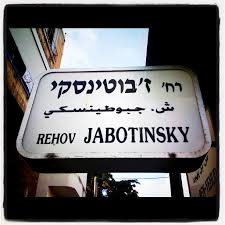
jabotinsky streetWhether it’s Jerusalem, Tel Aviv, Ashdod, Ashkelon or Haifa; many cities and towns in Israel have the same street names.  What is the history that lies behind these names and who are they named after?

Some of the most popular and famous streets in Israel are:

Arlozoroff (Arlozorov/ Arlosoroff)

Named after Chaim Arlosoroff (1899 – 1933) a Zionist leader of the Yishuv (refering to the Jews living in Palestine before the establishment of the State of Israel),  Arlosorff was also head of the Political Department of the Jewish Agency.  He was assassinated on June 16th, 1933 while walking on a beach in Tel Aviv.

You’ll find Arlosoroff in Haifa, Tel Aviv, Raanana, Beer Sheva, Rehovot, Holon, Hadera, Afula, Bat Yam and Ashdod….

Balfour

Named after Arthur James Balfour (1838 – 1930) the signatory to the Balfour Declaration, a document confirming support from the British government for the establishment in Palestine of a homeland for the Jewish people.

You’ll find Balfour in Haifa, Tel Aviv and Petach Tikva, Bat Yam, Ashkelon, Ashdod and Jerusalem

Begin

Menachem Wolfovich Begin (1913 – 1992) was a Polish-Jew and head of the Zionist underground group the Irgun, a Nobel Peace Prize laureate and the first Likud Prime Minister of Israel.

You’ll find Begin in Holon, Ramat Gan and Tel Aviv, Petach Tikva, Rehovot

Ben Gurion

Named after David Ben-Gurion (1886 – 1973 ) who was the first Prime Minister of Israel.  After leading Israel to victory in the 1948 Arab-Israeli War, he oversaw the establishment of the state’s institutions and vast influx of immigrants. After his death, Ben-Gurion was named one of Time Magazine’s 100 Most Important People of the 20th Century.

You’ll find Ben Gurion in Herzliyah, Rehovot and Haifa, Givatayim, Ashkelon and Netanya, Raanana, Hod Hasharon and Nes Tziona and of course, although not a street name, Ben Gurion International Airport.

Ben Yehuda

Named after Eliezer Ben-Yehuda (1858 – 1922) who was principally responsible for the revival of Hebrew as a modern spoken language from its previous state as a liturgical language.

You’ll find Ben Yehuda in Jerusalem, Tel Aviv, Herzliyah, Haifa, Netanya, Rechovot and Holon

Bialik

Named after Chaim Nachman Bialik (1873 – 1943) who was one of the pioneers of modern Hebrew poetry.  He wrote in Hebrew and Yiddish and is also recognized as Israel’s national poet.

You’ll find Bialik in Haifa, Holon and Tel Aviv, Tiberias and Ramat Gan, Jerusalem, Ashdod and Hadera…

Dizengoff

Named after Meir Dizingoff (1861 – 1936).  He was the first Mayor of Tel Aviv

You’ll find Dizingoff in Tel Aviv and Netanya and also the famous Dizengoff Mall in Tel Aviv

Hannah Szenes (Hanna Senesh)

Hungarian born, Hannah was only 23 years old at the time of her death in 1944.  She was one of 37 Jews from Mandatory Palestine parachuted by the British Army into Yugoslavia during the Second World War to assist in the rescue of Hungarian Jews about to be deported to the German death camp at Auschwitz. More streets in Israel are named after Hannah Szenes than after Golda Meir.

You’ll find Hanah Szenes in Haifa, Lod, Beer Sheva and Tel Aviv, Herzliyah, Holon and Ashdod, Givatayim and Raanana…

Herzl

Named after Theodore Herzl (Benjamin Zeev Herzl), born1860, died 1904.  He is considered to have been the father of modern political Zionism and in effect the founder of the State of Israel. Herzl formed the World Zionist Organization and promoted Jewish migration to Palestine in an effort to form a Jewish state.

You’ll find Herzl in Haifa, Tel Aviv, Petach Tikva and Ramat Gan, Beer Sheva, Jerusalem and Rishon Le Zion, Ashdod and Kfar Saba…

Ibn Gabirol

Solomon Ibn Gabirol, also known as Solomon ben Judah was an Andalusian Hebrew poet and Jewish philosopher. He was born around 1021 and died around 1058.

You’ll find Ibn Gabirol in Tel Aviv, Herzliyah and Jerusalem, Beer Sheva, Holon and Afula…

Levi Eshkol

Named after Levi Eshkol (1895 – 1969) the 3rd Prime Minister of the State of Israel.  Eshkol was a member of the Haganah and was engaged in arms acquisition for the Haganah prior to and during the 1948 Arab-Israeli War.

You’ll find Levi Eshkol in Nahariya, Tel Aviv, Netanya and Raanana, Rechovot and Herzliyah, Kiryat Ono and in Motzkin…

Jabotinsky

Ze’ev (Vladimir) Jabotinsky (1880 – 1940) was a Zionist leader, author, orator, soldier, and founder of the Jewish Legion in World War I. According to data collected by the Mapa geographical database, 57 sites (including streets, squares and parks) in the country are named after Jabotinsky.

You’ll find Jabotinsky in Bnei Brak and Tel Aviv, Ramat Gan and Rishon LeZion, Jerusalem, Ashdod and Givatayim, Raanana, Herzliyah and Netanya, Haifa and Ashkelon, Tiberias, Holon and Beer Sheva, Bat Yam, Netanya and Herzliyah

Weizmann

Chaim Azriel Weizmann (1874 – 1952).  Elected in February 1949, Chaim Weizmann was the first Prime Minister of Israel and served for 3 years until his death in 1952.  He was a biochemist and founded the Weizmann Institute in Rehovot.  His nephew Ezer Weizmann was the 7th president of Israel.

You’ll find Weizmann in Rechovot and Haifa, in Ashkelon, Sderot and Ofakim…

Yitzhak Rabin

Yitzhak Rabin (1922 – 1995), politician, statesman and general he was Israel’s 5th Prime Minister serving 2 terms of office until his assassination in 1995 by Yigal Amir.  Together with Shimon Peres and Yasser Arafat, he won the Nobel Peace Prize in 1994.

You’ll find Rabin in Jerusalem and Holon, Kiryat Ono, Tivon and Hadera…