For patients unable to take blood thinners, Rambam Health Care Campus, Haifa, implements a new, innovative procedure for treating atrial fibrillation.
Patients who suffer from atrial fibrillation (rapid and irregular heartbeat) are at higher risk for a blood clot, which could be a life-threatening condition – for this reason, most of them take blood thinners. However, some patients (around 90,000 in Israel), cannot take them. Closing the left auricle (upper chamber of the heart – atrium), reduces their risk of a stroke.
For the first time in Israel, during a catheterization procedure, Rambam physicians, can insert an ultrasound device through the vein which provides an accurate image of the heart thereby better-guiding the surgeon during the repair of auricle.
Dr. Mahmoud Suleiman, Director, Levine Family Electrophysiology Unit, Rambam HCC, briefly explained the benefits of the new procedure, “This is an innovative method. With the ultrasound device, we can clearly see the auricle. The patient is fully vigilant, recovers quickly and does not require life-long-treatment with blood thinning meds. Usually, under full anesthesia, we perform cardiac catheterizations through the vein of the leg, we usually insert an imaging tube through the esophagus, which could cause esophageal injury.”
Suleiman concluded by saying, “I believe that this surgical method will be adopted by other hospitals in Israel in a way that will greatly improve the quality of life of the patients.”
Rambam HCC receives special approval to administer a new breakthrough drug for Juvenile Hepatitis C.
Rambam Health Care Campus in Haifa, Israel, has received special approval to administer a new breakthrough drug that is highly effective in treating Juvenile Hepatitis C.
Professor Ronen Arnon. Photography: Rambam HCC
Two Israeli girls, nine-year-old Karen* and seven-year-old Yasmin*, were born with the Hepatitis C virus, transmitted to them by their mothers. Their mothers had suffered from the condition for several years but recovered after receiving treatment. However, Karen and Yasmin still live under the shadow of possible Hepatitis C complications that could affect their long-term health and general wellbeing.
Recent decades have seen a ‘therapeutic revolution’ with the development of groundbreaking treatments and drugs that have brought relief and curses for many illnesses and health conditions. The United States Food and Drug Administration recently approved two new drugs, Epclusa and Mavyret, for use in children with Hepatitis C between the ages of 3 and 12. Mavyret and Epclusa are used to treat different genotypes – the genetic makeup of the Hepatitis C organism.
Not yet available in Israel, the girls required a permit to obtain the drugs. Shortly after receiving approval, Karen began treatment at Rambam HCC and is expected to recover within a few weeks. Seven-year-old Yasmin is scheduled to begin treatment shortly.
Professor Ronen Arnon, Senior Physician, Head of Pediatric Liver, Gastroenterology and Pediatric Nutrition Institute in the Ruth Rappaport Children’s Hospital at Rambam HCC, explains; “These drugs are revolutionary in the treatment of Juvenile Hepatitis C. In the USA, these drugs are given to children under the age of 12 who have been diagnosed with Hepatitis C, with excellent results and almost no side effects.
“As the drugs are not yet available in Israel’s healthcare basket, Rambam HCC obtained permission for the girls to be treated with these new drugs. I hope that in the near future, the drugs will become routine treatment here. There is no reason for children to live with a harmful virus like Hepatitis C, when an effective treatment is available.”
Until now, drugs used to treat children with Hepatitis C had to be administered by injection and it took several months to see a positive effect. In comparison, the newly approved drugs, are easy to administer (orally), and bring about positive results within only 8–12 weeks.
*Names changed to protect the identity of the patients.
“My friend and I are looking to volunteer on a kibbutz in November but are unsure on what visas we require or where to get them from. Any information to help us would be greatly appreciated.
Kind Regards
Scott“
Thanks, Scott!
Working in an orchard, could be one of the jobs you may be offered on kibbutz (Image: Pexels)
Volunteering on a kibbutz is a wonderful way of getting to know the locals, their way of life and how things work in Israel.
Kibbutz life is generally slow, so if you want to be on the go 24/7, clubbing and partying, a kibbutz volunteer program, may not be right for you.
Fortunately the KVP office will submit your visa application on your behalf. There is a small administration fee.
The KVP will help you to complete the application form, which can be accessed via the Israel Ministry of Interior – Population Registration (Heb: משרד הפנים Misrad HaPnim) website.
You cannot enter Israel before you receive confirmation that your volunteer visa has been approved and you receive the required, official entrance visa stamp from the Israeli consulate (which you must obtain in person).
Once your Volunteer Visa is approved, you have 90 days to enter Israel. If you not, your visa will become null and void.
Travel tip: In case there is an unforeseen delay, do not purchase your plane ticket until you have stamped approval.
The Database for Your Business in Israel Could Be A Liability!
By: Advocate Aviram Goldstein of Hait Family Law
You’ve read all about how to start and run your own business in Israel So you have a lot of good information. But did you know this? If you digitally store your customer or client information (who doesn’t) you could be risking exposure to civil and criminal legal proceedings! Investigating specialized software and speaking to some cybersecurity experts is very important – especially if your database holds sensitive information. But legally speaking, your database could be a liability if you don’t take steps to protect it.
If you’re running a business here in Israel, you’ve been careful about your contracts and you’re probably storing all your information online, in a database. You’ve got personal details for contacts, customers, employees, suppliers, credit card details and everyone in between. But did you know that using a database may expose you to class action suits, individual lawsuits, fines, or even criminal proceedings? Here’s what you need to know about your legal obligations and responsibilities under the law.
A database can be any digital outlet. Folders on a computer or in the cloud (like Google Drive or Dropbox), CRM software and mailing lists, all qualify as databases and are subject to the requirements of the law.
In order to increase the protection of the personal information every business and organization holds, the legal regulations defining security in Israel have been amended. So, because almost every folder on a computer, mailing list or management software is a database, the way you handle it is crucial. The database for your business in Israel could be a liability if you avoid protecting it.
4 Levels of Security
Israeli law requires that different levels of security be taken depending on the type of business. So, size does matter here. The volume of information, the manner in which it is used, and the type of information stored in the database are all considered.
Security Levels
A database managed by an individual – This is an independent business owner or a company owned by an individual. For example, a flower shop where the owner has CRM software and stores customer information, phone numbers, addresses and maybe even birthday dates, anniversaries, etc., that are used as a marketing tool.
Basic security level – This is any business that is not considered an individual and is not at the medium or high level.
Medium security level – This group includes entities such as: public institutions, companies where there are more than 10 employees who are authorized to use the database. The details in the database are defined as “sensitive information” like medical, genetic, criminal authorizations, etc..
High security level – These include entities whose purpose is to collect information for another, or the database includes ordinary information about more than 100,000 people.
Exceptions
In some cases, an increased level of security is needed.
By virtue of ethical rules or professional affiliation. For example, a lawyer or psychiatrist cannot benefit from the security requirements of a database managed by an individual even if it is a self-employed person who works alone from home and his database is a folder on his personal computer. This is because he has a duty of confidentiality due to his profession.
Due to the purposes of the database. Databases that are intended to collect information in order to provide it to another are required to have a higher level of security. Thus, for example, mailing companies cannot have the same level of security as an individual and a higher standard is required of them.
And the size does matter. Businesses whose database includes details of more than 10,000 people, regardless of the field of activity and the type of information, will not be able to benefit from the level of security of an individual.
The nature of use. If the same flower shop owner from the previous example also employs three employees with access to the database, he will no longer be able to enjoy the level of security of an individual.
Don’t Let Your Database Be A Liability, Protect it
You need to apply to the Israeli Ministry of Justice in order to register your database. You’ll request a certificate confirming that you own a registered database. If you don’t do this you are holding the database illegally!
The regulations establish mechanisms designed to make information security part of your business management routine in accordance with the sensitivity and scope of the personal information in your database. So, you’ll be required to draw up a definition document for the database, implementing process and technological controls, mapping and conducting a risk survey, setting policies, procedures and more.
Compliance with the requirements of the Israeli regulations may reduce the level of business exposure to existing risks in cyberspace and significantly reduce the legal exposure for your business and you personally.
We recently witnessed a fine of millions of shekels and class actions of hundreds of millions of shekels that one of the huge Israeli insurance companies had to deal with due to a computer hack of the company’s computers resulting in the exposure of their personal information and that of their policy holders.
Avoiding Other Risks
There is more than a legal risk when a database is hacked. The harm to the operation of a business is also at risk. Trade secrets could be exposed. And your company’s competitors could get a hold of your lists of suppliers and prices. Your relationship with companies you may be working with from abroad could be harmed due European or American requirements to maintain cyber defenses in the business. And of course, there could be severe damage to the public’s trust in your company. Information hacks have caused company shutdowns and ultimately huge expenses to recover information that has disappeared. So, it’s also important that you investigate specialized software and speak to some cybersecurity experts if your database holds very sensitive information.
Complying with the Israeli legal requirements for operating a database will help protect you, your customers and/or clients and significantly reduce your business’s exposure to the resulting problems from a hack.
We are here to help you understand the regulations and process your business’s registration. Contact, me, Aviram Goldstein (from the Hait Family Law business department) at aviram@law-ag.co.il
Avoid traffic jams and parking problems – use public transport instead. Whether travelling by bus, light rail, or Metronit Israel’s public transport is mostly efficient.
An inter-city, Egged bus – Credit: RickP November 2006, Wikimedia Commons
Bus and Light Rail Fares
Public transport fares in Israel are calculated according to the distance traveled. The main distance brackets are: up to 15 km, 40 km, 75 km, 120 km, 225 km, and above.
If you use one of the public transport apps (instead of a pre-paid Rav-Kav), you may have notice that before validating multiple-fare rides you must select a ticket based on distance. The app will show you the available fare options for your route.
Currently, a local bus ride up to a distance of 15 km, Metronit and light rail fare, costs 8 shekels (March 2026).
Discounted Fares
The previous value discount for regular Rav-Kav users has been cancelled. In the past, loading a stored value onto your Rav-Kav provided a bonus. Today, the amount you load is the amount you receive—100 NIS equals 100 NIS of travel credit, with no additional value added.
Bituach Leumi Beneficiaries
Bituach Leumi beneficiaries, people with disability profiles, and seniors are entitled to a 50% discount. These discounts are applied automatically when your profile is loaded onto your Rav-Kav or public transport app. From age 67, public transport is free–you must be in possession of a Rav-Kav Zahav and get your profile officially updated if using one of the apps
Other Payment Options
There is no longer a cash payment option, so Egged has expanded its digital methods. Passengers can now pay using a smartwatch or credit card, offering greater flexibility for those who prefer not to use a Rav-Kav or mobile app.
Final Tip
If the mobile app isn’t working, make sure you have a backup payment option—either a small balance on your Rav-Kav or the ability to pay by credit card. Ticket inspections are routine, and you are responsible for ensuring your fare is paid. Currently, the fine for traveling without a valid ticket is 100 shekels.
The onus is on you. Should you be fined, you can submit an appeal within 60 days. You’ll need:
A copy of the ticket
A copy of your Rav Kav and its number (on the back side of the card)
A copy of your ID
You can also submit a letter of defense – check formatting options (the system does not support copy/paste or WORD)
Senior citizens—women aged 62+ and men aged 67+—are eligible for discounts on public transport. Women aged 62 – 67 are entitled to a 50% discount. On turning 67, both men and women are entitled to travel for free.
In other words, before 67 → no automatic 50% discount for men unless you qualify through another category like disability. At 67 you jump straight to free travel, making the 50% stage mostly irrelevant.
AI-generated image
How do I get this discount?
In order to enjoy the benefit of free travel on Israel’s public transport network, you must use a Rav-Kav card or one of the public transport apps ( Moovit, Pango, Rav Pass, Cello) with a dedicated profile – “Zahav Kav” (זהב קו).
If you are not physically able to get to the service station, you can provide a Power of Attorney (POA) and a proxy can arrange for the profile to be loaded on your behalf. In addition to the signed POA, the proxy must present his ID card, the ID card (or copy) of the cardholder and a passport photo of the cardholder.
Note: The POA must be specific and must specify the request for the issuance or update of a Zahav-Kav profile.
Good news if you’re 80 or older – just a click of a button and you’re exempt from standing in line at the post-office
PLEASE NOTE: Previously 70-year-olds+ were exempt from standing in line, but as of 1.01.2023 the law has changed and this privelage now applies to those aged 80+
Image courtesy: Israel Post
In Israel, seniors aged 80 and above are entitled to an additional level of service at the post office. They are not required to schedule an appointment in advance.
When you arrive at the post-office all you need to do is press on the “Exempt from Line” button (פטור מתור) at the self-service machine (ATM) and immediately thereafter, your turn will be called.
If, for any reason, you are denied this service, you should report it by calling 03‑6921195 and providing the details of the post‑office branch, the date of your visit, and the name of the service representative involved.
The telephone number for the senior citizens call center of the Ministry of Social Equality, is *8840.
Did you know that at some places pregnant woman or the disabled are exempt from standing in line.
At the post office
When filling prescription medications at the pharmacy, check for posted signage confirming this benefit, as it is not honored at all locations.
At the Population and Immigration Authority (Misrad HaPnim)
At the supermarket
Proof of eligibility must be presented in the form of a disability certificate from the National Insurance Institute or the Ministry of Defense.
Great news for travelers! Egged operates weekend and 24-hour bus lines from key locations across Israel.
An inter-city, Egged bus in Israel – Credit: RickP November 2006, Wikimedia Commons
Bus 485 (Jerusalem): Direct service between Jerusalem City Center/Central Bus Station and Terminals 1 & 3. Runs ~60 minutes, roughly hourly.
Haifa: During the day, Egged bus 947 connects Hof HaKarmel to the El Al Junction near the airport—be sure to check the schedule for night services. From the junction, you will need to take a taxi to Terminal 3 (International Departures), which is located a few kilometers away. Because of this inconvenience, taking the train or a shared taxi is a better solution.
There is a midnight bus from HofHaKarmel and a 1:30 a.m. bus to the airport. The service resumes at 5:00 a.m.
Weekend Bus – Tel Aviv: A bus line will be set up to connect the city with Ben Gurion Airport on weekends, when regular bus and train services do not operate.
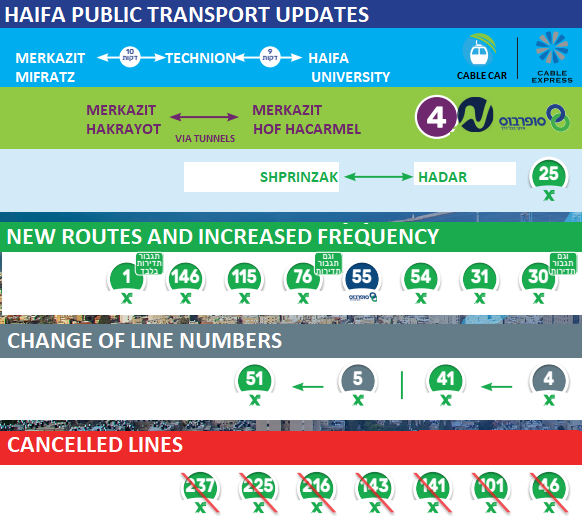
A summary of public transport changes (Image credit PTI.ORG.IL – translated by Anglo-List)
Details of the major changes are as follows:
Line 31 to the Technion and Line 115, which connect Merkazit Hamifratz and Hof HaCarmel central stations, will be rerouted and will no longer travel via Ramat Shaul and Kiryat Shprintzak.
Line 30 will no longer travel to the University of Haifa
Line 146 between the University of Haifa and Hof HaCarmel Central Station, will be canceled.
Line 25 – from the Hadar neighborhood through Ramat Shaul to Kiryat Shprinzak and back has so far only operated on Saturday. The service will now be extended and the line will now operate during the week as well. The route is to be extended to the Halisa neighborhood. New stops between Halisa and Kiryat Shprintzak will include Hagiborim, Gush Etzion, Halisa, Beit HaTaasiya, Talpiot Market, Lev Hadar, Beit HaKranot and Herzl/Yoel, and then in the opposite direction. The bus will run approximately every 15 minutes and will also replace line 115 which has been cancelled.
Line 30 – From Leon Blum (Chugim High School) to Hof Hacarmel Central Station and back is also to be rerouted. The buys will now travel via Elisha then the Western Carmel (Sderot Hanassi – Tchernichovsky) to Ramat Shaul, Kiryat Shprinzak, Sha’ar Ha’aliya, Neve David passed the Kfar Zamir cemetery, the Haifa Youth Hostel, onto the Sportan and the Congress Center and finally to Hof Hacarmel Central Station.
Line 31 – from Bat Galim train station via Ein Hayam to the Technion and back. Two new stations will be added to the line: on the corner of Derech Tzarfat/Yitzhak Nadav and another on Tchernichovsky Street near the Gordon Academic College. Line 31 will no longer travel via Kiryat Shprintzak and Ramat Shaul. Passengers from these neighborhoods will be able to use 25 and 30 and lines 3 and 5.
Line 115 – from Hof Hacarmel to Merkazit HaMifratz and back. The line will travel along Tchernichovsky and Derech Tzarfat and will no longer enter Kiryat Sprintzak and Ramat Shaul. (Use instead: 3, 5, 25, 30)
Line 76 – from Leon Blum to Yugur and back. The line will start and end at Chugim High School and will pass through Geula, Arlozorov, Golomb, Wingate and Bnei Zion Medical Center. The line will connect Hadar to Bnei Zion Medical Center and the Grand Canyon, Ziv Center, the Technion and Nesher.
Line 54 – from Hof Hacarmel Central Station to Daliyat al-Carmel and back. The line will now also stop at stations within the University of Haifa campus.
Line 55 – from the Merkazit HaMifratz to Daliat El-Carmel will now travel along International Street in Ramot Remez instead of on Komui Street.
237 – Bat Galim Railway Station – University of Haifa.
New Route Numbers
Route 4 will become route 41
Route 5 will become route 51
Metronit Route #4
The Metronit transport system introduces a new line – Route 4. Rout 4 will travel from the Krayot in the north to MATAM (at the southern entrance to Haifa). The route will incorporate stops along route #4 (Akko Rd) from Kiryat Motzkin, Kiryat Bialik, Kiryat Haim, along HaHistadrut Blvd, Lev HaMifratz, the Grand Kanyon and then onto the Haifa Mall with the final stop being Hof HaCarmel Central Station.
The Haifa University station of the Rachbalit – the new cable car transport system
Before we discuss how infidelity affects divorce we have to define it. Touchy subject. And that’s because it is currently understood in so many different ways. If you’re in a traditional marriage and you have physical relations with someone of the same sex as you, is it infidelity? If you’re in a same-sex marriage and you cheat with someone of the opposite sex, is it infidelity? There are also questions about what is considered a sexual relationship. What about kissing someone else? Is being emotionally attached to someone other than your spouse, infidelity?
One could get really bogged down in the semantics before even beginning a discussion of the legal ramifications of infidelity as far as divorce is concerned. And in terms of legal arguments in family court, that sometimes happens. But not in the rabbinic court which is bound by the traditional definition.
For the purposes of this discussion, we’ll be going with that definition. Infidelity is a sexual relationship with someone outside of the marriage, even if it only happens once.
When Secrets Get Revealed
There is a saying. “When alcohol goes in, secrets come out.” But, do you know where secrets are revealed without alcohol being involved? In divorce in court. How one conducts themselves in their private life can have tremendous consequences in a divorce.
Consequently, during divorce proceedings (and even in the event that the spouses utilize mediationto come to an agreement), we attorneys are obligated to probe the family’s secrets. How much does each spouse really earn? Are there savings or property hidden away? What about investments in foreign countries? The more we know about the private goings on in a family, the better we are able to represent our clients. So, one of the questions attorneys ask in their first meeting with a client is whether or not there has been any infidelity – on either side. The answer will affect the strategy a lawyer uses to get the best settlement for his client.
The three main aspects of divorce in Israel are asset division, child custody and child support. These can be settled in mediation, or if that doesn’t work, through litigation in either the secular family court or the rabbinic court. A Jewish couple is required to go to the bet din for the actual absolution of their marriage. For a couple where one or both are not Jewish, the divorce aspect will be settled in family court. While there are some differences, in both courts the effect of infidelity on a final settlement can be quite dramatic depending on the circumstances.
In the rabbinic court where the grounds for divorce are defined by halacha (Jewish law) and rabbinic case law, adultery is clearly stated as a basis to end a marriage; even though it is not easy to prove. Here, a woman who has committed adultery is not entitled to her ketuba money. This is the amount stipulated in the religious marriage document that the husband would pay the wife if they get divorced. There is no alimony in Israel other than what is written in the ketuba so this would not apply in the family court. A father is however, required to support his children until their 18th birthday in both courts.
Both courts take infidelity seriously and make their decisions about assets division, child custody and child support accordingly. They examine the negative financial consequences for the family resulting from the indiscretion. Child support payments may be changed. Assets, rather than being split equally, may be adjusted. They consider whether or not the offending party’s conduct has put into question their ability to be a responsible parent. An offending parent may lose out on full custody or even shared custody because of his or her actions.
Alternatively, there have been cases in family court where judges haven’t considered the infidelity relevant at all and decisions are made without taking it into account.
Can Infidelity Be Legally Justified?
People can justify almost anything if they feel it’s for a good reason. But there’s a big difference between emotionally rationalizing behavior and proving that it’s legal. And judges are obligated to examine facts, not feelings when a case is presented in court. Surprisingly, one may find lots of emotional reasons why cheating on their spouse is understandable. But, it’s up to the judge to make the final decision.
The fact that one of the spouses has committed adultery doesn’t always come up in a divorce case, depending on the circumstances. Notwithstanding, it is extremely important for you to share everything with your attorney. Yes, even the embarrassing parts. If your lawyer is blindsided in court, it could make a huge difference in your final settlement. And as difficult as it may be, I always advise my clients to try and hold their emotions in check whether sitting at the negotiating table or appearing in court. I have witnessed a number of surprises revealed in the heat of the moment.
There was a case recently that reached the bench of Judge Nimrod Felix, of the Jerusalem Family Court. A woman was suing her husband for divorce. She could have kept quiet about her infidelity. Her husband was unaware of it and her child had not suffered any consequences because of her actions. If it had remained undisclosed she would have shared in the equal division of the couple’s assets. But she became angry in court and chose to lash out at her husband with a disturbing fact.
She taunted him with the news that he was not the father of their 5-year-old son. His biological father was one of the woman’s coworkers who was aware of the fact that the child was his. She claimed she was motivated to conceive the child with someone else after learning that her husband was sterile. She argued that her actions should not be considered infidelity because her husband had deceived her by concealing his sterility.
The husband, in turn, brought an infidelity suit against her and asked for 650,000 NIS. He claimed compensation for the money he had spent to support the child. And expressed his severe mental anguish and emotional pain of disconnection from the child. He said he felt humiliation, shame and a huge blow to his personal self-esteem.
The Judge’s Surprising Decision
The judge declared that this was not actually a claim for infidelity but rather for paternity fraud. He said the wife failed to prove the husband was aware of his sterility. And, even if he had been aware there were other solutions they could have explored together to bring children into their lives.
The judge set compensation at 275,000 NIS with an additional 25,000 NIS to cover the father’s legal expenses. He recognized the husband’s humiliation, the blow to his dignity and to his personal self-esteem. The sum wasn’t higher because the husband couldn’t show evidence that he had supported the child. Nor could he disprove the mother’s claims that she in fact, was the one providing for the child.
One Size Does Not Fit All
As with many aspects of the legal system, when dealing with a divorce, things may appear one way on the books while being left up to the interpretation of the bet din or the family court judge when it comes to their application. There are many variables in each situation that make it almost impossible to determine ahead of time how infidelity will affect the outcome of a divorce.
But several things are clear; tell your attorney everything, choose the court you file in very carefully, and keep your emotions in check.
And may I suggest you consider the consequences of infidelity on your spouse and your children, before you act.
For more in- depth information on divorce download one of Jay Hait’s FREE books.