
11 C
Jerusalem
Wednesday, May 6, 2026
Sample Page
Home Blog Page 139

Terrorist Attacks in Israel.

Reading Time: 3 minutes

home front command pikud haoref

The Home Front Command – How to behave in the event of a terrorist attack in Israel.

Hebrew  – פיגועי טרור בישראל

We never know when there will be another wave of terror or even an isolated terrorist attack. Correct behavior when confronted with these dangerous situations can and will save lives.  Pikud Haoref (The Home Front Command) – פיקוד העורף – shares some valuable information with us.

There are three situations that the public and Israeli citizens need to be especially aware and suspicious of:

  1. A suspicious object
  2. A suspicious vehicle
  3. A suspicious person

A Suspicious Object

A suspicious object or Hefetz Hashud – חפץ חשוד is defined as an unfamiliar item in a location that raises the suspicion of possibly being used for the purposes of sabotage.   Weapons, ammunition and similar items can be hidden in school bags, shopping bags or any type of receptacle.  Seemingly harmless items like a loaf of bread in a shopping bag, can camouflage an explosive device.  If you notice a case, box, shopping bag or any other item left in a public or private location without an owner or without supervision do NOT touch it, move it, try to open it or peek inside it! The object may explode at any time.

Don’t ignore it and don’t hesitate – act immediately!!!

What do I do when I notice a suspicious object?

  1. Do not approach the suspicious object and do not join the crowd that might be gathering around it.
  2. Distance yourself from the suspicious object.
  3. Warn bystanders and ask them to move away from it
  4. Ask an additional person to warn the passers-by of the danger
  5. Dial 100 for the police emergency line
  6. Report the precise location and description of the object to the police.


Suspicious Vehicles

A car or a truck loaded with explosives can be detonated at a location chosen by a terrorist organization. The detonation can be carried out by a suicide bomber driving the vehicle, or by remote means. Car bombs are used for random acts of terror and also for specific assassination attempts. A  car bomb can have a large explosive load, thus achieving a potentially high number of casualties.  Car bombs can destroy barriers and can cause extensive damage and casualties.  The victims of these terrorist attacks suffer long-term emotional trauma. If you require emotional first aid can call ERAN – The Israel Association for Emotional First Aid by dialing 1201 .

When is a vehicle considered suspicious?

  1. If the vehicle is parked in an unusual location
  2. If the vehicle is parked for a long time in a illegal parking space
  3. If the driver of the vehicle appears suspicious
  4. If the driver of the vehicle is disoriented in his surroundings and appears unusually agitated
  5. If the vehicle looks overloaded
  6. For any other reason like suspicious number plates, unusual markings etc.

What do I do when I notice a suspicious vehicle?

When a suspicious vehicle is identified, it should be assumed that it contains munitions.

  1. Do not approach the vehicle
  2. Do not touch the vehicle
  3. Do not try to open any of the doors or the trunk of the vehicle
  4. Disperse the bystanders
  5. Try block any street approaches to the vehicle.
  6. Contact the police immediately – dial 100 and make sure you specify the vehicle’s location and the reason for your suspicion.

Suspicious persons (possibly a suicide bomber)

A suspicious person is a person whose behavior causes suspicion. Such behavior may be inappropriate to the circumstances or location.

Suspicious signs & behavior

  • Showing signs of excitement and nervousness. Heavy perspiration is one of these signs.
  • The suspect seems to reveal signs of collaboration and communication with other people by expressions, signs, hints and movements directed at them
  • The appearance of the suspect is unusual and does not match his personality.  His clothing may be inappropriate for the circumstances or for the season for example; a long coat on a hot summer’s day
  • The suspect seems to be hiding something under his clothes.

How should I act if I identify a suspicious person?

  1. Maintain visual contact with the suspect
  2. Inform the security forces and/or persons in charge; a store manager or security guard, the driver of a bus etc.
  3. Try to prevent,  if possible,  the suspicious person’s proximity to others
  4. Try to prevent the gathering of a crowd.

In any suspicious event….

Please help small children, the elderly and infirm to get to a place of safety.

Emergency Services: Telephone Numbers

Police

100

Ambulance

101

Fire Department

102

Israel Elections 2015.

0
Reading Time: 5 minutes

Elections for the 20th Parliament in Israel – March 2015

Hebrew: בחירות לכנסת ה-20 בישראל

Who is Israel voting for?

Prime Minister of the State of Israel

General information from the 2015 elections

National budget for the 2015 election 242 million shekels
Number of eligible voters 5,881,696
Number of voting stations across Israel 10,235
Voting stations with access for the disabled 1,552
Voting stations in hospitals 190
Voting stations in jails 57

Israel’s electoral system, voter’s registration, voting polls, procedure on election day…


  1. Every citizen of the State of Israel over the age of 18 years has the right to participate in elections.
  2. For the purpose of calculating the results of the election, the entire country is considered a single electoral district.
  3. Direct winners are determined directly according the results of the voting (and not indirectly, such as the system in the United States, where the president is elected by regional delegates to the Electoral College).
  4. In Israel, voters cast a ballot in favor of a list of candidates.
  5. Every citizen has one vote. All voters are equal in their power to influence the outcome of the election.
  6. Secret ballot – no one but the voter knows how he/she has cast his ballot.

Secret Ballot

  • Sealed, lined envelopes that prevent anyone from seeing the ballot slip inside, will be provided
  • Polling stations will have booths that prevent the voter from being seen by another when choosing a ballot and placing it into the envelope.

Mandates

1. Each list of candidates that receives at least 2% of the legitimate votes participates in the distribution of mandates.
2. The total number of legitimate votes for all lists that participate in the distribution of mandates is divided by 120, and the resulting number is the “index.”
3. Each list of candidates receives Knesset seats according to the total number of votes received as divided by the “index.”

The Primaries

The first round of voting is called the primaries. Registered members of a political  party are invited to vote for their party’s parliamentary candidates.  The winning candidate will be that parties candidate for the second round of voting i.e  for Prime Minister.

What is the “Voters’ Roll”?

  • The Voters’ Roll is a list of all those who hold the right to vote for the Knesset.
  • All persons listed in the Voters’ Roll have the right to vote.
  • Every person who fulfills the following three conditions is eligible to be listed:
    1. S/he is an Israeli citizen who received Israeli citizenship and was registered in the Civil Registry no later than December 18, 2014.
    2. His/her date of birth is no later than January 22, 1997.
    3. S/he was registered as a resident in Israel, and his/her name and address in Israel appear in the Civil Registry no later than December 18, 2014.
  • The Voters’ Roll and polling stations will be publicized via the Internet
  • Details regarding the dates during which the Voters Roll will be available online can be found on the Central Elections Committee Website: https://www.bechirot.gov.il.

Where to Vote

  • On the day of the elections, and a few days before, the Central Elections Committee will maintain telephone information centers that also supply the exact location of the polling station. Telephone numbers will be publicized in the press.
  • The ambulatory disabled can vote in special polling stations designed for accessibility. Addresses of these polling stations are available from the telephone information centers. Voting at these polling stations will utilize double envelopes.
  • Voters whose addresses are listed in one of the former Gush Katif or Shomron settlements may vote in any polling station that is defined as “accessible” and in the polling station of the Nitzan settlement.
  • Voting will be facilitated in hospitals, prisons, Israeli ships, and Israeli diplomatic missions abroad.
  • Approximately three weeks prior to the elections a notice will be sent to each voter containing the exact address of the polling station at which he/she is registered. A map of polling stations may be viewed at: https://www.gov.il.

The Election Day

  • The election day is considered an official paid holiday off of work, though public transportation will operate normally. All polling stations are open on elections day from 7:00 a.m. until10:00 p.m.
  • In small communities where the number of voters is smaller than 350, the voting hours are from 8:00 am until 8:00 pm. Those still waiting in line when the polling stations close will be permitted to vote, but one who arrives after closing time will not be permitted to vote.
  • In order to vote it is necessary to produce only one of the following identification documents:
    1. Israeli ID card with photograph
    2. Valid Israeli passport with photograph
    3. Valid Israeli driver’s license with photograph

The Polling Station and the Voting Booth

The steps involved in voting are as follows:

1. The voter identifies himself to the polling committee with one of the documents listed above.
2. Once the voter’s name is located on the voters list, the voter then receives an envelope with the words “Elections for the 19th Knesset” appearing on it. The envelopes are sealed and darkened inside, and have the stamp of the Central Elections Committee, the chairman of the Central Elections Committee, and the signatures of two members of the polling committee.
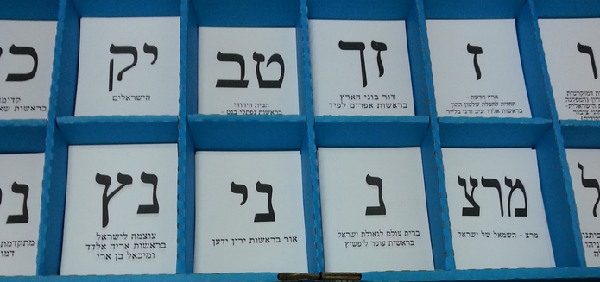
3. The voter enters the voting booth. Inside is a display of voting slips for each candidate list. There are also blank white slips.

Knesset Ballots for Every Party List

Voters cast their ballots for a list of candidates. Each candidate list is represented on a ballot by an initial or initials as well as by the name of the party.  The party names of candidate lists and their corresponding initials are publicized in the press and on the Central Elections Committee website – https://www.bechirot.gov.il.

The Voting Process

1. The voter selects a slip for the list of candidates he/she wishes to vote for. Voters may choose one slip only, which is then placed into the envelope. The voter must close the envelope. One may also use a blank slip to cast a ballot. In such a case the voter must indicate on the slip, in his/her own writing (in Hebrew or Arabic only) the name and initials of the list for which s/he is casting a vote.
2. The voter then exits the booth, and personally places the closed envelope into the ballot box, in view of members of the polling committee.
3. It is important for the voter to obey any further instructions on the part of election officials in order to ensure order and safety.
4. Only one ballot may be placed into the envelope. An envelope found to contain 2 or more slips from different lists, or 3 or more slips for the same list, is invalid. An envelope that contains 2 slips for the same list is considered valid, although only one vote will be counted.

The Parties

In Israel, each political party is represented by a Hebrew initial.

Employment Opportunities

Various workers are required during the election campaign and on the actual election day.  The public are invited to apply.

Voter’s Information Service

Information will be provided in the following languages: Hebrew, English, Russian, Amharic & Arabic

Tel: 1 800 800 508

Fax for Hard of Hearing: 1 800 800 608

You might like these…

The information in this article was published in the government’s official election website – www.bechirot.gov.il from an English translation of the Elections Information Sheet originally produced as a service for new immigrants by the Publications Department, the Ministry of Immigrant Absorption

Hebrew-English: Elections

Reading Time: < 1 minute

How do you say ‘elections’ in Hebrew? FREE word-sheet.

30 important Hebrew words you need to know for the upcoming elections with Hebrew, English & transliterations.

 ballots

 Ballot slips from previous elections

English Transliteration Hebrew
 Elections  Behirot  בחירות
 Ballot  Petek hatzbaa  פתק הצבעה
 Ballot station  Kalpi  קלפי
 Prime Minister  Rosh HaMemshala  ראש הממשלה
 Minister (m/f)  Sar/a  שר/ה
 Minister of… (m/f)  Sar/at Ha….  שר/ת ה
 Minister without portfolio  Sar Le Lo Tik שר ללא תיק
 Political party  Miflaga מפלגה
 Politics  Politika פוליטיקה
 Voter’s roll  Reshimat bochrim רשימת בוחרים
 Public opinion  Daat HaKahal דעת הקהל
 Identity document  Teudat Zehut תעודת זהות
 Citizen (m/f/pl)  Ezrach/it/im אזרח/ית/ים
 Coalition  Koalitziya קואליציה
 Opposition  Opozitsiya אופוזיציה
 Democracy  Demokratiya דמוקרטיה
 Election Campaign  Masa Behirot מסע בחירות
 Parliament  Knesset כנסת
 Member of Parliament (m/f)  Haver/at HaKnesset חבר/ת הכנסת
 Left wing (m/f/pl)  Smolan/it/im שמאלנ/ית/ים
 Right Wing (m/f/pl)  Yemani/t/im ימני/ת/ים
 Strategy  Strategiya אסרטגיה
 Term of office  Kadentziya קדנציה
 To choose/vote  Liv’chor / LeHatzbiya לבחור/להצביע
 Voter  Matzbiya מצביע
Candidates Me’umadim מעומדים
Electoral Committee Vaadat HaBehirot ועדת הבחירות
Mandate Man-dat מנדט
Election Results Totzaot HaBehirot תוצאות הבחירות
Percentage Poll Ahuz HaHatzba’a אחוז ההצבעה

You find these useful too..

Israel Retirement Homes Database

Reading Time: 3 minutes

Retirement Homes & Villages, Assisted Living, Frail & Specialized Care Centers in Israel

Hebrew: מדריך בתי אבות ודיור מוגן סיודי בישראל

Legend

1. Active Living2. Independent Living3. Assisted Living
4. Nursing Care5. Continuing Care6. Rehabilitation
K - KibbutzA - Alzheimer'snca - not currently available

Jerusalem Retirement Homes

RESIDENCE NAMETELEPHONELOCATION12345OTHER SERVICES
Beit Tovei Ha’ir is Jerusalem’s leading Torani retirement community 054-446-5276JerusalemA
Zigfried MozesJerusalem
Ahuzat Bet Hakerem 1 800 222 999 Jerusalem
Bet Sababa02 670 2999Jerusalem
Neve Horim 02 640 3333Jerusalem A
Neve Simcha02 500 8111JerusalemA
Valsra Itzhak02 537 1678Jerusalem
Neve Gilo 02 677 5333Jerusalem
Bet Horim Rehaviah 02 561 0011Jerusalem
Jerusalem of Gold 02 671 4932Jerusalem
Migdal Nofim02 658 0222 Jerusalem
Neve Hadar 02 572 4444Jerusalem
 

Retirement Homes in the Sharon Region

RESIDENCE NAMETELEPHONELOCATION12345EXTRA SERVICES
Bet Protea, Israel’s award winning retirement village loved by Anglos09 959 5223Herzliyah
Protea Village09 775 6111 Tel MondA
Bet Gil Paz 09 764 2626 Kfar Saba
Bet Shalom 09 959 6262Herzliyah
Bet Juliana 09 970 4646HerzliyahA
Herzliyah Nursing Home 09 950 0134Herzliyah
Bet Yaari 09 833 6036 NetanyaA
Hedvat Horim 09 746 5252 Hod Hasharon
Neot Gil Ram 09 931 2222 Petach Tikva
Vera Salmons Center 09 748 1251 Kfar SabaA
Bet Ami 09 861 1222 Netanya
Nofei HaSharon 09 860 1777 NetanyaA
Seven Stars 09 961 0003 Herzliyah
Lev Ganim 09 865 7367 Netanya
HaMavri 09 764 5555 Kfar Saba
Ad 120 09 741 6959 Hod HaSharon
Beit Yosef 09 740 5239 Hod HaSharon
Greenstein Retirement 09 862 2026 Netanya
Beit Hadarim 09 767 7777 Kfar Saba
Beit Tomer 09 957 2112 Herzliyah
Bet Rephael 09 882 8832 NetanyaA
Ahuzat Poleg --Netanya
Bet HaShemesh 052 242 3405 Hod HaSharon
Bet Mishad 09 950 6215 Herzliyah
Name Telephone Location Type of Living and Levels of Care
1 2 3 5 6 Specialized
Tel Aviv Area
Active Seniors Village – Neve Efal *6570 (Israel) Ramat Efal A
HaBayit Began *6570 (Israel) Givatayim
Mediterranean Towers 03 555 3022 Nordiya
Arbel 03 932 1477 Petach Tikva
Neve Amit 03 765 7700 Tel Aviv
Ahuzat Zahala  nca Tel Aviv
Gil Oz  nca Petach Tikva A
Gan Ba’Ir 03 675 955 Ramat Gan
Lev Ramat Gan 03 672 8989 Ramat Gan
Migdalei Natan 03 688 8154 Tel Aviv
Neot Aviv 03 518 9291/2/3 Tel Aviv
Ad 120 03 612 0120 Ramat HaChayal
Bayit BeLev 03 500 8900 Bat Yam
Ateret Rimonim 03 578 6990 Bnei Brak A
Bayit BeLev 03 500 8900 Bat Yam
Neot Afeka *6570 Tel Aviv A
Ramat Aviv Seniors’ Center *6570 Tel Aviv
Lev Holon *6570 Holon
Bet Ramat Aviv *6570 Tel Aviv
Bet Shalom 03 521 1444 Tel Aviv
Einat 03 938 5351 Kibbutz Einat (K)
Beer Sheva & The South 1  2 3  4 5 6 Specialized
Ganei Omer 08-6460988 Beer Sheva
Beit HaOren 08 672 0458 Yad Mordechai (K)
Neve Amit – Lev Avot 08 934 4888 Rehovot
Ganei Yeelim 08 610 1010 Beer Sheva
Bet Almog 08 944 3179 Bet Almog (K)  √
Ganim 08 859 1101 Gadera A
Bet Hadar 08 851 2222 Ashdod A
Sheila Residence 08 628 4777 Beer Sheva
Bet Horei 08 927 8133 Netzer Sireni (K)
Neve Shva 08 649 0690 Beer Sheva A
Neve Shva HaShalom 08 623 2242 Beer Sheva
Bet Avot Beer Sheva 08 647 4500 Beer Sheva A
Bet Vizel 08 859 8001 Gadera
Yad Binyamin 08 868 1872 Yad Binyamin
Hailpern 08 679 5777 Ashkelon A
Neot Avi Netivot 08 993 3911 Netivot A
Hatzor Nursing Home 08 857 9496 Hatzor (K)
Noam Avot 08 860 7430 Mesoat Yitzhak (K)
Neot Eilat 08 636 4666 Eilat
Haifa & The North  1 2 3 4 5 6 Specialized
Neve Holiot 04 694 7461 Sde Nehemia (K)
Edna Senior’s Residence 04 983 1311 Tivon
Edna Independent Senior’s Residence 04 992 7006 Nahariya
Bet HaAgam 04 691 5162 Hulata (K)
Bayit BeKfar 1 800 307070 Ginosar (K)
Bet Savion 04 985 8071 Western Galilee
Givat Oz 04 652 5347 Givat Oz (K)
Hadassim 04 658 1758 Bet Shean A
Maon Reut 04 870 8756 Kiryat Bialik
Nof HaYam 04 876 6111 Kiryat Yam
Beit Le VeLah 04 637 5209 Maanit (K)
Rishonei HaCarmel 04 824 3611/1 Haifa
Neve Shaanan 04 823 5512 Haifa
Beit Shikma 04 695 4100 Amit (K)
Bayit BeLev – Idan House 04 878 4784 Kiryat Motzkin V√ A
Maon HaTishbi 04 833 2856 Haifa
Amal Lilach 04 996 0378 Yasur (K)

You may like these…


About Us

0
Reading Time: 2 minutes

Making Aliyah with the Anglo-List

A website for olim by olim!

The Anglo-List was developed in 2009 to meet the needs of the fast growing English speaking community in Haifa. Online aliyah resources were extremely limited at that time and the need for specialized information  was clear.  The Anglo-List took up this challenge. Practical, unbiased, Israeli lifestyle information was not available on government and on Aliyah organizations’, websites.

As soon as Anglo-List went online, we received a flood of requests for information on a national scale and since then we have been adding to this site almost on a daily basis.  There are olim who fondly refer to this site as  their “aliyah bible”.

Seasoned and experienced immigrants contribute to the Anglo-List .  We talk the oleh through real life scenarios and by recalling the frustrations of our early Aliyah,  we successfully provide practical, hands-on information  without which relocation, absorption and integration is extremely difficult.  Even after 12 years our website continues to be an invaluable resource.

The Anglo-List is the only Aliyah website to provide Hebrew English translations of household bills, banking documents, instructional videos and others.

Israeli lifestyle information is also provided as well as an Israel-Anglo Business Directory another important resource for olim to locate English speaking oleh-friendly professionals.

International students, foreigners and tourists also use this site and we constantly evolve to meet their needs.

Anglo-List is within the reach the French and Russian speaking communities too with highly specialized translations included in the site.

It is our aim to give you unique and specialized information that will will make a significant difference to your Aliyah and integration.

Anglo-List tries to make Israel easier.  From emails and via our forums it is clear that the Anglo-List is succeeding in its mission and is filling an information gap.   We are accredited by The Jewish Agency and various Aliyah organizations and Jewish Federations.

Anglo-list is here to stay and we will continue to evolve and meet the growing needs of the community.

Good luck with your Aliyah!

Road Safety for Seniors.

Reading Time: 2 minutes

Road-safety for Israel’s Senior Citizens.

Hebrew: בטיחות בדרכים לקשישים

Israeli drivers are known to drive fast, take chances and be a little reckless. Anashim B’Adom is an organization that promotes road safety amongst Israel’s senior citizens.

Road Safety for Seniors

Anashim B’Adom recommends and suggests the following road safety measures for seniors:

  • Cross the road at designated pedestrian crossings.
  • Do not take a chance and cross when the pedestrian light is red.
  • Before you cross at the pedestrian crossing, don’t forget to look in both directions. Even though there is a pedestrian crossing, and you have the right of way, it is no assurance against speeding cars and careless drivers.
  • Distractions!  Speaking on a mobile phone, or similar, can distract your attention when crossing a road.  Please refrain from talking or texting while crossing the road.
  • If you are behind the wheel, take your medical limitations or conditions* into consideration.  Wear your glasses if necessary.
  • Stopping your vehicle, or standing and waiting on the “shoulders” of the road can be very dangerous. Israeli drivers sometimes try to beat the traffic and use the shoulders as an extra lane.  Naturally they are driving beyond the speed limit when they exercise this maneuver.
  • If you are on the sidewalk, please keep a safe distance from the edge of the road.
  • If there is no pavement or sidewalk, and you are forced to walk on the shoulder, keep to the left so that you are facing oncoming traffic.
  • Whether driving or walking, be extra careful at dusk when ease of visibility is lessened.
  • Wear clothes that are brighter in color so that you can be seen easily.
  • Be extra careful when crossing the road with your young grandchildren who are depending on you to get across safely.

*Anashim B’Adom list the following as medical conditions that might impact your driving ability

  1. Impaired  vision: long distance, short distance and peripheral
  2. A shortened concentration span
  3. Impaired hearing
  4. Slower reaction time


Converting your license in Israel

New olim are required to convert their license to an Israeli one, within the first year of their Aliyah. However experienced a driver you may be, we suggest you take a few lessons to familiarize yourself with local conditions and driving etiquette.  Budget around 150NIS per lesson.

Israel’s public transport is efficient and while it is important to maintain a sense of independence and control, your safety is paramount. Buses, trains, sheruts and taxis can take you wherever you need to go.  If you are willing and physically able, consider using public transport instead. Local buses are equipped with a hydraulic step which the bus driver can lower when you enter or alight the bus.  Inter city buses however, do not have such a step. Taxi drivers are generally patient and will help you to get out of the car if you ask.

Hebrew-English: Your Apartment

Reading Time: < 1 minute

Learn new Hebrew words and phrases with English and transliterations

Your Apartment

English Transliteration Hebrew
Apartment Dira דירה
Boiler (electrical)/ geyser Boyler דוד (חשמל)
Boiler (sun) Dud Shemesh דוד שמש
Carpet Shatiach שטיח
Cleaning Nikayon נקיון
Cleaning lady Ozeret / Menaka עוזרת / מנקה
Chair/s Kisay/Kisa’ot כיסא\כיסאות
Couch / sofa Sapa ספה
Cupboard Aron ארון
Electrician Hashmala’i חשלמאי
Electrical appliances Mach’shi’ray Hashmal מכשירי חשמל
Electricity meter Shaon Hashmal שעון חשמל
Exterminate Ri’soos ריסוס
Fridge Mekarer מקרר
Furniture Rehay’tim רהיטים
House Bayit בית
Insurance Bi’too’ach ביטוח
Kettle Koom-koom קומקום
Landlord Baall Ha’dira בעל הדירה
Lease agreement Cho’zeh חוזה
Meter Sha’on שעון
Ministry of Construction & Housing Misrad HaBinuy Ve HaShikun משרד הבינוי והשיכון
Microwave Mikro-gal מיקרוגל
Moving house Over dira עובר דירה
Oven Tanoor תנור
Plumbing Insta’la’tzia אינסטלציה
Plumber Instalator (common) / Shruv’ruv (Hebrew) אינסלטור\שרברב
Stove Ki’rayim כיריים
Shelves Madafim מדפים
Solar water heater Dood Shemesh דוד שמש
Television Televiziya טלוויזיה
Table Shulhan שולחן
Vacuum cleaner Sho’ev a’vac שואב אבק
Wall-to-wall / fitted carpeting Shti’chim mi kir le kir שטיחים מקיר לקיר
Water meter Sha’on ma’ym שעון מים

You may find these useful too…

Israel Old-Age Pension

Reading Time: 3 minutes

Israel Bituach Leumi Old-age Pension

Hebrew: קצבת זקנה ביטוח לאומי

retirees on beach

The basic old-age pension rates

As of January 2021, the basic old-age pension is NIS 1,558 for and individual and NIS 2,342 for a couple. The basic old-age pension people age 80 or older is NIS 1,646  for an individual and NIS 2,430 for a couple.

If each of the couple separately meet the entitlement conditions for an old-age pension, each one of them will be entitled to an individual pension.

In addition to the basic pension, you will also receive:

A seniority increment (insurance) – The old-age pension includes a seniority increment for those who were insured for over 10 years prior to the date of the beginning of his entitlement to an old-age pension, subject to the restrictions prescribed by law.

The seniority increment is 2% of the pension for each full year of insurance after the first 10 years of insurance. The total increment may not exceed 50% of the pension.

Pension deferral increment -This increment is paid in cases in which there was no entitlement to an old-age pension due to income from work (even if no claim was submitted) or, because of the income from work, the insured is only entitled to a small old-age pension, and he waives receipt of the small amount.

A pensioner must reside in Israel for at least 182 days a year, in order to apply for, and receive  a pension or a “kitzvat zikna”. 

From 01.01.21 The Amount you Receive
NIS 1,558 For an individual
NIS 1,646 For an individual aged 80 or older
NIS 2,342 For a couple (the pension for a couple is composed of a pension for an individual plus an increment for the spouse)
NIS 2,430   For a couple when the pension recipient is aged 80 or older
NIS 2,051 For an individual + 1 child
NIS 2,835 For a couple + 1 child
The increment for the child is paid to only one of them 
NIS 2,544 For an individual + 2 or more children* 
NIS 3,328 For a couple + 2 or more children* 

* The increment for a child is paid for the first 2 children only.

– The increment rate for each one of the two children is NIS 493 

– The increment rate for a spouse is NIS 784 

We do our best to update these figures regularly.  Do check on the Bituach Leumi website for the most current information

Israel Retirement Income

When you reach retirement age, you are entitled to receive an old-age pension provided that you pass an eligibility test; that  your income from work does not exceed (or exceeds by only a small amount) the maximum income, and provided that your income from sources other than work, such as income from property or interest on investments, does not exceed (or exceeds by only a small amount) twice the maximum income. Income from a pension is not taken into account.

Israel Retirement Age

Until June 30, 2004, the retirement age was 65 for men and 60 for women.

From July 1, 2004, the retirement age is determined according to one’s date of birth.

The retirement age for men is from 65 to 67 and for women is from 60 to 64, as can be seen in the following tables:

Retirement age for men:

Date of birth (month and year)

Retirement Age
From To
6/1939 65
7/1939 8/1939 65 and 4 months
9/1939 4/1940 65 and 8 months
5/1940 12/1940 66
1/1941 8/1941 66 and 4 months
9/1941 4/1942 66 and 8 months
5/1942 and thereafter 67
Retirement age for women:

Date of birth (month and year)

Retirement Age
From To
6/1944 60
7/1944 8/1944 60 and 4 months
9/1944 4/1945 60 and 8 months
5/1945  12/1945   61
1/1946 8/1946   61 and 4 months
9/1946   4/1947   61 and 8 months 
5/1947 and thereafter 62

Pension Conditions & Allowances

For more information on pensions, conditions, eligibility and allowances, visit the Bituach Leumi website (National Insurance)  

LEARNING HEBREW

0
Reading Time: 2 minutes

100 ways to learn Hebrew. Hebrew to English translations and transliterations that make Hebrew learning easy.

Modern Hebrew Text

Welcome to our Hebrew learning section where we share free tools and resources that will help you while you are  learning Hebrew – from now and until forever.

Learning Hebrew – An Overview

How important is it to learn Hebrew? Can you get by without it? What are the options and best way to go about it?

Dictionary of Hebrew English & Transliterated Words & Phrases – By Topic:  A-L

Dictionary of Hebrew English & Transliterated Words & Phrases – By Topic:  M-Z

Hebrew Acronyms & Abbreviations

Banking & Bank Documents

Confusing Hebrew Words – Don’t mix them up!

Loanwords

Everyday Hebrew words borrowed from other languages

Palindromes

Palindromes: Words spelled the same backwards and forwards. Have fun learning Hebrew

Salaries & Wages

Your pay slip translated from Hebrew to English

Hebrew Slang Words

Learn Hebrew slang words, their meanings and examples

Translated Household Bills from Hebrew to English

Hebrew English Translations of the Automated Answering Machines

Ulpan Database

Ulpanim recognized by the Aliyah Benefit, private ulpanim, on-line, kibbutz ulpan and other Hebrew learning options


ABOUT ISRAEL: FACTS, FIGURES & INFORMATION

Reading Time: 2 minutes

All about Israel: Facts, figures & general Israel information at your fingertips


Geographical location

Is Israel on the European or Asian continent?


Airports


Capital of Israel – Jerusalem

15 fascinating and interesting facts


Clothing for Israel

Clothing customs for Israel’s different cultural and religious groups…


Israel currency – The New Israeli Shekel (NIS)

Israel bank notes, coins and currency converter…


Common customs & behavior in Israel

Communication, gestures, etiquette, time and other common practices


Currency exchange and conversion

New Israeli Shekel to US-,Canadian and Australian dollar, Euro, Pound, South African Rand


Daylight saving time for Israel

Summer & winter times – one hour forward and one hour backward


Declaration of Independence

In 1897 Theodore Herzl, at the First Zionist Congress proclaimed the right of the Jewish people to national rebirth in its own country.


Distances in Israel

From Kiryat Shmona to Eilat – distances between major cities, towns and settlements


Flag of Israel

Origins of the flag of Israel and its symbolism. Where does the color Tekhelet come from?


Earthquake Emergencies

Israel lies on the Syrian African fault-line. Prepare your home and family for an emergency situation


Does Israel have a national food?

Favorite and popular foods, drinks, snacks and other delicious stuff


Electoral System

Elections and the Israel democratic electoral system and major political parties


Hamsin, Sharav or heat-wave

50 days a year of oppressive heat and desert sand storms in Israel


Innovations & Inventions


The Israel Defense Forces – IDF

Voluntary and compulsory service. What to bring from home. Your first day & other useful tips


Israel Independence Day

Independence Day – Heb: Yom Haatzmaut.  A day of immense sorrow is followed by celebrations and family fun time


Local time


Map of Israel

Find your way…


National Anthem

Israel’s National Anthem – Hatikvah. In Hebrew – The Hope


National Security & Emergencies

Prepare your family and home for terrorist events, missile fire and other emergency situations


The National State Bill

Details of Israel’s National State Bill of 2018


Official Languages

Hebrew & Arabic are the official languages of Israel. English, Russian, French & Amharic are widely spoken


Population information


Postage & postal services

Israel’s local and overseas postal tariffs, letters, parcels and other postal services


Presidents of Israel

Presidents of the State of Israel from 1948 to the present day


Prime Ministers of Israel

The first Prime Minister – David Ben Gurion.  Golda Meier, Yitzhak Rabin and other great leaders


Religious Holidays

Jewish, Muslim, Christian, Bahai & Druze holidays in Israel for the coming year


Suspicious objects and suspicious behavior


Telephone numbers & telecommunication Information


Television, Cable, Radio & Newspapers


Theaters & Cinema


Weather in Israel

Israel weather, unique conditions, climate and temperatures in Israel. A different wardrobe for every season