12.1 C
Jerusalem
Monday, April 20, 2026
Sample Page
Home Blog Page 89

The Weekly Torah Portion: Parshat Hashavua Va’era

0
Reading Time: 10 minutes

Parshat Hashavua Va’era

By: Rabbi Nissim Mordechai Makor

parshat hashavua vaera Rav Nissim Mordechai MakorThe Purpose of the Plagues

The Shem Mishmuel teaches us that It is perfectly clear that the Exodus did not actually require any of this once Pharaoh refused to allow klal Yisrael to leave his hand, God could simply have flattened Egypt in one mighty blow, annihilating them with a bolt of lightning or something similar. But this would not have achieved the main aim of the Exodus, which was not the destruction of Egypt, but a demonstration of Divine power which left no room for doubt that God controlled the world. The more miracles wrought in Egypt, the greater and clearer the realization that the holy God of Yisrael was in charge of His world. This was the point of this continuous barter with Pharaoh: each step in the destruction of their country led Pharaoh, his necromancers, and his people closer to an appreciation of God’s existence and power. This concept is further borne out by Yisro’s reaction to the miracles that God had performed on behalf of the Jewish Nation.
Yisro had tried every idolatry, every doctrine, every philosophy in the world. He had been convinced, however, of the veracity of the Torah after all the miracles, when he came to greet Moshe in the wilderness. It was the awesome nature of the destruction of Egypt and Kerias Yam Suf [the splitting of the SEA] which had persuaded Yisro beyond a doubt that God was the only Deity.
Another Purpose
There is another side to the function of the ten plagues. We have seen that one great plague would not have convinced the Egyptians as thoroughly of God’s existence as several smaller ones. If Egypt had been wiped out at the first moment of refusal, this would never have afforded them the possibility of teshuva [repentance]. As the Egyptians were punished for their wickedness, they had the opportunity to stop and think about their errors and repent. After any of the plagues, having experienced God’s miraculous intervention in their lives, they could have withdrawn their opposition to the Jewish Nation and accepted upon themselves the kingship of God, and they would have been forgiven. Alas, this did not happen and will not happen to the nations of the world until the ultimate future, but God nevertheless left the possibility of repentance open to the Egyptians during the plagues.
There is great lesson to learn from this when we engage in our own teshuvah [repentance]. Just as with Pharaoh and the Egyptians, proper teshuvah needs to be completely unconditional. The one who repents must acknowledge the wrong that they have done and resolve to do better in the future, regardless of any external factors. Particularly, one’s teshuvah should not depend on the success of one’s prayer, that if one’s teshuvah should not depend on the success of one’s prayer, that if one’s prayers are answered, then one will remain resolute in one’s repentance, but otherwise not. Even if one’s lot worsens, God forbid, one should remain steadfast and not deviate from one’s new level of commitment. If we do this, then we can be certain that our teshuvah is perfect and accepted by God and be confident that He will be there for us when we need Him.

The First Plague: Blood

God said to Moshe, “Pharaoh’s heart is stubborn. He refuses to let the people go.”
The Meam Lo’ez explains that Hashem said, “If Pharaoh had a heart would he ever have said, “Who is God that I should listen to His voice?” Would he have complained to you and Aaron that you did not bring him an idol like all the other ambassadors? Would he ever have forgotten how he was attacked by rats? Pharaoh might have a piece of flesh in his chest, but not a true heart. That is why he still remains so stubborn.”
Egypt was not irrigated by rain. Every year the Nile rises and waters the land, and through this, the Egyptians are able to raise crops. Totally dependent on the Nile, the Egyptians worshipped it as god. God therefore struck out at the Nile first, later he would punish its worshipers.
The plague could not be dismissed as a natural phenomenon. Until the water reached the borders of Egypt, it was perfectly pure and clear. But as soon as the water crossed the Egyptian border, it immediately turned into blood. Similarly, as soon as the water left Egypt and poured out into the Mediterranean Sea, it once again became pure water.
During the plague, the Egyptians heard that there was fresh water available in the upper reaches of the Nile, and they even sent out expeditions to bring back fresh water. But as soon as the barrels of water passed through the borders of Egypt, even that water turned into blood. There was no way that the Egyptians were able to drink even a drop of water from the Nile.
The Egyptians tried to force the Israelites to give them water, but as soon as an Egyptian put such water to his lips, it immediately turned into blood. Finally, the Egyptians had no other choice but to buy water from the Jews, for whatever price the Jewish people asked. Since this plague, like all the others, lasted seven days, many enterprising Jews were able to amass large sums of money. The plague of blood began on a Thursday.

The Second Plague: Frogs

“The entire land will swarm with frogs. The biggest ones will attack your palace, causing great damage. They will be in you and in your people, croaking inside your bodies. The plague will begin with you, since you are the one who led the persecution of My people.
“You claim to be a god, the creator of the Nile. I will show you that the Nile belongs to Me alone. I hereby decree that it should spawn countless frogs. The Nile will do My will, even though it will be to your harm.” The Egyptians had forced the Jews to catch frogs with their bare hands. The Egyptians were therefore punished with frogs.
Pharaoh was also punished for extinguishing the sound of the Torah. The Jews would get up early in the morning to worship and study.  In the attempt to destroy the Jewish nation, the Egyptians were trying to shut off this sound of worship and Torah study. Instead, the Jews were raising their voices in terror, crying out because of their harsh labor. Because of this the Egyptians were punished with frogs, who croaked and made noise without stopping. It was a fitting punishment.
Furthermore, when the Hebrew woman gave birth, they could not scream out, since if they did, their infants would be taken away by the Egyptians. When one is in pain and cannot even cry out, his agony is all the worse. Since the Egyptians did not let the Jewish women cry out, they were now assaulted by the cries of the frogs.
The Jewish also screamed and cried out when they saw their children thrown into the river. These cries now came back to Egypt to Egypt when the Nile spawned loudly croaking frogs. The plague of frogs only struck areas where the Egyptians lived. In Goshen, where the Jews lived, there were no frogs

The Third Plague: Lice

Hashem said to Moshe, ‘Tell to Aaron, “Stretch forth your staff and strike the dust of the earth.’ It will turn into lice in all the land of Egypt.” “Tell Aaron to initiate this plague. You cannot do it, because you once benefited from the ground. When you killed the Egyptian, you hid him in the sand, and the ground concealed his body. Since you once benefited from the soil, you should not be the one to make it into something destructive. Therefore, tell Aaron to do it.”
As soon as Aaron struck the ground with his staff, two things happened. Every man and beast near Aaron was immediately covered with lice and vermin, as if he had lived in a garbage dump for a year. Second, all the dust in Egypt, both far and near, was transformed into lice and gnats, attacking man and beast alike.
The Egyptians were stricken with this plague because they had forced the Jew to sweep the streets and roads of dust. As a fitting punishment, all the dust in Egypt turned into lice. If one dug a cubit into the ground, no soil would be found only lice. As a result, the Jews could no longer be made to sweep the streets. Another reason for this plague was that the Egyptians did not allow the Jews to bathe.  The Jews remained sweaty and filthy from their work making bricks, and were subject to attacks by live and vermin. Now the tables were turned and it was the Egyptians who were plagued by lice.
The insects attacked their faces, and even got into their eyes. The Egyptians tried to wash them off by bathing in the sea, but it was to no avail.
It is taught that ten measures of sorcery were sent to the world, and nine of these were taken by Egypt. The essence of the ten measures was therefore in Egypt, and the occult arts flourished there. But now they lost this power. This is indicated by the absence of the Yod which has a numerical value of ten and therefore alludes to the ten measures of sorcery that were lost. Although his wizards admitted that this plague was the finger of God.
Pharaoh remained stubborn and would not listen to Moshe and Aaron, just as God had predicted.

The Fourth Plague: Wild Beasts

The plague consisted of hordes of wild beasts: lions, tigers, wolves, bears, snakes, scorpions, wasp’s mosquitos, crows, locusts, and all other kinds of harmful creatures. Also, included in this plague would be the same frogs and lice as before. It would be a terrifying mixture of all the harmful creatures in the world.
There would be another time that God would use wild animals to take revenge against His enemies. When the prophet Elisha remedied the bad waters of Jericho, on the way to Bethel a number of young hoodlums mocked him and called him a baldy. They were actually very angry with him for remedying the water supply, since they had previously been able to sell pure water to the populace for a high price.
The Jewish People tried to keep many rules of the Torah even in Egypt. The Egyptians forced them to eat milk and meat together. For making the Jews partake of a forbidden mixture, HASHEM brought wild beasts to places where He had previously forbidden them to enter. It was a mixture of beasts that His laws of nature previously would not allow to exist.
The Jewish nation deserved to be punished by this plague and were not worthy to be protected by a special providence. They had sunk to great depths of depravity, and would require many good deeds to have sufficient merit for such a miracle. But God had mercy, and ordered that no Jew should be injured. If a Jew deserved to die, an Egyptian was taken in his place.
Therefore, when Egyptians were actually killed by plagues, as in the case of beasts, plague, and death of the first born, Pharaohs officials were struck first. Where the plagues were not deadly, such as in the case frogs, lice, boils, locusts, and darkness, the masses were struck first. In the case of all the plagues, however, the first one to suffer was Pharaoh. As King, the prime responsibility was always his.

The Fifth Plague: Death of Animals

Hashem also said that He would make a “Miraculous distinction” between the flocks of Egypt and those of Israel. The Egyptian flocks were pastured as far as Goshen, and there, they would often be in close proximity with those of the Jews. Furthermore, when an epidemic strikes one flock, it spreads to others very readily. The fact that not a single one of the Jewish animals died would be an obvious miracle.
The reason for this plague was that the Egyptians forced the Jews to tend to their flocks in the deserts and the mountains. They sent the Jews to the most distant pastures to keep them from being with their wives and having children. Also, the Egyptians made the Jews do the work of beasts, making them pull heavy plows across fields. Regarding this, Tehillim 129:3, “the plowers plowed with my back, and they made long furrows. Since the Egyptians used the Jews like animals, they were punished by losing their livestock.
The Egyptians were also punished because they expropriated Jewish livestock illegally. They also worked the Jews so hard, the did not have time or strength to care for the animals.

The Sixth Plague: Boils

Hashem told Moshe and Aaron to take ashes from the oven. These ashes were to be thrown up in the air, and wherever they settled on a man or animal they would cause boils, filled with pus.
One may wonder how Hashem could mention animals in this plague, since it appears that all the Egyptians animals had already died in the previous calamity.  But actuality, only the ‘livestock in the field died that taken indoors was often by the epidemic. Only in the case of Pharaoh’s own flocks were all animals killed, even those brought indoors.
The ash spread all over the land of Egypt. This small amount of ask was able to coat every man and beast in the entire. Until this time, the Egyptians would not let the Jewish people use their bathhouses, lest they “contaminate” the water. After the plague, the restriction was lifted.  Of all the plagues, this one affected Pharaoh the most. He was in absolute agony, covered from head to foot with boils and blisters.

The Seventh Plague: Hail

‘If I had so willed,” Hashem instructed Moshe to tell Pharaoh, “I could easily have exterminated you and all your people when I sent the epidemic killing your animals. The only reason I allowed you all to survive was so that I would be able to show you My great strength. I want all the world to speak of My acts.
In the case of this plague, God sent to warning. He did not intend that the hail kill man or beast. It was only meant to destroy the Egyptians crop and trees. The heavy sharp edged hailstones tore at the trees like axes. Initially, the hail fell as super-cold ice. Any Egyptian out in the fields, even with protection, was frozen to death. Later, when fire started to accompany the hail, many were roasted alive.
Out of hatred for the Jews, the Egyptians had beaten them, and had even thrown stones at them. It was now as if God were throwing “stones” at the Egyptians. Also, the Egyptians used to scream at their Jewish slaves. With thunder, the heavens now “screamed” at the Egyptians.
Of all the plagues, this was the only one for which God sought counsel from His heavenly tribunal. All agreed that it should be sent.
This is the mentality of the wicked. When evil befalls them, they beg God to have mercy. But after the evil has passed, they immediately revert to their bad ways. A truly moral person, however, must be consistent. Even when things go well, he must recall how he pleaded with God in his times of trouble. This will keep a person in a constant state of closeness to God.
Shabbat Shalom!

Pearls of life

The Pearls of Life will focus on matters of guiding one in the matters Kedusha [Holiness]. In the writings of Kabbala, Bris Milah [circumcision]. The spiritual midah [characteristic] of Yesod is the most closely associated characteristic of this as this is the completion of the human body, the sign of the holy covenant. Our spiritual growth is dependent of Shemiras habris, protecting our neshamos from immoral thought, speech and action. This is the yesod, foundation, upon which our destiny in this world and the Next rests. We can liken this to building a house. A house can only be as large and strong as its foundation.  And if a builder errs in the way he lays the foundation, then even a small structure will collapse  By definition, a bris, is a covenant, is a pact between two parties. Someone who is careful with shemiras habris can rest assured that Hashem will “keep His part of the deal” and reward him with blessing and success in life.”
Yeshiva Pirchei Shoshaim

Israel Traffic Violations & Parking Fines

Reading Time: 2 minutes

Traffic violations, parking fines & points for Israeli drivers.

Heb: נקודות על עבירת תנועה

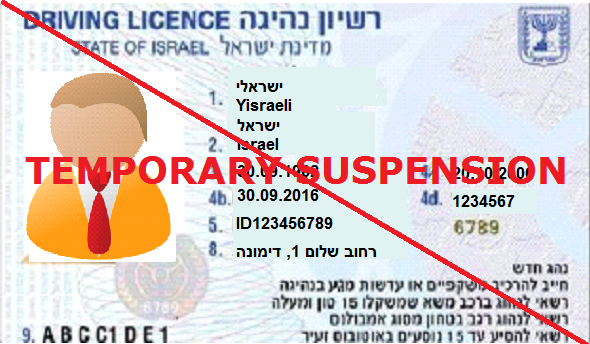
drivers license not validWhile it may now be easier for olim to convert their foreign driver’s license to a local Israeli driver’s license, the law on traffic violations and the point’s system for contraventions has been revised.

If you receive a ticket/fine (Heb. slang: ‘raport’) for a traffic offense it will be registered in the police system, a copy of the fine will be placed on the windscreen of your vehicle or handed to you personally.  You will also be sent a copy of the traffic fine by mail to your registered address (at Misrad HaPnim).  Our Hebrew English translation of a parking fine here and from Hebrew to French – Contravention: Ticket de parking

New legislation from January 5th, 2018:

1,000 NIS fine + 4 points

For using your mobile phone even at a red light

1,000 NIS fine + 4 points

Sending/receiving message texts while driving or even at a red light

1,000 NIS fine + 4 points

Adjusting your navigation device while driving or even at a red light

100 NIS fine

Holding a cup of coffee (or any drink) while driving or even at a red light

New points scale for some common violations (fines or criminal charges may also apply)

These are just some – there are many more…

Violation

Points

Failure to wear the luminous vest when required 2
Illegal turns 6
Motorcyclists failing to wear a helmet 6
New driver, unaccompanied 8
New driver exceeding the passenger limit 8
New driver driving beyond allowed time-frame 8
Driver and passengers not wearing a seat-belt 4
Not allowing pedestrians to complete their crossing at a pedestrian crossing 8
Allowing a non-authorized driver to use your vehicle 10
Refusing a breathalyzer test 10
Driving under the influence – DUI 10
Not driving with headlights as per regulations 2
Headlights not functioning properly 4
Driving without a license 8
Driving with the wrong license type/category 8
Driving with a suspended license 10
Hit and run 10
Driving through a red light 10
Failure to heed the instructions of a police officer 6
Overtaking from the right 4
Failure to stop at stop sign or give way to oncoming vehicle 10
Vehicle license expired more than 6 or 12 months 6

Contact the Ministry of Transport

Information on fines, call the Israeli Courts National Information Centre: *35592

Enquiries:  Israel Police Traffic Department call center by phone, on *9666 or 1-222-9666

Weekly Torah Portion: Parshat Hashavua Shemot

Reading Time: 7 minutes

Parshat Hashavua – Shemot

By: Rabbi Nissim Mordechai Makor

Verse [1:1] These are the names of the children of Israel

parshat hashavua shemot Rav Nissim Mordechai Makor

Parshat Hashavua Shemot: R’ Moshe Feinstein points out that Rashi commented that although Hashem had counted Yaakov’s sons during their lifetimes, He counted them again after their lifetimes, He counted them again after their deaths to show His love for them, like the stars which He also counts and calls by name when He brings out and returns them. How does comparing the tribes to stars demonstrate their importance?

We suggest that this comparison alludes to an important lesson concerning free will. Even though Hashem allows humans the freedom to disobey the Torah, the highest level of spiritual one can attain is to understand that when an act is prohibited, that act is virtually impossible for a Jew to do. This explains why certain commandments are given with the expression, you shall be unable.

Really, a Jew should never be able to do anything contrary to Hashem’s commandments. However, if it were actually impossible to disobey Him, what reason would there be to reward us for the times when we do obey Him? Indeed, Hashem gives us freedom of choice precisely to give us the opportunity to ear reward for obeying Him. Thus the highest spiritual level attainable is to understand that we virtually cannot transgress the word of Hashem.

This was the greatness of Yaakov’s sons, who performed all Hashem’s commandments as if they had as much free will in the matter as the stars which possess intellect, but nonetheless have no desire other than to do His will. Thus, Hashem returns the stars with the same names by which He brought them out, since they never tarnish their names with disobedience.

Similarly, throughout their lives Yaakov’s sons never altered their names by falling to lower spiritual levels. The same names they had been given at birth remained dear to Hashem because they continued to live up to them with good deeds all their lives, even during their sojourn in Egypt. Thus HASHEM “returned them” by names and by count just as He had brought out, with their souls at the same high spiritual level.

Shabbat candle lighting times for Parshat Hashavu Shemot

Parshat Hashavua Index

The VERSE 3:2 says: The Messenger of Hashem appeared to Him in a flame of fire from the midst of the Bush

Rabbi Avigdor Miller zt’l writes that the appearance of the flame in the Burning Bush was not merely a passing phenomenon, for later we see that Hashem is named “the Dweller in the Bush” [Devorim 33:16]. Among the significances of the Bush we may quote Rabbi Yehoshua ben Korach [Shemos RABBAH 2:9]: “To teach you that no place is empty of the Shechinah, even the thorn-bush.” Thus, “All Your works praise You Hashem. They speak the glory of Your majesty. To make known to the sons of man His mighty deeds” [Tehillim 145:10-12]. Moshe emulated the Father Abraham who sought to recognize Hashem from His handiwork in Nature, and he succeeded so well that finally HASHEM corroborated Moshe’s recognition by speaking openly to him exactly as had happened to Abraham [Bereshis 12:1]. Thus “Dweller in the Bush” [Devorim ibid.] means “even in the bush,” among other meanings.

Among all the reasons why Moshe was granted this encounter with the presence of Hashem, one of the chief reasons is because Moshe had desired such an encounter more than any other desire he had ever entertained. “They lead a man in the was that he desires to go” Makos 10b.” Rabbi Miller added to me personally, that the more a person wants the More HASHEM will pull him.

Remove Your Shoes: Verse 3:5

This was required for two reasons.

1] The shoes are soiled with the dust of the earth and therefore should be removed when standing on holy soil.

2] Shoes are a form of pride. Removing the shoes and baring the feet denotes humility [as in II Samuel 15:30, “when David showed penance and wept and he walked barefoot”].  This verse is repeated in Yehoshua 5:15. This serves as an important refutation to the Bible –Critics” that claim that the book of Shemos was composed “long after David”; if as they claim that Yehoshua was composed “long after David”; if as they claim that Yehoshua was composed by an ordinary non-inspired author, then they must admit that the author of the book of Yehoshua is quoting verbatim from Shemos 3:15 contrary to their thesis that none of the sacred book quote from Shemos.

3} “Shoes” represent the body says the “Tikkuny Zohar”

4) The Likutey Moharan teaches us that to be able to perceive Godliness, one must discard his corporeal desires. Then he attains a “heavenly body” from the Garden of Eden.

Anyone who wishes to attain a revelation of Godliness, as Moshe did, must divest himself of all material desires. The body is compared to a shoe because leather, when worked over, becomes very pliable and fit to be shaped and designed into clothing. Yet not always is it purified thoroughly: a smell may still remain. Only those types of leather that have been worked over in the tannery will be purged completely of all smells. So too, there are tzaddikim who have conquered their material desires, making their bodies a fitting receptacle for Godliness. Then there are tzaddikim like Moshe who have worked on themselves even more and shed their physicality completely.

{module [653]}

Moses hides his face

The Likutey Halachot tells us that Moshe because he hid his face, he merited to great revelations of Godliness.

A person who is humble “hides” himself from God’s great light. By minimizing himself, he is then able to receive that light! This sequence reflects the original Creation, when God constricted His Presence in order to create the Vacated Space, and then formed all the world all the worlds within that Space.

Even very great tzaddikim must be careful not to look beyond their station and abilities. Adam, the first created by God’s own hand, aspired to what was beyond him. His desire caused him to eat from the Tree of Knowledge.

The Jews in Egypt had fallen to the forty-ninth level of impurity. The lower the level to which people have descended, the greater the tzaddik they need to help them ascend. Therefore, only someone of the caliber of Moshe was able to redeem the Jewish people. But Moshe was very humble and did not consider himself worthy of redeeming the Jewish people, therefore, he said, “Who am I?”

When the Divine anger is present in the world, that anger enters the tzaddik as well. Consequently, he hides himself and refuses to lead the people. At the time of the episode recorded here, due to the prevalence to lead the people.

At the time of the episode recorded here, due to the prevalence of idolatry at that time, Divine anger was anger was present in the world [Exodus 4:14]. “God’s anger burned against Moshe”]. As that anger entered Moshe, Moshe initially refused to redeem the Jews. However, after God revealed His compassion by offering to redeem the Jews, showing that His anger was mitigated, Moshe accepted the mission.

I Will Be Who I Will Be

God’s Holy Name EHeYeH, [I Will Be] has the same numerical value as the word DAM, [blood]. This Name reflects the dynamic of transforming oneself and becoming fully human, instead of living an animalistic existence.

God is always with a person. He is even concealed within the person’s blood, i.e., within his base desires. Thus, whatever level someone is on, as soon as he seeks Godliness, as soon as he prepares himself to change, to “be”, he perceives the presence of God, who supports the dynamic of “I will be.”

‘’You have no need to know My Name. I will be with them in all time of trouble. Tell them that there is a God in heaven, and that he is ready to listen whenever they cry out to Him.

[At first God said, “I will be what I will be” [Ehyeh Asher Ehyeh].  He then said that Moshe should tell the Jewish people, “I will be” sent me to you. The first time the term Ehyeh is doubled, while the second time it is not.  God said, “I will be with them during this time of trouble, and also I will be with them during the many persecutions to come.

“Trouble is bad enough when it comes,” replied Moshe. “Why tell the Israelites about the other persecutions that they will endure in the future? Why should I reveal to them about the troubles that they will suffer in their future exile?”

“Well spoken,” said God. “Do not tell them that ‘I will be who I will be’ sent you, which alludes to future exiles, but merely tell them, ‘I will be’ sent you. I did not mean to tell you to reveal future exiles to them, but merely to explain what I will be to them.

“I told you that ‘I will be with you’ [3:12]. You wanted to know what I meant by that. I therefore explained that it means that ‘I will be who I WILL BE’, both in this and in future persecutions. Just as I will rescue them now, so will I rescue then. This is for your information but to them do not mention future persecutions.

‘Furthermore, I will be to them, just as they are to Me. If they open their heats and are charitable, I will also have mercy on them.”

Shabbat candle lighting times for Parshat Hashavu Shemot

Parshat Hashavua Index

One more thought from Rav Makor:

The Pearls of Life brings the wise words of the Garden of Peace which focuses on the honor of a woman. The worst breach of a woman’s self-respect comes from her husband’s comments. Mankind has to know that the spiritual source of a woman’s soul is honor. Her entire vitality and happiness is dependent on the way her husband honors her. Therefore, any affront to her honor damages her soul, weakens her vitality and virtually kills her both spiritually and materially.
A woman wants to be perfect in her husband’s eyes
This is her honor, her happiness and her security.  A wife that’s subjected to comments and criticism finds life unbearable. It is absolutely forbidden under Jewish law to make critical remarks to your wife for this is a breach of honor.

The Jerusalem Marathon

Reading Time: 2 minutes

The Eighth International Jerusalem Winner Marathon on Friday, March 9th, 2018.

Register now!

The annual Jerusalem Marathon is one of Israel’s largest marathons and is a challenge of physical endurance for the participants.  Not only will you work off a few thousand calories, you’ll also enjoy the spectacular route with views of the Knesset, Mahaneh Yehuda Market, Mt. Scopus, the Old City, David’s Tower and more.

There are several tracks; an 800m community race, a 1.7 km family race, a 5km race, a half marathon – 21.1km and a full marathon – 42.2km

The race attracts some 30,000 participants including novices and elite runners from abroad.

Support a cause

The Jerusalem Marathon encourages participants to run for a cause.  This year 17 NGOs are participating including Melabev, The Lone Soldier Center and Kav L’Noar.  There are other opportunities too. (Volunteer opportunities)

The Anglo-List stands behind The Talia Trust for Children which raises funds to support remedial teaching projects in Jerusalem, Haifa, Tirat HaCarmel and Kiryat Shmona. The Trust’s main aim is to ensure that all children who have specific learning difficulties will receive the educational tools they need to succeed, despite their families’ socio-economic level (which includes funding for the ‘ivchun’ – Israel psycho-didactic educational assessment)

The Talia Trust for Children has a team of runners participating again this year. The Talia Trust was founded by Haifa Olim, Marilyn & Maurice Hyman, in 2005 in memory of their 21 year old daughter, Talia, who was tragically killed in a road accident on her way to college,

To join the Talia Trust team  please contact Lynn Golombic by email at:  talia.trust.marathon@gmail.com

To support the Talia Trust team, please click here  https://my.fundme.org.il/en/campaign/Marathon2018

To open a sponsorship page or volunteer at the event, email Maurice Hyman at: taliatrust@012.net.il

Haifa Hotels

Reading Time: 3 minutes

Which are the best value-for-money hotels in Haifa?

A number of new hotels have sprung up in Haifa’s mid-town, down-town near the port and HaNamal Campus, on the beach-front, near the convention center and MATAM (Scientific and Industrial Park) as well as in the German Colony.  Now you have a wide choice of basic-, family-, luxury-accommodation and boutique hotel experiences available.

israel beaches

Bask in the sun along miles of golden beaches

Carmel Center

In the Central Carmel, hotels offer you luxury and family accommodation with views of Haifa Bay, Akko, Mt. Hermon and all the way to Israel’s northern border with Lebanon. These hotels offer you access to restaurants, boutique shopping, two supermarkets, the Haifa Symphony Orchestra and the Cinamatheque.  The hotels are a stone’s throw away from the Bahai Gardens – a major international tourist attraction and well as Haifa’s biblical zoo.  The Tikotin Japanese Museum, the Mane Katz Museum are all in walking distance and can also be accessed via the Louis Promenade. Plenty of public transport; buses, taxis, the TikTak, and the Carmelit, Haifa’s underground funicular.

Crowne Plaza Hotel
Yefe Nof St


Dan Panorama Hotel
Hanassi Blvd.


Dan Carmel Hotel
Hanassi Blvd.


Haifa Bay View Hotel
Hanassi Blvd.


Bet Shalom Hotel
Hanassi Blvd.


Carmella Boutique Hotel
Hatishbi St.


Villa Carmel, Boutique Hotel
Heinrich Heine St.


Haifa’s Beachfront

The Leonardo Hotel

Family accommodation on the beachfront.

Enjoy a walk along the 4km long promenade all the way to Park Hecht (the largest green strip of land situated within the urban area of Haifa), take a dip in the blue waters of the Mediterranean and relax on Haifa’s magnificent golden beaches.  The Leonardo Hotel also gives you easy access to the Central Bus and Train stations linking you to Tel Aviv and other major locations.

Midtown

The Theodor Hotel
Herzl St.

The Art Gallery Hotel
Herzl St.

The Eden Hotel
Shmariyahu Levin St.

Bay-Club Hotel
Hassan Shukri St.

Value for money accommodation in Haifa’s mid-town.  Dollar shops and other stores selling inexpensive items flank both sides of Herzl St.  Easy access to the Madatech Science and Technology Museum on the old Technion campus, and a must for any young budding scientist in the family. Buses and the Metronit run along Herzl St.

German Colony

The Colony Hotel
Ben Gurion St.

The Templars Boutique Hotel
Ben Gurion St.

If it’s the hustle and bustle of night-life you are after, this is the place to be.  Restaurants, pubs and assorted eateries stretch along Ben Gurion Street.  Take in the breathtaking view of the Bahai Temple and terraces as well as the Haifa Port.  Buses and the Metronit run regularly and connect you to all the major tourist sites and the best that Haifa has to offer.  During the Haifa Festival of Festivals in December, Ben Gurion is lit up with Christmas and Hanukkah lights.

Downtown

The Golden Crown Hotel
Yafo Rd.

Port Inn
Yafo Rd.

With easy access to the Haifa Port, these hotels are ideal if you are on a limited budget or if you need to be near Campus Hanamal (University of Haifa).

Bat Galim

Bat Galim Boutique Hotel
Yonatan St.

Sea Plaza Hotel
Bat Galim St.

Bat Galim is a quiet, beach-front suburb of Haifa.  There is a quaint promenade, close to the Cable Car, and adjacent to the Quiet Beach (Hof HaShaket).  On the other side of the main road is the Maritime Museum as well as the Illegal Immigrants Museum.  The Rambam Medical Center is also situated in Bat Galim.

For Business People

La Capella Business Boutique Hotel
Castra Center

The Garden Hotel
MATAM

These hotels are lose to the Haifa Convention Center, MATAM – Haifa’s Silicon Valley and the headquarters of many international companies, also two large shopping malls and adjacent to the Sammy Offer Stadium.

Most popular hotels and apartments in Haifa

Birthright Taglit in Israel

Reading Time: < 1 minute

Birthright-Taglit Israel

Birthright or Taglit is an educational organization that sponsors 10-day trips to Israel for youth with Jewish heritage.  These trips are designed to connect these youth with their Jewish roots and find their Jewish identity.  Since 1999 when the first Taglit trip was made, around 1/2 million youth have participated.

Birthright – Taglit

To be eligible for a Taglit sponsored trip to Israel, you must have at least one parent of Jewish descent. You must be between the ages of 18-26, post high-school, and never traveled to Israel before on an education or study program.

A Taglit-Birthright Israel trip includes airfare from major cities, hotel accommodation, two meals per day, security, all transportation within Israel, and other costs associated with touring the country during the ten-day trip.

‘Birthright Israel’ International CEO, Gidi Mark: “It is important, especially in this time, in strengthening the bond between young Jewish people in the diaspora, their Jewish heritage and the state of Israel.”

Weekly Torah Portion: Parshat Hashavuah Vayechi

0

Reading Time: 5 minutes

Parshat Hashavuah Vayechi

By: Rabbi Nissim Mordechai Makor

parshat hashavua vayechi Rav Nissim Mordechai MakorParshat Hashavuah Vayechi in a nutshell: Vayechi is the Hebrew for “and he lived,” the first word of this parashah, it is the twelfth weekly Torah portion  in the annual Jewish cycle of Torah reading and the last in the Book of Genesis. The parashah tells of Jacob’s request for burial in Canaan, Jacob’s blessing of Joseph’s sons Ephraim and Manasseh, Jacob’s blessing of his sons, Jacob’s death and burial, and Joseph’s death.

King David’s life was drawing to a close, and he gave his final instructions to (Solomon), his son… (Kings I 2:1).

Guided Tour

Parashat Vayechi relates the details of Jacob’s final words and blessings to his children, which assigned each son their respective ultimate roles in shaping the Israelite nation. The Haftara recalls King David’s final words.

They differ from Jacob’s in three fundamental ways. Firstly, unlike Jacob, he communicated his message to one son only – Solomon. Secondly, he stressed that his future success would be dependent in his ‘following the right path’ – Jacob, by contrast, seems to have taken the future good deeds of his progeny for granted. Thirdly, he left his son some ‘unfinished business’ to take care of, and most of it was of a highly unpleasant nature.

That unfinished business was to liquidate certain individuals who caused David great distress. They were Joab, his chief general, and Shimi ben Geira, who, according to the Talmud (Berachot 17a) was David’s teacher, and also confidante and advisor.

Shabbat candle lighting times for Parshat HaShavuah Vayechi

Parshat Hashavua Index

Joab killed Abner and Amasa – two military commanders. Abner, as the text relates, had originally been Saul’s premier general, but after his death and some unseemly ‘goings-on’ at the court of his successor, decided to leave that household and move over to David. Joab knew nothing about David’s acceptance of Abner, and on his first meeting with him stabbed him to death ‘in the fifth rib’. In so doing, Joab assumed that Abner was David’s deadly enemy – as he had been in the time of Saul.

Near the end of his life, David wished to replace Joab with Amasa. That was because he was furious that Joab had dealt the final deathblow to his son Absalom following Absalom’s almost successful rebellion against David. On a later campaign, Joab met Amasa and stabbed him to death – again ‘in the fifth rib’. In both cases the text implies that he murdered them in a cowardly and treacherous way after gaining their confidence.

Shimi ben Geira had sided with Absalom in his rebellion against David, and, in so doing, publicly execrated him with vile curses. Although he profusely apologized to him after Absalom’s rebellion proved to have failed, and later on sided with David and Solomon during Adonijah’s rebellion, David nevertheless told Solomon to ‘put him on the list’ to be ‘dealt with’.

On a kindlier note, David urged Solomon to show special kindness to the family of Barzilai of Gilead – who in his old age had gone out of his way to supply David with board and lodging during the hardest time of his life. That was when his and his followers’ lives were in grave danger as he fled from his patricidal son, Absalom. Solomon was to include Barzilai’s family amongst ‘those who sat at his table’. His loyalty to David was to be rewarded publicly, so that people would draw proper lessons for their own behavior.

D’var Torah

The obvious question: why did King David leave those unpleasant tasks for his son? Why did he not issue the royal decree for Joab’s removal from office after he murdered Abner – or Amasa? And why did he promise on oath to spare Shimi’s life after his apology, instead of putting him to death under the royal privilege?

In answering this question, it is essential to look at the stages of David’s life as king, and at his relationship with G-d during those respective stages.

When Abner moved over to David’s side and Joab murdered him, David himself was in a very vulnerable situation. He was not king over all Israel – Israel was a divided kingdom, and he ruled, rather tenuously, over Judah only. The northern part of the country was until then loyal to the ruling house of Saul, which at that time was ‘becoming weaker and weaker’.

Thus David had to establish his credibility to those loyal to the House of Saul – Saul himself had been his murderous enemy. He did this by publicly mourning Abner, who was their beloved commander, and in joining his funeral procession. At the same time his position in the south of the country was not yet strong enough to demand Joab’s removal from office. His own position as king was not well established, and Joab seems to have already been enjoying public confidence and popularity. In short, David needed him.

David’s lament for Abner finished with the words: ‘I am tender, and anointed as king. These men (Joab and his family) are too strong for me. May G-d pay he that did this act of wickedness in a manner commensurate with his wickedness.’ (Sam. II 3:39) In other words he handed the matter over to G-d, requesting Him to intervene personally.

In having to please both parts of the country, David used his skills as a political tightrope walker. In fact, subsequent events suggest that David never ruled over a united Israelite kingdom in the same way as his son, but rather, he ruled over two separate entities – each having entered into a separate personal contract with him.

But the words ‘I am tender’ may also mean tender in faith. Deep down, David felt that he should have removed Joab in some way or other, but his faith was too ‘tender’ to hand his own need for popular acclaim over to G-d. That was his test from G-d. And in saying that he was tender, he expressed regret that he was spiritually too weak at that early stage of his monarchy

Shabbat candle lighting times for Parshat HaShavuah Vayechi

Parshat Hashavua Index

Gratitude for the Tzaddikim [Righteous]

The Pearls of Life quotes the Garden of Gratitude that brings this General Rule, that a person should be connected to all the tzaddikim. Nonetheless, it is good and worthy for a person to have one main Rabbi from whom he receives guidance in life and in their service to Hashem, as our Sages say: “Make a Rabbi from whom one receives guidance in life and in his service of Hashem, as our Sages say” “Make a Rabbi for yourself and avoid any doubt.” If a person asks the opinions of many Rabbis all at once, he can create confusion. But the person must love all the other Rabbis, including those he does not feel close too. In addition, one must love all the holy books that were written by the Rabbis and not denigrate them, Heaven Forbid. We must thank Hashem profusely for the tzaddikim in our generation and pray that Hashem will give them strength, health, wisdom and understanding so that they may bring us close to Him and infuse the Nation of Israel with Emuna. Every person must thank Hashem daily for the tzaddikim who brought him close to Hashem. How much we must thank Hashem for the tzaddikim who bring us to the truth and enlighten our eyes!

Yeshiva Pirchei Shoshanim.

Internships in Israel

0

Reading Time: 2 minutes

Top Internships in Israel

jacob share internships in israelJacob Share is no stranger to the Israeli employment arena.  His employment blog – JobMob, has more than 27,000 Twitter followers, 10,000 subscribers and a large following on other social media.  His tips and strategies are invaluable for anyone looking to join the Israeli employment arena and especially English speakers who struggle with Hebrew.

If you want to further your studies in Israel, there are numerous options for bursaries, scholarships and subsidized study programs. Another option, especially  if you are thinking about Aliyah and want to get your foot in the door, is an internship.  You’ll gain valuable work experience and, at the same time, get a real taste of Israeli life.

There are internship opportunities for a few weeks, a few months and even an entire year.  Some of the most well known internship programs are offered by MASA, WUJS, Taglit (Birthright) and even Tel Aviv University but there are many, many more.  Whether it’s something in the non-profit sector, hi-tech, communications, travel or even religious Jewish studies, you are sure to find a program to match your interest.

In his article on Top Internships in Israel, Jacob Share suggests ways of funding an internship, dealing with deadlines as well as tracking and managing your internship application process.  Some of the top internship programs for 2022 are listed on his blog…

Internship Tip

Just as you would track your job search in a methodical way, with an Excel spreadsheet or similar software, track your internship applications in the same way.

Israel Ministry of Economy & Industry’s price control on basic food items.

Reading Time: 2 minutes

List of price-controlled basic food items

dairy products

After almost 2 years that prices were mostly frozen because of Covid-19, significant price hikes are expected in November, 2021. The price of gasoline is set to rise by 24 agorot per liter and of course, this will have a ripple effect on the price of food.

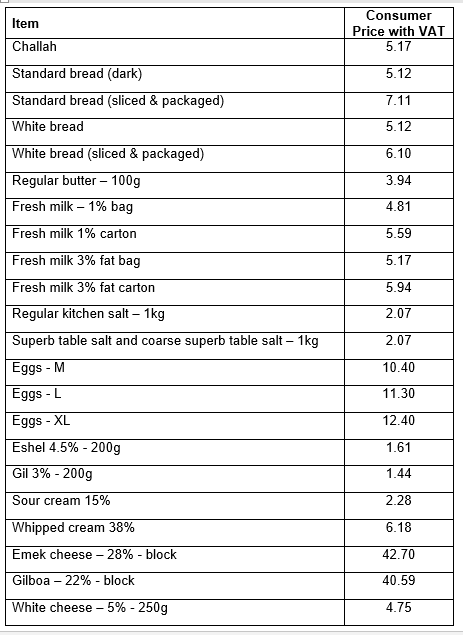
The price of certain basic food items in retail outlets, is controlled by the Israel Ministry of Economy & Industry; bread, milk, butter, salt, dairy products, eggs and cheese.  

If you are living on a tight budget or trying to economize, you might want to bear these prices in mind the next time you reach out for enriched milk which is 2NIS per liter more expensive than the controlled price of milk in a bag or when you reach out for ‘Symphonia’ cheese spread with olives at 11NIS per tub which is more than double the price of regular white cheese ‘Gvinah Levana’ at 4.75 per tub and into which you could slice 6 olives.

We are not suggesting that you stop buying your favorite foods, we are just pointing out the differences.

This information is correct as of June 2019 and is sourced from Israel Ministry of Economy and Labour. Prices in Eilat, where there is no VAT, are 17% cheaper than the prices listed here:

Haifa Festival of Festivals – Map

0

Reading Time: < 1 minute

Holiday of Holidays, Haifa – Festival Map

The annual Festival of Festivals, Holiday of Holidays or Chag HaChagim

חג החגים, חיפה מפת האתר

The Haifa Holiday of Holidays takes place along Ben Gurion Blvd in the German Colony and in the Wadi NisNas neighborhood of Haifa which is nestled between the Hadar neighborhood and downtown.  Rechov Allenby, Khoury, the lower half of Sderot Hazionut, Rechov Shabbtai Levi and Rechov HaWadi are also centers of activity.

Shown on the map below are also some places of interest you might want to visit while in Haifa.

Transport options to the festival

Just follow the crowds!

holiday of holidays map