16 C
Jerusalem
Sunday, April 19, 2026
Sample Page
Home Blog Page 82

Ben Gurion International Airport Train

0
Reading Time: < 1 minute

The Ben Gurion Airport train – important information for travelers.

Until further notice, the Ben Gurion Airport train will not be operational on weekends.

ben gurion airport train

The Ben Gurion Airport Train.  Travelers to and from Ben Gurion International Airport, please take note that every weekend, until further notice trains from 00h20 on the night between Thursday and Friday until Sunday at at 04h45 trains operating in both directions between Tel Aviv Savidor Central Station and Nahariya Station and will not arrive at Ben Gurion Station.

Consequently there will also be no train from Nahariya to Modiin- the last stop being Tel Aviv Savidor Central Station.

Please make alternative transport arrangements.

A free shuttle service between Tel Aviv Savidor Merkaz / Ben Gurion and Ben Gurion / Tel Aviv Savidor Merkaz is available.

Parshat Hashavua Korach

Reading Time: 3 minutes

Weekly Torah Portion – Parshat Hashavua Korach

Contributed by: Rabbi Nissim Mordechai Makor

Parshat Hashavua Korach rav makor 220x220

Parshat Hashavua Korach in a nutshell: Korach, Moses’ cousin, stages a rebellion against him, accusing Moses of a power grab. He and his entourage are swallowed up by the earth. The people protest, and a plague ensues.

Vayikach Korah. . . ” Numbers 16:1 “And Korach took. . . “

The Talmud explains that this verse teaches us that Korach took a bad “mekach” or acquisition for himself. What did he take and from whom did he take it? The Medrash Agadah explains that a wealthy person is called an “ashir” ( spelled ‘ayin shin yud resh’) to instruct us that money has the potential to cause a person harm. If one gives his money to charity and to other causes of olam haba which is known as “yesh” (yud shin) his money will not cause him harm because money can be harmful for a person if he wastes it on mundane selfish matters. Therefore the word ‘”ashir” which is glorious to its owner, contains a first and last letter that spells the word, “ra,” bad. The word “yesh” or charity breaks up the “ra” because the letters yud and shin comprise the middle letters of the word “ashir.”
When a person gives of his money to the necessities of “yesh,” on matters that will bring him to olam haba, he will not be harmed when he spends his money on material possessions. If money is selfishly horded and not spent on charitable and other worthwhile endeavors, it can become hurtful to its possessor, because the letters of “yesh” flee the “ashir” and what remains is “ra.”
Korach did not expend his money towards olam haba because he was a stingy miser. He therefore only actualized into “ra” because he never developed and exerted effort to bring out the “yesh” in his character. Thus, our Sages said that he took a bad “ra” portion for himself. Mishlei 28:22 states that “a miserly man runs after wealth; he does not realize that wealth will overtake it.” Since a miser does not give to charity he winds up lacking. By witholding charity the “yesh” is missing and the “ashir” is only left with “ra.”

Va’ani Tefillah

V’ha’osher v’ha’kavod milfanecha v’atah mosheil ba’kol.
Wealth and honor come from You. And You rule everything.
The Raavan explains the use of kavod, honor, in connection with osher, wealth. Indeed, there are those who gain wealth in an unscrupulous manner. This is certainly not b’kavodick, honorable. Osher v’kavod refers to wealth gained honorably. I think that the emphasis is on the “wealth and honor,” indicating that these are two very distinct attributes. This is unlike those whose honor is derived exclusively from their wealth. Perhaps they derive their wealth scrupulously, but this is all they have.
The Arizal had the custom to give tzedakah when he recited the words V’atah mosheil bakol, “And You rule everything.” V’yifgah Ba’makom explains that these pesukim detail the great contributions that David Hamelech and Klal Yisrael gave towards the building of the Bais Hamikdash. Those contributions exemplify the essence of lishmah, for its sake, charity given selflessly for no other reason other than to build the Bais Hamikdash. David knew that he would not see the finished edifice. What greater example of lishmah can there be? This is why it is an appropriate time to give tzedakah. In addition, the Ozrover Rebbe, zl, explains that when one declares, “And You rule everything,” he is intimating that the tzedakah he is giving actually belongs to Hashem, Who has “deposited” it with him, so that he can have the wherewithal to support the poor. He is just executing his function for Hashem.
As heard form my Torah Teachers
Shabbat Shalom
With Torah Blessings

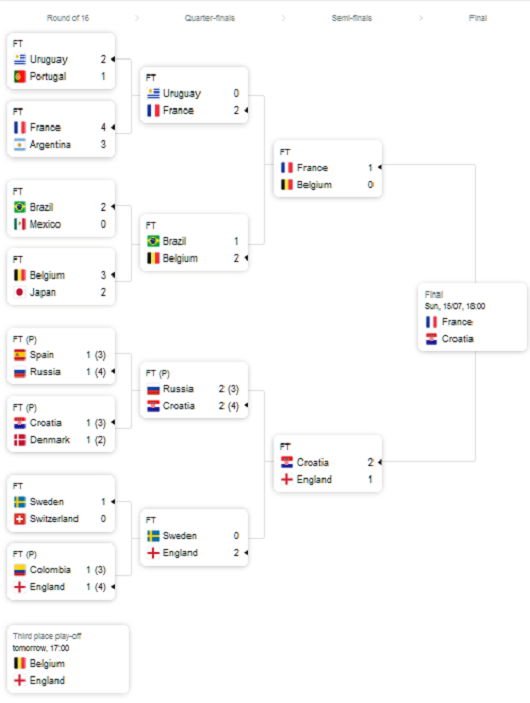
Mondial – Fifa World Cup 2018

0
Reading Time: < 1 minute

fifa logoFIFA World-Cup June/July 2018, game schedule, Israel television broadcasts & must know game terminology

WELCOME 2018 is the name of the World Cup app for Android and iOS but if you prefer to follow the games from the comfort of your living room, here is the official list of upcoming games and television broadcasts.

Games will be taking place across 11 cities in Russia; Moscow, St. Petersburg, Kazan, Sochi, Nizhny Novgorod, Samara, Rostov-on-Don, Ekatarinberg, Kaliningrad, Volgograd and Saransk.

Useful game terminology – English and Russian transliterations

  1. Scored a goal – zabil gol (or just goooool)
  2. Don’t bother me, the game is on – ne bespokoite menia, idet igra
  3. Bring me another beer please – prinesi mne yeshche pivo, pojaluista
  4. Wife to husband “I’ve had enough, I’m going shopping!” – s menia hvatit, ya idu po magazinam

TV Schedule

All games are to be broadcast on the open channels; channel 11, channel 33 and 4k digital

fifa world cup 2018


Hebrew Russian translations of useful documents

Favorite sporting activities for Anglos in Israel

Know who’s near. Locate English speaking, oleh-friendly professionals in your area

Parshat Hashavua Shlach

Reading Time: 4 minutes

Weekly Torah Portion – Parshat Hashavua Shlach

Contributed by: Rabbi Nissim Mordechai Makor

Parshat Hashavua Shelach rav makor 220x220

Parshat Hashavua Shelach in a nutshell; Moses sends twelve spies to the land of Canaan. Forty days later they return and report on a lush and bountiful land. But ten of the spies warn that the inhabitants of the land are giants and warriors “more powerful than we”; only Caleb and Joshua insist that the land can be conquered, as G‑d has commanded.

“The land is very, very good”

Yehoshua and Kalev rose to contradict the words of their comrades, insisting that the land does not “consume its inhabitants.”Its environment is good and it flows with milk and honey (see Ramban).What, however, did they mean in Parshat Hashavua Shelach when they said, “Tovah u ha’aretz me’od me’od” — “the land is very, very good”? A beautiful explanation appears in the commentary, “He’amek Davar” by the Nessiv zs”l of Volozhin, an approach to which he refers several times throughout his work on Chumash (Bereshit 1:31, 3:8; Bemidbar 32:11). Indeed, there is no land in the world like Eretz Yisrael! However, can the air quality compare with that of Switzerland, does it produce fruit like that of California, water like Turkey, oil like Kuwait, diamonds like the Congo, or gold like South Africa? How are we to understand the greatness of Eretz Yisrael?

We introduce the answer with another question: who receives greater enjoyment from a good meal — a millionaire or commoner?Undoubtedly, a regular person enjoys a big meal more, as he is not accustomed to luxury.Likewise, Israelis enjoy the air of Switzerland, while the Swiss themselves have grown accustomed to the clear air and do not realize this special quality of their country.We can now begin to understand the unique greatness of Eretz Yisrael.Some countries are blessed with an abundance of a given quality — water or sun, clear air or fruits.Others are lacking in every which way;they are dry, barren and poor.Our land is special in that it possesses everything but without one permanent quality.There are rainy winters and dry winters;difficult summers and easier summers;a bountiful produce and weak produce.We are therefore always aware of the blessings we receive and capable of appreciating them and thanking the Al-mighty.”The land is very good” — and we can then again appreciate the goodness: “very, very good.”

Why is this?First, in order that we express our gratitude to Hashem each time anew, just as we recite “sheheheyanu” when partaking of a new fruit.Secondly, the main reason, so that we constantly realize our dependence on the Creator.By His will the winter will be blessed with heavy rainfall, and by His will it will be dry.And it all depends on our conduct: “If you listen to My misvot. I will give the rain of your land in its time, and you will harvest your grain, your wine and your oil. Beware, lest your heart strays. He will withhold the heavens and there will be no rain, and the land will not give its yield.”We thus constantly lift our eyes to the heavens, working to improve our ways.

“The land is very, very good”

The Midrash cites Rabbi Yehoshua Ben Levi as comparing Benei Yisrael’s request of a scouting mission to a prince who, after his father made a match for him with a beautiful, wealthy girl from a distinguished family, asked to go see her.

The sacred Kabbalist Rav Haim Vital zs”l explained that this alludes to the three important qualities of Eress Yisrael. First, it is “beautiful” in its spirituality. It marks the “gate of the heavens” through which Am Yisrael’s tefilot ascend to the heavens and Hashem’s blessing descends from the heavens, as it says, “Hashem’s eyes are constantly on it.” It is also situated opposite the heavenly Bet Hamikdash, as it says, “to glorify the site of our Mikdash.” Secondly, Eretz Yisraels “wealthy” in material terms, as the pasuk says, “a land where you may eat food without stint, it lacks nothing therein.” It is therefore referred to as “a land flowing with milk and honey,” as demonstrated by the fruits brought by the scouts.

Finally, Eress Yisrael is “from a distinguished family.”Meaning, whoever earns the privilege of living there is called a sadik, as the pasuk says, “And your nation is all sadikim, they will always inherit the land.”This also alludes to the fact that the land’s “ancestors,” the sacred patriarchs, lived there and recognized its goodness and sanctity!

Ugly Picture

Most of us don’t like to lose our temper. Our egos always prefer to preside over a situation with cool control. Unfortunately, subduing the demon of anger is more easily said than done.

Our Sages suggest many different practical approaches to assist a person during a bout with temper. The Orchot Sadikim (chapter 12) suggests silence. When you start to boil, keep your mouth closed. Silence is to anger what water is to fire.

Orchot Tzadikim also advises that if you can’t keep the lid on, try speaking in a low tone. This should have a calming effect on you. The sefer also recommends that you avoid looking straight into the face of the person who is upsetting you, because this can increase your anger.

Another effective cure is to look in a mirror. Anger is ugly. You definitely look better with a smile on your face. When you are about to lose your temper, look in the mirror of your mind and kill the ire before it takes over your entire being.

The moments you spend using these techniques will save you hours of aggravation and add years to your life.

As heard from my Torah Teachers

Shabbat Shalom

New Carmelit in Haifa

Reading Time: < 1 minute

Hallelujah! The new Carmelit is on its way…

Following the closure of the Carmelit underground in Haifa, as a result of a large fire,  the first two coaches of the new Carmelit began their journey to Haifa on Friday morning. The coaches were loaded onto a ferry on the Rhine River in Switzerland where they will make their way to the port of Antwerp, Belgium.  The coaches are expected to arrive in Haifa on June 26, 2018 About a week later, an additional two additional coaches will join them. At the beginning of July, the coaches will be moved into the tunnel.  The Carmelit is expected to be operational in early September.

It has been reported that the cost of the new coaches is 50 million shekels.

The capacity of each train is 264 people (sitting and standing room) in each direction – a total of 528 passengers.

carmelit video

Parshat Hashavua Behaalotecha

Reading Time: 6 minutes

Weekly Torah Portion – Parshat Hashavua Behaalotecha

By: Rabbi Nissim Mordechai Makor

Parshat Hashavua Behaalotecha Rav Nissim Mordechai Makor

Parshat Hashavua Behaalotecha in a nutshell: The parashah tells of the Menorah in the Tabernacle, the consecration of the Levites, the Second Passover, how a cloud and fire led the Israelites, the silver trumpets, how the Israelites set out on their journeys, complaining by the Israelites, and how Miriam and Aaron questioned Moses.

Pure beaten gold

More than two hundred years ago, Rabbi Shimshon Vertheimer zs”l, died in Vienna, a wealthy banker who supported Torah and chesed projects. Shortly after his death, the holy Rabbi Hayyim from Sanz zs”l, told his Hasidim: Come and let me tell you what happened in the judgment of that noble Jew from Vienna. When he went up to Heaven, he was asked to give a full accounting. He said: “I had a set schedule every day. In the morning, I got up and went to prayer, I returned to my house for breakfast and then drank coffee and smoked while reading the newspapers. Someone in my position has to be up-to-date! I said birkat hamazon and then went to the bank until noon. At noon I came back home for lunch, and then said birkat hamazon and took a nap. When I got up, the Tzedaka collectors and representatives of yeshivot arrived. They spread out their requests and received my donations. Then I would go to the bet knesset for minha, a Torah class and then Arvit. After prayer, I would attend another Torah class and then return home for dinner and a game of chess, to relieve the tension of the day.

Finally, Shema and then to sleep. This was the schedule of my day. “The heavenly court heard and said: “Gan Eden!” Two white angels came to bring him to his place and then, his friend, another banker who had died on that same day, stood up for judgement. He was at first afraid and trembling from the awesome judgement, for he had not been a religious Jew, keeping the Torah and mitzvot. But when he heard his friend’s judgement, he calmed down. When he was asked to give an accounting, he said: my daily schedule was also set, very similar to my friend’s at least in three quarters of the day. I would get up from my sleep. I did not go to the bet Knesset, but I did eat breakfast and finish off with coffee and a cigar. I did not say Birkat hamazon, but I did go to the bank and returned for lunch. I did not bless after that either, but I did take an afternoon nap. I did not accept requests for donations instead I went to enjoy myself with my friends but I did return for dinner and after a game of chess I went to sleep. No Torah, No prayer, No chesed, No strengthening of Torah and the court decided: Gehinnom. The man jumped up and asked: Was the Gan Eden you granted my friend – for his prayer and learning and chesed alone?! They said to him: No, he received reward for all twenty-four hours of the day! The friend complained: But twenty of our hours were exactly the same, for both me and him. Why can I not receive reward for them?! They answered: Let us relate a parable. A merchant buys grain from a farmer, bags of grain and chaff and straw and even dirt and rocks. The farmer chooses to sell it like that and receives for that his price. But if a man will come and try to sell the chaff alone and to get half the price for that they will only make fun of him…Our case is similar: Just as there can be a partnership between “Yisachar and Zevulun,” one who learns Torah and the merchant who supports him and enables him to learn, so too can a man be “Yisachar and Zevulun” himself. He can work and earn his livelihood, in order to be able to live a Jewish lifestyle, to educate his children with a Jewish education, to learn Torah and participate in acts of hesed.

This man turns even his hours of work and even his hours of rest into “enablers” of mitzvot and receives the reward for them, too. Those hours enable him to pray with peace of mind and to learn the Torah, to educate his children and to run his house in the way of G-d. But work and rest alone, if they do not enable spirituality and mitzvot, do not bring about reward! This is a wonderful story, and its message is pointed and obligating. The message is already hinted to in the Torah, at the beginning of our parashah: “And this was the work of the menorah: it was of beaten gold, from its shaft to its flowers, it was beaten work. According to the pattern which G-d had shown Moshe, so he made the menorah.” The Hafetz Hayyim zs”l explained: The pure menorah is comparable to the Torah, “The Torah of light.” The pure oil is like the pure wisdom, the knobs and flowers are like the details of the laws and it is all like “the pattern which G-d had shown Moshe,” all was given to Moshe at Mt. Sinai. But there is an innovation: even its shaft, the base which holds it up, comparable to the livelihood which enables the learning of Torah it also of the same beaten gold. It is one unit with the menorah itself and is also pure gold. For it, the purpose is to be a base and a stand for the holy Torah and even for that, we receive the reward!

Those who lust for their desires

What can one say about a land surrounded by enemies, besieged, that opens its gates wide before its enemy with indifference, saying “It will be fine; We will overcome.”?! Man is also under siege, his evil inclination ambushes, waiting outside, as it says “At the doorway, sin crouches.” What is the judgment of a man who opens his gates for him, brings him into his house, his mind and his heart?! This was the sin of the “complainers”: they lusted for their desires. They wanted their evil inclination to incite them! “The wrath of G-d was very inflamed, and it was evil in the eyes of Moshe.”When we think about this, we will realize that we too are also steeped in the culture of “lusting for our desires.” Our culture incites us to rise up and to fall, to sin and to pollute, to impurify and to corrupt. The written, broadcast and televised communication details every hidden and open thread uses all its channels and plots to bring into the house, into the heart, the licentiousness and abominations, the corruption and the filth. Why should we open our doors to it? Why should we bring poison into our house with our own money, to poison the souls of our children? It is not enough to struggle with the evil inclination within us, that we must bring ourselves to more difficult and increase the power of the inclination to triumph?! Let us purify our houses and guard our fortresses!

A Step in the Right Direction

Rashi, quoting a Chazal, explains that the word “BEHAALOTCHA”, which has connotations of climbing, teaches us that there was a step leading up to the Menorah on which the Kohen would stand and prepare the lights. The question arises why this was necessary. The Menorah, after all, was only three Amos tall (the height of an average person minus his head), so that anyone other than a midget could reach the lamps with ease.

The Me’lo ho’Omer points out, however, that the Pasuk is talking about Aharon (see also the Ramban, who explains that it was probably Aharon who usually kindled the Menorah). And Aharon, in his capacity as Kohen Gadol, was forbidden to raise his hand higher than the Tzitz that he wore on his forehead. Consequently, without the step, kindling the Menorah would have been problematic.

With this, says the Gerer Rebbe, we can also understand why Rashi refers to ‘preparing the lights’, rather than kindling them. Kindling the lights (each evening), he says, is permitted to a Zar (a non-Kohen) in which case, Aharon would not necessarily have worn the Tzitz whilst performing the Mitzvah. Preparing the lights (each morning) on the other hand, was confined to Kohanim, and Aharon would have been forbidden to do it without wearing the eight garments of a Kohen Gadol.

Genuine Humility

“And the man Moshe was very much more humble than all other men” (12:3).

Some people, explains the K’sav Sofer, put on a show of humility purely so that others should praise them for their modesty. The moment, however, that people see through their disguise and begin to accuse them of vanity, they drop their pretense, which no longer serves any purpose. Not so the person who is genuinely humble. He behaves humbly because he considers himself small, and remains unperturbed by the talk of others.

Moshe heard Aharon and Miriam talk about him, accusing him of unprecedented pride (in considering himself superior to themselves and to others). Yet the Torah testifies that even after that, Moshe continued to be the most humble of all men. Incidentally, the Torah here refers to Moshe as the ”Ish”, and at the same time, describes him as more humble than any other “Adam”. Moshe was truly an ‘Ish’ (defining a spiritually superior man), yet he was more humble, not only than ‘Anashim’ like himself but even than all ‘B’nei Adam’ (a title which usually describes the ordinary man in the street). It is one thing for a great man to be more humble than other great men, and for an ordinary man to be more humble than other ordinary men. It is quite something else for the greatest of men to be more humble than the ordinary man in the street. That is indeed the highest form of humility.

As heard from my Torah Teachers

Shabbat Shalom

Safety guidelines for rocket and missile fire over Israel.

Reading Time: 2 minutes

Pikud Haoref safety guidelines for rocket and missile fire.

Alerts, secure areas and preparing your family and home.

home front command app min
Image credit: Screenshot Home Front Command App

The Home-Front Command (Pikud HaOref) is the national authority for  civil protection.  They oversee the safety of the public during emergency situations like rocket and missile threats, wars, terror threats, natural disasters and dealing with dangerous substances.

In general, The Home Front Command’s guidelines, to ensure your personal safety during rocket and missile fire, suggest the following:

  1. Know how much time you need to get into a safe and secure area (bomb shelter, safe-room etc.)
  2. Choose your secure area according to the timetable provided by the Home Front Command
  3. Prepare and equip your secure area.
  4. Sign up for location alerts.  The Home Front Command app, available in 4 languages, provides real-time life-saving alerts, instructions and information.  Set your location and  get an alert on the App.


Prepare shelters & secure areas

After a long time of disuse,  now is the time to clear away the junk  that might have accumulated in your nearest bomb shelter and prepare these secure areas in case of an emergency

  1. Clear the Ma’mad – the secure room in your apartment (built in accordance with national building codes and regulations).  Older apartments do not have them.
  2. Ma’mak – If your apartment does not have a ma’amad and it takes too long to get to the bomb shelter upon hearing the siren, prepare the ma’mak with your house committee (vad habayit) – a secure room in your building (on each or every other floor)
  3. Miklat – a bomb shelter (shared by the tenants in your building or a public shelter). The shared bomb shelter in your building should be easily accessible within the recommended amount of time, via an internal stairwell.
  4. A public shelter should only be used if you can get to it within the recommended amount of time upon hearing the siren.
  5. If you are outside and cannot reach a shelter, the Home Front Command recommends that you lie on your stomach, face to the ground and your hands protecting your head

Alternative secure areas

If you cannot access any of the above secure areas, the Home Front Command advises that you seek shelter in a stairwell. Use your discretion here; there may be better options than this if the stairwell faces an external wall.

Choose an internal room in your dwelling with minimum external walls, windows, or other openings. Do not choose the kitchen, bathroom, or WC – lots of glass, sharp edges, loose tiles, and other dangerous flying objects.

Residents of the Gaza Envelope residents of communities who have only 15 – 30 seconds to reach a secure area choose an area in their home furthest from the source of attack.

Remember – Do not use elevators during an emergency!

Ezer Mizion – Israel’s Bone Marrow Registry

Reading Time: 3 minutes

Ezer Mizion – The bone marrow registry

You can help save a life!

ezer mizion

Established in 1979, Ezer Mizion is Israel’s largest non-profit organization providing medical and social support services. It provides a diverse range of services to positively impact the lives of the sick, disabled, elderly, and underprivileged within the State of Israel including cancer support services, medical referrals, medical equipment loan, mental health services, food distribution, support and empowerment for children with special needs, and the elderly and their families/caregivers. What originally got started as a small project today serves more than 670,000 individuals annually across Israel.

Ezer Mizion was founded by Chananya Chollak who was inspired from his own personal family experience. In addition to his own family’s struggles, he took notice of the toll that illnesses were having both emotionally and financially on other Jewish families and it was that empathy upon which the foundation of Ezer Mizion was established.

In 1996, Moshe Schayek, a young man desperate for a bone marrow transplant, turned to Ezer Mizion for assistance in finding a matching donor. Ezer Mizion’s Cancer Support Division helped his family coordinate a bone marrow drive, but no match was found among the 5,000 people who participated in the drive. Sadly, the young man died, but he left a legacy that has enabled dozens of other sick Jews to live. This led to the establishment of Ezer Mizion’s International Bone Marrow Donor Registry.

In 1998, Ezer Mizion expanded its services to include a bone marrow registry, which currently includes 885,264 active members, more than half of whom joined as Israel Defense Forces (IDF) recruits. A key differentiator for Ezer Mizion is its exclusive partnership with the IDF which was initiated and facilitated by Moti and Dr. Bracha Zisser in 2005.

Since its inception, Dr. Zisser has served as the Director of Ezer Mizion’s bone marrow registry and cancer support services. Through this partnership, IDF allows Ezer Mizion to obtain swab samples from new inductees for inclusion in the bone marrow registry.

The specific advantage of having IDF recruits as registry members is the registry expansion at each recruitment cycle which constantly brings new healthy, young potential donors from a broad ethnic spectrum.

Young people are ideal donor candidates as they can remain in the registry for a long time and are preferred by medical teams for their higher success rate when it comes to transplants. To date, nearly 12,000 complete donor-patient matches have been made and nearly 3,000 transplants have been facilitated directly through the Ezer Mizion bone marrow registry.

Today, the registry has evolved to become the organization’s major global initiative and the largest Jewish Bone Marrow Registry in the world. Each year, the registry handles thousands of search requests from dozens of transplant centers based around 48 countries.

In connection with all the impactful accomplishments of the organization, Ezer Mizion has been invited as a highlighted guest at this year’s American Israel Public Affairs Committee’s (AIPAC) Annual Policy Conference in Washington, D.C. Here, the organization unveiled its latest campaign, #SharedLife, with which it aims to spread the word about the importance of the Jewish bone marrow registry and help patients from communities worldwide.

The idea of #SharedLife can only be achieved through the coordination of three critical partners: the generous stem cell donors, the benevolent financial supporters, that provide the necessary funding for testings and tissue typing, and Ezer Mizion’s team.

To learn more, get involved, or donate, please visit: sharedlife.ezermizion.org

Did you know?

Bone marrow contains stem cells, the cells that produce blood. A bone marrow transplant from a healthy donor can enable a person with diseased bone marrow to begin producing blood cells.  Bone marrow transplants are used as therapy for about 100 different illnesses, including leukemia, Hodgkin’s disease, diseases of the blood, and enzyme deficiencies. These diseases destroy bone marrow, which contains the stem cells responsible for manufacturing blood cells. Chemotherapy and radiation, the most common methods of destroying cancerous cells, also destroy healthy bone marrow cells.

Chances for a match increase significantly if the patient and potential donor share the same ethnic background. Because Jews in the past lived in isolated communities, they are today more genetically related to each other than to non-Jews.

This registry was established to increase the pool of Jewish potential donors. Israel is home to an entire spectrum of Jewish communities and ethnic backgrounds and is therefore the natural location for a Jewish bone marrow registry

Parashat Hashavua Naso

Reading Time: 8 minutes

Weekly Torah Portion – Parashat Hashavua Naso

Contributed: Rabbi Nissim Mordechai Makor

Rav Nissim Mordechai Makor

This week’s reading,  Parashat Naso, is the longest single portion in the Torah, containing 176 verses.

The man shall bring his wife to the Kohen. (5:15)

Rashi notes that the Torah presents the laws of sotah, whereby the man is compelled to bring his wayward wife to the Kohen, following the laws of Matnos Kehunah, gifts to the Kohen. This teaches us that one who refrains from giving the Kohen his due, will end up coming to him with his wife. To quote the words of the Midrash, “A door which is not open for charity is open for the doctor.” One close student of Horav Elazar M. Shach, z”l brought him five thousand dollars to be dispersed for charity. When Rav Shach queried him concerning the source of the funds, the man related the following story.

A certain talmid chacham, Torah scholar, was to undergo a surgical procedure. The surgeon’s fee was five-thousand dollars. One of the friends of the talmid chacham was able to appeal to the Kupas Cholim, an organization for the sick and needy, to underwrite the surgery. After the procedure, the talmid chacham gave his friend one hundred dollars to give to Rav Shach for the benefit of charity. After about an hour, he returned with another forty nine hundred dollars, explaining, “When I came home and related to my wife that I was giving one hundred dollars to charity, she felt I was wrong. In truth, I had saved five-thousand dollars. Therefore, I should contribute the entire amount of the surgery to tzedakah.”

When Rav Shach heard this, he said, “Please invite this couple to my home. If this is the way they act, I would like to bless them.”

The Kohen shall inscribe these curses on a scroll and erase it into the bitter waters. (5:23)

Ordinarily, the Torah prohibits us from erasing Hashem’s Name. In this circumstance, in order to promote marital harmony, Hashem allows His name to be erased. Interestingly, much of the discord that is manifest in a marriage originates in foolishness. The following story, which occurred with Horav Elazar Menachem M. Schach,zl, is anecdotal and certainly not the standard. Nonetheless, it demonstrates how far some people will go to propagate nonsense. Once, a young married student approached Horav Moshe Aharon Stern,zl, regarding a marital problem. Rav Stern was a man who was not only a great talmid chacham, Torah scholar, and tzaddik, he was also known for his unique ability to reconcile discord between husband and wife. The young man complained that he had not had a moment’s peace since he had gotten married. Every night he would study practical halachah in the Mishnah Berurah. His wife, however, did not agree with this practice, claiming that this is not what she had expected when she married him. She had sought a yeshivah student who devoted himself totally to lomdus, in-depth analysis, of the Talmud and its commentaries.

The young man explained that since he spent an entire day engrossed in such study, he wanted to delve in halacha l’maaseh, practical law, at night. Unfortunately, this dispute was destroying the very foundation of their marriage.

Thinking that he had “heard it all,” Rav Stern naively assumed that a simple conversation with the young woman would solve the problem. Therefore, he went to the young couple’s house and endeavored to explain to the woman the significance of practical halachah. The young woman listened patiently and respectfully, but was unmoved by the Rav’s words. “Rebbe, it might all be true, but this is not what I expected of him. I sought a lamdin, not a posek!” Her ideal was not in halachic arbitering; it was in in-depth analysis. Rav Stern left the home in a deep quandary. How could he help this couple?

A short time afterward, Rav Stern was speaking with Rav Shach and shared this troubling incident with the venerable sage. Rav Shach told him to send the young woman to him, asking, if possible, for Rav Stern to join them. Rav Stern immediately notified the young woman that Rav Shach wanted to see her. She was, of course, flustered and nervous, but one cannot say no to the gadol hador, preeminent leader of the generation.

They went to Rav Shach’s home and were immediately ushered into his private study. Although the anteroom was filled with many people seeking an audience with the Rosh Hayeshivah, this young lady took precedence. As the two entered the study, Rav Shach dispatched his attendant to bring in refreshments, specifying that the serving plate should have two types of pastry on it. When the cake was brought in, Rav Shach directed the young woman to eat from the first piece. He then told her to eat from the second slice of cake. The young woman was a bit taken aback by this strange request, but respectfully complied.

As she finished the second piece of cake, Rav Shach asked her to tell him the difference between the two slices. As she stared back incredulously, Rav Shach explained, “I assume you know how to bake, so I want you to tell me the ingredients that comprise each piece of cake.” Very timidly, she responded, “It seems to me that the piece on the left has a bit more cocoa, while the piece on the right has more sugar than its counterpart.” “Very good,” Rav Shach said, “Please continue. What other differences do you notice between these pieces?” The discussion continued about baking and the various techniques for making delicious pastry, with the young woman demonstrating a broad knowledge of the subject. Rav Shach finally concluded the conversation, saying to the young woman, “I see that you have expert knowledge of baking. I suggest that you return home and direct all of your attention to cooking and baking – and leave the decisions regarding your husband’s learning to him.” It did not take long for the Rosh Hayeshivah’s words to penetrate her mind. She covered her face as she suddenly sensed the truth behind his words. From that time onward, the couple’s relationship changed drastically, as respect, peace and harmony began to reign in their home.

I am sure that Rav Shach’s response to the young woman might “rattle” a few people – both men and women. When you think about it, however, he dealt with the issue in a most brilliant manner. His practical approach to their differences was the catalyst for resolving them.

This is the law of the Nazir on the day of the completion of his vow. (6:13)

At the conclusion of the Nazir’s term he brings a sacrifice. The reason for this korban is enigmatic. Usually a sacrifice of this sort is a sin-offering, but how did the Nazir sin? One would think that at the completion of such a mitzvah, whereby the Nazir dedicates himself to Hashem on such a lofty spiritual plateau, that a Korban Chatas, sin-offering, would certainly not be necessary. Rabbeinu Bachya explains that since it appears that the Nazir is distancing himself from Hashem, he must bring a korban. Actually, he is only returning to his original state, but perception is what counts. If people might perceive him as faltering in his spiritual progression, he is to offer a korban as penance. Apparently, appearances are significant in regard to spiritual matters.

Horav A. Henach Leibowitz, Shlita, maintains that although our actions may very well be within the parameters of halachah, the mere appearance of impropriety is in itself a sin. Indeed, everything we do, regardless of its nature, has an impact on us. Because of our position as Klal Yisrael, we have a certain status to uphold, a specific standard to which to adhere. The way we eat, speak, or dress must be consistent to standards for an individual who is a member of Klal Yisrael. If it even seems that we are acting inappropriately, then we have sinned.

We may add that this is especially true in regard to parents and their relationship vis` a `vis their children. At times, we act in a manner that might fit into our “comfort zone” of respectability. Our children do not always realize this, however, and will either derive the wrong message from our actions or lose respect for us. Unknowingly, we continue along our merry way, blatantly disregarding what might be misconstrued by those nearest and dearest to us. Parents must bear in mind that they are constantly on the public stage with their children serving as the captive audience. We should seek their applause, not criticism.

The Princes of Yisrael brought offerings…they were those who stood over the counted. (7:2)

The Nesiim, Princes, each offered sacrifices in honor of the inauguration of the Mizbayach. They each brought an identical offering. Yet, the Torah records each one’s offering, emphasizing the individuality of each. The Ramban adds that each Nasi maintained a different kavanah, intention, in his offering. Hence, the Torah records each Nasi’s korban separately, to underscore his individual thoughts. Horav Simcha Zissel Broide, zl, derives from here that two actions, albeit identical, which are the result of two different machshavos, thoughts/intentions, are considered two distinct actions. In other words, since the Nesiim each had different intentions, the korbanos are viewed as being distinct from any other. It is all in the mind. Every individual thinks in his own unique manner. Even if the result of two individual’s way of thinking coincides, their thoughts are not analogous, thus creating two different representations of thought. This is to be noted from a statement made by Chazal in Zevachim 7a. According to Rav Chisda, if one slaughters a Korban Todah, thanks-offering, in the name of his fellow’s Korban Todah, it is deemed invalid, because it falls under the rule of Shinui Kodesh, transferred holiness. Although both animals were holy and destined to be slaughtered as a Korban Todah, my Korban Todah is not my friend’s Korban Todah and vice versa. Each person possesses his own individual faculties which creates a distinction in actions. Hence, it is as if he slaughtered the animal for a completely different korban.

We should add that this type of individuality should be respected in all people. A mechanech, educator, is mandated to recognize each student’s individuality and uniqueness: “Chanoch l’naar al pi darko,” “Raise a child according to his way” (Mishlei 22:6). Shlomo HaMelech teaches us the most important maxim in education: every child must be raised and taught as an individual. The overall objective is the same: the child should grow up to be a G-d-fearing observant Jew whose actions will be pleasing to his Maker and to the society in which he lives. The practical method by which we are to guide each individual to reach the intended goal, is not the same. There are varied proclivities and temperaments, as well as intellectual and emotional potential that must be considered. Each student, or siblings in a family, must be guided commensurate with his own unique qualities. Only then can we hope to achieve success in this noble endeavor.

And the Kohen shall take from the earth that is on the floor of the Mishkan. (5:17)

The leader of Klal Yisrael, regardless of his eminent stature, should be able and prepared to learn from everyone – regardless of his simple or lowly position. The Kohen takes from the “dirt” of the Sanctuary. Its obscure and humble origins notwithstanding, it is the lesson that counts.

~~~~~~~~~~~~~~~~~

From wine and hard drink he shall abstain. (6:3)

Horav Sholom, z’l, m’Belz says that a drunk is worse that a sinner. The drunk, looking through his stupor, sees the entire world as straight. He sees nothing wrong. He will, therefore, never repent. We may add that this applies equally to those who have intoxicated themselves with life’s materialism. They can no longer see things in their true perspective.

To his father or his mother…he should not make himself impure. (6:7)

The Sochatshover Rav, z’l, explains why a Kohen may be metameh, defile himself to his relatives, while a Nazir may not. The Kohen receives his sanctity as a result of his family lineage. He owes them. The Nazir reached this pinnacle on his own accord. He owes nothing to anyone. Likewise, the Kohen Gadol is not metameh to relatives, since his position is achieved by his own accord.

As heard from my Torah Masters

Wishing everyone a Shabbat Shalom