18.7 C
Jerusalem
Saturday, June 13, 2026
Sample Page
Home Blog Page 122

The Workday in Israel – Working Hours & Overtime.

0
Reading Time: 2 minutes

Israel’s Workday & Working Hours

Hebrew:  שעות עבודה בישראל

workday in israelThe Israel Labor Law

The  Israel Labor Law provides for a 43 hour work week.  This can be divided up into 2 categories:

  1. A 5 day work week – workers who work 5 days a week, work 9 hours per day.
  2. A 6 day work week – workers who work 6 days a week, work 8 hours per day.

It should be noted that some work agreements stipulate a 45 hour work week.

Actual Working Hours

Some factories operate from 7:00 a.m. until 9:00 p.m. – broken down into shifts

These days most offices start work anywhere between 7:30 a.m. and 8:30 a.m.

Mostly shopping centers open their doors at 10:00 am and are open all day until 9:00 or 10:00 p.m. – broken down into shifts.

Some small, privately owned shops and establishments (not in malls) close between 2:00 p.m. and 4:00 p.m.  They then remain open until 7:00 p.m.

Banks have their own hours, all work in the morning.  You may be required to work afternoon shifts as well.

If you are in the public sector, you could finish as early as 3:00 p.m. or 4:00 p.m.

Emergency services; hospitals, fire, police and ambulance services work 24/7 broken down into shifts.

The building trade: on-site laborers generally work from 7:00 a.m. to 3:00 p.m.

Self-employed tradesmen can choose their own hours, but are generally available between 7:00 a.m. and 7:00 p.m.

Real flexi-time is not common in Israel however your employer may be slightly flexible with your starting and ending times.

Many hi-tech industries dealing with the American of Eastern markets require their employees to start work later in the day – around 11:00 a.m.  Companies dealing with forex and financial markets often require their employees to work shifts which may start at 8:00 a.m. and end as late as midnight.

Lunch & Tea Breaks

According to the law an employee is entitled to a 45 minute break during a work day of at least 6 hours.  Your employee may break this down into a 10 minute morning coffee break, a 25 minute lunch break and another 10 minute afternoon coffee break.  Bear in mind that in some industries competition is rife and employees may choose to work through their lunch break.  Before you sign your employment contract you need to clarify your working hours.

Clocking your Working Hours

Your employee may require you to clock-in and clock-out every day.  You may be lucky and your employee may offer a small monthly bonus for adhering to strict working hours.  This is not common however.

If you do not have a clock-in, clock-out system, be sure to keep an accurate time sheet of regular and overtime hours worked


Overtime Hours

Overtime hours are dealt with in detail here

Saving with a Keren Hishtalmut

0
Reading Time: 2 minutes

Keren hishtalmut – A tax-free savings plan

Hebrew: קרן השתלמות

piggbank

What is a Keren Hishtalmut?

A Keren Hishtalmut is a short term tax free saving plan available in Israel.

How does it work?

Both employer and employee contribute to the savings plan. The fund accumulates for 6 years.  At the end of the 6th year you are able to withdraw the money from the fund without paying Capital Gains Tax.  If you make a withdrawal prior to the end of 6th year, you are liable for tax penalties.

Do I qualify for a Keren Hishtalmut?

  1. The Keren Hishtalmut was originally made available for government employees, academics, teachers etc., who are likely to take a sabbatical year.  So you contribute for 6 years and withdraw for use in the 7th or Sabbatical year.
  2. Regular salaried employees, depending on the terms of their employment contract, may also contribute to this savings plan.  The employer also makes a contribution.  For the employer, his portion/contribution is tax deductible.
  3. An employee who have a significant financial interest in the company is can also have a Keren Hishtalmut.  Rules, regulations and tax benefits for this type of employee differ slightly to those for regular salaried employees.
  4. Business Owners – Self Employed: A self-employed – Atzmai – in Israel can also have a Keren Hishtalmut which affords them certain tax benefits.

Our Tip

Their are various contribution levels depending on your status – take the advice of a tax consultant, accountant or investment advisor before you sign up for a Keren Hishtalmut.

Employment Resources to help you land that perfect job

Vocabulaire des services bancaires en Israël – Banking

Reading Time: 3 minutes

Cette information fut rendue possible grâce au don généreux d’un bienfaiteur anonyme.Cette information fut rendue possible grâce au don généreux d’un bienfaiteur anonyme.

Vocabulaire des services bancaires en Israël

Français – TranslitérationHébreu


Français

Translitération

Hebrew

 A

Actions / Titres


Niyarot Erech


 ניירות ערך

Agence bancaire

Snif

סניף

 Argent

Kesef

 כסף

Autorisation

Ishur

אישור

Autorisé

Mursha

מורשה

 Avantages fiscaux

Hatavot Mas

 הטבות מס

B


Banquier

Banka’i

בנקאי

Bénéficiaire

Hamotav

המוטב

 Bénéficiaire

Hamotav

 המוטב

Billet de banque

Shtar Kesef

שטר כסף

 Blanchiment d’argent

Halvanat Hon

 הלבנת הון

C


 Calculer

Lehashev

לחשב

 Carte de crédit

Kartis Ashrai

 כרטיס אשראי

 Carte de credit internationale

Kartis Ashrai Bein Leumi

 כרטיס אשראי בין לאומי

 Chèque

Tzek

צ’ק

 Chèque guaranti

Tzek banka’i

צ’ק בנקאי

 Chéquier

Pinkas Tzekim

פנקס צ’קים

 Client

Lakoach

לקוח


 Compte bancaire

Heshbon Bank

חשבון בנק

 Compte client

Heshbon Prati

 חשבון פרטי

 Compte commun

Heshbon MeShutaf

 חשבון משותף

 Compte courant

Heshbon Over VeShav (abbr: Osh)

חֶשְׁבּוֹן עוֹבֵר וָשָׁב

 Compte d’affaires/d’entreprise

Heshbon Iski

חשבון עסקי

 Compte épargne

Heshbon Hisachon

 חיסכון

 Conseil en investissement

Ye’otz Hashkaot

 ייעוץ השקעות

 Conseiller bancaire

Minahel HaBank

מנהל הבנק

 Conseiller en investissement

Yo’etz Hashkaot

 יועץ השקעות

 Conseils financiers

Ye’utz finansi

 ייעוץ פיננסי

 Contrefaçon

Ziyuf

 זיוף

 Contrôle de sécurité

Tzek Bitachon

 צ’ק ביטחון

 Crédit

Ashrai

 אשראי

 Crédit d’impôt

Zichui Mas

 זיכוי מס

D


 D’échéance

Ta’arich Pira’on

 תאריך פירעון

 De facturation

Ta’arich Hiyuv

תאריך חיוב

 Débit

Hiyuv

 חיוב

 Débiter

Chayev

 חיב

 Découvert

Meshichat Yeter (common: overdraft /minus)

משיכת יתר (אוברדרפט/מינוס

 Déductible d’impôt

Mokeret LeMas

 מוכרת למס

 Déduction fiscale

Nikoy Mas

 ניכוי מס

 Dépôt

Lehafkid

 להפקיד

 Détournement de fonds

Gnivat Kesafim

 גניבת מס

 Devises étrangères

Matbaya Hutz (abbr: Matach)

 מַטְבֵּעַ חוּץ  – מט”ח

 Dollars

Dolarim

 דולרים

E


 Économies

Hischonot

 חסכונות

 Économiser

Lachsoch Kesef

לחסוך כסף

 Elai d’encaissement

Siluk

סילוק

 Employé de banque

Pekid/a

פקידה

 En faillite

Poshet Regel

פושט רגל

 Encaisser un chèque

Tzek atzmi

צ’ק עצמי

 Espèces

Mezuman

מזומן

 Euro

Euro

 אֵירוֹ

 Exempt d’impôt

Petor Mas

 פטור מס

F


 Fonds

Keren

 קרן

 Fonds commun

Keren Neemanut

 קרן נאמנות

 Fonds d’investissement

Keren Gidur

 קרן גידור

 Fonds de pension

Keren Pensiya

 קרן פנסיה

 Fonds de prévoyance

Kupat Gemmel

 קופת גמל

 Fonds fiduciaire/Trust fund

Keren Neemanut

 קרן נאמנות

 Fonds monétaire international (FMI)

Keren Hamatbeya HaBein Leumi

 קרן המטבע הבינלאומית

 Frais bancaires

Amalot

עמלות

G


 Garant

Arav

 ערב

 Garantie

Bitchonot

ביטחונות

 Gestion de compte

Nihul Heshbon

ניהול חשבון

 Guichet automatique

Kaspomat

כספומט

H


 Hypothèque

Mashkanta

 משכנתא

I


 Imposable

Huyav BeMas

חויב במס

 Impôt

Mas

 מס

 Indemnité

Pitzuim

פיצוים

 Indice de taux d’intérêt

Madad

 מדד

 Indice des prix à la consommation

Madad LeTzarchan

מדד לצרכן

 Intérêt couru

Rebit Mitztaber

רבית מצתבר

 Intérêts

Rebit

 רבית

 Intérêts à taux fixe

Rebit Kevuah

 רבית קבוע

 Intérêts à taux variable

Rebit Mishtaneh

 רבית מִשְׁתַּנֶּה

 Investisseurs

Mashka’im

 משקיעים

J


Jour ouvré

Yom Avoda

יום עבודה

L


 La banque à domicile

Bankaut Beiti

 בנקאות ביתי

 Libre-service

Sheroot Atzmi

 שירות עצמי

 Limite de crédit

Misgeret Ashrai

מסגרת אשראי

 Livres Sterling

Lira Sterling

לירה שטרלינג, 

M


 Marché boursier

Bursa

 בורסה

 Marché financier

Shuk HaHon

שוק ההון

 Mineur

Katin

קטין

 Modification

Tikun

שִׁנּוּי, תִּקּוּן

 Monant forfaitaire

Schum Kollel

 סכום כולל

 Montant

Schum

סכום

N


 Négociation

Masa o’matan

 מסע ומתן

 Non résident

Toshav Hutz

 תושב חוץ

 Numéro d’identification personnel

Kod Sodi

 קוד סודי

P


 Paiement de facture

Tashloom Heshbonot

תשלום חשבונית

 Paiement différé

Tashloom Dachoy

 תשלום דחוי

 Paiement minimum

Tashloom Minimali

 תשלום מינימלי

 Perte

Hefsed

 הפסד

 Pièce

Matbeya

מטבע

 Plan d’épargne cadres supérieurs

Bituach Minhalim

 ביטוח מנהלים

 Plan d’épargne étudiant

Keren Hishtalmut

 קרן השתלמות

 Politiue

Polisa

 פוליסה

 Prélèvement mensuel

Horaot Keva

 הוראות קבע

 Prêt

Halva’a

 הלוואה

 Procuration

Yipoi Ko’ach

 יפוי כח

 Profit

Revach

 רווח

R


 Rands sud-africains

Rand Drom Afrika’i

 ראנד דרום אפריקאי

 Rapports

Divuach

 דיווח

 Récession

Mitoon

 מיתון

 Référence de la transaction

Esmachta

 אסמכתא

 Règlementation des banques

Takanon HaBank

תקנון

 Relevé bancaire

Daf Heshbon

דף חשבון

 Remboursement

Hechzer

 החזר

 Retirer de l’argent

Limshoch kesef

 למשוך כסף

S


 Services bancaires

Banka’ut

בנקאות

 Services bancaires privés

Banka’ut Pratit

 בנקאות פרטית

 Shekels

Shekalim

 שקלים

 Signature

Chatima

 חתימה

 Solde bancaire

Yitra BeHeshbon

יתרה בחשבון

 Solde créditeur

Yitrat Zchut

 יתרת זכות

 Solde minimum

Yitra Minimum

 יתרת מינימום

 Solvabilité

Dirug Ashrai

 דירוג אשראי

 Sommaire

Rikuz

 ריכוז

 Suivi

Ma’akav

 מעקב

T


 Taux d’escompte

Rebit Banka’i

רבית בנקאי

 Taux de change

Shaar Yetzig

 שער יציג

 Taux préférentiel

Rebit Prime

 רבית פריים

 Total

Sach HaKol

 סך הכל

V


 Virement

Haavara

 העברה

 Virement bancaire

Haavara Banka’i

העברה בנקאי


Israel Employment: Monthly Salary Slip – Tlush Maskoret

0
Reading Time: 2 minutes

Understanding your salary slip – the pay stub

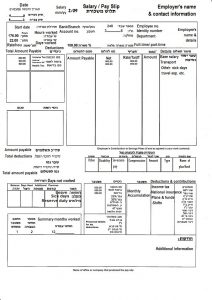
israeli payslip salary slip

Congratulations!  You’ve aced the job interview and now, after a long job search, you are finally starting to work in Israel.

There is still a lot to learn in the future; there is form 101 which needs to be filled in on your first day, overtime hours in Israel, maternity benefits, sick leave, unemployment etc.  But for now you are on the payroll and anxiously awaiting your first paycheck.  According to Israeli labor laws, your employer has up until the 10th of the month to pay you. 

Finally payday arrives and you are presented with a Hebrew salary slip or ‘tlush maskoret’ – תלוש משכורת.

What information is included in the salary statement?

While there is no one standard format for your salary statement, according to law however, every statement needs to include the following information:

Your basic information; full name, identity number (teudat zehut), marital status, details of your bank account, if you are a full-time or part-time worker and your salary level.

Employer’s details; employer name and address, their tax registration number and their Bituach Leumi (National Insurance) file number.

Salary information; your base salary (bruto), all allowances and deductions and your net salary (netto)

Must I keep my pay slip?

Yes, your pay slip is a very important document and you need to file and keep it even though your employer has it on record.

Your pay slip is proof of your income and there are certain situations where you may need to reference the slip:-

  • In case of dispute
  • To get unemployment benefits
  • You may also be asked to prove your salary when applying for certain reductions like school fees.

At the end of the year, which is also the end of the financial year in Israel, your employer will issue the Tax Form 106.  Form 106 is a summary document reflecting your total salary for the current fiscal year as well as all income tax and National Insurance deductions (bituach leumi).

You must keep Tax Form 106 – you will need it when applying for tax refunds or reductions.

Hebrew English  Salary Stub Translation

To make your Aliyah easier, we have translated a typical salary slip from Hebrew to English.


Facture de téléphone.

0
Reading Time: < 1 minute

Facture de téléphone

Traduction de l’hébreu vers anglais

Cette information fut rendue possible grâce au don généreux d’un bienfaiteur anonyme.Cette information fut rendue possible grâce au don généreux d’un bienfaiteur anonyme.

Ressources et informations complémentaires…>>

Best Ways to Save Water in Israel

0

Reading Time: 3 minutes

What are you doing to save water? Ten easy to implement water saving tips for the Israeli household.

Hebrew: עצות שימושיות לחיסכון במים

By: Tony’s Plumbing

save water israel

Hopefully this winter will good rains and the water level of the Kinneret will remain above the upper red line. Even if rain is plentiful, it’s important to create water consumption awareness and save water wherever we can.

Israel’s water shortage is not new and one of the results of this has been the invention of water saving systems now in use all over the world – drip irrigation is just one example.

Join us, let’s all do our bit to save every precious drop.  Let’s teach our children good water saving habits. A few minor changes can save huge quantities of water and cut your water bill too.

tony new logo

10 easy solutions

  1. Don’t keep taps open and running unnecessarily; close the tap while soaping the dishes and then run the water for rinsing. Turn the water off while you soap yourself in the shower or while brushing your teeth.   You’ll be surprised at how much water you will save by closing taps this way. It’s estimated that every time you wash the dishes with the water running you use 50 liters of water.  In comparison a dishwasher use 16 liters only.
  2. It’s tempting to turn the dishwasher on at the end of the day even if it is not completely full.  Only run a cycle when the dishwasher if full and use the economy cycle wherever possible.
  3. The same goes for the washing machine – run a cycle only when the machine is full.
  4. Install a double flush system on your toilet; full-flush and half-flush.  Older toilets that are not fitted with a double flush, use 9 liters of water every time.  Newer toilets are designed to use 6 liters per flush or 3 liters when the half-flush is used.  A family of four can save as much as 100 liters per day just by using the half-flush.
  5. Check toilets for leaks.  Slow leaks may not seem like a  big deal but they still cause plenty of wastage.  Places to check: the base of the toilet, the main outlet pipe and the water cistern. Do your bit and get them fixed as soon as possible.
  6. Check the plumbing in your home (and garden).   Close all the taps and then check your water meter – if there is a water leak, your water meter will continue to spin.
  7. Check the taps under the bathroom basin and under the kitchen sink.  You probably don’t realize how much water gets wasted by leaking taps.  Place a bucket under a leaking tap for just one day and see how much water collects. If you have a leak, call a plumber straight away and let him attend to it.
  8. Install a water saving device on your taps (Heb: chascham – חסכם).  This reduces the flow of water from your taps and you won’t even notice the difference.  Buy these at your local hardware store for a few shekels.
  9. Washing your car with a garden hose wastes water – fill a bucket with water and use that instead.
  10. Collect the water from your air-conditioner.  Use this to water your household plants and in the garden.

Remember if you are installing new taps consider purchasing a tap that has a water sensor and switches on/off automatically.

If you are purchasing a new washing machine or dishwasher look for water saving and energy efficient models.

Did you know?

  • Did you know that the term ‘grey water’ refers to the relatively clean waste water from baths, sinks, washing machines, and other kitchen appliances.
  • The term ‘black water’ refers to waste water from toilets.
  • The term ‘brown water’ refers to water that contains iron sediments.
  • The term ‘white water’ refers to water that appears white or milky usually the result of air bubbles suspended in the water.

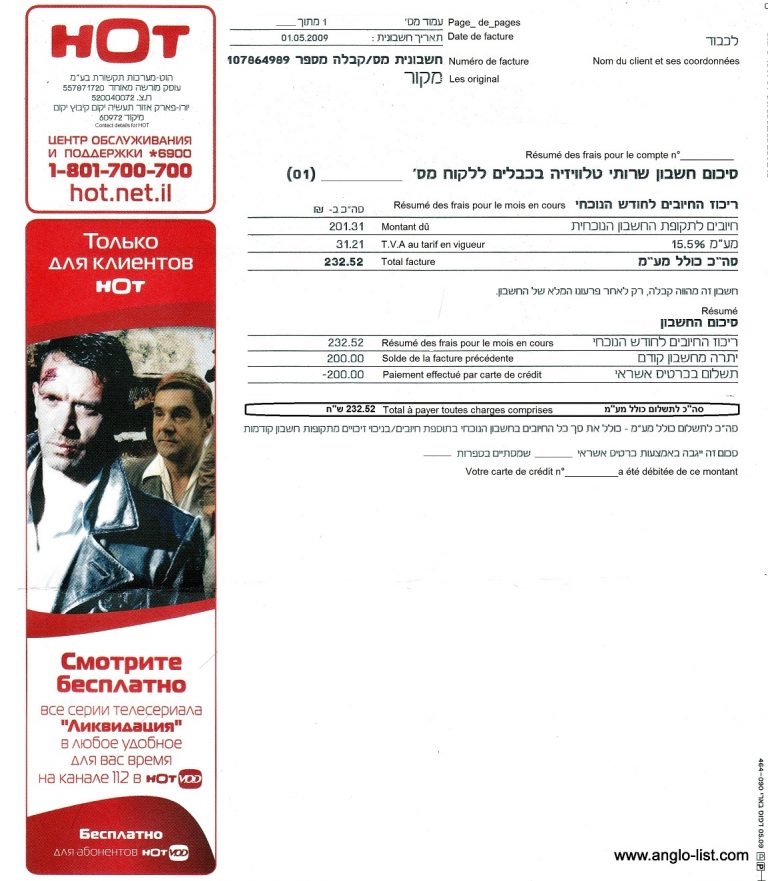
Française Hébreu: Facture de télévision par câble.

Reading Time: < 1 minute

Traduction française hébreufacture de télévision par câble.

Cette information fut rendue possible grâce au don généreux d’un bienfaiteur anonyme. Cette information fut rendue possible grâce au don généreux d’un bienfaiteur anonyme.

Facture de télévision par câble hebreu francais


Ressources et informations complémentaires


Facture d’électricité

Reading Time: < 1 minute

Facture d’électricité traduit de l’hébreu vers le français

 Cette information fut rendue possible grâce au don généreux d’un bienfaiteur anonyme.Cette information fut rendue possible grâce au don généreux d’un bienfaiteur anonyme.

Facture d’électricité

Your Israel Salary and Wages.

0

Reading Time: 2 minutes

You Monthly Pay Package: Salaries & Wages

Hebrew:  משכורת חודשי (Maskoret Hodshi)

 pile of shekels minimum wage

Before you sign an employment contract, there are a few things you need to know about salaries in Israel.

Israel’s equal wage law

The Equal Opportunity Employment Law in Israel, among other things, ensures that both men and women receive equal remuneration for equal work.

Hourly, weekly or monthly salary

Mostly, Israeli workers receive a monthly salary although some workers can be paid on a daily or hourly basis.

How is my salary made up?

Your salary is made up of a few parts;

  1. Your gross wage – “bruto” – as stipulated in your contract of work. 
  2. Benefits; car and other allowance, savings plans etc.
  3. Deductions
  4. Your final net wage or take-home pay -“netto” – is determined after all benefits have been calculated and deductions have been made.

Compulsory deductions

Your employer is obligated by law to make certain deductions and you are obligated by law to make these payments.  These include your personal income tax (misim), bituach leumi (national insurance) and your health insurance premium.  Any other deductions like savings plans must be stipulated in your work contract.

Salary Negotiation

It is common practice in Israel to negotiate your salary.  You do not have to accept the first offer that is made to you even if you are a new immigrant and a little desperate.  Familiarize yourself with the going rates in your professional field – ask your friends, check out average salary charts.  If this is your first job in Israel, you may need to accept a slightly lower wage in the beginning but this should be reviewed at the end of your trial period (generally after 3 months).

When will I get paid?

Your employer can pay your salary until and no later than the 10th of each month.

If for some reason your salary is overdue, you are entitled to a 5% compensation for the first week and a 10% compensation for each following week.

How will I get paid?

Your salary can be paid directly into your bank account or your employer may choose to pay you by check – this is highly unlikely in these days of digital banking.  The method of payment should be determined prior to employment and stipulated in your contract.

Your pay slip – tlush maskoret

The law states that every employee received a printed pay slip.  All deductions, benefits, taxes, bonuses etc., must be recorded on the pay slip.

Keep all your pay slips.  You will need them in case of disputes, when applying for unemployment (avtala) benefits, bank loan applications and other discounts according to your circumstances.

Guidelines for an employment contract in Israel

0

Reading Time: 2 minutes

You employment contract for the Israel labor market.

employment contract israel

Is there a standard employment contract in Israel?

The answer is no.  No standard employment contract exists in Israel.  There are specific labor laws and worker’s rights that every employee is entitled to which include:

  • The right to a minimum wage
  • The right to timely payment
  • The right to a labor agreement
  • The tight to recuperation /rehabilitation  – Dmei Havraa
  • The right to overtime hours
  • The right to annual leave and vacation days
  • The right to a travel allowance and reimbursement

Written agreement vs a verbal agreement

While both a written and verbal agreement are legally binding, it is often difficult to prove a breach of contract or win a labor dispute if there is nothing written down.

What should be included in the work contract?

  • A clear job description
  • The date of commencement
  • Date of completion in the case of a temporary job or one with a specified time limit.
  • Notice period.  This can be as little as two weeks, often it is one month but it can also be more than that.
  • Salary
  • Additional benefits
  • Trial period; usually 3 months
  • Salary reviews
  • Working hours
  • Overtime expectations
  • Lunch breaks
  • Holidays and vacation days
  • Any other points that might be relevant to your job and level of seniority.

An English or Hebrew Contract?

Unless your employer has an English contract, your contract of work will be written in Hebrew.  It is up to you to ask a friend or labor expert to check the contract.

Secrecy Agreement

In certain industries employees may be asked to sign a secrecy agreement as well.  The secrecy agreement may restrict you from getting a job in a similar field at a later date.  The agreement may also include a clause that restricts you from starting your own business in a similar field.  Check this carefully as it can limit your options in the future.

Signing the Contract

Your employment contract should be signed within 30 days of commencing your new job.