Telfed celebrates its 70th year with the Colin Schachat Charity Concert – February 2nd, 2019.
Having performed on the world stage with greats such as Andrea Bocelli and Jose Carreras, renowned international baritone Colin Schachat joins forces with his son Gabi in a one-time charity concert (brought back by public demand).
The show includes performances by the Ofer Portugaly Gospel Singers and Ra’anana Symphonette Orchestra, conducted by Dudi Sebba.
Bring along your family and friends and be part of an evening with a repertoire of modern music and old favourites in Ra’anana (02.02.2019 @ 20:30).
Former Israeli Defense Minister Moshe Arens passed away in his sleep on Monday, January 7th, 2019 at the age of 93. He is survived by his wife, Muriel and his four children, Yigal and Raanan Rut and Aliza and his grandchildren.
13 interesting facts about Moshe Arens
Moshe Arens was born in Lithuania in 1925.
His family immigrated to the USA in 1939 when Moshe was 14 years old.
Moshe Arens was a founding member of the Herut party, a forerunner of the Likud
Arens returned to the USA for 6 years, from 1951 – 1957 during which time he studies at MIT and CIT.
In 1957, Arens became professor of aeronautical engineering at the Technion, serving in this position until 1962.
Three times during his lifetime, Prof. Arens was a Member of the Knesset and held the positions of Israeli Minister of Defense and Minister of Foreign Affairs from 1988 – 1990.
He was the Ambassador to the United States and his protege was Binyamin Netanyahu.
He also held the position of Vice President for Engineering at Israel Aircraft Industries. He served as Chairman of ZIM-the Israel navigation company and served on the Board of Directors of various Israeli companies.
In 1971, Arens won the Israel Defense Prize. In 2016, Nefesh B’Nefesh awarded him the Bonei Zion Prize
Moshe Arens authored 4 books; ‘In Defense of Israel’, his political memoirs, ‘Flags over the Warwaw Ghetto’, the story of the Warsaw Gehtto uprising, ‘Broken Covenant’, American Foreign Policy and the Crisis Between the U.S. and Israel and ‘Moshe Arens, Statesman and Scientist Speaks Out’
His close friends affectionately called him Misha.
His funeral will take place in Savvyon on Tuesday, January 8th 2019 at 2:00pm
As of Sunday January 6, 2019, every Sunday to Thursday from 21:00 to 04:00 the next morning – on the Be’er Sheva Center Train Station – Rishon LeTsyyon Moshe Dayan Train Station – Ra’anana West Train Station line.
Trains departing from the Ra’anana West Train Stationwill commence and terminate their trips at the Tel Aviv Savidor Center Train Station.
Trains departing from the Be’er Sheva Center Train Station via the Ashkelon Station to the Rishon LeTsiyyon Moshe Dayan Train Station and the Bat Yam train stations will commence and terminate their trips at the Tel Aviv HaHagana Train Station
As of Friday, January 11, 2019 and every subsequent weekend, from Friday morning at 00:01 until Saturday night at 18:00, changes will occur in the following lines:
The service will operate between the Nahariyya Train Station and the Tel Aviv Savidor Train Station, in both directions.
The Nahariyya to Be’er Sheva Center Line
Trains from the northern direction will commence and terminate their trips at the Tel Aviv Savidor Train Station
Trains from the southern direction will commence and terminate their trips at the Lod Train Station.
The Binyamina to Ashkelon Line
Trains from the northern direction will commence and terminate their trips at the Tel Aviv Savidor Train Station
Trains from the southern direction will commence and terminate their trips at the Lod Train Station.
The Ra’anana West to Be’er Sheva Center line (including trains that commence and terminate their trips at the Rishon Letsiyyon Moshe Dayan Train Station):
Trains departing from the Ra’anana West Train Station will commence and terminate their trips at the Tel Aviv Savidor Train Station.
Trains departing from the Be’er Sheva Center Train Station via the Ashkelon Train Station, the Rishon Letsiyyon Moshe Dayan Train Station and the Bat Yam trains stations will commence and terminate their trips at the Tel Aviv HaHagana Train Station.
The Tel Aviv Hashalom Train Station will be closed.
Customers holding a periodic ticket (Flexible 30), the expiry date of which is prior to or on February 2, 2019, at the latest and one or more of the closed stations are included therein, are entitled to compensation.
The compensation is the extension of the valid period of an existing trip ticket, respective to the number of days during which the trip ticket was valid, and the relevant section of the track was closed.
For additional information, contact the Customer Service Hotline on *5770.
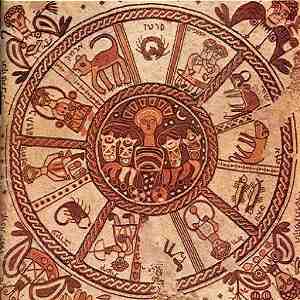
The Hebrew month of Shevat aligns with Aquarius. It’s time to move ahead!
Hebrew: שבט
Contributed by: Rav Nissim Mordechai Makor
Tu B’shevat a time to plant trees (Unsplash)
This time we are exploring the Hebrew month of Shevat. Remember, astrology is all about learning what the energy of each month is, because you cannot act the same way every month. Every month has a different energy and if you don’t know what it is, the month can become a problem.
As mentioned last month, both Aquarius and Capricorn are ruled by the planet Saturn. Having a common planet ruling them does not mean that they possess similar qualities. Actually Aquarius and Capricorn could not be more different. Capricorn is an earth sign while Aquarius is a air sign. Capricorn’s are stuck to the earth while those born under Aquarius, fly around the sky.
Capricorn’s like to build structures, Aquarians like to tear them down.
We see from the planet Saturn, that one aspect faces back into the solar system towards the Sun while the other faces out to the infinity of space.
You cannot ignore an Aquarian, they are the Zodiacs eccentrics. They are different from other people and believe they can change the universe by themselves. They see the problem already fixed. They struggle to focus on the details. They just see the big picture. Time has no hold on an Aquarian.
Aquarius is a good time to move ahead with projects. There is an awakening for growth and expansion in this month. The secret though is that the awakening has to come from below, from us. This is the concept of Maim Nukvin. Below is a brief explanation of this concept.
“When we develop within ourselves a great longing and yearning for Hashem, this produces a corresponding yearning on His part and a union is created(zivug). This is a big secret. In Kabbalah we call this Maim Nukvim and Maim Dochrim. What does this mean? Main Nukvim is our effort to serve Hashem while Maim Dochrim is the energy/light(Siyata deShemaya) Hashem gives us in return for our effort. It is not always something that we can actually feel, but it is never in doubt that it is there. Some people are sensitive to things and can actually feel this energy, like a warm glow all around them.
Hashem gives us energy/light(life force) regardless of whether we yearn for it or not. This is one of the biggest gifts that we get as it is unconditional, regardless if we deserve it or not.
The secret here is for that our arousal toward Hashem will precede His arousal towards us. This relates to the statement of Chazal that “when a woman’s seed exits first during marital relations then she gives birth to a male.” This light comes with mercy/rachamim. NB!
However, when man does not arouse himself to Hashem, then it is Hashem that initiates His desire for man, for Hashem desires for man to return to Him. This relates to the statement, “when a man’s seed exits first then the woman gives birth to a daughter.” Unfortunately this scenario comes with the attribute of judgement.
Great damage takes place when a person feels no spiritual stirring to return to Hashem”.
This is the tikkun of the Aquarius. To focus on the details. Get the job done. They have to change their nature. Make the first move.
The month of Aquarius symbolizes redemption. You can actually feel it this month. The Aquarian sees the unity already there. He feels that it is already done, but we live in the physical world where actions count, and this is the weak point of the Aquarian.
We have the holiday of Tu B’shevat in Shevat. What is this holiday all about? It is said that Tu B’shevat is the Rosh Hashana – the New Year – of the vegetable kingdom.
On the fifteenth of the month, full moon/powerful day, we have the holiday of Tu B’Shevat. The same as we have Rosh Hashanah, the vegetable kingdom has Tu B’Shevat What is the lesson we learn from the vegetable kingdom, the tree.
Everything is this world is subject to gravity. Drop a coin off a building and guaranteed it will fall to the street below. This is nature, gravity. The tree and plants are different. The grow up. They defy gravity and actually overcome it. Look at a tree 50 feet high and see how proud it stands, erect, going against nature. Like a tree, Aquarian’s have the power to break through the constraints of the physical world and tap into the world of miracles. This is a very good attribute to have.
A miracle is something above nature. The word in Hebrew for miracle is Nes. The root of this word is Lanoos, to run away. When we run away from our nature and go against it, we go above nature and bring MIRACLES into our lives.
Use this holiday to connect to this energy of miracles. Look into your life, and I am sure you will find something to go against. Start small and guaranteed Hashem will help you succeed.
In Hebrew, Aquarius is Dli or דלי, meaning bucket or pitcher. The sign is represented by a water bearer, pouring water. Water represents mercy and purification and the whole pouring means no limit.
The letters of the month are tzadik and bet. The line of the Ana Bekoach is the same as Capricorn, the first line.
The month is actually split into two, the first two weeks are judgement and the last two are mercy.
Aquarian’s believe they can change the world highhandedly. This is their power. The tap into the Redemption because they see everything already fixed and unified. They can tap into the universal consciousness. If they are able to put their ideas into practice, they can become very big.
Israeli Shakshuka; easy to prepare, tasty, healthy, low in calories and a real good food.
From Tel Aviv to Toronto, from New York to Naples and Melbourne to Minnesota, everyone is into the craze and enjoying shakshouka/shakshuka (Hebrew: שקשוקה) eatenfor breakfast, lunch or supper. The recipe for shakshuka is easy and you can make many variations of the classic, original recipe.
A well-spiced tomato sauce (Israeli chef, Yotam Ottolenghi suggests making the sauce from fresh tomatoes and tomato paste) combined with sweet red peppers and spices including cumin, chili flakes or harissa, Shakshuka is popular across the Mediterranean and Middle East however, the more modern version, served with baked eggs, originates in Tunisia.
In addition to the spicy tomato sauce, you can make endless variations to the Shakshuka recipe to suit your family’s taste buds; sweat some onions and add to the sauce; wilted spinach, feta or halloumi cheese, chorizo or any spicy sausage, or even cubes of boiled potatoes. (Note: according to Jewish dietary laws it is forbidden to eat chorizo – or any meats – with cheese or dairy products)
When served in a restaurant In Israel, Shakshuka is commonly eaten with chunks of Challah (a special sweet loaf of bread eaten at the Jewish Sabbath meal) to scoop up the tasty sauce and egg.
Shakshuka is low in calories
The nutritional value of Shakshuka; it’s healthy, low in calories – around 500 per serving (with 2 eggs), low in carbs and a high dietary fiber content. Most of the calories in shakshuka come from the olive oil used in the recipe. Extra calories and carbs will come from the chorizo, feta or halloumi cheese you might add.
Shakshuka recipe
This is Ottolenghi’s recipe:
2 tablespoons olive oil
1 teaspoon harissa
2 teaspoons tomato paste
2 (2 cups / 300 grams) large red peppers, diced in 1/4-inch pieces
4 cloves garlic, finely chopped
1 teaspoon ground cumin
5 cups (800 grams) very ripe tomatoes, chopped; canned are also fine
4 large eggs, plus 4 egg yolks
1 pinch salt
Directions
In a large, heavy based, frying pan over medium heat, warm the olive oil and then add the harissa, tomato paste, red peppers, garlic, cumin, and 1/2 teaspoon salt. Sauté for about 10 minutes, until the peppers soften. Add the tomatoes, bring to a gentle simmer, and cook for another 10 minutes, or until the sauce has thickened.
Make eight little dips in the sauce. Gently break the eggs and carefully pour each int its own dip. Do the same with the yolks, Use a fork to swirl the egg whites a little bit with the sauce, taking care not to break the yolks. Simmer gently for 8 to 10 minutes, until the egg whites are set but the yolks are still running. Remove from the heat, leave for a couple of minutes to settle, then spoon into individual plates
Shakshuka recipe for cheaters
Most of the preparation time for shakshuka comes from sweating the onions and simmering the sauce, so if you can get hold of canned tomatoes and onions or even a ready-to-use shakshuka base (you can get this in Israeli supermarkets), this will cut prep time down by about 15 minutes. Failing canned tomatoes and onions or shakshuka base, tomato paste will do. Remember to add plenty of water to the tomato paste – at least half of it will evaporate during cooking.
Serious foodies might make their own harissa but it you can buy it ready-made. Why not?
Shakshuka is traditionally a breakfast food but now its a popular Sunday brunch dish – eat it whenever you can and serve it to a crowd of friends. Daring chefs can adapt the recipe and make a novel shakshuka pizza.
Whenever, wherever and however you eat, shakshuka gets our vote as a super food.
7 facts about Amos Oz, one of Israel’s greatest authors.
Amos Oz – Image Credit Wiki Common
Israeli author, Amoz Oz was born Amos Klausner in 1939 and grew up in Jerusalem. His father’s family were from Lithuania (near Vilna) while his mother’s were from Rivne – then Poland but now Ukraine.
Amoz Oz’s parents were multilingual; his father claimed he could read 16 or 17 languages. His mother spoke 5 or 6 languages and could read 7 or 8. In spite of this, neither of his parents were comfortable speaking Hebrew and, in-spite of this, the only language they allowed Amos to learn was Hebrew.
Oz’s mother suffered from depression and when Amos was 12, she took her own life.
At age 14 Amos Klausner moved to Kibbutz Hulda in Central Israel. It was here that he changed his surname from Klausner to Oz (Hebrew: courage) and also started writing.
Oz published his first book, Where the Jackals Howl, a collection of short stories, in 1965
In his lifetime, Amoz Oz published 40 books. His works have been translated into tens of languages, including Chinese and Esperanto – more than any other Israeli writer.
He was the recipient of many international literary honours and awards as well as the Israel Prize.
Amos Oz passed away on December 28, 2018.
Oz’s family requested that his organs be donated, and his corneas are to be transplanted to waiting patients.
Oz’s casket will be placed at the Tzavta Theater in Tel Aviv on Monday morning for the public to bid him farewell. A memorial ceremony for Oz will be held at noon. His funeral will be held at 3 p.m. in Kibbutz Hulda.
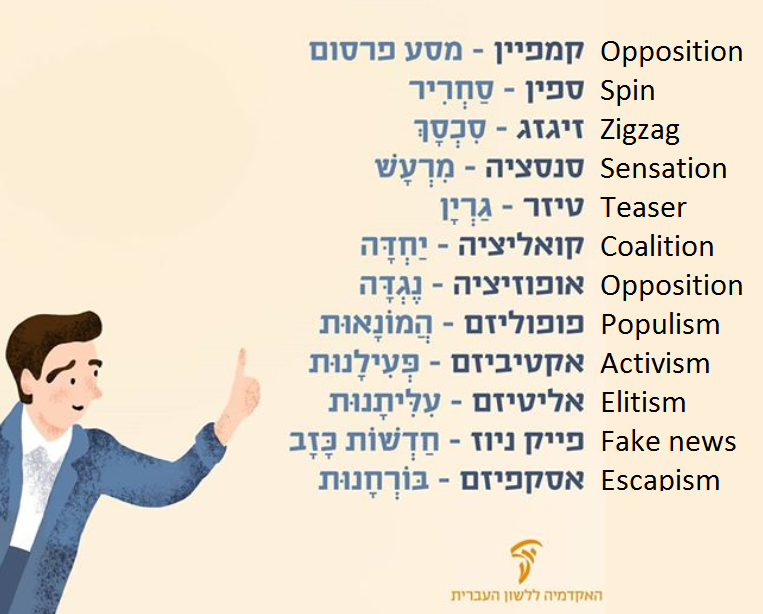
Modern Hebrew sometimes borrows words from other languages and the majority of these ‘loan words’ come from English.
Words like; apartheid, televisia, technologia and psychologia are all foreign words that have been borrowed.
The Academy of the Hebrew Language decides if new Hebrew words need to be created. The Academy researches existing Hebrew resources for solutions and often words are ‘recycled’.
Here are a few Hebrew ‘election’ related words borrowed from English
Is Oleh Hadash Barry Braun Israel’s next Eurovision finalist?
More than 8 million Israelis cheered and celebrated when Netta Barzilai took the crown at the 2018 Eurovision Song Contest in Lisbon, Portugal. Israel will host the upcoming Eurovision Song Contest to take place in Tel Aviv and the question on everyone’s mind is – can Israel take the crown for a second year in a row?
HaKovah Haba (The Next Star) is an Israel TV program wherein aspiring artists audition for the Eurovision Song Contest. Established singers and entertainers; Keren Peles, Shiri Maimon, Assaf Amdursky, Harel Skaat and Static and Ben-El are this year’s judges.
Contestants come from all walks of life and their song choices are just as varied; Hebrew songs, English-, Eastern (Hebrew: Mizrachi) and everything else in between. The competition has, over the years, attracted Olim Hadashim, but this year an Anglo oleh from South Africa – Barry Braun had the audience and all of Israel gob-smacked and in the palm of his hands.
Barry’s motivation to make Aliyah is typical of many Anglo olim. While on stage he shared bits of his story and the very next day he agreed to share his personal Aliyah story with us. Here it is:
My Aliyah Story – Coming Home
By: Barry Braun
Allow me to introduce myself. My name is Barry Braun, 45 years young and living in Ra’anana, Israel. The land of opportunities, well for me at least!
I am married to Claudine and have 3 children, Daniel 16, Shira 12 and Ora age 11. Funny how all my children have Hebrew names, it must have been written in the stars, that one blessed day, they would be living in The Holy Land!
If you would have told me 2 years ago that I would be making Aliyah(Hebrew עליה) and living in Eretz Yisrael, I probably would have told you to go have your head read.
We were living in Cape Town, one of the most beautiful cities on this planet, with literally everything we needed and dreamt of……or so we thought!!!
So how did it come to pass that we would give up everything, all our comforts, to try and build a new life in a foreign land, unable to speak the language, having complete Emmuna, that yes, we will be okay?
So, this is my – Barry Braun’s – personal Aliyah story…
It all started with a wedding invitation to a good friends son’s wedding, and lo-and-behold as luck would have it, the wedding would be taking place in Israel.
So there I was, plotting a holiday to Israel, with my wife Claudine, without our children, free from parental responsibilities for a full 10 day period. Oh, and then I uttered the famous words that would seal our fate and change our lives forever…
Should we use this as an opportunity for a pilot trip?
I remember seeing the kids on the streets of Ra’anana, living just like the words of the Israeli National anthem state, being “free” and living as a “free” nation.
That is when the penny dropped.
We would be making Aliya 6 months later, however, not as much for ourselves, rather for our children and for the sake of their future.
We made Aliyah and arrived on the 2 May 2017. What a day it was! Totally unplanned, we arrived in Israel on Yom Ha’atzmaut, and yes, I did go down on my hands and knees to kiss the ground!
I cannot express in words how lucky we are. When I was 3 years old I made Aliyah with my family. However, unfortunately, we returned to South Africa when I was 6 years old. Yes, I could have been Israeli and fluent in Hebrew…I think about that often. How different my life would have been if we didn’t return to South Africa, however, I’m a firm believer that everything happens for a reason and that this is how it’s meant to be!!!
Barry Braun the Shiputznik
My parents built a house in Ra’anana in 1978, we lived in that house for less than a year and returned to South Africa in 1979.
This is the house that I now live in with my family.
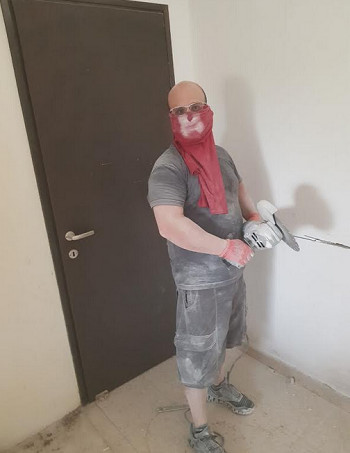
After day 3 of making Aliyah, I started renovating the house.
The 5 of us started taking down walls and loading rubble bags.
We gutted the kitchen, bathrooms and basically I renovated the entire house with my wife and 3 children.
I take my hat off to my wife and kids for what they had to endure. We lived in the house throughout the entire renovation, with all the dust. At one stage all 5 of us were sleeping on mattresses on the floor, in the shell of the kitchen, with 2 dogs.
This continued for 6 months and I can honestly say that this was hands down the most challenging 6 months of my entire life!!!
This was no normal Aliya. Making Aliya is challenging enough, but making Aliya and living in a building site for 6 months and not being able to speak Hebrew…in hindsight, I’m not sure if I would do that again!!!
I received a call from Moshe Cohen, Choir master of the Eitz Chaim Choir. We met and we spoke about the choir and me being a Chazan. Shortly after our meeting, Moshe called me and asked me if I would like to officiate as Chazan for the City of Ra’anana for Yom Kippur.
I spoke to many of my friends and they advised me not to do it as I had just made Aliyah and I was in the middle of renovating the house.
Also, Claudine and I were starting Ulpan in September and the kids were starting school.
Not being one to dismiss a challenge, I accepted the offer.
So a few months into making Aliyah, I was renovating the house, studying at Ulpan Ra’anana and waking up every morning at 4am to practice the Yom Kippur prayer service and learn all the pieces that I needed to sing with the Choir. I hadn’t officiated as Chazan for Yom Kippur in 6 years and was very “rusty”.
The Tefilah for Yom Kippur was a massive success, the officials from the Iriyah loved the Tefilah and I was asked to meet with the Mayor and they presented me with a gift.
It was on Sukkot, at a community event, where I met my now good friend Ivan Horowitz. Ivan told me that he was about to start studying at the Center for Chazanut in Petah Tikvah. I immediately showed interest and the next day I called and enrolled myself into the school. I am now in my second year of studying under the guidance of Yisrael Rand, Yecheskel Klang, Yossi Schwartz, Menachem Bristovski and Maestro Elli Yaffe.
I must add that all this time we didn’t have a car. I thought that we could get away without owning a car, we commuted everywhere on bicycles but it just became too difficult especially when getting caught in the winter rains.
Barry Braun the Cyclist
After 9 months we were no longer ‘carless’, and my word, did this change our lives. We could actually stay late at the canyon without the fear of how we would get home!!! In a way it restored our dignity and made us feel human again.
It’s amazing how one adjusts. From having 4 cars in South Africa, to commuting everywhere on bicycles.
Ulpan was intense. Having to adjust to being a student again isn’t easy and takes getting used too. I loved Ulpan, I met so many people and it also gave me the opportunity to sing at all the events at the Ulpan.
This opened more doors for me, as often there were officials from the Iriyah attending the events giving me further exposure.
It’s funny how people come into one’s life…
In June 2017, I saw an advert on Facebook adverting auditions for a choir in Ra’anana of Olim Chadashim. I went to audition for the choir and this is where I first met Hedya Cavenor.
I joined the choir and we were both inspired by each other’s commitment and energy. It later emerged that Hedya was also the music teacher at Ulpan Ra’anana and by the time Ulpan started we already knew each other quite well. Hedya was so kind and welcoming to me and my family, she understood that we had no family in Israel and literally offered her extended family as our family, who welcomed us with open arms.
Another amazing thing happened at Ulpan. Out of all the teachers at Ulpan, I was privileged enough to have Esti Asher as my teacher. Esti was the only Dati teacher at Ulpan. When she heard that I was a Chazan, she would often teach me Hebrew by referencing Nusach and Tefila. We soon built up an amazing relationship. Esti also arranged for me to come and officiate as Chazan at her Shul, Ariel Shul, once again accompanied by the Eitz Chaim Choir. This was highly successful and many people called the Iriyah and gave me recommendations.
This led to the Iriya asking me to officiate as Chazan for the Shabbat before Yom Haatzmaut at the Great Synagogue in Ra’anana, accompanied by the Eitz Chaim Choir. One year after making Aliya, and there were now posters of me all over the city advertising this special Shabbat. Truly unbelievable!!! To put this into perspective, the previous year, the Iriyah commissioned Tzvi Weiss, the Chazan from the Great Synagogue in Jerusalem to officiate with Ofir Sobels Choir.
In March 2018, I entered a competition held by Chazonus.com and judged by the world famous Chazan Yaakov Motzen.
Cantors had to submit their rendition of Retzi – Moshe Ganchoff.
I won this inaugural competition, which was truly a great honour for me as many talented cantors entered the competition.
In May 2018, I received a call from Chazan Ezra Sher of Pine Street Shul, Johannesburg. Ezra is a good friend of mine and we have performed in many concerts together. Ezra told me that he was coming to Israel for his nephews wedding, this was a great opportunity for us to sing together again in concert. I approached the Iriyah and they agreed to let me use The Great Synagogue as a venue.
I produced and sang in my first concert at the Great Synagogue in Ra’anana with Ivan Horowitz and Ezra Sher, accompanied by my now good friend Hedya Cavenor (piano) and her 2 boys Avi-Noam (Saxophone) and Daniel (Clarinet). This concert was in honour of Yom Yerushalayim. This concert was very successful and was also attended by officials from the Iriyah.
In June 2018, I was asked to sing at the end of the year concert for the Center of Chazanut in Petah Tikvah, the only first year student to be asked to sing in the concert. This was a great honour for me. I was accompanied by the Ra’anana Symphony Orchestra.
In South Africa, being accompanied by an orchestra would have certainly been a faraway dream, however, in Israel, this dream has become a reality!!!
Throughout the year I was asked to sing at events and officiate as Chazan on numerous occasions.
I performed for Telfed (South African Aliyah Office), honouring Sylvia Raphael and at the Truth Be Told Event.
I set up my sound equipment and gave 2 free concerts on Achuza, the Main Road in Ra’anana.
I have built up a great relationship with the Moatzah Hadatit, and have been asked by them to officiate as Chazan at many Synagogues in Ra’anana. My goal was to try and officiate as Chazan at a different Shul every Shabbat Mevarechim accompanied by the Eitz Chaim Choir. This has turned out to be very successful as now I’m being requested to officiate as Chazan.
After my concert at the Great Synagogue, the Gabbi from the Synagogue requested that I do another concert. I approached the Iriya and suggested a concert with songs from the Yamim Noraim, however, unfortunately there was not enough time.
A Chanukah concert was confirmed, this time with the full support from the Iriya. A date was set for the 8 December 2018. The timing of was perfect as it coincided with the airing of my Kochav Haba performance……
It was great to know that the Iriya now had the faith to put their trust in me, appreciating my hard work and talent by supporting me with this Chanukah concert.
Once again, there were posters of me throughout the city advertising the Chanukah concert. Amazing exposure, resulting in a sold out concert.
This concert was an all-round success and this time the newly elected Mayor attended and spoke at the concert.
What was next?
I heard that there were auditions in Kvar Saba for a reality show called Hakochav Haba, I honestly didn’t think much of it, as I already auditioned unsuccessfully for X-Factor and The Voice.
Furthermore, I didn’t know that this was for Eurovision Song Contest!
However, this audition was different. The producers seemed to really like me, my voice and my story.
I made it through 4 auditions culminating in being accepted to perform on Israeli National Television in front of “apparently” famous judges and a live audience of close to 1000 people.
Why I say apparently is because I really didn’t know who the judges were. In fact, the day before I had to perform I embarrassingly sent through a message requesting the names of the judges so that I could Google them.
I had also never seen one of the episodes before. So the night before I had to perform, I watched my first episode of Hakochav Haba. Oh my word!! There I was lying in bed at around midnight with my heart beating really fast thinking to myself…”Why oh Why” did I not watch these episodes before, so as to acquaint myself with all the aspects of the show.
It was now 3am and I was still watching audition after audition, not because I needed to, rather because now I couldn’t sleep. It was a combination of emotions, fear, excitement and mostly frustration with myself, having left my “homework” for the night before my performance!
The performance was very emotional and I won the hearts of the judges, audience and the nation.
I still didn’t realize how popular the show was until I was walking through the shopping mall(Hebrew: Kenyon) a few days after the show had aired and people were coming up to me asking me for selfies.
You know that people liked the performance when even the employees of the bank start helping you and being kind to you….true story……haha!!!
Where to with this new found fame…???
I have been asked this question, what do you actually want to do….Are you doing this because you want to be famous?
The answer is that I don’t know. I don’t know where this will lead? However, what I do know is that I love music, performing and singing. I love the way I have the ability to touch people’s hearts when they hear me sing. BEH’ I’ll be able to make a living and support my family doing what I love to do.
We all know the saying often used by the American singer Marc Anthony
In one’s job, “If you do what you love, you’ll never work a day in your life!” (The actual origins of this quote are unknown. It is thought to be an oriental quote.)
So, I’ll continue doing what I love and reaching for my dreams by making my own luck, as I keep telling my children – Nothing lands in your lap and hard work will always eventually pay off!!!
Let me be clear about this….Aliyah has not been easy and everyday has its challenges. This new career change has also been very taxing. I usually wake up every morning at 4am and study music for at least 4 hours a day. I question myself continuously, am I doing the right thing but I have faith that this will lead to fruition …..In a way it already has!!!
I want to take this opportunity to thank my amazing wife Claudine and my precious children for all their love and support throughout this amazing journey.
And lastly, thank you to Hakadosh Baruchu for always being with me, helping me and guiding me through this amazing journey that we call life.
The Hebrew Month of Tevet aligns with Capricorn in the zodiac.
Hebrew: טבת
By Rav Nissim Mordechai Makor
Let us investigate the The Hebrew Month of Tevet; Tevet is the fourth month of the civil year and the tenth month of the ecclesiastical year on the Hebrew calendar. It follows Kislev and precedes Shevat. It is a winter month of 29 days. Tevet usually occurs in December–January on the Gregorian calendar.
The Hebrew month of Tevet aligns with the astrological sign of Capricorn.
The Hebrew month of Tevet is considered one of the three negative months with Tammuz and Av. We have a fast day on the tenth of Tevet.
The Hebrew month of Tevet and next month Shevat/Aquarius are connected. They are both controlled by the planet Saturn, yet they are completely opposite. The name in Hebrew for Saturn is Shabbtai which has the letters of Shabbat in it. Saturn is connected to the Jewish people. Saturn can be either cold or hot. Tevet/Capricorn is an earth sign while Shevat/Aquarius is an air sign. Totally opposites.
The month of Tevet is a very heavy month. People born in this month are connected to the earth/physicality. They have a big desire for money and often make good business people. They have the power of manifestation.
The tikkun of Tevet is to trust Hashem. Because they are so connected to the earth, they have a difficult time with emunah because they count on nature/earth and their abilities. They have to break their chains, go against their nature and trust Hashem 100 per cent. If they put their trust in Hashem and become spiritual, they will gain mastery over the physical.
Also, people born in this month struggle to be happy. They worry about things and never have peace of mind. When they let go, they can reach great heights.
The book of Exodus starts in this month, and there is a period of six weeks which connect to the first six portions of the book of Exodus. This period is called “Shovavim”. It is a time to restore and refresh our value system and our priorities.
The thing to realize is that the spiritual is more important than the physical. Think how you can change your consciousness and manifest the blessings.
The two letters that control this month are: Ayin and Bet עב
These letters have a numerology of 72.
72 connects to the second highest Sefirah, Chochma. In this level there is only good, evil does not exist. This is the power of this month, to connect to this high level. Happiness connects us directly to Chochma.
The first line of the Ana Bekoach is connected to this month. The acronym for this first line has a numerology of 506 which is the same numerology as, Love for no reason, Ahavat Chinam. This line is a direct connection to the spiritual world and the antidote to Sinat Chinam, hatred for no reason which is what destroyed the second Temple.
Things are hidden in this month. The pull of physicality is so heavy, it covers the potential in this month. Through the letters of the month and the first line of the Ana Becoach, we are able to overcome the heaviness of this month and connect to the potential of this month, to Chochma.
It is a good month to make big transformations in ones life.
The last two days of Hanukkah are part of this month. The last day, Zot Hanukkah, is one of the most powerful days of the year.
The Admor from Ruzhhin teaches, that what a simple man can accomplish on the 8th day of Hanukkah, even great Tzadikkim cannot accomplish with their Tefilah during Neilah of Yom Kippur.
What is so special about the 8th day of Hanukkah? On Rosh Hashanah we are judged, on Yom Kippurthe judgement is sealed and on Shemini Atzeret it is delivered. We still have one chance to change things until the 8th day on Hanukkah., after which everything is completed and the decrees start to get carried out.
Therefore it is a very special day to beg Hashem for mercy for all that we need, and that we should have only good decrees upon us.
The number eight always connects to the upper worlds, to the Sefirah of Binah. Seven is Shabbat which is Malchut, which is the physical world. The Brit is on the eighth day.
It is simple to connect. Just sit in front of the candles.
Remember that we all have these tests this month not only the people born in this month.
The process of opening a bank account in Israel starts immediately upon your arrival in Israel at Ben Gurion Airport. The Ministry of Aliyah & Integration (Misrad Haklita) will issue you with your identity document called a Teudat Zehut as well as an oleh document called a Teudat Oleh. You will also be given a document called “Note of Future Bank Account”.
In order to receive your Oleh Benefits, you will need to open a bank account at one of Israel’s commercial banks within the first few days of your arrival in Israel. Here is a list of local commercial banks approved by The Bank of Israel (BOI).
Mizrahi Tefahot Bank Ltd
Arab Israel Bank Ltd
Bank Hapoalim B.M
Bank Leumi Le-Israel B.M
Bank Massad Ltd
Bank of Jerusalem Ltd
Bank Otsar Ha-hayal Ltd
Bank Yahav for Government Employees Ltd
Dexia Israel Bank Ltd
Mercantile Discount Bank Ltd
Poaley Agudat Israel Bank Ltd
The First International Bank of Israel Ltd
UBank Ltd
Union Bank of Israel Ltd
On the day
Make sure you have a few hours on hand for opening your bank account. Have patience (Hebrew: Savlanut), the process can be time consuming as there are many forms to be filled out and explanations to be given.
You will need to present yourself at the bank of your choice with the documents given to you at Ben Gurion Airport: Teudat Zehut, Teudat Oleh and “Note of Future Bank Account”. You will also need some cash or cheques to deposit into your account in order to activate the account. Shekels, dollars, pounds and euros will do but South African rands will not!
Once you have opened and activated your bank account, the bank clerk will give you your bank account details. Your bank account is made up of 3 sets of digits
1. Every bank in Israel is given a code number for example Bank Leumi is code 10 and Bank Hapoalim is code 12 (see the table below)
2. Each branch of each bank also has a branch code number, for example; the branch code of Bank Hapoalim in Central Carmel is 701.
3.Then of course, there is your personal bank account number (usually 6 digits)
Your full bank account number will look like this xx-xxx-xxxxxx or as per our example 12-701-123456
Credit cards
You will want and need a credit card; Mastercard and Visa are the most popular. While at the bank, you will fill in an application for a credit card and you will be required to set a credit limit. The credit limit is usually set at around the equivalent of one monthly wage but this can be negotiated.
Some tips for choosing a bank in Israel
Choosing a bank can be a little more complicated than you think. As you will be making a fair number visits to the bank and many transactions during the first few months, try to choose a branch that is closest to you. Most bank clerks speak some English but be prepared. It is quite likely that you will not receive the same level of service you have been used to in the old country.
Try to get recommendations from family and friends before you arrive in Israel. Foreign currency transactions are often only done at bigger, central branches.
It is very common for a husband and wife in Israel to hold a joint checking account. If you are a small business owner or independent worker(Hebrew: Atzmai) then you might want to keep your business affairs in a separate bank account.
If you are opening a joint bank account, then both of you must be present at the bank.
If you wish to keep money in foreign currency, the bank can arrange for a foreign currency account associated with your current account. Note that there is a certain minimum foreign currency balance required in order to accrue interest.
Bank Contact information
Bank Name
Bank No.
Telephone
Bank Website
Leumi Bank
10
076-885111
www.leumi.co.il
Hapoalim Bank
12
03-567333
www.bankhpoalim.co.il
Discount Bank
11
03-5145555
www.discountbank.co.il
Mizrahi Tefahot Bank
20
03-7559000
www.mizrahi-tefahot.co.il
Mercantile Discount Bank
17
076-8044530
www.mercantile.co.il
Massad Bank
46
03-5641333
www.online.bankmassad.co.il
Bank of Jerusalem
54
076-8096001
www.bankjerusalem.co.i
Union Bank
13
03-5191111
www.unionbank.co.il
Bank Yahav
4
02-5009666
www.bank-yahav.co.il
Otzer HaChayal Bank
14
03-7556000
www.online.bankotsar.co.il
Bank of Israel
99
02-6552211
www.boi.org.il
Digital banking
Once you get the hang of it, digital banking is the way to go. Access your account, perform transactions, request loans, order check books etc. can all be done online via the bank’s website or their smartphone app without having to stand in line or get frustrated by limited banking hours.
Bank fees and bank charges
Current account fees are just one of the bank charges you will have to deal with. There are ATM fees, foreign currency transaction fees, interest of loans and tons of other fees and commissions you are probably not even aware of. Choosing a bank with the lowest fees and best conditions makes financial sense.
Pepper Bank
Pepper Bank is Bank Leumi’s digital bank. Managed entirely from your mobile phone, you can manage your account, loans, savings, money transfers, investments etc. – all from your mobile. You can even open your account from your mobile in just a few minutes.
Pepper offers you 13 free bank transactions.
Pepper Pay
Pepper Pay is the Pepper payment app, part of Bank Leumi. Anyone (not only Bank Leumi clients) can use the app as long as you have a credit card and a bank account in Israel. Download Pepper Pay from the app store. There is a quick and easy sign up process.
Bank Hapoalim
Bank Hapoalim’s digital services has improved over the years. Their website is in Hebrew. There are a small selection of transactions that are exempt of commissions and bank charges.
Bank Discount
Bank Discount and Mercantile Discount Bank are 2 separate banks but both under the same management. They’re a smaller bank and so personal service might still exist. Their websites have an English interface.
Heshbon Yarok (Green Account)
Heshbon Yarok the digital banking platform of Bank Otsar HaChayal offers you a minimum commission free, Israeli shekel, current checking account.
No SMS fees. Heshbon Yarok offers a 50% discount when ordering a check book and a reduced commission of 0.35% on the purchase/sale of Israeli securities (subject to a minimum).
Please tell us about your bank and its customer service in the comments section below.