14.8 C
Jerusalem
Wednesday, May 6, 2026
Sample Page
Home Blog Page 62

Kosher Restaurants in Israel

0
Reading Time: 3 minutes

Best kosher restaurants in Israel.

Depending on where you are, finding kosher restaurants in Israel can sometimes present a challenge. Here are some of our favorites…

kosher restaurants
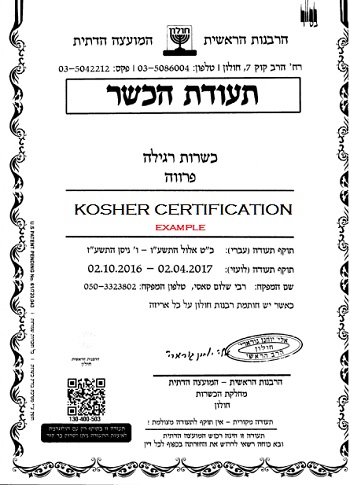
An example of a Kosher restaurant certification

Lechem Basar – A favorite Kosher restaurant in Tel Aviv

Located at the Namal (port) in Tel Aviv, along the boardwalk and overlooking the Mediterranean Sea, Lechem Basar serves tasty and creative food.  The sea breeze on a summer’s night and a meal with a view all makes for a magical experience.  The food at Lechem Basar is top class and also holds a Menhadrin Kashrut certificate. If you are a serious meat eater and looking for a special dining experience, this is the place to go.

Mike’s (Kosher) Place in Jerusalem

If you are a regular Facebook user, you are sure to have seen adverts for Mike’s Place.  Kosher restaurant Mike’s Place, in Jerusalem has the same  fun vibe as the branches in Tel Aviv, Herzliyah and Eilat (only the Jerusalem branch is Kosher). Come here to relax after a long day at work and enjoy a drink with fun music and delicious food. If you are up for it, you can even take the stage and sing a few tunes on Open Mic Night, there is also jazz night and band night.  Some of Israel’s popular singers entertain on Saturday nights.  Mike’s Place has a reputation for having an informal, relaxed and inviting atmosphere.

‘Wanna’ munch in Jerusalem? Check out our selection

Two of Haifa’s kosher restaurants – El Gaucho & Shaltieli

El Gaucho is one of the few restaurants in Haifa that has survived many decades. As its name suggests expect to eat some of the best grilled meats with a South American flair.  At night, you will experience the truly magical view of the Haifa bay. Open from midday to midnight El Gaucho has local Rabbinate kosher certification. There are branches of El Gaucho in Eilat, Netanya and Rishon LeZion as well.

Shaltieli, a meat restaurant, on the Dado Beach boardwalk, next to the amphitheater, attracts a younger crowd – the 20 -30 somethings.  From the upstairs terrace you can enjoy the sea view. Their menu is pretty standard – nice burgers though. Busy nights:  Thursday and Saturday.   End off your meal with a nargilla (hooka), shots and hours of conversation.

Biga – Kitchen, Bakery & Coffee Shop

This countrywide chain, mostly in the shopping malls has a delightful menu. You can also buy their home-baked breads – sourdough breads being their specialty.  Pastries and cakes and cookies can also be bought separately.  They also have a vegan menu which has more than 25 items on it.  They have the usual coffee shop menu and their prices are comparable to other similar eateries – a breakfast for two costs around 120 NIS.

Be sure to contact your local Rabbinate for an up-to-date list of all the kosher eateries in your area.  Dial 144 for the Israel telephone information service.

Share details of your favorite Kosher restaurant in your area in the comments section below.

Hebrew Month of Tishrei

Reading Time: 12 minutes

The Hebrew month of Tishrei – its place in the zodiac, Rosh Hashanah, Nitzavim and Vayelech.

Contributed by Rav Nissim Makor

tishrei zodiacRemember, Astrology is not about telling the future, nobody can do that. By understanding the energy of each month, we are able to navigate smoothly through the month, because one cannot act the same way every month. Every month has a different energy and it helps to know what that specific energy is.

These two portions – Nitzavim and Vayelech are usually read together the last Shabbat before Rosh Hashanah. This year, however, they are split as it is a leap year.

There are two very interesting situations in the portion of Nitzavim. We have a large Lamed and eleven dots over three words.

Even though this Shabbat is the week before the new month of Tishrei, we don’t bless the moon this Shabbat. Also we don’t even call Tishrei a new month. We call it new year.

The question is why don’t we bless the new moon? One idea is that we don’t want to awaken the Satan to the fact that the new year is coming, so that he can’t come and testify against the Jews. If this is the case then it is ok, but we get a lot of power (chizuk) from the blessing of the new moon. We don’t want to miss out on the energy of Tishrei because it is a very powerful month with all the holidays. In verse 29:27, there is a big Lamed. This Lamed is written in the Torah larger than all the other letters. Why? There are a few places in the Torah where letters are either larger or smaller than the rest of the letters. This is not by chance and the meaning behind these letters is usually a deep secret.

Lamed is the letter that created the month of Tishrei/Libra (according to the Sefer Yetzirah). The Lamed is the only letter in the Hebrew alphabet that goes above the line. What does that mean? The Lamed connects us to the upper worlds. During this month we are connected to the upper worlds all the time. On Yom Kippur we connect directly to the Sefirah of Binah.  By connecting to the Lamed, when we read the Torah on Shabbat, we get the same energy as the blessing of the month.

Tishrei festivals and Shabbat candle lighting times and blessings

Weekly Torah Portion – Index

Also there are ten places in the Torah where there are or a dot or a few dots above a letter or letters. In this portion there are 11 dots above the words, Lanu uLevaneinu Ad, verse 29:28.
What does this mean?

This is the tenth and last time in the Torah that there are dots. The ten times connect to the sefirot and also to the ten days between Rosh Hashanah and Yom Kippur. Being the last time, the dots connect to the Sefirah of Keter and also to Yom Kippur. Also why are the eleven dots this time? When we see the number 11, it always connects to the eleven spices of the incense/ketoret. The main purpose behind the incense was to purify the courtyard before the sacrifices. These dots are giving us a chance to purify ourselves before Rosh Hashanah as well as getting the energy of this month with the big Lamed.

Tishrei is a special month. Why?

The whole month of Tishrei is just pure Rachamim(mercy). There is an abundant flow of Divine energy into the physical world this month. We connect to the Sefirah of Binah the whole month and create a connection for the whole year.

We don’t have to wait for the new year to connect to this energy. This Shabbat we can already connect to the new year and Yom Kippur, by concentrating on the large Lamed and the eleven dots.

The letters of the month are Pei and Lamed. As we said above Lamed created the month of Tishrei/Libra and the the letter Pei created the planet of Venus/Nogah. I mentioned earlier about the Lamed which is the only letter that goes above the line. If we look at the white inside the Pei, we find a Bet, which stands for Beracha, blessings, which is what this month is all about. We have to a little careful about Tishrei, as Tishrei is all about building our year, for example, on Sukkot we build our surrounding Light for the whole year. With the holidays, we build potential. The problem is that we still have to manifest this potential and that is what the next month Cheshvan is all about. (Tune into next month to find out how we do it).

The line of month from the Ana Becoach is the fifth line.

The tikkun/correction of people born in this month is to make decisions with certainty. The sign of Libra are the scales. This sums up people born in this month. They are able to see both sides of a situation, but struggle to make a decision. They always have an internal dialogue with themselves. They vacillate between both sides and end up making no decision. They become frozen. Libra’s need to decide quickly, even if it is the wrong decision. By breaking their mold, they will eventually be able to make the right decision in their search for equilibrium. Stop thinking and start doing and trust in HaShem.

The big question about Tishrei is why do we call it New Year?

In Exodus 12:2, it says that Nissan is the first month. If that is so, Tishrei is the 7th month. This does not make sense. Why do we say Shana Tova/Happy New year on Rosh Hashanah.

Rosh Hashanah:

For many Jewish people Rosh Hashanah is a time for the family to get together and have a festive meal. However, Rosh Hashanah extends far beyond a family gathering. Rosh Hashanah is a very serious day and actually a day of judgement. The very existence of the world is dependent on Rosh Hashanah. On Rosh Hashanah a persons video for the following year is produced and recorded. This does not mean that things are set in stone, as we have other chances to change our video, but taking Rosh Hashanah seriously, means that we are concerned about the upcoming year and realize that it is up to us and our actions to have a good year. It is proper to have a great fear of this day.

Rosh Hashanah is called a hidden holiday. Why?

We act like all the other holidays by celebrating, eating and drinking, yet it is totally different. Rosh Hashanah is the most serious day of the year and must not be taken lightly. It is written that we don’t sleep in the afternoon of the first day of Rosh Hashanah because it is not the right thing to do when we are being judged.

It is called a hidden holiday because all our work on Rosh Hashanah is internal. There is no outward repentance. The whole idea of Rosh Hashanah is to take upon ourselves new goals to improve. The mind is connected to the Sefirah of Keter which is the highest level. We live in a world of cause and effect. If a person wants to change something in his life, he has to first change it in his mind. Once he has made the commitment in the mind, the rest will follow. The mind is always the cause never the effect.

The Tzaddikim called the resolutions people make for the new year; “A new garment for the new soul for the new year.” They say that it is important to take on things that one can keep. Setting goals to high can cause a person to get disillusioned and stop trying. The key is to keep up ones resolutions the WHOLE year not just a few days or weeks. One Rabbi advised his student to add just one minute of Torah study. One minute might seem insignificant to us, but nothing is small in HaShem’s eyes. Also mitzah goreer mitzvah, one mitzvah leads to another.

On Rosh Hashanah we want to become servants of Hashem. What does this mean? It means that we have to act like Hashem. The seal of Hashem is truth. If we want to change we have to be honest with ourselves.

Remember the saying: “there is no growth in spirituality without honesty”.

Many people think they are ok and don’t see their faults. EVERYBODY HAS FAULTS. If we had to compare ourselves to Tzadikkim, we would see low we actually are.

“You shall do what is fair and good in eyes of Hashem, so that it will good for you.” Deuteronomy 6:18

What does this mean?

The commentators say that we have to act in a straight way(yashar). Do what is correct in Hashem’s eyes. Go beyond the letter of the law. Try and understand what Hashem is trying to tell us. I was taught by my Rabbi that the saying: “Derech Eretz Kadma LaTorah (proper conduct comes before the Torah), is the most important dictum of the Torah.

What does this mean? It is not a law but is more important than any law.

A person can keep the whole Torah, yet he can be on the totally wrong path.

Reread this a few times and try and internalize it;-

How is this possible? Remember the golden rule: “You can’t break the Torah to keep the Torah.” There is more to the Torah than just the laws. What was Hashem’s intention behind the laws? He wants us to act in a straight way. This is the most important thing and this what Rosh Hashanah is all about. Changing our bad middot. We have to have fear of sin. Today it is to easy to get caught up in the cycle of physicality and forget about spirituality. We can’t do Torah and Mitzvot when we want, and then put it away when we want to act in a crooked way. The best example is business. How easy is it get caught up in crooked business and then after work, go and daven Minchah/Maariv and ask Hashem to bless us.

Remember this. Torah is 24/7, not just when you are davening or learning. The whole idea of learning is to take the knowledge and internalize it. What is the difference between information and knowledge? Information only becomes knowledge when we use the information. If we learn just to acquire information it is better not to learn. The Zohar says that the Torah can be either a drug of life or a drug of death. How many wars and arguments have been waged over people interpreting religious beliefs in their own way. We have the commentaries from the Tzadikkim that explain and tell us how to act. We cannot make up our own commentaries.

There is a story of one of the Tzadikkim in America who was audited by the IRS. He was very worried that he had missed something and done something wrong. The IRS agent arrived and said he just wanted to meet the person who was in his eyes the most honest person he had ever met. Why? The Tzadik had claimed only half a pencil on his tax return because he said that he used the other half for private use. Think about yourself and compare what you have claimed on your tax return.

Think about this for a moment and you will realize why Hashem listens to the prayers of the Tzadikkim!!!

Rabbi Nachman of Breslev says;

“The Jewish people are above nature. A Jew who doesn’t sin defies nature.” That’s why the Tzadikkim who never sinned have supernatural powers. Regular people who sin fall under the forces of nature.

On Rosh Hashanah this is our goal. To change in a straight way, not to find loopholes to be able to do what we want. Remember the biggest thing is that Hashem sees into our hearts and knows 100% if we are being true. You can con people, but NOT Hashem. Hashem doesn’t mind if we slip and fall along the way as long as our desire is true and straight. Our desire to be straight is a very high level. Desire connects to the Sefirah of Keter.

We have proof from the Torah about being straight. When Yaakov returned to meet Eisav, he sent him a message saying that he wasn’t scared of him as he had lived with Lavan. He used the word ‘Garti’, Genesis 32:5, which has a numerology of 613. He was telling Eisav that he had kept the whole Torah. But in the next verse it says that Yaakov became very scared. The commentators says that he became scared because he was worried that he hadn’t always been straight. If Yaakov was scared, surely we should be scared. I can’t stress this enough. Guaranteed that if you follow this path, Hashem will grant you a good year filled with only blessings.

Rosh Hashanah is approaching fast, and everyone is seeking ways to earn a good judgement. The Kedushat Levi advises that we should judge others favorably. We should give people the benefit of the doubt and see the virtues in others instead of their faults. If we do this, guaranteed HaShem will judge us favorably. We have to arouse these attributes above. When we judge favorably, this rouses the same attribute in Heaven.

Rabbi Yisrael Salanter said that another way to earn a good judgment is to become a public person. What does that mean? Become a sharing person. Start looking for ways to help people.
The same way as we are required to give 10% of our money, we are also supposed to give 10% of our time. How many people do you know who gives 2.4 hours a day to helping others. This is not expected from us, but is one hour a week too much to ask. Volunteering is one of the best tonics there is.

Chazal tell us that the reward for Mitzvot is only in the next world. This is great but we also want some reward in this world, in our lives today. How do we do this? Go the extra mile!!!

There is a saying; “the extra mile highway is NEVER full. What does it mean in today’s world?

When people need help, volunteer. Be the one to help set up and clean up at events. Offer lifts to others. Look for opportunities and you will find them.

We learn this principle from Pinchas in the Torah. He went the extra mile. He was the only one stood up and acted. Because of his action, not only did he get the next world, but he also got blessings in this world. He was given the covenant of peace and also became a Kohen. He received immortality. Learn from Pinchas and become a channel to help people.

The Shofar is the tool we use on Rosh Hashanah to draw down the energy we need for the whole year. We don’t realize the power of the Shofar. There is a Midrash that says when the Satan hears the Shofar, he goes crazy. He can’t stand the sound of the Shofar. It is like the scratching of a nail on a blackboard, but thousands of times worse. The Midrash says that he is holding all the files of the Jews and is on his way to prosecute them. When he hears the Shofar, he can’t handle it and throws all the files in the air and tries to run away. When he comes to the upper courts he doesn’t have any evidence against the Jews. This is the power of the Shofar. Anyone who doesn’t go to Shul to listen to the Shofar on Rosh Hashanah is missing out on an incredible opportunity.

The reading of the Torah on Rosh Hashanah is from the portion, Vayera, which includes the famous story of the binding of Isaac/the Akeida. Why is this portion read? The main reason given is that the binding of Isaac took place on Rosh Hashanah but there is a deeper meaning.

Tishrei festivals and Shabbat candle lighting times and blessings

Weekly Torah Portion – Index

Every morning, one of the first things we read in the prayers is the Akeida/binding of Isaac. Why?

The Akeida is the source of all merit for the Jews. Everything stems from this act. There is no end to the merit of the Akeida. So many blessings and salvations come to the world because of it. When we remember the Akeida, HaShem has mercy on us and it is an atonement for Klal Yisrael. HaShem binds all the guardian angels of the other nations and removes judgement from us when we remember the Akeida. After reading this we can continue with our prayers.  When we read this portion on Rosh Hashanah, HaShem remembers the great sacrifice made by Avraham and Yitzchak and surely He will have mercy on Klal Yisrael and grant us a good year.

Every Rosh Hashanah, we are created anew and so is the world. It is not a time where things carry on the same the next day. No, Rosh Hashanah gives us the opportunity to create a completely new person. Therefore, Rosh Hashanah is an ideal time to change one’s behavior and ways, and to act like a completely new person. The actual reality is that you don’t just act like a new person, but you become a new person.

Free will is the very core of self-transformation, because teshuvah, true repentance exists only within a world of free will. While teshuva is often translated as repentance, its literal meaning is “return”. The goal of teshuva is not only to free ourselves of punishment and responsibility from our past. It’s about self-transformation, returning to a higher and better version of ourselves. We don’t only wish to escape, we wish to ascend.

Free will is an incredible gift that HaShem gave us. Only humans have the ability to change.

The first step of teshuva is recognizing that there is a problem to fix. It is impossible to solve a problem without first admitting that the problem exists. It is all too easy to simply push forward in life, ignoring our inner struggles.

A person’s actions express their very essence and changing those actions is a process of complete transformation. Free will is the foundation of this process of change. The only way that one can genuinely change is through the unique human capacity to assert one’s inner will, to create a new reality within oneself. It is this decision to change, to become a new, fundamentally higher being, that creates true return.

Change starts with a single decision to turn the tide, to begin building that positive momentum, to start climbing uphill and move towards your true and higher self. If you can take that first step and push towards greatness, your life will start riding that new wave of positive momentum. This is the power of choice.

This is the root of teshuva. If you can make a new decision, you can create a new reality for yourself. When the shofar blows this year, let us truly awaken and make a firm commitment to not only change but to keep the changes going. This is the key, one step at a time.  Dig deep and make a commitment to change, YOU WONT REGRET IT.

One of the reasons Teshuvah works is, with the desire to change and become a new person, the yetzer hara cannot find the old person to execute his judgement because that old person doesn’t exist anymore.

Please take these messages to heart. It is worth more than gold. Use them and Hashem will give a GREAT new year. Teshuvah fixes everything!!!!!!!!!!!!!! We learn this from the word Kedem(history). It is written in Hebrew קדם. The letters stand for Kayin, David and King Menasha. If Hashem accepted their Teshuvah, surely he will accept ours. Also on Rosh Hashanah, Chazal says that not only do they open the books of the living, but also the dead. Your actions on Rosh Hashanah affect not only you but also your ancestors. Your ancestors can be elevated because of your actions. For people who don’t have parents, this is a perfect way to fulfill the mitzvah of honoring your father and mother. This mitzvah maybe the mitzvah that tips the scale.

On Rosh Hashanah we crown HaShem. Don’t miss out on this opportunity.

Shana Tova.

Thinking about divorce in Israel

Reading Time: 4 minutes

Are you thinking about divorce?  Adv. Jay Hait – Israel divorce specialist – advises…

 thinking about divorce

Image credit – Unsplash

What are some of the NON LEGAL issues that people should be considering when they are thinking about divorce?

When people are thinking about divorce, a lot of times the first thing that they think about is just how they can get away from their spouse. Not to see them every day. I say this because one of the first things that almost everybody asks me when they come to my office regarding divorce is (for women) “When can I get him out of the house” or (for men) “Can I just rent an apartment somewhere and leave?” I am not going to address the answers to those questions in that article because it can be complex (but feel free to call me about your personal situation if you want – at 077-200-8161), but would like to look at what happens at other stages during the course of the divorce and/or preparation for and/or evaluation of whether or not divorce is the answer.

At some point, everybody comes to the realization that:

1. The divorce is not just about getting away from the spouse, and that as a consequence thereof,

2. Each side’s financial situation is about to change, and

3. When there are minor children (or adult children living at home) the relationship with the children (at least on a time and hopefully not on a quality basis) will change.

When the realization that they will have to deal with these issues hits people, different people react differently. Much of this has to do with the way that their family has worked up until now.

jay hait law offices

One example that I see a lot is that the spouse who hasn’t been dealing with finances has no clue – no clue with regards to how much money is being spent and on what, no clue with regards to what assets are owned and in whose name, and most importantly and scary for them – no clue as to how they are going to be able to survive financially after the divorce. To be fair, on the other hand I often see that the person who has been managing the finances goes into a state of fear and apprehension – they do the numbers and tell me “there is no way that I will be able to survive financially after divorce. By the way – on this issue – I have read some very interesting articles that speak about a high number of couple in Israel that stay together simply because they believe that financially they will not be able to survive if they get divorced.

Another example occurs regarding relationships with children. I cannot tell you how many fathers have an acute fear of their children being disconnected from them or of “losing” their relationship with their minor children after getting divorced. Now – it may be true that there are women who utilize their children as a tool to “abuse” their husbands or soon to be ex-husbands and initiate a disconnect between them and their children (this is called parental alienation syndrome or PAS), just like it is true that there are men who financially abuse their wives or soon to be ex-wives including but not exclusively via blackmail tactics for granting them the get – the Jewish writ of divorce. This is all due to the crappy system we have in Israel for family law – which in my opinion is inherently flawed.

All that being said however 1. The vast majority of spouses or soon to be ex-spouses don’t engage in such behavior, and 2. All of these issues are legitimate subjects which must be addressed at some point – and sooner rather than later.

So – how should you be addressing these issues if you are thinking about divorce? The first way is to consult seasoned professionals. Therapists or counselors to help you deal with pressure and fears, and to help you with strategies for maintaining and improving your relationships, and accountants or financial planners to help you to build a financial plan.

In point of fact, after having seen one of my clients getting a large lump sum of money from the division of assets from her divorce and then “burning” through it in the course of three years – in my office I offer people the ability of taking a package whereby they get a life coach for 16 to 32 meetings during the course of and/or after the divorce, and a premier financial planner who builds a plan with them from the ground up (usually in 6-8 meetings) to figure out how they are going to not only survive but to thrive financially.

In any case, if you have any questions about, or thinking about divorce, in Israel, please feel free to call my office (Tel: 077 200 8161) and to tell them that you are coming from Anglo List.

Download these free ebooks

mens divorce ebook download

womens divorce ebook download


Israel Election Results September 2019

0

Reading Time: 3 minutes

Adjusted 2019 Israel Election Results as reported by the Central Elections Committee (CEC) at 02.09am September 25th, 2019.

The Times of Israel reports – “The Central Election Committee announced after midnight Tuesday, September 25th, 2019 that following an investigation which found several instances of apparent election fraud, it had amended the election results and Likud gained an additional seat at the expense of the ultra-Orthodox party Yehadut HaTorah – United Torah Judaism.

  • 6,394,030 Israeli citizens had the democratic right to vote in the 2019 September elections. 
  • Actual number of voters – 4,465,168
  • Spoiled votes – 28,362
  • Twenty three parties did not reach the minimum electoral threshold of 3.25%

The latest results gave Gantz’s Blue and White 33 seats to Likud’s 32. Third was the Joint List alliance of Arab-majority parties at 13, followed by the ultra-Orthodox parties Shas with nine and Avigdor Liberman’s Yisrael Beiteinu with eight seats.

Rounding out the list were United Torah Judaism and Yamina with seven seats, Labor-Gesher with six and the Democratic Camp with five.”

More about Israel’s elections and electoral process…

These are the results:

september 25th results

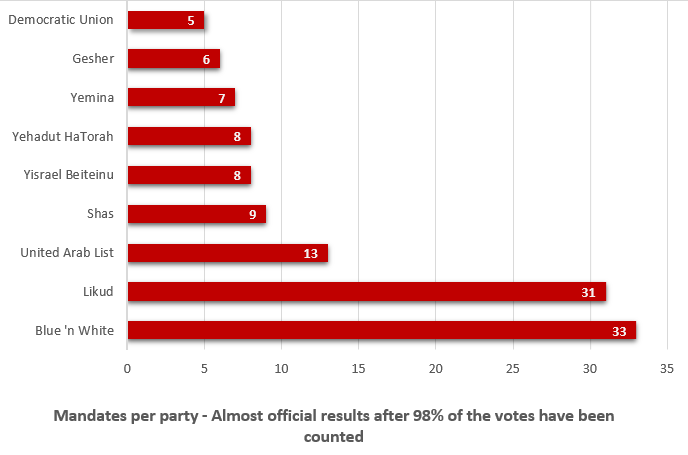
Results on September 29th, 2019 after 98% of the votes had been counted

official results israel election 2019

Results in percentages and actual votes

results 20 sept

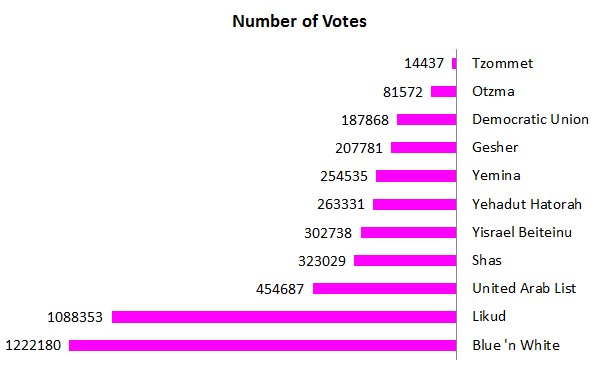
Number of votes as at 10.03 am September 19th, 2019


Number of votes as at 10.03 am September 19, 2019

number of votes

Results in percentages at 08.06am on September 19th, 2019

israel election results 2019 percentages

Results in percentages as at 10.00pm September 18th, 2019

israel election results September 2019 in percentages

Results at 10:00pm September 18th, 2019

Results as at 12:00pm September 18th, 2019

election results 2

Results published by CEC at midday September 18th, 2019

Predicted results by Channel 12 at 7:00am September 18th, 2019

israel election results September 2019

Predicted results by Channel 12 at 7:00am, September 18th, 2019

Israel Political Parties

0

Reading Time: 2 minutes

What’s on the ballot slip? Israel political parties for September 17th, 2019. List of candidates.

Information by courtesy of the Israel Central Elections Comittee

Party Name on the Ballots

English Name or Transliteration

Authorized Representative Letters on the Ballots

דעם – כלכלה ירוקה מדינה אחת

Green Economy – One State (Da’am)

ץ

מנהיגות חברתית

Manhigut Hevratit

י

עוצמה כלכלית קולם של העסקים בישראל

Otzma Calcalit

ז

ישראל ביתנו בראשות אביגדור ליברמן

Yisrael Beiteinu, headed by Avigdor Lieberman

ל

זכויותנו בקולנו – לחיים בכבוד

Zechuyoteinu B’Koleinu – L’Haim Bekavod

ק

אדום לבן – לגליזציה לקנביס, שוויון לאתיופים, ערבים ומקופחים

Adom Lavan

יז

הפיראטים – כי כולנו באותה סירה והכל אותו שייט

HaPiratim

ףז

מתקדמת

Mitkademet

נ

מפלגת הגוש התנ”כי

Bible Bloc Party

יק

התאחדות הספרדים שומרי תורה תנועתו של מרן הרב עובדיה יוסף זצ”ל

Shas

שס

צדק בראשות אבי ילאו

Tzedek

צ

קמ”ה – קידום מעמד הפרט

KaMaH – Kidum Maamad HaPrat

קץ

כבוד האדם

Kevod HaAdam

יף

יהדות התורה והשבת אגודת ישראל – דגל התורה

United Torah Judaism

ג

כבוד ושוויון

Kavod V’Shivyon

נך

מפלגת הדמוקראטורה

Democratura

זכ

נעם – עם נורמלי בארצנו

Noam

כ

כחול לבן בראשות בני גנץ ויאיר לפיד

Blue and White, headed by Beni Gantz and Yair Lapid

פה

כל ישראל אחים לשוויון חברתי

Kol Yisrael Ahim

נץ

סדר חדש – לשינוי שיטת הבחירות

Seder Hadash

קך

הליכוד בהנהגת בנימין נתניהו לראשות הממשלה

Likud, headed by Prime Minister Binyamin Netanyahu

מחל

האחדות העממית – אלוחדה אלשעביה בראשות פרופ’ אסעד גאנם

HaAhdut HaAmamit

כי

המחנה הדמוקרטי  בהנהגת הורוביץ, שפיר וברק

Democratic Union, led by Horowitz, Shafir and Barak

מרצ

צומת – התיישבות וחקלאות

Tzomet

זץ

התנועה הנוצרית הליברלית

HaTnua HaNotzrit HaLiberalit

ינ

הרשימה המשותפת חד”ש, רע”ם, תע”ל, בל”ד

Joint List (HaReshima HaMeshutefet)

ודעם

עוצמה יהודית בראשות איתמר בן גביר

Otzma Yehudit, headed by Itamar Ben Gvir

כף

רון קובי – הימין החילוני נלחמים בכפייה החרדית

Ron Kobi – HaYamin HaHiloni

רק

צפון

Tzafon

צן

.ימינה בראשות איילת שקד הבית היהודי – האיחוד  הלאומי – הימין החדש

Yemina, headed by Ayelet Shaked

טב

העבודה – גשר בראשות עמיר פרץ ואורלי לוי אבקסיס

Labor – Gesher, headed by Amir Peretz and Orly Levy-Abekasis

אמת

SURVEY Expat Life in Israel

0

Reading Time: 8 minutes

Expat Insider Survey 2019 – Expat life in Israel.

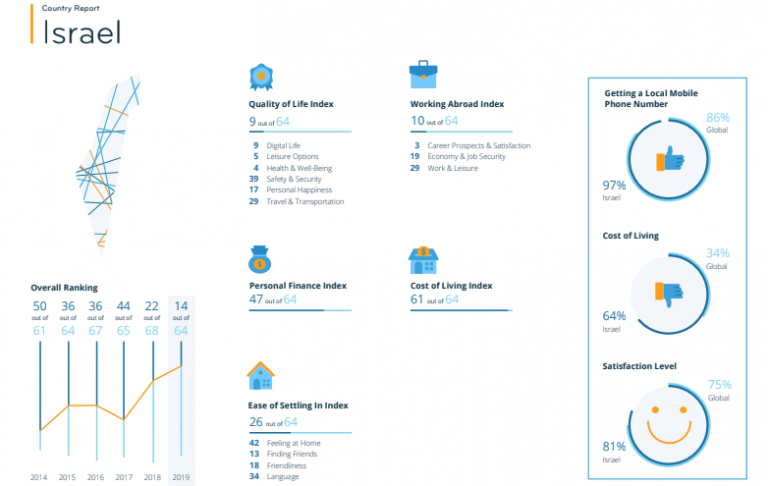
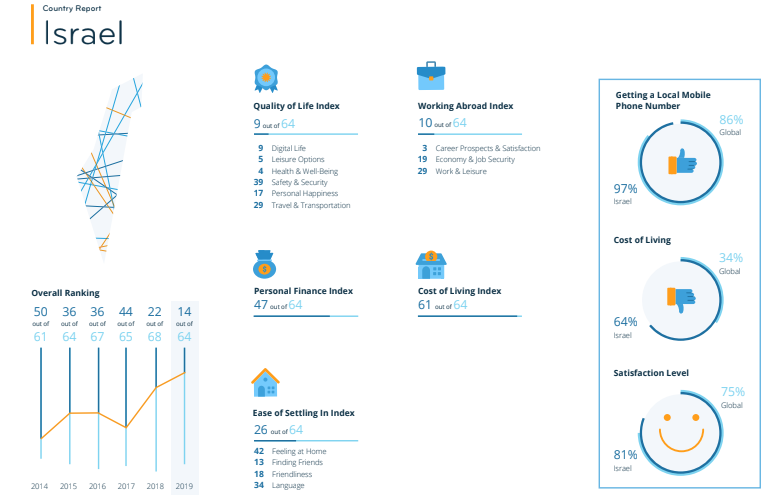
Israel ranks 14th out of 64 counties for quality of expat life in Israel, in the latest Expat Insider Survey.

Coming in 14th out of 64 destinations in the Expat Insider 2019 survey, Israel reaches its best rank ever. Compared to last year, it gained ground in all indices of the survey and places among the top 10 countries in the Working Abroad (10th) and Quality of Life Index (9th). In fact, expats are very happy with the available leisure activities in Israel (88% vs. 75% globally), with one expat from the USA highlighting that there is “always something going on” in Tel Aviv. Ranking fourth in the Health & Well-Being subcategory, expats are also happy with the affordability of healthcare (84% vs. 55% globally) and the quality of medical care (88% vs. 65% globally) — 51% and 43%, respectively, even give the best possible rating for these factors. In terms of working abroad, Israel gains twelve ranks in one year (from 22nd to 10th): expats are, for example, more satisfied with their jobs overall (78% in 2019 vs. 65% in 2018) and rank the country second in the world for this factor now, only beaten by Vietnam.

On the downside, Israel is among the world’s worst countries for cost of living for the sixth year in a row (61st out of 64 in 2019): close to two-thirds (64%) find the general cost of living high, which is close to twice the global average (34%). However, Israel climbs up 17 places in the Personal Finance Index since 2018 (from 64th to 47th), making it out of the bottom 10 countries of this index for the first time. Close to three in five expats (59%) are happy with their financial situation in 2019 (vs. 54% in 2018), and 41% say that their disposable household income is more than they need to cover their daily life (vs. 29% in 2018).

expat life in israel

How expat life in Israel ranks against other countries?

If you are considering moving from Israel and relocating to one of these countries, this is what you can expect;

Mexico

Mexico is the world’s easiest country to settle in as an expat, and more than four in five expats (84%) feel at home in the local culture (vs. 60% globally). Expats consider Mexicans to be very friendly (92% vs. 68% globally), they also find it easy to make friends with them (80% vs. 42% globally). Mexico also ranks first in the world for socializing and leisure activities (84% positive ratings vs. 65% globally).

Australia

Australia ranks 17th out of 64 countries in the Expat Insider 2019 survey. It mainly lost ground in terms of quality of life (8th to 15th), working abroad (13th to 19th), and personal finance (40th to 52nd). In fact, 19% of expats are dissatisfied with their financial situation (vs. 14% in 2018). Additionally, close to three in ten expats (27%) are not satisfied with healthcare costs.

On the other hand, Australia claims the top position worldwide regarding the available of leisure options. Over nine in ten expats (91%) are pleased with the leisure activities on offer (vs. 75% globally), and 60% even find them very good (vs. 36% globally). Meanwhile, expat parents rank Australia 12th out of 36 destinations in the Family Life Index: they are particularly happy with the available leisure options for children (90% satisfied vs. 75% globally) and the available education options (67% satisfied vs. 53% globally).

Canada

Canada receives its best ratings in the Family Life Index, ranking 7th out of 36 countries worldwide. Over nine in ten expat parents (92%) are satisfied with their children’s general well-being (vs. 81% globally), only Spain (93%) and Finland (95%) score higher for this factor worldwide. Additionally, Canada ranks in second place worldwide for the availability of education options. Close to seven in ten expat parents (67%) agree that options for their children are widely available (vs. 53% worldwide), with Canada following only behind Finland (76%).  Additionally, Canada ranks 11th out of 64 destinations in the Quality of Life Index, with a particularly strong performance in the Digital Life subcategory (5th). For example, close to all expats (96%) find it easy to pay without cash (vs. 79% globally) and over three-quarters (77%) even say it could not be any easier (vs. 50% globally).

While Canada has fallen in the Working Abroad Index (from 15th to 22nd), expats are still more satisfied than the average with their working life. More than three in five (61%) are rate their career prospects positively (vs. 55% globally), 77% are happy with the state of the economy (vs. 63% globally), and 67% are satisfied with their working hours (vs. 62% globally).

United States of America

The USA remains in a below-average 47th place out of 64 countries in the Expat Insider 2019 survey. Over seven in ten expats (71%) find that healthcare in the USA is not affordable (vs. 26% globally), which makes the USA the worst-rated country worldwide for this factor. The country also performs badly in the Family Life Index, ranking 32nd place out of 36 countries. With over half the expat parents (55%) being unhappy with the costs of education (vs. 35% globally), it is hardly surprising that one French expat says: “If you have kids, their education will cost a fortune.” What is more, the USA ranks last worldwide for the affordability of childcare, with over seven in ten expat parents (73%) rating costs here negatively (vs. 40% globally).

Conversely, the USA performs well in the Digital Life subcategory, ranking 7th out of 64 countries. Having a fast internet connection is not an issue, with 90% of expats having easy access to high-speed internet at home (vs. 75% globally). Moreover, 70% are happy with the availability of administrative and government services online (vs. 55% worldwide). Expats in the USA also appreciate their career prospects, for which the USA ranks fifth worldwide. However, the country still only ranks 40th out of 64 countries in the Working Abroad Index overall, its worst result in this index so far. Expats are mainly dissatisfied with their work-life balance (28% negative ratings vs. 21% globally) and their job security (27% vs. 21% globally).

China

Ranking 50th out of 64 destinations in the Expat Insider 2019 survey, China ranks among the world’s worst destinations for family life (29th out of 36), quality of life (55th out of 64), and the ease of settling in (58th out of 64). For the latter, it even lands among the bottom 10 for the sixth year in a row: expats struggle to feel at home in the local culture (59th), settle down in the country (60th), and get used to the local culture (62nd). In fact, 28% say that culture shock was one of their main concerns before moving to China (vs. 14% globally).

Within the Quality of Life Index, China ranks last in the Digital Life subcategory. China ranks among the top 10 for is the transportation infrastructure (9th): nine in ten expats (90%) are satisfied with this factor (vs. 68% globally).

Expats are very concerned with the quality of the environment (63rd), with over three-quarters (76%) giving this factor a negative rating (vs. 20% globally). A quarter of expat parents (25%) also worries about their children’s health (vs. 10% globally).

South Africa

Coming in 52nd out of 64 destinations in the Expat Insider 2019 survey, South Africa ranks among the worst destinations for personal finance (56th), working abroad (57th), and quality of life (57th). Safety and security is a major concern for expats, with the country placing 63rd worldwide: 36% rate the peacefulness negatively (vs. 10% globally), 51% are unhappy with the country’s political stability (vs. 17% globally), and 63% worry about their personal safety (vs. 9% globally).

South Africa is not a top scorer for digital life, either (49th): only 26% of expats think government services are easily available online (vs. 55% globally), and 27% struggle with getting access to a high-speed internet connection at home (vs. 15% globally). However, paying without cash is not an issue for over nine in ten (91% vs. 79% globally). While the quality of medical care seems to satisfy expats in South Africa (75% happy vs. 65% globally), it does not seem to be affordable (37% unhappy vs. 26% globally). On the bright side, South Africa ranks 8th out of 64 in the Leisure Options subcategory: 80% are satisfied with the available leisure activities in general (vs. 75% globally), and 89% are happy with the climate and weather (vs. 61% globally).

Within the Working Abroad Index, South Africa ranks worst in the Economy & Job Security subcategory (60th): almost six in ten expats (59%) rate the state of the economy negatively (vs. 18% globally). What is more, just 44% are happy with their career prospects (vs. 55% globally).

The United Kingdom

The UK ranks 58th out of 64 countries in the Expat Insider 2019 survey admit ongoing Brexit uncertainty: it has fallen 14 places in terms of political stability, now ranking among the ten worst countries in the world for this factor (57th). Over two in five expats (42%) rate the political stability negatively (vs. 17% globally). As one German expat puts it: “Brexit makes our future uncertain.” In addition, the UK receives its worst ratings ever in all subcategories of the Working Abroad Index: it ranks 45th for economy and job security, which is 29 places lower than in the Expat Insider 2016 survey before the Brexit referendum (16th out of 67).

In 2019, nearly one-quarter of expats in the UK (23%) are unhappy with the state of the economy (vs. 8% negative ratings in 2016), 21% are unsatisfied with their career prospects (vs. 12% in 2016), and 23% worry about their job security (vs. 17% in 2016).

Expats also struggle to settle in, with the UK ranking 45th in the Ease of Settling In Index. Nearly three in ten expats (28%) say that Brits are unfriendly towards foreign residents (vs. 19% globally). It might be no surprise then that the UK ranks third from the bottom for personal happiness (62nd), only ahead of Denmark (63rd) and Kuwait (64%). Just 66% of expats are generally happy with their life in the UK (vs. 74% worldwide).

Brazil

In the Expat Insider 2019 survey, Brazil comes in last worldwide in the Safety & Security subcategory: 41% do not find the country peaceful (vs. 10% globally), 61% do not feel safe (vs. 9% globally), and 53% are dissatisfied with the political stability (vs. 17% globally). An expat from New Zealand describes having the “underlying feeling of people always living in fear” in Brazil.

While Brazilians seem to be very friendly towards families with children (13th out of 36 countries), Brazil still comes in second to last in the Family Life Index overall (35th), only ahead of Turkey. It is rated the worst destination for family well-being, with more than half the expat parents (54%) concerned about their children’s safety (vs. 9% globally). The quality of education is also rated negatively by 38%, more than double the global average (16%).

While Brazil also ranks low for working abroad (58th out of 64), it comes in 37th place for the ease of settling in. More than four in five expats (83%) find the Brazilians friendly (vs. 68% globally), though nearly three-quarters (74%) disagree that it is easy to live in the country without speaking the local language (vs. 40% globally).

For its annual Expat Insider survey, InterNations asked 20,259 expats representing 182 nationalities and living in 187 countries or territories to provide information on various aspects of expat life, as well as their gender, age, and nationality. Participants were asked to rate up to 48 different aspects of life abroad on a scale of one to seven. The rating process emphasized the respondents’ personal satisfaction with these aspects and considered both emotional topics as well as more factual aspects with equal weight.  The respondents’ ratings of the individual factors were then bundled in various combinations for a total of 17 subcategories, and their mean values were used to draw up six topical indices: Quality of Life, Ease of Settling In, Working Abroad, Family Life, Personal Finance, and Cost of Living.  In most countries the sample size exceeded 100 participants.

Currency Converter

0
Reading Time: < 1 minute

Convert the New Israeli Shekel to American, Australian and Canadian dollars, British pounds, Euros the South African rand and other currencies.

pile of shekels minimum wage

Shabbat Shalom!

Reading Time: < 1 minute

Shabbat information.

Shabbat shalom and welcome to our Shabbat page with all the essential resources you need for this week.

Shabbat (Hebrew: שבת) the seventh day of the week and the Jewish day of rest that brings Jews, around the world, together.

shabat shalom

Shabbat Times

Shabbat candles must be lit before sunset. It’s a desecration of the Shabbat to light candles after sunset.  Shabbat candle lighting times listed are 30 minutes before sunset.

Shabbat candle lighting times for Israel and other international locations


Parshat HaShavua

Inspiration, lessons, Divrei Torah, ethics, stories and commentaries for all levels.

An index of all the weekly Torah portions – Parshat Hashavua


Shabbat Dinner

Shabbat guide for first time guests – what you can expect at a Shabbat dinner.


Shabbat words & phrases

Shabbat words and phrases: Hebrew, English and transliterations

Jewish calendar months & their place in the zodiac

Jewish months of the year

Shabbat shalom!

The Hebrew month of Elul

Reading Time: 11 minutes

Wake up! The significance of the Hebrew month of Elul which aligns with Virgo in the zodiac.

Contributed by Rav Nissim Mordechai Makor.

Elul and t’shuvah – Remember, astrology is not about telling the future, nobody can do that. By understanding the energy of each month, we are able to navigate smoothly through the month, because one cannot act the same way every month. Every month has a different energy and it helps to know what that specific energy is.

month elul aligns with virgoI recently heard a shiur where the Rabbi asked a very interesting question. He was talking about Elul and t’shuvah. He said that the month of Elul is the month to do t’shuvah, to try and change ourselves for the upcoming year.  The question he asked his class was;

“Are you any different this year from the same time last year? Did you change besides being one year older? Did you do the things you promised yourself last Elul and Rosh Hashanah? Were you able to manifest your goals?”

In the secular world, people make New Years resolutions on January 1. How long do these last until one falls back into their bad habits?

If this is the case, what is the benefit of t’shuvah? Is t’shuvah just lip service? We know that HaShem knows our innermost thoughts. If so, how can we expect to con HaShem?  What is this all about?

Stop for a minute and reflect on the last year – have you changed?

The Rabad, referred to Elul as a time of “Eit Ratzon/time of mercy or desire. Eit Ratzon is a very special time. Eit Ratzon connects directly to the Sefirah of Keter and Elul is a very good time to bring down blessings for the new year.

The Gaon of Vilna said that the main reason we came to this world is to improve/change our middot (character traits).

Elul is a very interesting month. Officially it belongs to the year that is finishing, yet it is completely connected to the upcoming new year. How is this possible? It is written that after the fifteenth of Av, Heaven begins preparing the chairs in the upper courts for Rosh Hashanah and it is a good time to start doing t’shuvah.

Summer is drawing to a close. In the world of nature, especially in the very cold climates, all the animals are very busy at this time getting ready for the upcoming winter. They have to make exact plans for food or otherwise they won’t survive the harsh winter. They take this time very seriously. They know instinctively what to do and how to prepare. It says that the fish in the sea tremble when Elul comes around. Every animal is seeking to do while there is still time left, because the Master will call. When we say this, we mean that Rosh Hashanah will come around and everybody will have to answer for the last year. We must remember, on Rosh Hashanah we are judged at the level where we are at that moment. What we did in the last year has brought us to that point.

In nature, obedience is the rule. All of nature stands around Hashem’s throne, each one bringing Hashem the product of it’s labor. No animal or plant would dare to go against it’s nature. Nature has rules and the animals have to follow them. This is a definite.

Only man can be enticed from his set path. Man is casual and inattentive and ignores the seriousness of this time. The animals shiver with fear that Hashem won’t destroy the world.

With free will, man has to choose with his own intellect what is right or wrong. He has the power to go against what is right(nature).

This is one of the reasons we start to blow the shofar the beginning of Elul, to wake us up. In the old days, people used to faint at just the mention of the word Elul. The shofar speaks a language. It is telling us; do t’shuvah and change your ways. We just need to understand the language of the shofar.

Elul is a gift from Hashem. Nobody would dare go into a court case in the physical world without preparing. A persons lawyer would be interviewing witnesses, checking facts etc.the month of  Elul is the time for preparation for Rosh Hashanah.

Hashem made it easy for us to do t’shuvah in Elul. Chazal says that in Elul, “the King is in the fields”. What does this mean? During the rest of the year, if a person wants to do t’shuvah, he has to go to Hashem. The analogy is the person has to make an appointment with Hashem, go to him and present his case. In the month of  Elul it is different. Hashem makes it easy for us and He comes to us, “the King is in the fields”. Wherever we are, Hashem is listening and waiting for us every second.

Let’s ask the question, what actually is t’shuvah? We say it is repentance but what is repentance? It is very simple. Stop doing the negative thing or things that we have been doing. It sounds easy but is actually very difficult. To change our nature is the most difficult thing in this world for us to do.

“Great is t’shuvah, for it brings healing to the world”, Yoma 86b.

T’shuvah is equal to all the Mitzvot.

The concept of t’shuvah/repentance is so far above human comprehension. Why?

It is one of the biggest Chokim. A chok is a law which is very difficult for humans to understand. Some of them are, meat and milk, the red heifer and Shatnez. Why is t’shuvah a chok? In the physical world if a person is caught by the police for doing a serious offense, and he goes to court and tells the judge he is sorry and won’t do it again, the judge will never let him off. However, in the spiritual world, when we do t’shuvah,(we are truly sorry for what we have done), Hashem looks into our heart to see if we are serious and not just doing lip service. This is the key to t’shuvah, as we can’t hide anything from Hashem. If Hashem decides to give us a second chance, He wipes the slate clean. This is mind boggling to think that we can be forgiven just like that for our sins. This is the reason we cannot comprehend t’shuvah.

A conventional understanding of t’shuvah would suggest that one can do wrongful deeds all year long and come to Shul on Rosh Hashanah and Yom Kippur and ask for forgiveness. People think they can evade the consequences of their actions over the past 12 months. But can we really expect to be forgiven for our sins simply by saying some prayers on these holidays. This is definitely not t’shuvah.

We can see that repentance is not a ritual that we do once a year like matzah and sukkah. Repentance takes us back to our source and we are able to make changes for the next year. It is a very powerful gift that HaShem gave us to guarantee a good year. Use it!!!

Remember there can be no growth without honesty. Humans have an incredible ability to con themselves. We will make up the biggest stories in our minds and before long we will have convinced ourselves that we are perfect and don’t need to change, only our friends have to change.

We also have to have the desire to do t’shuvah. Many people don’t want to change their bad habits. Take for an example a person who smokes. He knows it is very bad for him, yet he does not stop. He makes excuses that he enjoys it or it calms him down.

Please understand, I have simplified the process, but the basic message is that we have to stop doing things that we are doing wrong.  Also know that Elul includes an the whole of the next year. What we do in the month of Elul is going to affect Rosh Hashanah and the whole of the next year.

One of the ways the Tzadikkim suggest we should prepare for Rosh Hashanah is to write two lists, one with what we want from Hashem for the new year and one with things we will do for Hashem, example, more charity, more learning and davening etc, in the new year. Write down ten things on each list. With the list for Hashem, try to put down things that we have been trying to do for years. Things like, trying to change a bad character trait, to do mitzvot better, to get healthier, go to the gym etc. On the other list put down things you want from Hashem. Things like better parnasah, health, nachas from the children etc.

Think about ways you can achieve your goals. Read the list on Rosh Hashanah and also read it every day. You most probably won’t achieve the ten things for Hashem. It is doubtful if you can achieve half, but if you achieve one or two, guaranteed you will have a good year. It seems like this is kind of childish, but believe me it is a very powerful tool to do t’shuvah. If you read it everyday, slowly the things on the list will become imprinted on your consciousness and change will become possible.

Elul is the month of perfection, HaShem’s purpose in creation. The word in Hebrew for the zodiac sign this month is Betula, which means virgin, the same as the English word, Virgo which is connected to virgin, which implies purity. In this month we have the ability to cleanse ourselves of a lot of dirt.

The tikkun of people born in the month of Elul is that they focus on details too much and don’t see the big picture. Virgo’s live in a world of fantasy and, because they have the ability to see perfection, they have the trait of judgement. They can’t understand why people can’t see things the way they do. Many Virgo’s are very particular about there possessions and are fanatical about keeping things neat and in order. I know some Virgo’s whose clothes are not only neat and tidy but are all color coded. Look at a Virgo’s office or home and you will find everything perfectly in place. It is very difficult for a Virgo to live in a mess, it drives them crazy. Virgo’s are not very sensitive to others and don’t have a lot of patience. Because they see perfection, Virgo’s also have a bit of a superiority complex. Try not to pass judgement in this month.

The letters of the month are Reish and Yud and the line of the Ana Bekoach is the sixth line. Virgo is an earth sign and is center of the three earth signs.

The Gemara says:

Tshuvah is great; it reaches Hashem’s honored throne. Before Hashem’s throne is t’shuvah.

T’shuvah is for everyone. Regardless of what you did, one can repent, and Hashem will cherish your t’shuvah. Our entire status changes when we do t’shuvah. We become different people and when the Satan looks for us on Rosh Hashanah, he can’t find us because we are a totally different person.

It is very hard to do t’shuvah, because change is so difficult to make. We must not be satisfied with a small degree of success. We must keep going until we change completely.

To break a habit you need to impress on your subconscious a new thought pattern. This is a very difficult thing to do. First you have to break the old habit and then imprint on the subconscious the opposite to what you were doing.
It is not easy, in fact it is extremely difficult. It takes an enormous effort and most importantly it does happen overnight.

The definition of insanity is doing the same thing over and over and expecting a different result. I think this is not only the definition of insanity but also the definition of a habit.

The Shevet HaLevi(vol. 4 55), said that Yismach Moshe zy’a, had a dream where he was told that castigations and fasts are not necessary, because the greatest castigation of all is CHANGE itself. To succeed to change oneself, one must endure many hardships. Such a person has already received his castigations. He doesn’t need anything else such as fasts.

Every Rosh Hashanah, we are created anew and the world is new. Therefore, Rosh Hashanah is an ideal time to change one’s behavior and ways, and to act like a completely new person.

The actual reality is that you don’t just act like a new person, but you are actually a new person. When you act differently, changing your habits, on Rosh Hashanah you become that new person because everything on Rosh Hashanah is created new.

It is easy to find faults if we look closely. Don’t be sensitive to criticism. Let go of your selfish desires.
Moshe was in Heaven during Elul and received atonement for the golden calf and received the thirteen attributes Let’s take Moshe Rabeinu’s example.

There is a Gemara that says; if we don’t know what we have, then it doesn’t belong to us. In the old days, people used to faint at just the mention of the word Elul. It also says that the fish in the sea tremble when Elul comes around. Take this opportunity to prepare for Rosh Hashanah and guaranteed Hashem will grant you a good year.

Wake up!!!

Take the example of the animals. Get ready now for the upcoming year. If you prepare properly for the new year in Elul, it will help you a great deal on Rosh Hashanah. Take advantage of this gift that HaShem gave us. It only comes around once a year.

We have to accept responsibility for our actions. Each and every one of us is responsible for our own success or failure. There is no free ride. In spirituality we have to earn everything.

Sefer Yetzirah tells us that Elul/Virgo gives us the opportunity to achieve control over our lives and to shape our destinies. In this month we literally have the power to go back in time to those moments we erred, fix them and then erase them and all the suffering they brought us. This is the power of this month. I beg you, take advantage of it. Please do a list.

The month of Elul/Virgo is the solution. Go back, become pure and have a great year.

Chodesh Tov and Shana Tova.

Another perspective on change

From a shiur given by Rabbi Moshe Aaron Pinto.

There is a very interesting Gemara, Gitten 50:7.

It talks about Onkalos who was a ger (convert). He came from a very prominent Roman family and was involved in sorcery. He was able to bring up spirits. He brought up Titus harasha and Bilaam harasha.

He asked Titus, “Where is the truth in this physical world. Titus answered with the Jews. He then asked Titus; “Who is the chosen nation and Titus answered, the Jews. He then asked Titus, what is your punishment for hurting the Jews. Titus answered that every day he brings wood and they burn him to ashes which is very painful. He then asked Titus, should I become part of the Jews. The answer given by Titus was no, you should kill them, hurt them.
Onkolos then asked Bilaam the same questions. His punishment he said was that every day they put him in a pot of boiling water and boil him which is very painful. He then also asked Bilaam if he should become part of the Jews. Bilaam’s answer was the same as Titus, to kill them.

This Gemara is very strange. Why?

Both of them were in the next world where the truth is known. They answered about the Jews the truth yet they still wanted to hurt them. How could they give this advice when they were suffering so much. The Gemara explains that this is the power of habit. They were so negative that even when they knew the truth, they could not change. This is the power of habit.

The Gemara goes on to talk about the other side. In Gan Eden there was a bat kol(Heavenly voice) that said a big Tzadik had just died, Yehoshua ben Levi and that he was coming to Gan Eden. His place was near Rabbi Shimon bar Yochai who was sitting on gold bricks. In heaven there is no more ego. If a person merits a reward, he gets it. This was Rabbi Shimon’s reward. Rabbi Shimon went over to Yehoshua ben Levi and asked him if there was ever a rainbow in his life, as there was never one in Rabbi Shimon’s life. There was not one in the life of Yehoshua ben Levi as he was a Tzadik Gamur(complete). Yet his answer surprises us. He said yes, there were many. How could he lie in the world of truth. He was so humble in his life on earth, then he couldn’t change even in the world of truth. Again we see the power of habit.

Reb Kalman Leví

Pearls of Life

The Pearls of Life teaches that there is a famous verse in Mishlei 3:6 – “In all your ways know Him, and He will make straight paths”. According to Rabbeinu Yona it means that a person has an obligation to have Betachon in Hashem in every step he takes. Every minute movement a person makes, he must turn his eyes to Hashem and have Betachon that Hashem will help him. A person must also remember that he is incapable of doing anything at all without Hashem’s help. All success is in Hashem’s hands, and if a person has success in something and thinks that he didn’t get it through Hashem, then he is guilty. However, when a person fulfills the words “In all your ways know Him” then Hashem will reward him and he will be success in all his deeds. Besides having success, he will also receive merit for having had Betachon. This merit is “the greatest thing in Heaven. When a person is Nifter [passes away] he is asked did he ever believe that when one is nifter did he believe he will be saved by Heaven? Did you have Bitachon in Hashem (and not be give up) in every new factor of your life? He also adds that by doing this – besides getting what you hoped for you will receive tremendous merit in the next world for the Mitzvah of Betachon in believing in the next world. The Ramban teaches that a person should praise Hashem always. He says, that it also could mean that you are praised since you have Hashem as your God. Adapted from the Betachon Weekly by Yeshiva Pirchei Shoshanim

Safety & Security in Israel’s daycare, kindergartens and preschools

0

Reading Time: 3 minutes

Daycare safety & security in Israel – kindergartens and preschools.

daycare safety and securitySome very unpleasant incidents in Israel’s daycare, kindergartens and preschools have caused real anxiety amongst parents. Prior to the start of the academic year on 1 September we need to ensure that daycare safety and security checks are in place and all children can play, learn, and interact in a safe and nurturing environment indoors and outdoors.

You can expect a huge difference in levels of daycare safety and security in private daycare and in municipal daycare, kindergartens and preschools.

Before enrolling your precious child into daycare, ask for recommendations from your neighbors and friends especially if you are entering the education system for the first time. There are parent support groups on Facebook which are an ideal platform to ask questions and get recommendations.

The Israel Ministry of Labor, Social Affairs and Social Services sets out these guidelines

  • Sending your little one to a Mishpachton in a Metapelet’s home?  The maximum number of children allowed is 5 and none older than 12 months.
  • Number of carers per child in a daycare center
Age Maximum Capacity Adult:Child

Ratio

Classroom Size Area per child
6 – 15 months  15  1:6 50 sq m 3.3 sq m
16 – 24 months  22  1:9 70 sq m 3 sq m
25 – 36 months   27  1:11 70 sq m 2.6 sq m
3-4 years 3 2:35
  • Ratio of carers:children in a municipal kindergarten, ages 3-6, is 2:35.
  • Private kindergartens usually have one carer to 3 or 4 children between the ages of 3 – 24 months. Ages 2 -4 months, it is usual to have one carer to 6 or 7 children.  From ages 4 -6 you can expect one carer for every 10 children.

Daycare safety and security questions you might want to ask

General security

  1. Is there a security gate and is it locked at all times?
  2. Are there security cameras around the perimeter and at the main entrance of the kindergarten?
  3. Are there security cameras within the indoor space of the day care center?
  4. What are the rules for dropping-off and picking-up your child? Who is authorized? How is that monitored?
  5. Can a parent or guardian just pop-in at any time to observe or pick-up their child?
  6. What qualifications do the caregivers have and what kind of background checks are done on staff members?
  7. How is suspicious behavior handled?

Health safety questions

  1. Are staff members trained in first-aid and CPR?
  2. What systems are in place for monitoring your child’s health?
  3. Rules for administering medications?
  4. Sterilization and sanitization of play areas, surfaces and toys on a daily/weekly basis?
  5. Potty and bathroom hygiene?


Food safety related issues

  1. Kitchen hygiene
  2. Food allergies and sensitivities
  3. If meals are provided, what is the daily/weekly menu plan?
  4. If you are providing meals, what factors need to be taken into consideration? Is there adequate refrigeration? What about heating of food?

Accident safety

  1. Consider some of these; smoke detectors, anti-slip floors, maintenance of outdoor play equipment, sand-pit hygiene.
  2. What plan is in place in case of an emergency; fire, earthquake or a national security situation?

Physical and emotional safety – common signs of child abuse

  • Changes in your child’s behavior or extreme mood swings
  • Showing an unusual interest in sexual matters
  • Showing fear or anxiety toward the daycare or an employee
  • Unexplained injuries, bruises, welts and cuts
  • Reverting to infantile behavior that they outgrew a long time ago
  • Night terrors or recurring nightmares
  • Urinary tract infections or soreness around the genitals
  • Trust your instincts

What should you do if you suspect daycare abuse?

If you feel that the safety and security of a child in daycare is being compromised in any way, reporting your suspicions to the daycare operator or manager is simply not enough. If you suspect or have evidence pointing to daycare abuse, immediately report your suspicions to the authorities as well.  Someone who reports child abuse is not necessarily making an accusation, but rather they are reporting their suspicions that there may be abuse or neglect occurring. It’s important to remember that your actions could prevent further instances of abuse and save a child from the lasting effects of abuse

Good luck for kindergarten. Learn, laugh and have fun!

“Education is the most powerful weapon which you can use to change the world” – Nelson Mandela