12.6 C
Jerusalem
Sunday, April 19, 2026
Sample Page
Home Blog Page 165

Aliyah Organizations for English Speaking Countries

Reading Time: 3 minutes

Aliyah Organizations & Jewish Federations for English Speaking Countries.

The AACI – Association of Americans & Canadians in Israel

By: Yanina Musnikow

AACI, a voluntary, non-profit organization, was established in 1951 to help North American immigrants acclimate to Israeli society. AACI’s services today are available to all English speakers who reside or wish to reside in Israel. New and veteran immigrants, students, tourists and returning residents are among those who use our services. Our members pay a nominal fee and receive free counseling services concerning immigrant rights, housing, employment, status changes,ulpan, Social Security and more.

AACI has national and local programming. For more information, see the AACI website – www.aaci.org.il and/or subscribe to the North newsletter – ymusnikow@aaci.org.il.  We currently have about 30,000 members nation-wide.

Yanina Musnikow, the AACI Counselor for Haifa and the Northern Israel is available for appointments in the Information Service Center at 131 Sderot HaMeginim, Haifa, once a month.

Nefesh B’Nefesh

By: Nefesh B’Nefesh Contributor

Nefesh B’Nefesh is a nonprofit organization providing Aliyah assistance and support for Olim from the U.S., Canada and the U.K. Nefesh B’Nefesh offers a comprehensive basket of services including financial assistance, employment counseling, job placement services, assistance with governmental absorption, and community-based guidance.

The Nefesh B’Nefesh website offers detailed information about the Aliyah process, Aliyah rights and benefits, the Israeli job market and more. It includes an online guide to Israeli communities, schools and Ulpanim.

For more information, please phone 02-659-5800.

Telfed (Olim from Southern Africa, Australia & New Zealand)

Telfed, the South African Zionist Federation (Israel) is happy to welcome you to your new home in Israel.  How fortunate you are to have made Aliyah to Israel.  The stunning natural beauty of this country; the Judean Hills, miles of golden beaches on the coast-line, the Carmel mountain range in Haifa, the Bahai gardens etc. – all join together and proclaim “Welcome Home”.

Telfed is very proud of its Regional Committees across the country.  The committees of veteran Southern African volunteers is eager to contact all new Southern African Olim, inform them of the manifold services available to them and invite all Southern African Olim to the regular social events run by the committee volunteers.

Telfed takes care of the needs of olim from Southern Africa, Australia & New Zealand.

Wishing you a smooth and enjoyable integration into Israeli society.

B’Hatzlacha!

Dorron Kline –  Director

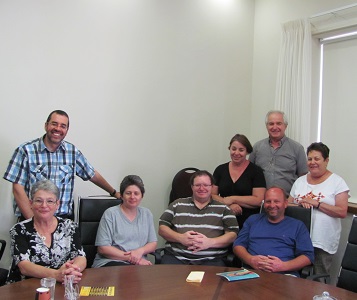
Telfed haifa volunteers

Telfed and Haifa olim meet with Municipality representatives & Haifa Mayor Yona Yahav.

Standing from L to R: Dorron Kline (Telfed), Suzanne Suckerman, Martin Klein & Nechama Keynan (volunteer)

Seated: Susan Sharon (Telfed) z”l  & new olim – Bat Sheva & Mark Sida and Erin Schneider


Affiliate Aliyah Organizations

ESRA

ESRA – English Speakers Residents Association – are a group of English speakers in Israel, volunteering for the community.  ESRA has branches all over the country.  Over a thousand English speaking volunteers help run scores of social, cultural and educational programs.

Merkaz Hamagshimim – Hadassah: Jerusalem’s Anglo Community Center

Offers you:

  • An amateur English language theater
  • An activism center
  • An art gallery showcasing the work of new olim
  • Social events all in English
  • Information on Aliyah tourist programs, volunteer opportunities, internships, studying in Israel as well as FREE assistance to olim on any aspect of living in Israel

Address: Tzipora #5, Jerusalem

Telephone: 972-2-6722405


Floor Plan & Design of an Israeli Apartment

Reading Time: < 1 minuteFloor Plan of a Typical Israeli Apartment.

Avoid costly Aliyah shipping mistakes!

It’s much easier to plan your Aliyah or Israel relocation shipment when you know the dimensions of a typical Israeli apartment.  Many new immigrants have shipped over-sized household items and large furniture and other items with dimensions that are just too big or not appropriate for the Israeli lifestyle.  In addition to the unnecessary shipping costs, these inappropriate items of furniture or large appliances are difficult to sell even at second-hand prices.  

floor plan of a typical israeli apartment

Preparing for an earthquake in Israel.

Reading Time: 6 minutes

Earthquake drills, preparation and proper action to be taken in the event of an earthquake.

The Geological Survey of Israel published these details for today’s (23.01.22) earthquake felt in Israel as follows:

  • Earthquake Magnitude: 4.1
  • Date: 23.01.22
  • Depth of the earthquake: 10km
  • The earthquake was felt in: Jordan, Israel, Lebanon, and Syria

Hours later, a second earthquake was was felt south of Tiberias, measuring only 3.7 on the Richter Scale.

No injuries or significant damage was reported.

Earthquakes in Israel

About 20,000 earthquakes a year occur around the world, but many more go unrecorded and undetected because they occur in remote areas or are of very small magnitudes. That is a scary number. What about Israel?

Preparing for an earthquake (Hebrew: Re’i’dat A’da’ma) in Israel should be taken seriously. Israel lies on the Syrian-African fault line.  The fault run along the Red Sea, the Dead Sea and Jordan Valley, causing geological activity in the area. While most of the tremors in Israel rank low on the Richter Scale, one should always be prepared.

Earthquakes cannot be predicted in advance and they can take place at any time. We must be fully prepared – correct behavior during a quake can prevent damage and save lives.

Earth slides, structure and building collapse, falling debris, glass shards, fire, flooding and gas leaks are consequences and dangers that can be expected with significant quakes.

How to prepare for an earthquake?

The Home Front Command (Pikud HaOref – פיקוד העורף) tells us that during a significant earthquake furniture will begin to move, vibrate and shake from side to side. These first few seconds are critical and offer the best chance of survival. Stay calm!

  • Locate a safe place in your home – far from exterior walls or in a MAMAD if you have one
  • Be familiar with the location of the main electrical breakers, water and gas valves, and how to close them
  • Familiarize yourself with the emergency exits in your building
  • Decide on a meeting point for family members to meet should an earthquake take place and you are separated
  • Any object which can move, fall or break, is a source of danger.

Structural integrity of the building

It is recommended to have your building examined by a licensed structural engineer who will determine whether your building complies with Israel’s structural bylaws. Buildings constructed before 1980 do not comply with these requirements. If your building does not meet the requirements consider taking appropriate action to have it reinforced it as soon as possible!

Making your home safe

We never know when a quake will happen, but there are a few minor things you can do to make your home a little safer. Most casualties in an earthquake are caused by collapse of heavy objects or by fire and gas leaks and it is therefore advisable to do the following:

  • Make sure bookshelves, cupboards and television sets are firmly attached to walls
  • Reinforce supports of water boilers, heater tanks, gas bottles, air conditioners and their compressor units
  • Store hazardous and flammable materials in a safe place and far from heat sources
  • Place heavy objects as low as possible.

Earthquake tips – Basic family training

Pikud HaOref suggests that in the event of an earthquake the safest thing to do is evacuate the building you are in.  If you do not have time for that, then the drop, cover, hold-on drill should be followed.

earthquake drill
Standard earthquake practice: Drop, cover and hold on and practices for the infirm and disabled.

Tip # 1

Locate in advance, with the family, according to the guidelines above, the safest place in your home and at work, where you can take shelter during an earthquake: for example the MAMAD, a staircase in a multistory building or an open space outdoors if you have a ground-floor dwelling.

Tip #2

Show all members of the household how to close the main electrical breakers, the water and gas mains.

Tip #3

Establish an outdoors meeting spot for your family in advance. Also, agree upon a contact person outside your household to be approached in case you lose contact with one another.

Tip # 4

Have periodic family drills to increase your earthquake preparedness.


Household emergency supplies

  1. Food and water – stocks of drinking water (at least 4 liters per person) and preserved ready-to-use food refresh the stock from time to time before it reaches expiry
  2. Essential equipment – a first aid kit, battery-operated torch and radio, first aid equipment and other essentials.
  3. Important documents – Keep hard or electronic copies of medical documents, identification documents, personal and financial documents, outside the house, as backup

How do I know that there is an earthquake?

For those of you who have never experienced one, during an earthquake you will feel the floor trembling under your feet, the windows will rattle, furniture and household objects will move, light fittings hanging from the ceiling will swing, and your stability and mobility will be hampered by the unusual motion.

Correct Behavior During an Earthquake

Indoors

If you are indoors and feel the earth shaking under your feet, move quickly to a safe place – in the following order of priority:

  • Protected space (MAMAD) – if you are unable to go outside immediately (within a few seconds), enter the MAMAD in your apartment
  • If you don’t have a MAMAD, go out to the staircase and stay there until the tremors are over.
  • Under a heavy table or in an inner corner of the room – if you are unable to go outside immediately or move quickly into a MAMAD/staircase, take cover under a heavy table or in an inner corner of the room.
  • If you can leave the building immediately (within a few seconds), do so and go outside, into the open!

Additional instructions for staying in various structures after reaching a safe place

  • Keep away from external walls, windows and shelves
  • Kneel, stay close to the floor and cover your head and face with your arms
  • If you are in a wheelchair, lock the brakes and protect your head
  • Do not use elevators during an earthquake

Outdoors

  • If the earthquake takes place while you are outdoors, stay in the open and move as far as you can away from buildings. It’s safest to be out in the open.
  • Beware of falling objects, such as walls, air conditioner compressor units, glass shards and torn, overhead electrical cables.

In a vehicle

  • If a quake takes place while you are traveling, pull over immediately and wait inside the vehicle until the tremors subside
  • Avoid stopping under bridges, on overpasses, near buildings or sharp slopes in case of collapse. Move away from them, in the vehicle or on foot.

On the beach

  • If a significant earthquake takes place while you are on the beach, leave immediately and move as far as possible from the sea 
  • Not likely to happen in Israel but a sudden and sharp ebbing of the tide is a sign of a coming tsunami wave. 

It is recommended to drill all the steps, described above, on a regular basis.

After an Earthquake

  • To avoid potential explosion due to possible gas leaks, do not light fires or turn on electrical power or any appliances – even cellular phones.
  • Leave the building and remain in the open, far from any structures
  • Prior to leaving the building, close off the cooking gas main and the main electrical breaker in your apartment. In addition, it is advised to close the main gas valve supplying your entire building. The electricity/gas supply must be renewed by a licensed technician, after an examination that establishes that the system and the valves supplying residents of the building are in working order and properly shut off
  • Do not enter damaged buildings without authorization by a structural engineer (except for search and rescue purposes)
  • Tune into the media for information and instructions.

Trapped Under Rubble

  • If there are people trapped under rubble in close proximity to you, use your judgment and try to rescue them using household objects. If possible, offer first aid.
  • If you find yourself trapped under rubble, try and rescue yourself. Cover your airway with clothing to protect it from dust and avoid exhausting yourself by shouting.
  • Tap on pipes or walls so that rescue teams might locate you.
  • Do not light a fire!

Aftershocks

After a serious quake, be prepared for aftershocks. They can appear within minutes, days or even months following an earthquake and may collapse structures weakened by the main quake.

Home Front Command – Pikud Ha’Oref

It must be noted that when preparing for any emergency situation in Israel – information supplied by the Home Front Command must be strictly adhered to and takes precedence to any advice you may have been given by anyone else.

Other emergency situations

Israel Security – Dealing with Suspicious Items.

Reading Time: 2 minutes

Dealing with Suspicious Items – Hefetz Hashud

Hebrew: חפץ חשוד

What is Hefetz Hashud?

The phrase “Hefetz Hashud” literally means “suspicious item” and it refers to any parcel or item that has been abandoned or is unaccompanied, whether accidentally or on purpose, by its owner.  Hefetz  Hashud can be identified anywhere; on a bus, a train, in the park, the supermarket, in the street or in any public or private place.

YouTube screen shot

It does not matter if it is a child’s schoolbag or if you can  clearly see the contents of the  parcel and make out a loaf of bread and a chocolate bar – any unaccompanied parcel is suspicious.

Some of Israel’s security precautions may be annoying and overwhelming to visitors and new-comers.   You need to just accept them and cooperate with the authorities.  Whether a security guard at the school or the shopping center insists on searching your bag or makes you walk through an x-ray machine, it is for your security and safety and it must be accepted.  Following these procedures has prevented terror attacks and other dangerous situations in the past.  Any attempt to defy them will be treated with suspicion and will result in forceful action taken by the authorities.

What should I do if I see a suspicious item?

  • Remain calm
  • Children should inform a responsible adult
  • Do not approach or touch the item whatsoever
  • Immediately contact the authorities, owners of establishments, security guards, police etc.
  • Tell them the exact location of the item and provide a precise description of the article.
  • Back away and keep a safe distance.

What will happen next?

  • Within a few minutes of being informed, a special police unit will arrive on the scene.
  • The police will clear the area of passers by.  In the street, the traffic will be stopped and the road closed off.
  • If the  suspicious object is on public transport, you will be evacuated
  • The area will be sealed off
  • The item will be checked, removed and neutralized
  • After inspection, it may be neutralized by removal or may be blown up with specialized equipment.

It may take as much as half-an-hour to deal with the “hefetz hashud”.  It may be annoying and it may make you late for  an appointment or for work, you will just have to  wait patiently until an all-clear is given.  People in Israel accept the situation for what it is. Hopefully, the suspicious object was a few grocery items in a forgotten shopping bag and was of no danger to anyone, but  you cannot be sure, and it is not worth taking a chance.

Emergency Numbers

Police

100

Ambulance

101

Fire

102

This article is for you general information only and must not be substituted for any instructions given by the authorities

Safety Guidelines for Rocket Fire

Reading Time: 4 minutes

Important information from the Home Front Command – Pikud HaOref. Safety Guidelines for Rocket Fire.

pikud haoref

There is always a constant and real threat of  war in Israel.  It’s part of Aliyah and you just have to accept it.  We all have to deal with it and prepare ourselves for rocket or missile fire. It is not always possible to board a plane to get out of harms way.  For new immigrants who have never experienced this first hand, it can be a really trying time.

Many immigrants were not required to serve in the armed forces abroad but now that you are living in Israel, you might have to serve some time in the Israel Defense Force (IDF). In times of a threat, families may be separated when dads are called up for reserve duty and moms could be left to look after the children on their own.  Taking care of your children during this time is challenging; Depending on the type threat, schools may shut down.  Scary as it is, you may be required by law, to be at work.   Children are out of their regular routines and might suddenly be thrust into the care of an elderly relative, a neighbor, friend or babysitter and possibly placed in a strange environment.

What happens when there is a threat?

In case of an emergency situation, the Home Front Command (Pi’kud Ha’oref) will issue appropriate instructions via the media. Instructions are generally in Hebrew, Russian, English and Amharic.  Instructions via text messaging may also be sent through your mobile phone. 

In case of an emergency, the Home Front Command, emergency and rescue services, government offices, local municipalities and volunteer organizations are well prepared and work together in helping Israel’s citizens through the crisis.

Rising Lion

Rising Lion: You’ll get an alert on your app of an incoming threat.  You have a few minutes waring. Don’t delay, get to your shelter a.s.a.p.

Safety Guidelines for Rocket Fire

Equip your secure area with these emergency items

  1. A digital device with internet access so that you can get continuous updates on the situation outside and other possible instructions.  Have chargers, power banks or battery back-up wherever possible as there may be electrical outages.
  2. 2  liters of sealed bottled water per person, per day
  3. A kettle 
  4. Good quality garbage bags that seal very well.  Keep your garbage output to a minimum.  You don’t want your room to be full of garbage or have to deal with unnecessary smells if you are forced to remain in a shelter for a number of hours.  
  5. A non-aerosol air-freshener could be very useful.
  6. Non perishable food; tuna, corn, long-life milk, biscuits, energy bars, nuts, baby formula and baby food if necessary. Don’t forget the can-opener!
  7. Emergency lighting and/or flashlight with spare batteries.  
  8. First aid; bandages, sterile gauze, plasters, tape, cotton wool, burn ointment, antiseptic, eye drops, tweezers, baby wipes (useful for lots of  different clean-ups), paracetamol or similar
  9. Supplies of your regular medication and other emergency medications or equipment your may need; inhalers, walking stick etc.
  10. Small fire extinguisher
  11. A hard copy of emergency telephone numbers  
  12. Access to or copies of important documents, medical records, prescriptions, identity documents, wills etc. 
  13. Recreational matter (books, games etc.)
  14. A small bag for you and your family with your personal stuff, in case you are evacuated and cannot return home for a few days
  15. A few towels.  You may not be able to shower or bath, but in the event of smoke or chemical seepage, you could place a wet towel at the bottom of the door that will minimize smoke or odors coming into the room.
  16. If you do not have access to a loo, you can improvise with a bucket (and a lid), a camping or chemical toilet.  Camping shops have some great solutions.
  17. Mattresses, blankets, cushions, a fold-up chair etc. for your personal comfort
  18. Warm clothing.  When in a state of shock one might begin to shiver.  Have a sweatshirt or some warm clothes on hand in case you need to evacuate from your home.


Top Tips – Safety First

  • Don’t over-stock your secure room or clutter it with unnecessary items.  Any items that can injure you or are easily breakable, have sharp edges or are heavy, should be kept to an absolute minimum.
  • Do not keep any aerosols or poisonous or flammable chemicals in the room.  
  • Make sure you are wearing comfortable and appropriate clothing at all times. You may have to leave your home in the middle of the night. Make sure you have comfortable shoes that you can walk, run or climb in.  

How much time do we have to get to our secure area?

The Home Front Command recommends that you be able to reach your secure room within a few seconds or minutes from the time the siren is sounded depending on your location, as per the adjacent diagram.

On the road

Should you be in your car when you hear the air-raid siren, the Home Front Command suggests that you stop your car, get out and head for the nearest building to seek shelter.  Should there not be access to a building, lie face-down on the road and cover your head with your hands.

Sleep peacefully!

Scared you won’t hear the siren? If necessary, the Home Front Command will operate a silent air-waves radio station.

Sleep peacefully and leave your radio on the silent air-waves radio station.  Only air-raid sirens and emergency information will be broadcast on this station.

Contacting the emergency services

Your friends found these useful…

Volunteer in the Israel Defense Force – I.D.F.

Reading Time: 2 minutes

Hebrew: צה”ל – צבא ההגנה לישראל


The Mahal Program

The Israel Defense Force or IDF programs, for overseas residents, enable young Jews from all over the world to strengthen their relationship with Israel and the Jewish people by volunteering for the IDF. The IDF programs aim to contribute to the defense of Israel, the Middle East’s sole democracy, and to provide knowledgeable and enthusiastic young leaders for Jewish communities.

Over one thousand young people from more than 40 countries have already joined the IDF through its exciting programs for overseas enlistees.

For more information, contact:

Daniel Katz

Mahal-IDF – Volunteers Organization

email: mail@mahal-idf-volunteers.org

website: www.mahal-idf-volunteers.org

Fax: +972-2-5346567

Phone: +972-2-5337040 from 9 AM to 6:30 PM 

The Sar-El Program

Are you interested in doing something meaningful for Israel & for the IDF? Join SAR-EL, a program which gives you a chance to work on an army base as well as to meet & work with Israeli soldiers. We have about 4000 volunteers a year from all over the world. Sar-El is part of the logistics unit of the IDF and our volunteers work on logistics bases all over the country, doing warehouse and supply work, filling soldiers’ kitbags, maintaining and repairing equipment, packing medical supplies, and a variety of other jobs. The schedule is on the website along with pictures of volunteers at work & their personal stories about their experiences. The website is www.sar-el.org

Please feel free to contact Pamela Lazarus at Pamela@sar-el.org 

If you would like more information on military service and joining the Israel Defense Forces, contact:

The IDF Information Center, HaKirya

Tel: 03-697 5144

37 Rechov Kaplan, Tel Aviv

The Lone Soldier Center

The Lone Soldier Center in Memory of Michael Levin is a non-profit organization founded and run by former lone soldiers.  The Lone Soldier Center is the only organization providing for all the physical and emotional needs of the more than 5,000 lone soldiers in the IDF before their draft,  during their service and following their release from the IDF.  The Center creates a community of lone soldiers by offering social events such as Shabbat and holiday meals, tiyulim (hikes), recreational activities, educational programs and more.  The Center provides one-on-one counseling, food, furniture, household appliances, assistance in finding apartments, adoptive families, support at ceremonies and other milestone events, post-army guidance, vouchers and so much more! For more information visit our website at www.lonesoldiercenter.com or call us at 02-502-2211.

Eran was a lone-soldier and this is his story.

The Druze Sword Battalion

Did you know that the Israeli Druze serve mandatory service in the Israeli military? The ‘Herev’ Battalion (Gdud Herev – גדוד חרב), also known as the ‘Druze Battalion’, is a ground force battalion in the regular forces of the IDF, consisting primarily of Druze soldiers.

Induction to the IDF

What every soldier should bring from home

What happens on induction day

Medical, Healthcare & Health Funds in Israel

Reading Time: 2 minutes

Israel National Health Insurance Law

health servicesThe National Health Insurance Law requires all residents of Israel to join one of the four health funds: – Kupt Holim Maccabi, Kupat Holim Me’uhedet, Kupat Holim Klalit or Kupat Holim Leumi.

Health Care Comparison

Health care in the USA is mostly private.  In Canada and the United Kingdom the health systems offer free care paid from general taxation.Private health care is available for those willing to pay.  In Australia the government is responsible for a certain level of health care. Individuals are encouraged to have additional, private health insurance to cover the services not provided by the government.  In South Africa the most basic of health care is offered free by the state.   Private health care affords you specialized health services.

Health care in Israel is both universal and compulsory ensuring that all residents of Israel have it.  It is administered by a few organizations with funding from the government.  All Israeli citizens are entitled to the same uniform, government controlled, benefit package (sal briyut), regardless of which organization they are a member of and regardless of their financial means.  The sick funds may not bar applicants on any grounds, including age and state of health.  Equal status is accorded to all four sick funds.

Services are offered in the areas of family medicine, emergency treatment, elective surgery, transplants and medications.

Supplementary Insurance

Supplementary health insurance programs are offered by the health funds.  They offer you a broader range of services than provided by the government funding.  The health funds charge an extra fee for them. Each fund has its own range of extra services provided.  A list of extra services is available in English from each fund. The supplementary health insurance program offers you a broader range of health insurance services on what could be described as semi-private basis. The health funds can, and do, alter the supplementary services from time to time and they can do this more-or-less at their discretion.

It is recommended to take out supplementary health insurance as offered by the fund. The facilities offered by each fund can become the basis of your decision to choose that fund.

Private Medical Insurance

You can also elect to purchase private Medical insurance from your insurance company. Private Health Insurance will fill in the gaps in the services provided by the public Health Funds. The “health basket” (sal ha’bri’yoot) can fluctuate according to the amount of money made available by the government.  Private Medical insurance policies offer you a wide range of additional benefits, services and choices both locally and worldwide.  Private health insurance will also provide for medications not in the “health basket”.

Relative to the cost of private health insurance abroad, these plans here are not considered expensive. Premiums are based on age, gender and Medical history.

Useful Contact Information

The Israeli Ministry of Health
www.health.gov.il
Tel: 02- 670 5705
Ombudsman (for public complaints, health fund issues as well as the basket of health services)
Tel: 02-568 1234

kvilot@moh.gov.il


Medical & Health Resources


{module [394]}


Housing & Real Estate in Israel.

0

Reading Time: 5 minutes

Housing, Renting, Real Estate & Mortgages in Israel – An Overview

israel housing

You have made Aliyah, relocated and moved to Israel. Welcome to your new home.

Under normal circumstances the price of real estate in Israel is always on the rise but the coronavirus crisis has resulted in a price drop for sellers.

While some new-immigrants have ready-cash to buy property, the majority will require a mortgage. Real-estate in Israel is relatively expensive and consequently the demand for mortgages is relatively high – mortgages however, are not hard to obtain.

Obtaining a mortgage in Israel

There are various types of mortgages in Israel: linked, unlinked etc. Details of mortgages and loans can be obtained by commercial banks who offer mortgages and from specialized mortgage banks. Some years back housing prices were quoted in US dollars but now the law insists that property prices be quoted in shekels. You will be paying your mortgage in Shekels. Your mortgage bank will do all the necessary calculations and conversions to determine the final price.

Some mortgage banks  in Israel

  • Adanim Mortgage Bank
  • Bank Mishkan – Hapoalim Mortgage Bank
  • Discount Mortgage Bank
  • First International Mortgage Bank
  • Leumi Mortgage Bank

Hebrew English mortgage terminology with transliterations

Mortgage assistance for new immigrants

Currently, new immigrants are entitled to rental and mortgage assistance as part of their “Aliyah Benefits Package” as outlined by the Jewish Agency (Sochnut) as follows:

  • Nominal rental assistance for 4 years, starting from the second year from date of Aliyah.
  • Mortgages at special terms (approximately $25,000 per family) for 10 years.
  • Discount on purchase tax when buying an apartment, approximately $4,000, for up to 7 years from date of Aliyah.

The amount of assistance offered by the government to new immigrants varies according to the location and the socioeconomic grading of the applicants in accordance with the criteria of the Ministry of Construction and Housing. Exact details and a breakdown of your entitlement are available from The Ministry of Immigrant Absorption or your Aliyah office. Always verify with them for any changes and updates.

When taking out your mortgage in Israel, it is recommended not to exceed a monthly repayment of more than 25 percent of your total monthly income.

A typical Israeli family apartment (3 to 4 bedrooms) generally measures between 90 to 120 sq. meters.  To help you plan your housing requirements and aliyah shipment, we have included a typical floor plan of a 3 bedroom apartment in an Israeli hi-rise apartment block.

Choosing a location

Many English speaking immigrants prefer to locate to the center of the country. Jerusalem attracts the religious community, hi-techies benefit from the job opportunities in Tel Aviv. Tel Aviv’s satellite communities like Raanana and Kfar Saba attract Anglo families. Recently Haifa has become a popular destination for English speakers. There are many incentives to relocate to some of the development towns. Options for the religious communities exist as well. Your realtor will give you details on the current rates per square meter in the various cities and communities. Remember the golden rule when purchasing: location, location, location…

Popular neighborhoods

The more affluent neighborhoods in Jerusalem are Talbieh, Baka, the German Colony and Rehavia.

In Tel Aviv; the Northern Suburbs, Ramat Aviv and the beachfront are popular, luxurious neighborhoods. Tel Aviv’s satellite towns; Rehovot, Givatayim and Ramat Gan are growing in popularity.

Towns like Raanana, Kfar Saba, Netanya, Herzliya have always been popular amongst English speakers.

In Haifa the suburbs of Denya, Ahuzza, Carmeliya and Ramat Almogi are also some of the favorites. Of course beautiful, comfortable and affordable homes are available in all the suburbs, all over the country.

Housing options for retirees in Israel

Seniors who have the available funds can join one of the many luxurious retirement villages around the country. These residences offer communal services, security and specialized medical assistance. There are various options and resources for the elderly in Israel. Counseling services on pensions, rights, home assistance, shopping etc., are available at some of these retirement villages. There are varying types of accommodation available from shared rooms to private dwellings in cluster units.

Many English speaking retirees choose Beth Protea – an award winning retirement facility situated in Herzlia. Beth Protea offers options for Independent Living, Assisted Living as well as a Nursing Unit that provides exemplary nursing care. All 3 units offer warmth, care and activities suited to each individual’s particular requirements, ensuring your loved one maintains the highest quality of life. For more information visit their website at www.bethprotea.org.il

Land  acquisition tax

When purchasing an apartment or house, everyone is liable to pay Land Acquisition Tax (mas rechisha). This tax is based on the cost of the apartment, as well as the personal status of the person buying it. Citizens, immigrants and tourists are entitled to different benefits and are liable for different amounts of tax. Consult with a real-estate lawyer who will explain the details and will help you work out the most advantageous package and details of Capital Gains Tax if necessary.

Arnona – Property tax

Arnona is a municipal or regional council property tax. The homeowner is responsible for paying arnona except in the case of a rented dwelling where the tenant must pay these municipal rates and taxes.  Arnona discounts are available for new immigrants and other sectors of the population.

Real estate lawyers

When signing a purchase agreement the real-estate lawyer will help you to understand the agreement and its implications. The real-estate lawyer will probably charge you a percentage of the value of the property rather than an hourly fee. Verify this accordingly.

When purchasing an apartment from a developer it is also recommended to take legal advice from a real estate lawyer who will take all measures to ensure and protect your rights as purchaser. Your lawyer will also check ownership rights on the land and verify whether this is land that appears on the Land Registry (known as “Tabu”), at the Israel Lands Authority or with a housing company.

Realtors & estate agents

In 1997 the government passed a law which oversees and regulates the work of Real Estate Agents. Presently, the agent must pass a licensing exam in order to work in the field. It is recommended to sign an agreement between the client and the agent detailing properties that were shown and the final fee and terms of payment on the purchase. The law also specifies that the agent is entitled to a fee only if they were instrumental in finalizing the deal.

The customary commission in Israel is 2% + VAT of the purchase price from both the seller and the buyer. You may be able to negotiate a different fee or arrangement with the agent.

Renting in Israel – how to find apartments

I you are not in a position to buy, renting is the alternative. You can arrange a rental through a realtor or relocation agent, which may be the best way if you are still finalizing your Aliyah. New immigrants may not yet know the suburbs in the city and the types of accommodation available in each one. Having a real estate agent accompanying you on this journey is useful. You will be required to pay the realtor or relocation agent a fee – usually the equivalent of one month’s rent.

Here are some websites where you can start your apartment or housing rental search.

Househunt Yad2
Homeless Winwin

Also, consult the large real-estate companies’ websites which might be of help:

Anglo-Saxon Century21 Remax

Other ways to find a rental are through the local newspapers, public noticeboards in the area of your choice, notices posted on trees and lampposts, via friends, forums and Facebook or similar pages.

Housing survey results

Check our the results of our January 2015  housing survey, of English speaking olim – who had recently entered or were about to enter, the property market.

The Ministry of Construction & Housing

Contact information

Tel: 02-584 7211
www.moch.gov.il (Hebrew only)

Compensation for damaged property

The Property Tax Division provides compensation to those whose personal property is damaged during security related incidents. Applications can be made at the following branches:

Beer Sheva (31 Sderot Shazar) Tel: 08-629 3555
Haifa (15 Ha Palyam) Tel: 04-863 0400
Jerusalem (66 Kanfei Nesharim) Tel: 02-654 5222
Tel Aviv (125 Menachem Begin) Tel: 03-763 3333

The Filipino Community in Israel.

Reading Time: 5 minutes

Israel’s Filipino Community.

The content and images for this article about the Filipino community in Israel have kindly been contributed by The Philippine Embassy in Tel Aviv.filipino community in israel

Members of the Filipino community celebrate Labor Day in Tel Aviv

As a service to the large English speaking Filipino community living in Israel, mostly contract workers, we have provided some information to ease their integration into the Israeli lifestyle. We welcome you to join our social groups and participate in our social activities.

Little Manilla – The Filipino community in Israel

The Philippine Embassy estimates that the Filipino community in Israel is between 30,000 and 50,000 strong (September 2017). A large majority of the community living and working in Israel is concentrated in Tel Aviv, Jerusalem and Haifa. There are also a considerable number of Filipinos working in Beer Sheva, Netanya, Rehovot and Rishon Lezion however, most of them maintain apartments in Tel Aviv where they normally spend their weekends.

True to their gregarious nature, Filipinos in Tel Aviv have taken flats near each other and have congregated in distinct areas like the Carmel Market and the new central bus station (Tachana Merkazit).  On any given Saturday evening, when most are on their day off, the Tachana Merkazit  gives the impression that one is in Divisoria or Cubao with the thousands of Filipinos letting their hair down after a week’s work.

Sunday is normally market day for the Filipino community in Israel.  In Tel Aviv, the Carmel market is very popular since several stores sell pork, Philippine vegetables, Filipino delicacies and other Asian products.  In Tachana Merkazit, there are many stores catering to Filipinos, selling Philippine products and delicacies, including VCDs of Philippine movies. There are also shops for airline booking and money remittance. There are also video bars, restaurants, pubs and discotheques in Tel Aviv which cater to Filipino clients. In Jerusalem, the Filipino store enjoys popular patronage. In Haifa, two stores offer more than Philippine products, they have billiards pool, karaoke and Filipino refreshments.

Religion has always been a facet of expatriate Filipino workers, and is very pronounced with their awareness of being in Israel. Filipino worshipers usually flock at St. Anthony Catholic Church along Yefet St. in Jaffa for the Saturday masses at 5:30 p.m. and at 7:30 p.m. Weddings are usually scheduled during the 5:30 p.m. mass. The church which is run by the Franciscan friars can accommodate about 1,500 people at any one time. In Haifa, Filipinos frequent the St. Joseph Church. In Jerusalem, the Notre Dame Church and the Church of the Terra Sancta. Saturdays are also the day for worship for some Filipinos who belong to other religious orientations. Filipinos in Israel practice their faith freely.

Under Israeli law, foreign workers are only allowed to stay in Israel for a maximum period of five years. However, they may continue to stay in Israel after five years provided that they are working for the same employer. Although official working days in Israel commence on Sunday until Thursday, working days for majority of the Filipinos start from Monday until Friday noon.

Most of the Filipinos in Israel work as caregivers and a small fraction work in hotels and restaurants. Women outnumber men by 6 to 1.

The Embassy of the Philippines in Israel & services for the community

The Philippine Embassy regularly meets with the Filipino Community through the FFCI. The Cultural Attaché and the Labor Attaché sit as advisers to the FFCI during its meetings held every third Sunday of each month at the Philippine Embassy conference room.

The Embassy has identified Filipino focal persons in major areas in Israel who will coordinate with other Filipinos in their jurisdiction in case of emergency or special events at the Embassy.  In addition, the Embassy maintains the “text brigade” which was launched in 2004 to monitor Filipinos in case of bombings and emergency situations.

Contact the Embassy of the Republic of the Philippines in Israel

Rehov Bnei Dan 18
Tel Aviv-Yafo, 62260 Israel
Telephone: +972.3.601.0500
Fax: +972.3.604.1038
Email: filembis@netvision.net.il
Business Hours: Sunday to Thursday 8:30 am to 4:30 pm

Services including; passport related issues, visa and citizenship related issues, marriages and births, documents and fees for consular services are handled at the embassy – call +972.3.601.0500 for more information.

The Federation of Filipino Communities in Israel (FFCI)

The Federation of Filipino Communities in Israel  (FFCI) is the   umbrella organization of  all Filipino associations/groups in Israel.  Represented by the Presidents of each organizations, the FFCI   conducts sports and social activities for the Filipino Community.  They also extend assistance to Filipinos in Israel on case to case basis as   well as work on projects assisting Filipinos in the Philippines.

Elected FFCI Officers

Appointed Officers

  • Assistant Secretary: Ms. Cheryl Sevegan chaps_1022@yahoo.com
  • Assistant Treasurer: Mr. Bernie Jimenez
  • Assistant PRO:  Ms. Grace Cardenas – honeygmc@yahoo.com.ph
  • Assistant Business Manager: Mr. Russ Pagarigan

List of Filipino organizations in Israel

Filipino religious leaders in Israel

FATHER ANGELO ISON, OFM ,  PHILIPPINE CHAPLAIN  – 052 33 51 065

FATHER RIC FERNANDO, SBD, VICE CHAPLAIN – 054 30 93 463

MS. ANNE GONZAGA – 054 79 26 791

A delicious meal and a fun evening – try a Filipino restaurant, bar or food corner in Tel Aviv or Haifa

PINAY NAMASTE INTERNET CAFE AND RESTO-BAR,
RM.3000 3rd flr. infront of LEVINSKY PARK.
108 LEVINSKY ST.TEL AVIV.
Tel: 036870217  /  0544946766

MOMMY’S PLACE,
#10 BENE BRAK ST.
TEL AVIV.
Tel: 0546856612

ARLENE BAR & RESTAURANT,
#15 HERZL ST.CORNER SHEMARYAHU LEVIN ST.
HADAR HAIFA
Tel: 0774401416

Stock up on favorite delicacies at one of the Filipino stores

TAMBAYAN NI ATE LISA INTERNET CAFE,
#2BALFOUR ST.HADAR HAIFA
Tel : 0524244445

EAST & WEST
#1 HEHALUTZ ST.
HADAR HAIFA

INTERNATIONAL DRAGON FOOD PRODUCTS
48,6 ROSH PINA ST.
TEL AVIV.
Tel: 03-6884219   /  0508377632   /  0508377641

MAKATI CABALEN SUPER MARKET AND MAKATI PAWNSHOP
4312 4th flr. 108 LEVINSKY ST.
TEL AVIV.NEW CENTRAL STATION

PINOY PINAY YOUR GIFT & JEWELLERY SHOP
4th flr.108 LEVINSKY , TEL AVIV
Tel: 03-6873177.

WORLDCOM INTERNATIONAL COMMUNICATIONS
#107 Levinsky St., Tel-Aviv, Israel
Tel: 03-6399977
website: www.wic.co.il
email: info@wic.co.il

Keep up-to-date, subscribe to one of these Filipino magazines

FOCAL Entertainment Magazine
#108 Levinsky St.
New Central Bus Station,
4th Floor, Unit 5436
Tel-Aviv, Israel
Contact Nos.: 03-6877598 / 03-6877592 / 052-7474544
email: jena@focalmagazine.com
P.O. Box 59568
Tel-Aviv 61593

Religious services: Catholic churches in Haifa & Jerusalem

ST.JOSEPH LATIN PARISH CHURCH,
#80 Hameginim St, .Haifa,048524346
mass every sat.7:00pm

STELLA MARIS CONVENT,
PO Box 9000,Haifa,
mass everyday  at 7:00am,and every sun.8:00am and 9:00am

CARMELITE CHURCH,
Tchernikovsky St, Haifa – mass everyday at 7:00am

San Lorenzo Ruiz Community
Ratisbone Church.
Shmuel Hanagid St.Jerusalem.
Wednesday: Novena mass for Immaculate Mother (English) at 9:00pm, Saturday; regular mass at 9:00 pm (English), Sunday; regular mass 9:00am (Filipino mass)

Visa requirements for Israelis traveling to the Philippines

Israelis are not required to secure visas for a maximum stay of fifty nine (59) days in the Philippines. There are cases however, that the Bureau of Immigration limits the stay of tourists.

Would you like to contribute your story to this website? 

We would love to hear about your experiences as a Filippino living in Israel? If you enjoy writing, have great content and would like to be published, we’d love to get an article from you. If it is suitable we will publish it. Write to us at anglolist [@] gmail dot com

Sites & Attractions Around Haifa & Northern Israel

Reading Time: 7 minutes

Attractions & places to visit in & around Haifa

Hebrew:  טיולים בעזור חיפה והצפון

People flock to Northern Israel for a quiet respite and break from the hustle and bustle of the big cities.  On your way up north, to the Galilee or the Golan, stop, take some time and discover some popular spots and some that are off the beaten track.

Nahariyah: Kibbutz Lohamei HaGetta’ot – The Ghetto Fighters’ House

 Lochamey Hagetaot Museum

The Ghetto Fighters’ House or The Itzhak Katzenelson Holocaust and Jewish Resistance Heritage Museum was founded in 1949 by Holocaust survivors and members of the Jewish underground in the ghettos of Poland, and veterans of partisan units. It is a place that tells the story of the Jews during the 20th century and during the Second World War. The Ghetto Fighters’ House was the first museum in the world to commemorate the memory of the Holocaust and Jewish resistance.

The Yizkor Hall allows the public access to the archives and art collections for viewing.  Names of the communities from which Jews were taken to their deaths are displayed here to.

Directions:

The Ghetto Fighters’ House is located on the Coastal Highway (Route #4) between Akko and Nahariya.  Bus No. 271 from Haifa-Mercazit ha-Mifratz to Nahariya or “sherut”  to the stop opposite the Ghetto Fighters’ House.  You can also take the northbound train to the Akko station; continue from there on the Coast Road by bus or taxi – both leave regularly from the “Egged” station which is approximately a five minute walk from the train station.

Touring tips

  • Many primary schools introduce their pupils to the Holocaust by taking them on a visit to the Yad LeYeled memorial museum.  Go with if you can.
  • Guided tours in English, German, French, Spanish, Portuguese and Russian.
  • Wheel-chair friendly. Hearing impaired visitors can borrow a device, worn on the neck, that transfers the words of the guide or the personal audio guide to their hearing aid. Three cheers for that!
  • Amazing ancient Turkish aqueduct adjacent to the museum

Opening hours

Sunday – Thursday: 9:00 – 16:00, Friday:9:00-13:00 (by group reservation only). Saturdays and holidays: closed (unless by special arrangement for groups)

Telephone: +972-4–9958-035/044/052

Akko: The Tunisian Synagogue

Tunisian Synagogue Akko
Stained glass windows, mosaics and silver adorn the Tunisian shul in Akko

From Lisa K: “I have been visiting Akko for over 20 years with guests from abroad and only recently discovered the Tunisian Synagogue.  I have never seen any other synagogue like it in the world.  The 4 story building is covered with mosaics from floor to ceiling.  This place takes your breath away.  Our guide for the day, who is also the Beadle, founded the synagogue over 60 years ago.  He speaks Hebrew with a heavy Tunisian accent which was sometimes difficult to understand.  His stories and explanations were fascinating though.  I don’t think he speaks any English at all as he asked me to translate for my guests. The other visitors that were there that day, all had English speaking guides.  Scenes of ancient Israel, the Twelve Tribes, Jewish symbols and more decorate every surface; walls, floors, ceilings, stairwells and handrails.  Panel after panel of mosaics.  The Beadle said that the design ideas just come to him.  The doors to the main Ark (on the second floor), are made of silver and engraved with text and blessings.  You don’t really need a guide to take in the beauty of this place.”

Getting there:

  • 13 Kaplan Street, Akko
  • A short taxi ride from the central bus and train stations.
  • The sherut (shared taxi) stops on the main road, just a couple of blocks away.
  • You can also take the Haifa – Naharia bus (271) from Merkazit Hamifratz Central Bus Station
  • Plenty of parking outside

Our top tips

  • Open from 9:30 – 13:30
  • Ladies, make sure your shoulders are covered and that you are dressed modestly.
  • Gentlemen are required to cover their heads.  Bring your own kippah.
  • Allow at least two hours for the visit
  • There is a gift shop.  Buy their album  with color photographs and explanations (5 language options) for around 100 Shekels – makes a great gift or memento.

Kfar Hassidim: Jankel’s Shtetl Station

Step back in time into the unique atmosphere of a lost world recreated – life in the Jewish Shtetl. See how some of our ancestors lived, worked, cooked and celebrated.  You can see the tools and implements they used, household furnishings typical of the time and experience the sounds  of Yiddish and traditional songs.

Top Tips

  • An outing for the whole family – lectures, anecdotes and stories of Jewish life
  • Children’s workshops and creating activities
  • Savor the flavors of Bobba’s cooking – meals can be arranged in advance
  • They have facilities for private functions of various sizes as well
  • The site is accessible to disabled visitors
  • Closed on Shabbat

Directions

At the Kfar Hassidim Junction, between Yagur and Kryat Ata, turn right (from Yagur) and then left into Kfar Hassidim.  Follow the road and at the circle turn left.  Turn left again at Hapoel Hamizrachi and then right at the sign post to Jankele’s Shtetl.  To arrange a visit contact call: +972 52 448 1481 or 04-9846417

Haifa: The Bahai Temple

The Bahai Temple is probably Haifa’s most popular attraction.  There are 4 options for viewing the grounds.  The first is a visit to the Temple (Shrine of the Baab) on Sderot HaZionut.  The second is from the lookout on Yefe Nof Street in the Central Carmel, the third is a pre-arranged tour of the terraces which starts on Yefe Nof and the fourth is a spectacular view from Ben Gurion Blvd in the German Colony.  This tour operates daily, except Wednesdays. It is free of charge and no reservation is needed.

Participants are accepted in the order of arrival and to the extent of available space. This tour is not recommended for people with walking difficulties or health problems.

The tour starts at 45 Yefe Nof Street, and lasts 50 minutes, ending at the main gardens entrance on Hatzionut Avenue.

Travel Tips

  • English tours are at midday.  No entrance fee.
  • There are lots of stairs on the terrace tour, wear comfortable shoes and take plenty of water with you.
  • Think carefully about taking young children on the terrace tour – once you begin there is no going back.
  • The tour is not recommended for people with health problems or walking difficulties

Haifa Museums

The Madatech – The Science and Technology Museum, The Tikotin Museum – The Japanese Art Museum, The Haifa Museum of Art, The National Maritime Museum, The Haifa City Museum, The Mane Katz Museum are just a few of the many world-class museums in the city. The permanent and and ever changing temporary exhibitions will delight your entire family.

The Haifa Cable Car

The cable car travels from the lower station at Bat Galim to the upper station at Stella Maris in the French Carmel.  From the three cabins, you have a panoramic view of Haifa and the bay.  Take Bus nos. 41 and 42 from Bat Galim and 25, 26, 27, 30, 31 from Stella Maris. Free parking is available at both ends.

Opening hours: Sundays through to Shabbat in summer 09.00 – 24.00 hours. In winter, 09.00 – 19.00 hours

Tel: 04 833 5970

Travel tip:

  • Visit the Stella Maris Carmelite Monastery and Church opposite the upper station.  The Church is open daily from 06:30 -13:30 and 15:00 – 18:00

Haifa now has a second cable car (commencing October 2021).  The cable car will travel from Merkazit Hamifratz to the Technion and then onto the University of Haifa where you can visit the Hecht Museum.

The X-Park

Hours of extreme activities and fun for the kids:- wall climbing, bridge rope park, omega (rappelling), paint ball, skate boarding, bungee and free climbing.

Getting there: By car, on Flieman St. (a continuation of Freud) next to the Congress Center opposite the Kenyon Haifa/Haifa Azrielli Mall.

  • Parking is available
  • Bus numbers:  3, 113, 114, 115, 125, 133 stop at the center.
  • By sherut from Shapira St. in the Hadar that go to Tirat HaCarmel
  • Kenyon Haifa is also a 10-15 minute walk from the central bus station and from the train station at Hof HaCarmel.

The Haifa Zoological Gardens

The Haifa Zoo at 124 HaTishbi Street is built on the slopes of Mt. Carmel.  It is a small zoo and very compact.  It is home to a variety of animals and indigenous fauna and flora.  Walk through the bird cage; take in the dark bats cage and the petting zoo.  White tigers, camels, Syrian bears and antelope from the Judean Hills and the Negev are just some of the local wildlife to be found.

The zoo is open from 09:00 till 16:00 Sunday – Thursday & Saturday, and from 09:00 – 13:30 on Fridays

Top Tips

  • Entry into the zoo closes an hour before final closing time.
  • The zoo hosts children’s birthday parties and summer camps.  Call 04-8372390 for more information
  • You can combine your trip to the zoo with a stroll down Wadi Lotem.  Starting in the Central Carmel the Wadi winds down the mountain, via the thicket, through some of Haifa’s suburbs. The Wadi is at the southern corner of the Gan ha Em (see below) on the left of the events platform.  The walking tour, demarcated in blue, is about 2.5 kilometers long and finishes In the Sha’ar ha Aliyah neighborhood, in the public gardens. The Wadi is host to a variety of trees, shrubbery and flowers.
  • Best way to get to the zoo is on the Carmelit underground funicular.  Get off at the last station – Gan Ha’em (Mother’s Park)

The Hai Bar

The Hai Bar is part of the Carmel Forest National Park.  The animal sanctuary aims to restore Israel’s wildlife and has re-introduced numerous native species to the area.

Entrance on Saturdays only from 08:00 – 16:00 and the entrance fee to the Hai Bar, is per vehicle.

Top tips:

  • You can buy an annual membership – Matmom – from the Israel Nature and Parks Authority.  This is really worthwhile.  You get free entrance into most of the parks and 50% discount to others.  Some credit card companies have a deal where you can trade your points for part of the cost of the card.   The Matmon is also available at many of the site entrances.
  • Tourists can buy a similar card called “The Green Card.  For 80 shekels you get entrance to 6 sites operated by the Israel Nature Parks Authority.  Call *3639 for more information.
  • Visit the forests in the spring to enjoy the masses of wild flowers.

Plan your next family outing and vacation with out resources and recommendations.