12.1 C
Jerusalem
Wednesday, April 22, 2026
Sample Page
Home Blog Page 158

Aliyah Story: David – Israel via Iran, Syria, Kuwait & Moscow

0
Reading Time: 3 minutes

Israel via Iran, Syria, Kuwait & Moscow.  The story of David the “Wandering Jew”

By: David Reid

david reid aliyahFor most of my life, I have been the stereotypical “Wandering Jew”.

I was born in the US but always felt out of place there, so as soon as I received sufficient academic qualifications, I headed out, working, studying, traveling, not having any base for longer than my job contract or study period.

Along the way I met my future wife, but it took a few years of international chess-like moves as both of us moved from country to country, sometimes crossing in the same one, until we married in Turkey. We continued to wander together, but eventually we decided that we needed a bit more stability.  I had lived in my wife’s home country of Russia, and this did not seem to be the place for me any more than the US. We had both visited Israel before, and found the prospect of living there inviting. We knew that under the Law of Return, we could get citizenship. We made the decision to apply for Aliyah while we were in India, and were told that we would have to apply from Moscow. We flew to Moscow, and were told that, if all the papers were in order, this would take about a month. Fine! We stayed with my wife’s family in Samara, another Russian city, and traveled to Moscow to present the documents. Although my wife experienced as much antisemitism in Russia as any Jew, she is not listed as a Jew because her father, not her mother, was Jewish. I am also not Jewish. However, this did not create problems. What confounded the consular officer in Moscow was that she had no idea what to do with an American passport.  She wasn’t even sure that she was authorized to put a stamp in it. She was very nice, but explained that our case was unique in the history of the consulate: an American with no known Jewish ancestry applying for Aliyah in Moscow. She had to send our papers to Tel Aviv for advice.  We went back to Samara to wait.  One day in our place in Samara, the phone rang, and my wife answered it.

“Hello”

“Hello, this is the Department of Foreign Affairs in Tel Aviv. Could we speak to (…my wife…)”

My wife: “Let me turn off the borscht…….”

Then followed half an hour of questions as to why she wanted to make Aliyah. They then asked to speak to me, and another half-hour conversation followed.  They asked me why I wanted to make Aliyah, including the infamous “But you could go live in America!” But the first hint as to why they called me was when they asked me why I had been so long in Iran, Kuwait, Syria … They also asked me why I wanted to come to a country at war.  (This was during the 2006 war with Lebanon.) Putting these two questions together could give a hint as to their suspicions, but these were made clearer when they called our references in Israel. These friends knew us well, and since they work for a company requiring top security clearance, this clinched it. Our friends contacted us right after and told us how they were amused by the implicit question whether I might be a spy.

So, my application was finally given approval after four months.  At the airport, we stood out. The “Sochnut” (Jewish Agency) that was helping the Russians making Aliyah, were extremely generous with luggage allowance.  Those making Aliyah on that flight brought so much luggage with them that I wondered whether the plane would get off the ground. My wife and I, with our relatively modest possessions, each one with a backpack , bought special for the occasion, and small suitcases, were a relief for the security at the airport.

Most new immigrants to Israel have, besides the typical problems with the language and employment, also a bit of culture shock, as they adapt to Israel. For my wife and me, a life of wandering had eliminated any chance of such culture shock.
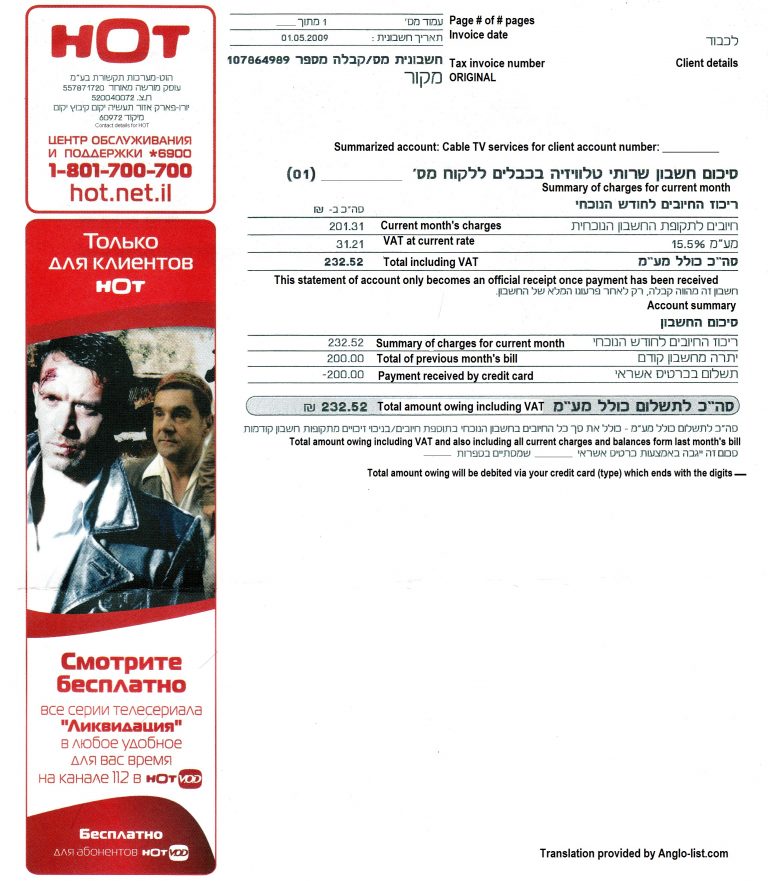
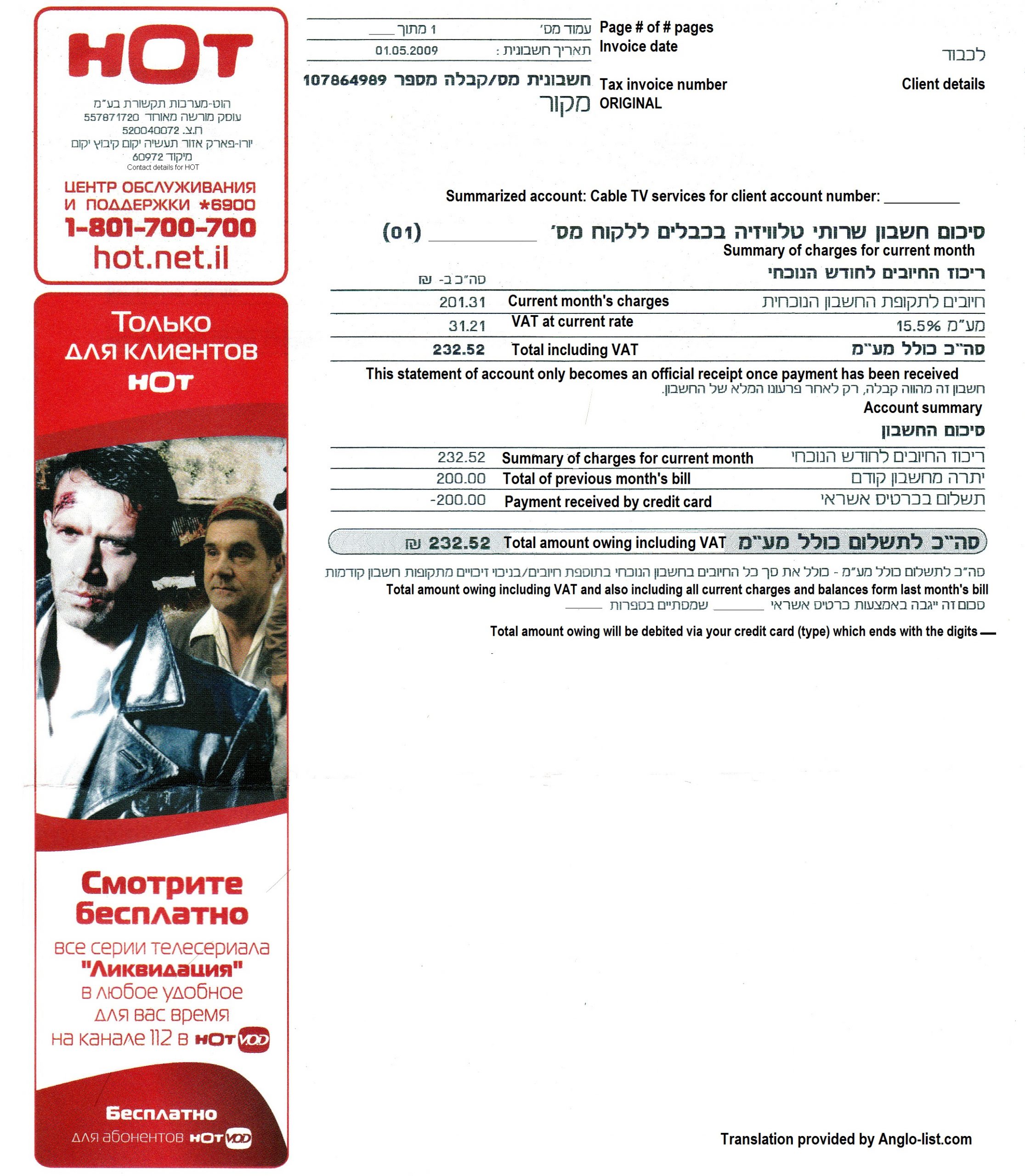
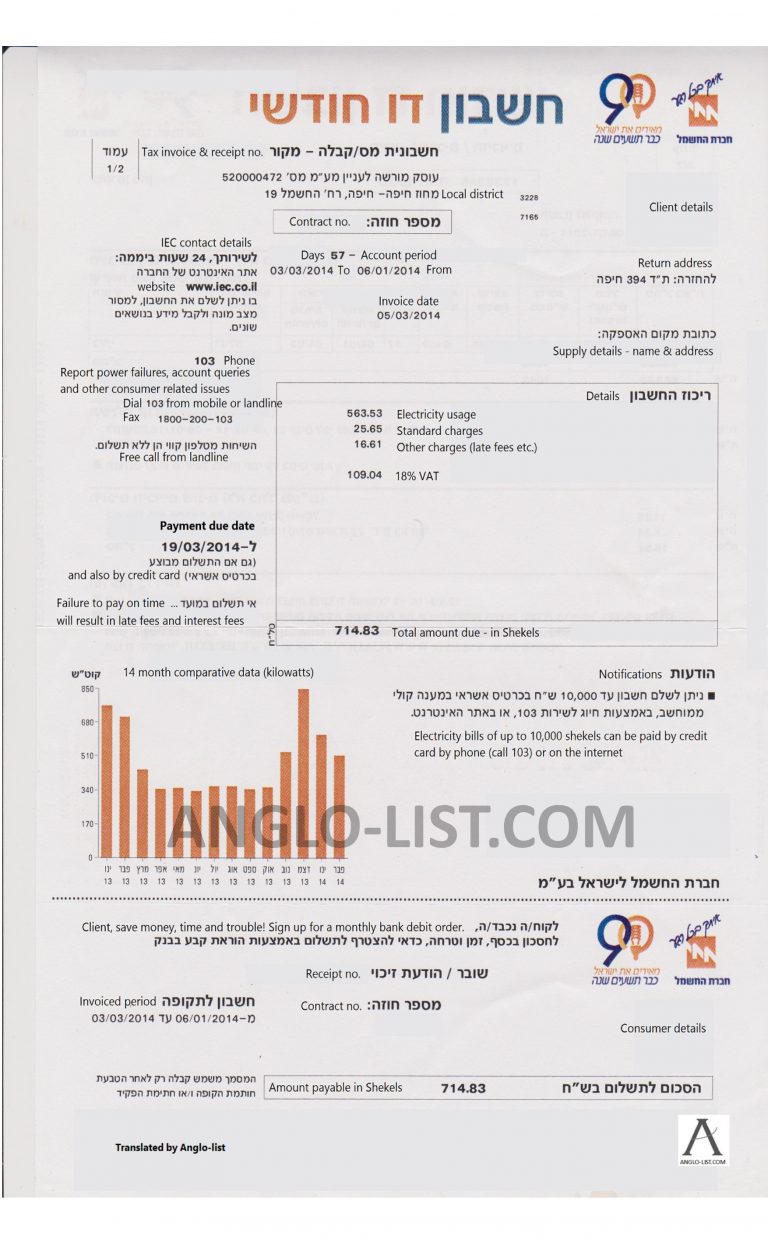
Hebrew to English Translation of Electricity Bill

Reading Time: < 1 minute

Hevrat HaHashmal – The Israel Electric Company

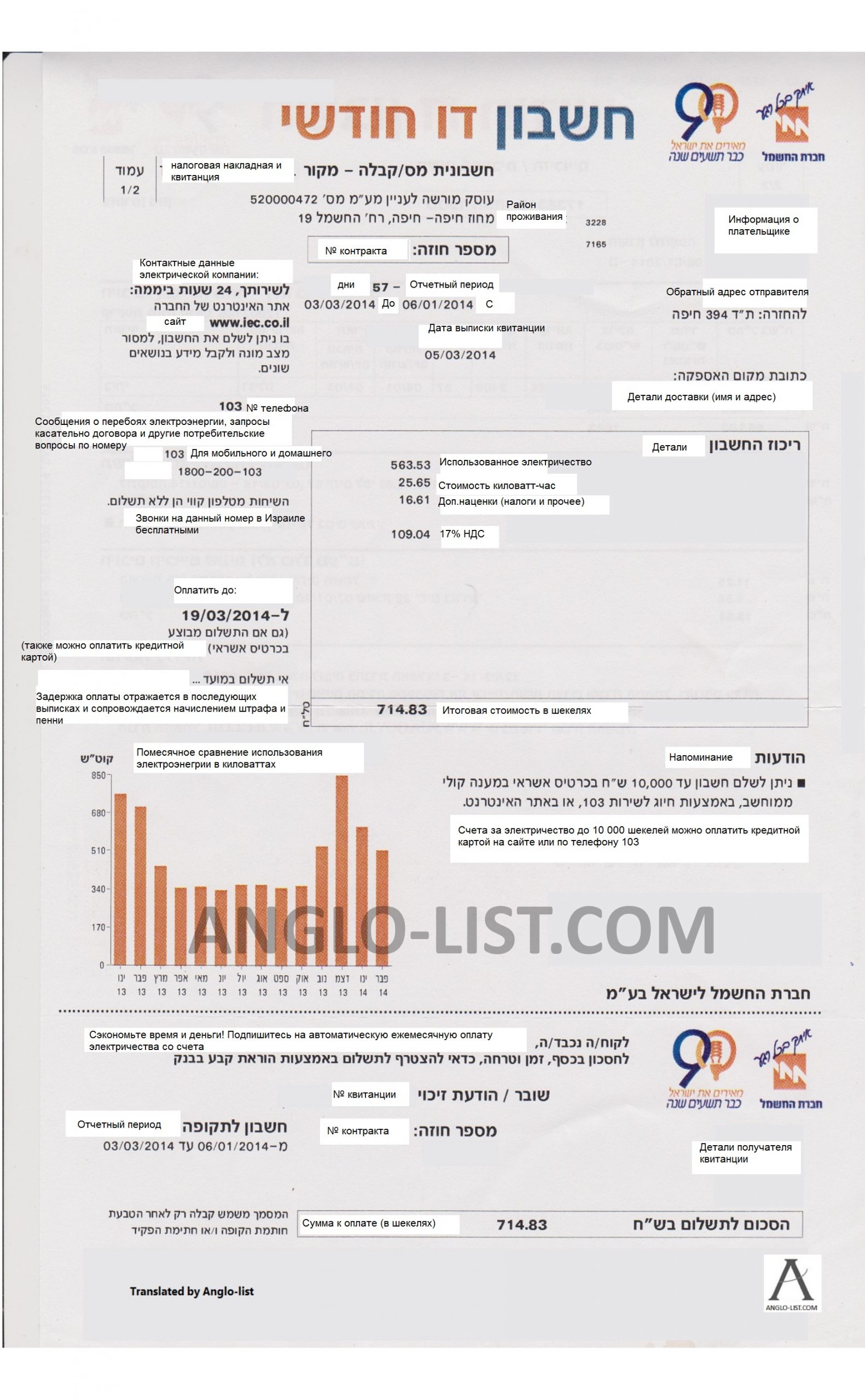
Bi-monthly electricity bill translated from Hebrew to English hebrew english translation of israel electric company electricity bill

Important Billing Information

Electricity is billed every two months.

It is very convenient to pay your electricity bill online.  Don’t worry that it’s Hebrew – we’ve taken care of that –  just follow our English instructions. 

If you do not pay your electricity by the due date then the system does not allow you to pay it online.  You will have to call 103 and pay the bill via their computerized telephone system or via a customer service rep.  You will be charged late fees for untimely payments.

Final warning to pay your bill before cut-off

Press 1 for Hebrew, 2 for Russian… Don’t hassle about calling the Electric Company, press here for Hebrew English translation of their automated answering machine

Save on your electricity bill

More Handy Hebrew English & French Translations


Aliyah & Living in Israel – Welcome.

Reading Time: 2 minutes

Making Aliyah & Living in Israel.

What does Aliyah mean?

ISRAEL FLAG
Flag of Israel

Are you making Aliyah, moving to Israel as an Oleh hadash or are you relocating to study or work?

Understanding the locals, the Hebrew language, the customs and culture can be challenging and frustrating.

This site is all about bridging the social and cultural gaps; what to do, how to do it and where to do it. Practical information and advice from locals and seasoned olim is key to your integration and absorption.  In this site you’ll find information on all aspects of Aliyah; learning Hebrew, employment, managing your Aliyah finances, general services, communities, Hebrew English translations and resources of all kinds.

Anglo-List truly understands the frustrations of Aliyah and relocation; finding your way around a new city, the challenges of making Aliyah alone and making new friends. Learning Hebrew is not easy, but so much depends on it; finding a suitable job, dealing with the bankshealth-funds and other service providers as well as the bureaucracy at the government offices.

We share out best  Aliyah and relocation tips on every possible topic;  the education system, transport options, the housing market, shopping and consumerism to name but a few.

We help you learn Hebrew with our transliterated dictionary of common Hebrew words and phrases on a multitude of topics.  You’ll be able to communicate from day one, and even Hebrew slang words and expressions. We offer you unique Hebrew English translations; your payslip, household bills, and bank documents.

We address your finances, your Aliyah budget and experts even teach you to save and stretch your shekel.

Contact information for government offices, emergency services, the Jewish Federations, embassies, consulates and  volunteer organizations are included.

You can take  an active part in the site; comment on articles and share your personal Aliyah story.

Network socially and professionally, exchange advice and information with our huge on-line community on  Facebook, Twitter,  LinkedIn and YouTubeSubscribe to our newsletter for regular updates and special offers.

Our Business Directory connects you with English speaking, oleh friendly, professionals in your area.  We offer advertisers a unique opportunity to connect with an English speaking clientèle, drive traffic to their websites, benefit from on-line exposure as well as personal introductions and referrals.

We are delighted that you have chosen Israel as you new home.  We welcome you to our beautiful country  and wish you every success with your Aliyah and relocation.

The team at Anglo-list.com

Email: anglolist at gmail dot com

Office hours: Sunday – Thursday 8:30 am – 5:00 pm Israel time

Aliyah Story: Gershom from Chicago to Haifa

Reading Time: 4 minutes

Aliyah from Chicagoland to Haifa

By: Gershom Lichtenberg

Gershom LichtenbergMy wife and I made Aliyah to Haifa in July, 2007. We came from Chicagoland, having spent much of our lives in the New York/New Jersey area. Our two children are grown enough to have remained in the U.S., so there is still a major part of our lives in the U.S. But all our physical belongings that were not sold or given away came with us. That was quite a sorting process!!

We came to Haifa because I am one of the small percentage of Olim who could be reasonably sure to have a job here, thanks to Protekzia (also called Vitamin P). For those who have not learned the word, it simply means that I know someone who opened an employment door for me. And we visited Haifa on our Pilot Trip in 2006 and found that it would be a very nice place for us to live. We liked the urban setting in that it has all that we need and much of what we would want to do easily available. The very good public transportation system made it easy for us to decide not to get a car. The mixed population which lives together relatively harmoniously is another plus for us.

We decided not to fall into a common Oleh pitfall of trying to live our American lifestyle here in Israel. We made a point of trying to live on less money than we had planned. Our original plan was to assume that we would have no outside income for one full year after arrival. After the 42nd time that someone told us the joke, “How do you get a small fortune in Israel? You come with a large one,” we pledged not to overdue it financially. So we picked Hadar as our neighborhood to live in for a number of reasons:

1)    inexpensive apartments,

2)    ability to get buses and sherut (shared taxi) service to anyplace in Haifa and many places outside of it,

3)    proximity to the Shuk for lots of fresh food,

4)    deficit of English speakers so that we would have to speak Hebrew to perform normal life functions,

5)    opportunity to interact with other groups and cultures so that we don’t just stay within our comfort zone.

We arrived in Israel knowing that Ulpan would be a critical part of our first few months here. We contacted them within the first few days and found that our class would start about two weeks later. We treated this as our full-time job until the class finished at the end of December. We did our best to do homework and study regularly, and as a friend told us, at the end of Ulpan Aleph we were ready to learn Hebrew. Or to put it more precisely, we understood many of the basics and were ready to learn to speak Hebrew by using it as much as we could manage in our daily lives. We also continued for some months after the Aleph level in additional classes at the Ulpan. Many of the Olim we see realize that they can do many things here in English, but when they restrict themselves to this we see them on the fringes of the society (and ourselves as well at times) because they do not understand the Hebrew that surrounds them. I often remember the Mexicans that I saw around me in Chicago who had trouble operating outside their own communities because they did not speak English. Now that is us.

One of the places that we are accepted well is at Or Hadash, our Reform synagogue here in Haifa. Rabbi Edgar Nof (also known as the rabbi with the guitar) is a warm, high energy leader of the community here. But it took me a while to understand the difference in  organized religion here. In the U.S., we attended a Reform synagogue to be part of the Jewish community inside a largely Christian community. To be part of the Jewish community here, all we have to do is to walk out of our front door. Almost anyplace we go, we are part of the Jewish community. So it took time to understand that the synagogue serves as a center of Jewish values, of promoting them within the community, as well as participating in Jewish observance and education. Or Hadash is also very active in promoting ties to the Jewish community outside of Israel, and to giving visitors a sense of connection.

Now, more than two years after Aliyah, we have settled into a regular routine of work (I am a technologist at Rambam Medical Center, my wife works at Madatech (Science Museum) and socializing. We have some wonderful friends who helped us get oriented at the beginning and we continue to enjoy their company. Occasionally, we do some traveling within the country. In May ’09, we visited family and friends in the U.S…….. and were happy to return home to Haifa.

We continue to recognize the importance of our Zionism, doing our small part to make sure that Israel’s existence persists for future generations. We try to help to provide information and guidance to those English speakers, Olim By Choice, who continue to come. It is important that all know as much as possible about what they are getting into and how to manage the challenges that we all encounter.

So we continue to live with laughter and determination for the daily challenges that we encounter. And we see wonderful people like the founders of Anglo-list who put a great deal of effort into making this all work for us. Best of luck to all of you who decide to embark on this journey together.

Update:

Now, 14 years after their Aliyah, both Gershom and Bobbie are retired and enjoying their retirement.  Gershom continues to volunteer with new Olim and especially with Anglo olim in Haifa.  

Eran – A Lone Soldier in Israel – Chayal Boded

0
Reading Time: 3 minutes

I was a Lone Soldier – A Chayal Boded

By: Eran Zingman

Lots of unsteady, Zionist motivated, young American adults come to Israel to show their Jewish/Israeli attachment. Maybe it’s just an excuse, and they are searching for their identity in what they presume is a different and friendlier society.  In my case, I came to Israel, not because I wanted to contribute to Israel, but because I needed to get away from a hectic way of life in Los Angeles.  I was searching for a combination of stability, equality, loyalty, individuality and even similarity.  I hoped that my endeavors would propel my personal growth, maturity and purpose in life.

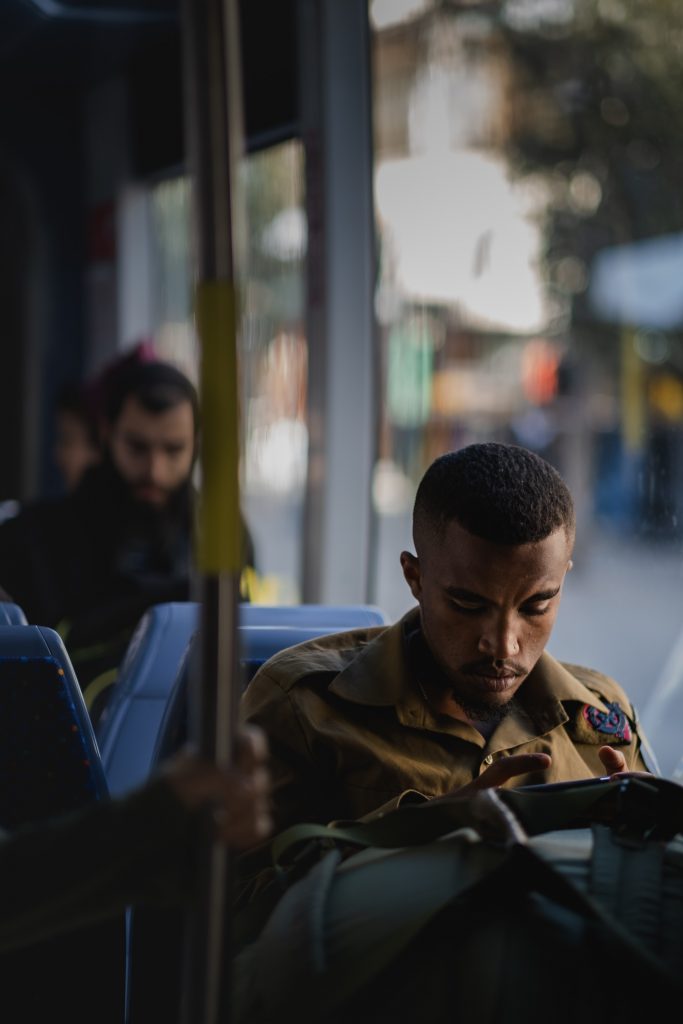
soldier in bus
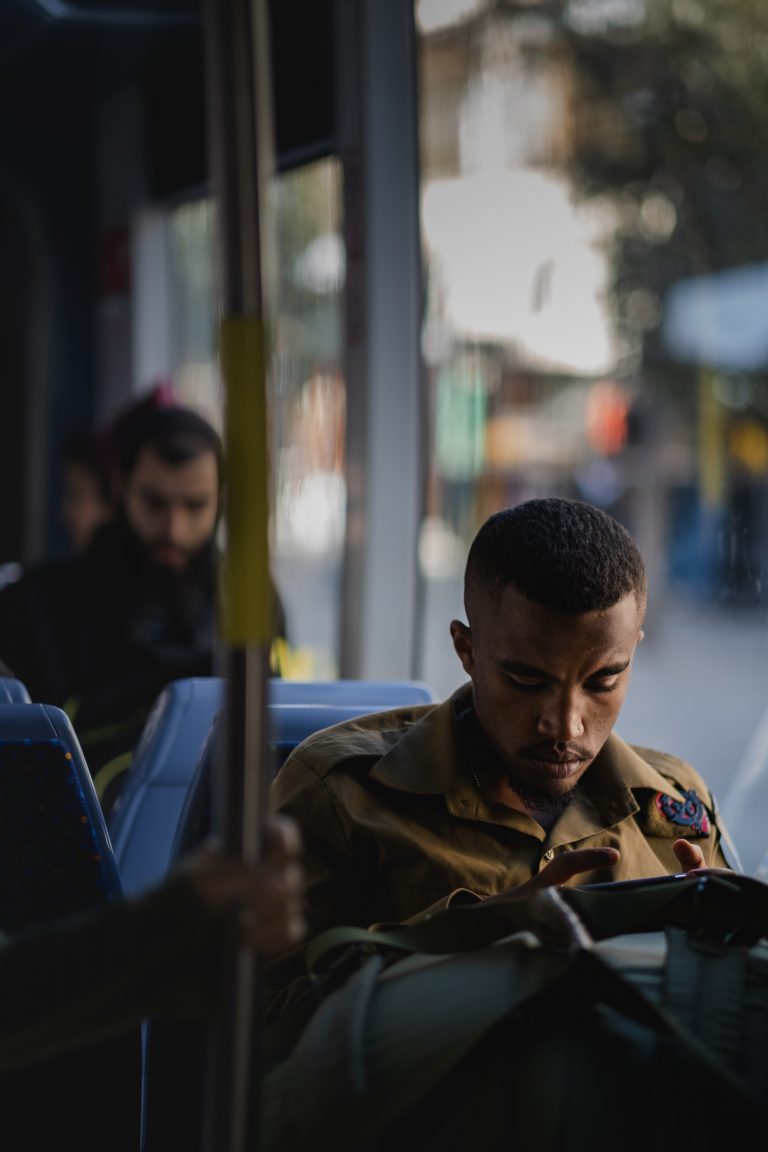
An Israeli solider serving in the I.D.F

I was single and only 20 years old when I arrived in Haifa. I didn’t do a lot of preparation before I came other than buy a plane ticket and find a friend to stay with temporarily.  On my arrival, I had to get my identity card (te’udat ze’hut) from Misrad Hapnim (Ministry of the Interior), my Teudat Oleh (immigrant card) from Misrad Haklita (Ministry of Aliyah & Integration).  I had to open a bank account so I could make rental payments and organize a credit card so I could get a mobile phone.  Within a week, I had done this all and found a (reasonable) studio apartment to live in.

I was on a solo mission; my parents were too old to move with me. I have family (uncles and aunts) around the country, but I couldn’t depend on them for everything. In fact, I found doing things alone much easier. It was less demanding, I was more mobile, and it was much cheaper.   Sometimes it was a hassle getting things done without knowing the language and understanding the process.   But sill, I was eager to learn. Tirelessly, I asked locals how to get to places, and where and how to get things done. 

Shortly after registering my address at Misrad Hapnim, I received my draft papers to join the army.  At Lishkat Gi’yus, (the military drafting office) in Haifa, I completed the rudimentary questionnaires and psychology test. Six months later, because of my Hebrew level, I was sent to an Ulpan unit at a special base near Karmiel.  In a 3 week basic training program, aimed at absorbing new immigrants, I was grouped with a bunch of Russians, a few French and American people.  During this time, I realized that I wasn’t suited for a fighting unit.  Many army coordinating counselors lead me to focus my interest in the Air Force.   I was appointed as a F16 Fighter Jet technician and immediately transferred to a base for a 2 month instructional course.

In the army I was registered as a lonely soldier (cha’yal bo’ded), and was appointed a Mashakit Tash, which is a kind of army social worker who was responsible for my well being.  She researched my status in Israel and requested on my behalf, aid and assistance from numerous facilities. This assistance was a so important and it really helped me out.  I managed to live rent-free from a subsidy I obtained.  I received a higher (double) monthly army salary, and I had 3 evenings leave from the base every week.  On my evenings off, I worked as a waiter and would return to the base the following morning.  As long as I worked part time, it was not difficult to support myself during my army service.

Although my time in the army was aggravating, I found it an enriching experience. It was a comfortable environment and gave me the opportunity to learn, and get accustomed to, Israeli traditions. I found ways to follow orders and later on, give orders.  I matured immensely.  I would advise any single person who is planning on living in Israel to join the army first.  Being patient, observant and open-minded, is a great way of starting over.

Childcare, Pre-school & Kindergarten in Israel

0

Reading Time: 2 minutes

From pre-school to primary.  What are the options in Israel?


Infant & Childcare

Infant and childcare in Israel provides a solution for the high percentage of working mothers.  After 3 months of maternity leave parents are required to find a solution for the care of their babies.  If you cannot afford to be a stay-at-home-mom or you don’t have an extended family that is willing to help out, you will have to consider the following alternatives:-

Metapelet – Child minder – מתפלת

A metapelet is a woman who takes care of your baby only at your house or hers.

Preschool kidsA mishpachton – Play group – משפחתון

A mishpachton refers to a metapelet who takes care of a few babies, usually about 4, at her home.  It is an intimate, warm and secure environment for your small baby.

A P’ooton – Crèche – פעותון

A p’ooton is for babies and toddlers from 3 months to 3 years


Kindergarten – Gan Yeladim – גן ילדים

From age 3 there you can consider kindergarten. There are 2 types of kindergartens in Israel, private and state funded.

A private kindergarten – Gan Prati – גן פרטי

Private kindergartens are supervised by the Ministry of Education and cater for children from 3 months to 5 years.

A municipal kindergarten – Gan Ironi – גן עירוני

Municipal kindergartens are run by qualified kindergarten teachers. They cater for children from 3 to 6 years in three age groups;

  • ages 3-4 (Trom-Trom Hova or Tut Hova) – Optional
  • ages 4-5 (Trom Hova) – Recommended
  • ages 5-6 (Hova) – Compulsory

Kindergarten attendance is compulsory from the age of 5. At the conclusion of the Hova (compulsory) year (5-6) the child will either begin primary school or will repeat the Hova year if he/she is not psychologically and cognitively ready for primary school.

An afternoon framework – Zaharon – צהרון

A zaharon is an optional afternoon program that many pre-schools and primary schools offer. The cost is calculated separately.


Big school!


School Registration

Compulsory education is from kindergarten to the 10th grade although most continue through to the 12th.

During the compulsory (hova) kindergarten year, you will have to register your child for school.

Registration of your child for pre-school and elementary school is generally according to district and must be done via the regional Education Department

Documents Required for Registration

You need the following documents to register your children for school for the first time in Israel:

  • Your Teudat Oleh or immigrant certificate  – תעודת עולה – updated with your current address
  • Rental contract.  Registration of children for pre-school and elementary school is usually by district so if your address has not yet been registered in your teudat zehut you may need to bring a copy of your rental contract with you.
  • Teudat Zehut your identity document – תעודת זהות – or authorization of registration of both parents in the Ministry of the Interior’s population registry (mirsham toshavim)
  • Tuedat Leida  or birth certificate – תעודת לידה – for each child
  • Transcripts or certificates from schools your children attended previously


Learning & Educational Resources


{module [395]}


Tertiary Education in Israel

0

Reading Time: 2 minutes

tertiary education

Universities, Colleges, Trade and Vocational Schools in Israel


Trade & Vocational Schools

Some Trade and Vocational Schools are publicly funded and others are privately run.  They provide instruction in specific fields primarily at the undergraduate level. Certain schools focus on law, management, and technology and teacher training. Others train students in areas of the paramedical profession such as optometry, radiology and dental hygiene. Additional schools work to ready students for careers in sports or the cultural and culinary arts.

  • The Wingate Institute in Netanya trains teachers and professionals in physical education, athletics, sports medicine and bio-physics.
  • The Bezalel Academy of Art and Design in Jerusalem, offers Bachelor’s degrees in fine arts, architecture, graphic and industrial design.
  • Students wishing to enter the fashion industry can do so at Ramat Gan’s Shenkar Institute of Textile and Fashion.
  • The Hadassah College of Technology offers degrees in scientific and technical fields.

Universities

Each university in Israel (except for the Weizmann Institute) grants bachelors, masters, and doctoral degrees in all areas of the fine arts, humanities, and the sciences. In addition research in these areas is carried out at the country’s 9 public universities:-

  • Hebrew University of Jerusalem
  • Tel Aviv University (TAU)
  • Weizmann Institute of Science
  • Technion
  • Ben-Gurion University of the Negev
  • Haifa University
  • Bar-Ilan University
  • Open University 
  • Ariel University

Regional Colleges

Regional Colleges are university-mandated satellite campuses which provide supplementary opportunities to students who live far from the country’s centrally situated universities. Some regional colleges offer full degree programs.  Undergraduate studies are often started at one of these schools and completed at the main campus of the sponsoring university.

Foreign Universities

Today there are about 30 foreign universities in Israel  with campuses both for Israeli and foreign students, undergraduates and graduates.

Teachers Training Colleges

A list of teacher’s training colleges in the main centers

  • Ahva Academic College, Ahva
  • Al-Qasemi Academic College of Education, Baqa al-Gharbiyye
  • Arab College for Education Haifa
  • Beit Berl College, Kfar Saba
  • College of Technology Education, Tel Aviv
  • David Yellin College of Education, Jerusalem
  • Efrata College of Education, Jerusalem
  • Emuna College of Education, Jerusalem
  • Givat Washington College of Education, Givat Washington
  • Gordon College of Education, Haifa
  • Hemdat College of Education, Netivot
  • Herzog College, Alon Shvut
  • Jerusalem College Michlala, Jerusalem
  • Kaye Academic College of Education, Beersheba
  • Kibbutzim College of Education, Tel Aviv
  • Levinsky College of Education, Tel Aviv
  • Lifshitz College of Education, Jerusalem
  • MOFET Institute, Consortium of Colleges of Education
  • Moreshet Yaakov Religious College of Education, Rehovot
  • Ohalo College, Katzrin (Golan Heights)
  • Oranim Academic College, Kiryat Tivon
  • Ort College for Teachers of Technology, Tel Aviv
  • Shaanan Religious College of Education, Haifa
  • Talpiot College of Education, Tel Aviv
  • WIZO Haifa Academy of Design and Education, Haifa


Learning & Educational Resources


{module [395]}


Special Education in Israel.

0
Reading Time: 2 minutes

Programs for Israeli Children with Special Educational Needs.

Hebrew: חינוך מיוחד

special education


Israel’s Special Education Law

The Special Education Law allows for the advancement and development of the abilities of disabled children, to correct and improve their physical, mental, psychological & behavioral performance, to convey knowledge, skills, habits & social behavior for the purpose of becoming part of society.

The Law provides special education or individuals between the ages of 3 to 21.  The law also states that it is the right of every child from the special education system, to study in Israel’s regular education system and to receive all the necessary rehabilitative services.

  • Special education enrichment and complementary therapies available, include:
  • Diagnosis and Treating of children with learning disabilities
  • Mental retardation. (Down’s Syndrome, Fragile X , Cerebral Palsy, Autistic traits, Hyperactivity)
  • ADD & ADHD
  • Emotional disorders and psychological disorders
  • Visual impairment
  • Developmental & language delay
  • Deafness and hearing impairment
  • Career education – Young entrepreneurship project and induction to the IDF
  • A Snoezelen Room

The Placement Committee of the Israel’s Ministry of Education

Children between the ages of 3-18, who require a special framework can request an assessment from the Ministry of Education.  Requests are made in writing by parents or by the school to the Chairman of the Placement Committee of the Ministry of Education  Decisions can be appealed within 21 days to the Appeals Committee.