13.7 C
Jerusalem
Monday, April 20, 2026
Sample Page
Home Blog Page 90

Weekly Torah Portion: Parshat Hashavua Vayigash

0
Reading Time: 5 minutes

Parshat Hashavua Vayigash

By: Rabbi Nissim Mordechai Makor

parshat hashavua vayigast

In this week’s Parshat HaShavua Vayigash, Judah pleads on behalf of his brother Benjamin, Yoseph reveals himself to his brothers, Jacob comes down to Egypt, and Yoseph’s administration of Egypt saves lives but transforms all the Egyptians into bondmen.

Verse 45:3 tells us Yoseph said to his Brothers: I am Yoseph is my Father still alive? And his brothers were not able to answer him, for they were affrighted before Him.
Here the Torah supplies a foreknowledge of the judgement in the World to Come. “Woe to us on the Day of Judgment, woe to us on the day of reproof! Yoseph was the youngest of the tribes, yet they could not withstand his reproof. When the Holy One blessed is He shall come and reprove each one according to that which he is, how much more so [will he be affrighted]’ .
The brothers had justified their actions against Yoseph by what seemed to them entirely sound reasons, and they considered themselves as acting out of pure motives of righteous concern for the future of the family and of the holy nation. Yoseph’s dreams were to them the results of his constant thoughts of seizing power.

Candle lighting times for Parashat HaShavua Vayigash 

Parsha Index

Now suddenly, like a flash of light in the dark of night, they saw their own fault: “His brothers were envious of him” [37:11]. Now they saw their own fault: “His brothers were envious of him” [37:11]. Now they saw that they had been blinded by envy, and that his dreams were true portents which had now been fulfilled, and that they had committed a great wrong to a brother of the highest character. Now they realized that they had bowed down not to an Egyptian, but to their brother Yoseph, just as he had dreamed. The Sages understand this episode as a model of what transpires when a man finally comes before the great judge Who suddenly confronts him with the full truth of his true motives and reveals to him the enormity of their misdeeds, at that time, the accused becomes unable to answer, and all his excuses and self-justifications fall away.
The Meam Loez tells us that upon hearing Yoseph announcement, the brothers were so ashamed that they hid their faces. They were embarrassed even to look at him. Yoseph spoke to them gently, and said, “Please come close to me.”
The Midrash says that another reason Yoseph told them to come close was that he wanted to show them something private, his circumcision. The brothers would not believe him until he showed them his mark of circumcision.
This might seem to be weak proof since Yoseph forced all the Egyptians to submit to circumcision.  In reality, this was the greatest possible proof that he was Yoseph since he worked to spread circumcision. When the Midrash says that the brothers would not believe him until he showed them that he was circumcised, this cannot be taken literally.  It obviously would not have been proper [for Yoseph to deliberately expose himself, even to his brothers]. But Yoseph showed them how he had gotten all the Egyptians to circumcise themselves, a commandment that had been given to his great-grandfather Avraham.
When the brothers came close, Yoseph whispered to them, “I am Yoseph your brother, whom you sold to Egypt.” He told it to them quietly, so that Benjamin would not hear. He also promised them that he would not tell their father that they had sold him as a slave.
Some of our sages say that Yosef was wrong in ordering everyone to leave his chambers. He left himself alone with ten powerful angry men, and they were very likely to kill him. Others, however, say that he did a very good thing in ordering the Egyptians out since he did not want to embarrass his brothers in front of strangers. He knew that they were pious men and that he would have nothing to fear. Besides, he said to himself, “Better they kill me, than that I commit the moral equivalent of bloodshed by embarrassing them publicly.  According to one opinion, the brothers were actually ready to attack Yosef and kill him. The angel Gabriel suddenly appeared, and scattered them to the four corners of the palace.
YOSEF THE TREASURER
The economic situation in Egypt during the years of famine. After describing the severity of the famine, we learn: Yosef gathered all the silver which was found in the land of Egypt and in the land of Canaan for the grain which they had bought, and Yosef brought the silver to Pharaoh’s house. [Bereishis 47:14]
This is most puzzling. What was the point of this exercise? And, more specifically, the exact sequence of events seems obscure. It seems that firstly all of the silver was collected by Yosef and then it was deposited in Pharaoh’s treasury. What did Yosef intend?  It would surely have been more usual and, indeed more practical, to have passed the silver to Pharaoh’s treasury as I was delivered by the populace, rather than waiting until it had all been deposited before handing it on.
R’Avraham Bornstein zt’l explained that Yosef gathered all of the wealth of the world so that the nation of Israel would eventually take it with them when the Exodus came centuries later. This concept actually extends far beyond the purely physical money. There is as always a spiritual parallel to physical events. The word Kesef, the silver in our story, finds its basic meaning in the words longing or desire. This can be seen in the following verse.
And now, so you have left, as you longed [nichsof nichsaftah] for your father’s house. [Bereishis 31:30]
The physical silver was paralleled by a spiritual yearning, and it was that feeling that Yosef was “gathering,” so to speak, in his role as viceroy of Egypt. Yosef collected every bit of desire for holiness that was present in the world at that time, ready for the nation of Israel to use at the appropriate moment. In real spiritual terms, this was the great wealth with which Israel left Egypt.
When they reached a point of sufficient development in their exile, they were able to appreciate and utilize all these “sparks” of desire and left Egypt to prepare for holiness and Matan Torah. The physical silver that Yosef gathered was merely a front for this aim. We could describe it as an outer garment to the real purpose that Yosef had to achieve.
This explains why Yosef returned his brothers money when they came to buy grain in Egypt. The silver, or, in our context, the desire for matters spiritual, which already belonged to Yaakov and his family did not need to be gathered by Yosef. This was the starting point, the level of desire that they already possessed, even before the exile began. This was left with Yaakov’s sons, ready to be the base upon which all future longings for spirituality would be based.
This concept will help us to resolve our original difficulty: why did Yosef gather all the silver first, before handing any to Pharaoh?  Yosef was a great tzaddik, and knew that the corruption and immorality of Egypt would not be healthy for the family of Yaakov. Therefore, all the wealth of Egypt had to pass through the hands of Yosef to ensure that they remained pure and holy.
So when Yaakov and his sons arrived in Egypt to commence the exile, everything was in place: they brought with them their own “silver,” their present level of spiritual yearning, and the means by which their descendants would acquire similar, stronger feelings, Yosef’s collection of all the “silver” in the ancient world. This was the wealth that the Klal Yisrael took with them as they left Egypt giving them a solid foundation to building the nation of Hashem and be a light to the world until the days of Mashiach.
Shabbat Shalom!

This week in Jewish history

  • In 1837 a violent earthquake shook Eretz Yisrael; over 2000 died in Tzfat and another 700 in T’veriya
  • Jews of Genoa, Italy, were expelled in 1598
  • The Nazis prohibited Jews from gathering in shuls or private homes for prayer, 1940

Weekly Torah Portion: Parshat HaShavuah Mikeitz

0
Reading Time: 5 minutes

Parshat HaShavuah Mikeitz

By: Rabbi Nissim Mordechai Makor

parshat hashavua mikeitz by Rav Nissim Mordechai MakorThis week’s Torah portion – Parshat Hashavua Mikeitz in a nutshell:  Joseph interprets Pharaoh’s dreams and becomes viceroy over Egypt.  He implements his plan to save the region from famine. When Joseph’s brothers come to Egypt, he demands that they return and bring Benjamin to Egypt. Upon his arrival in Egypt, Benjamin accused of theft.


Yoseph, a righteous person, dreamed about working in the field with his brothers, building sheaves. Pharaoh, a wicked man, had a dream which involved no effort on his part at all.
Pharaoh’s dream is the very beginning of the story of Egyptian exile. The dream predicted a famine which eventually caused Yaakov and his family to settle in Egypt where, a generation later they were enslaved.
In times of exile, the Jewish people are forced to withstand the fluctuation between two contradictory modes of life: love of God at the time of prayer, and then total immersion into the physical world during one’s business and private affairs the rest of the day. Chasidic teachings compare this situation to a dream because in a dream the opposite often happen, contradictory phenomena can exercise simultaneously.
Rabbi Nachman tells us that the term shenatayim yamim [literally, “two years of days’] refers specifically to slander. [Slander misleads the person who talks evil of others into thinking of things not as they actually were: hence, “days are years,” what actually happened is viewed through the lens of imagination rather than reality].
As punishment for the sin of the spies who slandered the Holy Land, the Jews were forced to spend a year in the desert for every day of the spy’s mission [Numbers 14:34]. More broadly, because the slanderer is unsure of the facts or of people’s motivations for their actions, slander is associated with the power of unbridled imagination.
In his dream, Pharaoh was “standing on the river.” This river is the Nile, which is also called the Pishon River (Rashi on Genesis 2:11). Pishon alludes to the phrase Pi Shoneh Halakhot, a mouth that speaks Torah Law. True Torah teachings bring blessing [VaYikra 26], whereas imaginary Torah teachings result in famine [for they create a delusory, “false Heaven” that cannot rain].
“Pharaoh” refers to a person who is not steeped in or steadfast in Torah law, yet who seeks to create novel Torah teachings based on his imagination. These imaginary Torah thoughts are harmful to the world, for they prevent God’s blessing from descending. Thus, in Pharaoh’s dream, the seven fast cows of blessing are swallowed up by the seven scrawny cows of imaginary teachings.
In summation, the verse “Two years later, Pharaoh was dreaming. Behold! He was standing on the river” may be interpreted to mean “Blessings are withheld due to the power of deluded imagination, which leads a person to create unfounded TORAH insights.”
These false teachings are rectified by Yoseph, the tsaddik, who elevates a person beyond his imagination, so that with a rectified [the opposition of slander], one can find good even in bad situations.
Pharaoh dreamt about seven fat cows that were swallowed up by seven scrawny cows. Pharaoh represents one who has great wealth yet always craves more, as if he is always hungry. His name, Pharaoh resembles PeriRaon [repayment]. Pharaoh always made payments, whether he is buying material goods for his comfort or paying off his debts. Yoseph, the tsaddik, advises him to “tax’ the bounty at twenty percent. In other words, Yoseph, advises the wealthy to “tax their wealth” by giving to charity, an act that will protect their wealth.
Rabbi Avigdor Miller brings the verse in Psalms 105:16 “And He proclaimed a famine upon the earth.” The miraculous nature of this famine is demonstrated by the number seven, and also by the fact that it was preceded by seven years of exceptional abundance in Egypt. “And the famine was in the lands” (41:54). This international calamity, whereby countless men perished, was performed solely for the sake of the sons of Israel. Because of a tiny tribe of 70 souls, Hashem sent a famine upon the land of Egypt and all the surrounding nations, thereby causing this family to go down to Egypt where they were being prepared for the Giving of the Torah. This famine and the preceding seven years of plenty were the occasion for Pharaoh’s dream, which caused Yosef to be elevated to supreme power (41:44) in order to rule over the sons of Israel to prepare them for their great future.
The purpose of this especially disastrous famine was to force the house of Yaakov to come to Egypt, where they would sojourn for 71 years under the absolute power of the righteous Yoseph and then they would be afflicted by bondage to the Egyptians, in order to be prepared for the supreme function of the nation: the receiving of the Torah at Sinai.
By his total power Yoseph trained the people of Egypt in good behavior, thus preparing Egypt as the land where Israel would sojourn for 210 years. This was necessary both in order to make Israel’s sojourn less burdensome, and also in order that the Egyptian influence should not be too harmful for the Israelites’ character and way of life.
Another purpose in this decree was to bestow absolute power which Yoseph, would utilize to control his family’s behavior. When they would begin to increase, he was able to prevent them from spreading out of Goshen [46:34] to mingle with the Egyptians, and he prevented the Israelites from surrendering their language and their national ways, and in general, he enforced justice and righteousness among his own people, and he prepared them to accept the Torah.
There was another purpose in the bestowal of such great power upon Yoseph, and this purpose was for the furtherance of Yoseph’s perfection. The Perfection of the righteous individual is to the Creator an important justification for the existence of the world, and He manipulates the history of nations for the furtherance of even a single great man’s virtue.
Verse 41:38 wrote that “Pharaoh said to his servants, “Can there be another man like this who has the spirit of Hashem in him?”
The Likutei Moharan explains that because Yoseph guarded his covenant, he attained a spirit of Hashem.
Verse 41:39 then tells us that Pharaoh said to Yoseph, “Since Hashem has informed you about all this, there is no one as perceptive and wise as you.”
The reason Yoseph was so perceptive and wise was because he guarded his covenant. Yoseph achieved a pure mind. He attained Torah revelations and the levels associated with the sefirot of Binah (Understanding) and Chokhman (Wisdom).
Breslov Oral tradition tells over the story of how once someone asked Reb Moshe Breslover [a leading student of Reb Noson] about the tsaddik emess [true righteous person] that Rebbe Nachman always speaks about in his lessons. ‘Who can Rebbe Nachman be referring to?” the man wondered. Reb Moshe told the man that even Pharaoh was wiser than he. Pharaoh understood that because Yoseph spoke of a wise man to oversee the production of food in Egypt, he was wise enough to be that person. If Rebbe Nachman always spoke of the true tzaddik [righteous person], then he must have that special quality to make him a truly righteous person. We learn from the actions of Yoseph that when a person works on himself with totally devotion and attachment to HASHEM, they literally can change the world.

Best Hummus in Haifa

0
Reading Time: < 1 minute

The best hummus in Haifa.  Fighting for first place! Sharing a Haifa secret.

Haifa cultivates and advances tolerance between all the religious groups that live here.  ‘Breaking bread’ is one of the best ways of bringing people together or as in this case – hummus.  Hummus represents Israeli culture and Haifa has a brilliant selection of top hummus eateries. You can enjoy it many of different ways; with tahini, ful (fava beans), meat, peppers, mushrooms and more…

hummus2

Some hummus eateries have been around for decades and new ones have gained a good reputation in Haifa.  These are some of our favorites

Hummus Allenby

Hummus Allenby also offers a wide selection of Middle Eastern cuisine

43 Allenby Road


Hummus Faraj

Hummus Faraj also famed for its red burghul

29 Hameginim Road


Hummus Um Shakker (a.k.a Hummus Abu Shakker)

Hummus Um Shakker takes hummus to a new level with a subtle undertone of lemon.  Their ‘ful’ is to die for.

Paris Square


Abu Yousef

Abu Yousef has been around for decades.  Packed at lunchtime.  Good kubbeh too!

Paris Square


Hummus Fadi

Hummus Fadi for tasty hummus with ful and French fries with sumac

4 Habankim Street


Hummus Abu Marwan

Hummus Abu Marwan serves good fries too!

1 Kibbutz Galuyot


Hummus Berdichev. 

Hummus Berdichev is kosher and delicious.

1 Wedgewood Street


Which is your favorite ‘hummuseria’ in Haifa?  Share your experience in the comments section below.

Weekly Torah Portion: Parshat Hashavua Vayeishev

0
Reading Time: 3 minutes

Parshat HaShavuah Vayeishev

By: Rabbi Nissim Mordechai Makor

Vayeishev in a nutshell – Joseph is sold into slavery to an Egyptian master and after an act of defiance, he is thrown into jail. It is here that he interprets the dreams of Pharaoh – the cup-bearer and the baker.

Dvar Torah

vayeishev Rav Nissim Mordechai MakorWith his brothers already on bad terms with him Joseph had a dream that he told to his brothers… “Behold, we were binding sheaves in the middle of the field… my sheaf arose and remained standing. Then your sheaves gathered around and bowed down to my sheaf”. His brothers retorted: “Are you going to reign over us? Are you going to be our ruler?” So they hated him even more… (37:4-8)
Abarbanel comments on Joseph’s manner of presenting his dream to his brothers. He highlights the words: “My sheaf arose and remained standing”, as suggesting that the forces enabling him to rise to power would be independent of the other sheaves. His sheaf would stand up; without asking permission from the other sheaves. Which implied that he would rule whether his family approved or not. What the brothers might feel was of no consequence. They would have no say in the matter.
And once the sheaf “arose”, it would “remain standing”. The Sforno observes that it would not sit down in a hurry. And indeed, Joseph appears to have been viceroy in Egypt from when he was thirty until his death eighty years later, a very long time.
There are two ways a person may rise to a dominant position. It may be by merit and the general goodwill and acquiescence of the population. Had Joseph not got to his favoured position as Jacob’s favourite, but though the social and administrative skills that he was to employ with so much initial success in Potiphar’s household, it could have been a different matter. His charisma and efficiency might have eased him to the top on their own accord, without resentment from his brothers. 
Joseph’s dream, however, implied to his family that he would not “get there” on the value of service to his brothers and the wider community, but by forces that the brothers had no means of influencing. He would achieve dominance the second way, as an independent force, as an outsider rather than on the strength of being a valued member of the circle of brothers. The matter would be quite beyond their control. They would have no stake in their individual futures. The entire spiritual Patriarchal legacy so painstakingly built up by Abraham, Isaac, and Jacob, would be out of their hands, independent of their own merits and positive qualities.
However, it was not clear whether “achieving dominance as an outsider” would happen by means of Jacob’s goodwill and at the brothers’ expense or by means of patronage from another direction, and in a different context and environment. 
That could be the detail of the dream that Joseph should have been less precise in relating to his brothers. Though the dreams were (according to the Ramban) divine communications on future conduct, Joseph should have been more discreet in revealing the information, and avoid much fraternal strife. 
A lesson for bearing in mind that “there is a time to speak and a time to remain quiet” (Eccl. 3:7).

Misrad HaKlitah: Ministry of Aliyah and Integration – Information Call Center

Reading Time: < 1 minute

Ministry of Aliyah and Integration – Information Call Center

call center services 2

The Ministry of Aliyah and Integration now have a call center for Aliyah information on a wide range of topics.

Call center representatives will provide information in the following languages English, French, Russian, Amharic, Spanish, Portuguese and Hebrew

Call: *2994 or (972) 3 973 3333

Since 2009 Anglo-List has been helping Olim by providing free Aliyah and Israel lifestyle information as well as employment guidelines, via this website and our growing Facebook groups.  Start your Aliyah journey with us!

Weekly Torah Portion: Parshat Hashavua Vayishlach

0
Reading Time: 6 minutes

Parshat HaShavua Vayishlach

Contributed by: Rabbi Nissim Mordechai Makor

nayishlach Rav Nissim Mordechai Makor

Parshat Hashavua Vayishlach in a nutshell:  Jacob, who still fears Esau returns to the land of Canaan where they make peace.  Jacob’s name is changed to Israel  Rachel dies while giving birth to Benjamin, her 12th son.  Isaac also dies.

Obadiah’s communication of the word of G-d to the descendants of Esau – the people of Edom:

“The House of Jacob will be a fire,
 And the House of Joseph a flame.
 The House of Esau will be as straw.
 They will kindle and consume them.
 There will be no survivor from the House of Esau,
 For G-d has spoken.” (Obadiah 1:18)”

The Book of Obadiah

This very short Book of Obadiah focuses on the people of Edom – Esau’s descendants (Gen. 36:1), who lived south east of Israel, to the East of the southern Arava. Not only did they rejoice over the sufferings of Jacob’s progeny within the Holy Land, but they also took advantage of their plight to loot their territory and help the invader. Obadiah prophesied that Edom would be punished and defeated in Messianic times, along with other nations that were enemies of Israel.

The problem with this Haftara is its general context. Who was Obadiah? What was the situation of the Israelites at that time?

The Talmud (Sanhedrin 36b) links the Prophet Obadiah with the Obadiah who was steward to King Ahab of Israel, who ‘feared G-d’ and saved a hundred of the prophets from being slaughtered by Queen Jezebel (Kings I 18:3-4). The Rabbis teach that, of all prophets, this vision was left for Obadiah for two reasons. Firstly they have the tradition that he was a descendant of an Edomite proselyte, and therefore of Esau himself (Yalkut: Job 897). Secondly, Obadiah was the complete opposite of Esau. Esau lived amongst two righteous people, Isaac and Rebecca, and yet he did not follow their ways. Obadiah, on the other hand, was the courtier of Ahab and Jezebel – two monarchs noted in the Book of Kings for their wickedness. Yet he remained a righteous person. Moreover, at a time when the king and queen murdered all the prophets of G-d in favor of the prophets of Baal, Obadiah risked his life to shelter and feed a hundred surviving true prophets.

This would make Obadiah a contemporary of the very early prophets – amongst them Elijah – at approximately 840 BCE. This has been challenged for several reasons. Firstly, all the other Twelve Minor Prophets lived at least a century later. Secondly, there was no known conflict between Israel and Edom at that time. For the incident where Edom revolted against Joram, King of Judah (Kings II 8:20), implies that Edom, at the time of Ahab and Elijah was a vassal (under the domination) of Judah and probably the northern kingdom of Israel as well.

Ibn Ezra and the Radak place Obadiah within a much later period – when Edom indeed became a serious threat to the surviving southern kingdom of Judah. At that time, Edom did take advantage of its weakness to invade from the south and overrun parts of the Negev up to Hebron, and very likely even up to the borders of Jerusalem. That would have coincided with the years of strife under Nebuchadnezzer of Babylon, culminating in the exile of the Jewish elite in 597 BCE and again, with the Destruction of the First Temple, in 586 BCE. Indeed the first five verses of Obadiah are almost exactly stated in the prophesies of Jeremiah (who was active in that period) against Edom (Jer. 49:14-17), where he states that G-d will make Edom ‘least amongst nations, most despised amongst men.’

There are several customs concerning the reading the two Haftarot from Hosea (11:7-12:12; 12:14-14:10), and Obadiah (whole book) over the weeks of Parshiyot Vayeitzei and Vayishlach within both Ashkenazi and Sephardi communities. Last week – for Vayeitzei – I combined the two Haftarot from Hosea, leaving the Book of Obadiah for this week – Vayishlach.

Vayishlach – Part 2

Candle lighting times for Shabbat Vayishlach

Parsha Index

D’var Torah

The words of G-d’s wrath conveyed by Obadiah are related to Esau, the ancestral father of Edom. However, in the Torah narrative, Esau in many instances appears to have been sinned against, rather than been a sinner. In a moment of personal weakness, he was beaten by Jacob to the birthright. He father was tricked in to giving the blessing meant for him to his brother. Although he intended to avenge Jacob, he did not actually carry out his plan. Backed by his army of four hundred men, he could easily have done so on meeting Jacob journeying home from Haran. Moreover, he allowed him to participate at his father’s burial (Gen. 35:29). Indeed, the Torah forbids the Israelites to abhor Edom ‘for he is your brother’ (Deut. 23:8).

Thus Esau’s sins seem to be largely in the future – those of his offspring, rather than his own. As Obadiah states: ‘for the outrage to your brother Jacob, disgrace will engulf you, and you will perish for ever’ (Obad. 1:10). The ‘outrage’ – from the context of the prophecy – is more than a millennium after his death. Why does Esau appear to be held to blame for the sins of his of progeny?

This question strengthened by the following. Ishmael was also regarded as wicked during his earlier life – to the degree that he was expelled from Abraham’s household. Tradition (based on Isaiah 21:13-17) has it that his descendants were also to impose agony and suffering on the Jews. For when Nebuchadnezzar exiled the southern kingdom of Judah, some were received into their new surroundings of the descendants of Ishmael – the people of Arabia (c.f. Isaiah ibid.), who offered the thirsty Jews ‘hospitality’ in the form of goat skins filled not with drink, but air, which instantly rushed into their lungs and choked them – as well as tormented their thirst still further with salted meat and fish (Tanhuma: Yitro 2). True, the Rabbis have the tradition that Ishmael repented of his sins towards the end of his life (Gen. Rabba 38:12). Nevertheless, the text does not drag him into the attacks of his descendants on the Jews, as it does with Esau. Why is only Esau given the harsh treatment of being associated with the behavior of his descendants in the manner described in the text of the Haftara?

One suggestion is that there are different types of teshuva – repentance. Esau’s self-restraint in accepting, rather than attacking Jacob (following Jacob’s huge gift to him) was on impulse. The Midrash (Sifri: Behaalotcha 69) quotes R. Shimon bar Yochai who said, ‘even though it is an immutable rule that Esau hates Jacob, at that moment his feelings of mercy were aroused’. Indeed, much of Esau’s conduct appears from the text to be on whim. Examples include his readiness, in his hunger, to exchange a bowl of soup with lentils for his future role of being the heir and director of the Patriarchal traditions, and his sudden resolve to kill Jacob because he received the blessing meant for Esau himself.

So his momentary acceptance of Esau to accept Jacob on his return from Laban, and his later allowing him to take part at his father’s burial, may be seen as good deeds done on impulse. They do not contradict the fundamental elements in his character, or the Rabbinical tradition that ‘it is an immutable rule that Esau hates Jacob’. Esau’s momentary repentance was teshuva of sorts, but not real teshuva. There was no fundamental change in his character or attitudes. That may well explain why, in contrast to Ishmael, there is no Rabbinical tradition that Esau repented. And for that reason, the violence of his descendants against those of Jacob is linked with him.

Vayishlach – Part 2

Candle lighting times for Shabbat Vayishlach

Parsha Index

Ishmael, on the other hand is recorded (supra) to have repented. The very fact that one of the Rabbis of the Mishna – R. Ishmael – is named after him, testifies to the power of that tradition. True teshuva is not a single good deed, but a fundamental change in personal character. That is for what ask G-d’s help to work towards daily in the Amida. That would explain why there is a tradition that Ishmael repented, but no tradition that Esau did the same thing. And because Ishmael intrinsically improved himself for the good, he is not associated with the sins of his descendants.

We learn from here the value of teshuva sheleima – perfect repentance. On Yom Kippur we change our conduct to suit the day, and may well, on inclination, make new resolutions. The true test of the value of those changes is whether we maintain them and build on them during the year… Thus we may be worthy of being part of the process of the last words of the Haftara… ‘the Kingdom will be G-d’s’ (Obad. 1:21).

Acknowledge: Jacob Solomon

Israel Film Day October 17, 2018

0
Reading Time: < 1 minute

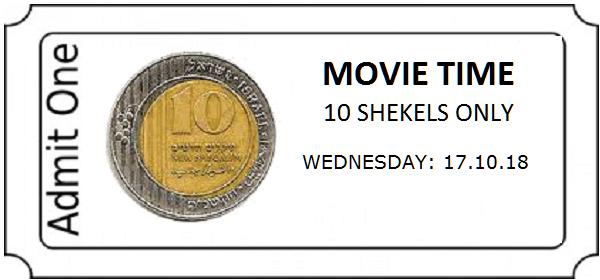
10 shekel movie tickets on Israel Film Day – October 17th.

Israeli Film Day is an initiative of the Culture and Sport Ministry and the Film Industry Association.

This Wednesday, October 17th, 2018 is Israeli Film Day and  you will  be able to see a selection of Israeli movies at a theater near you for only 10 shekels!! 70 years of Israeli cinema will be celebrated with the screening of 33 Israeli films.

Films include Avi Nesher’s “The Other Story” as well as other movies released earlier this year and some that have not yet been released.

10 SHEKEL MOVIE TICKET2

Tickets go fast, book early or expect long queues.

For more information, screening times etc., check with a cinema  near you.

Yes Planet: www.yesplanet.co.il

Globus: www.globusmax.co.il

Rav Chen: www.rav-hen.co.il

Cinema City: www.cinema-city.co.il

Online ticket purchase

Online ticket costs 14 shekels instead of 10.

Car Sharing

Reading Time: 3 minutes

Car sharing in Israel – is it a smart choice?

smartcar3

If you don’t want the hassle of owning or only need a rental car for a few hours, you might want to consider the car sharing option.  It’s an attractive option and Israeli drivers can now rent cars by the hour/minute and distance traveled.

Car sharing vehicles are available in Tel Aviv, Ramat Gan, Givatayim, Raanana and Haifa. Cars are parked in specially reserved parking spots around the city, fueled, insured and ready to go. You can order a car ahead of time, just like a regular rental, or even shortly before you need to leave. Cars open with a smart card. At the end of the rental period you just need to return the car to a reserved parking space.

Like many olim, we have never quite been able to afford to buy a reliable car for ourselves (Heb slang: ‘a private’). So renting a few times a year when local public transport services cannot get us to where we need to be, is a hassle free and economical solution.  The idea of car sharing sounds simple, it’s appealing and easy especially if you only need a vehicle for less than 24 hours.  Is it actually?

In October 2017 we needed a car rental for 3 days (72 hours).  We selected a basic, 5 seater, automatic vehicle.  With full insurance the rental, together with the online booking discount, cost us 656 Shekels or 219 shekels per day. Included with this was up to 3,500 free kilometers.

Then we had a special event on a moshav near Zichron Yaakov and there was no public transport option so we looked into the car sharing option.  Our round trip was 50 km and the event together with traveling time was approximately 7 hours.

How much does car sharing cost?

First you need to register and then select a pricing plan. There are two price options:

1. Take the car from Point A and return it to Point A (round-trip plan)

2. Take the car from Point A and return it to Point B (one-way-trip plan)

Round-trip plan

Fees are calculated by the hour plus distance or per day plus distance.

By the hour

20 shekels per hour + 2 shekels per kilometer for the first 50km

To travel 50km for our event on the round trip plan we would need to pay:

7 hours = 140 shekels

50 km = 100 shekels

Total cost 240 shekels

By day

180 shekels for 24 hours + 1 shekel per kilometer for the first 50km

This option would have cost us 230 shekels

This rate is based on the car category “basic” – small 2 door or 4 door box-cars

There is an extra charge for family sedans, prestige and commercial vehicles

One-way-trip plan

Fees are calculated on a per minute basis @ 1.70 per minute which works out to 102 shekels per hour for a basic car.

So if you need a car for less than 6 hours, according to our calculations, it pays to car-share.  Anything more than that, we suggest you go with a regular old rental company and pay by day or else just call a cab!

The Weekly Torah Portion: Parshat HaShavuah Vayeitzei

0
Reading Time: 3 minutes

Parshat HaShavuah Vayeitzei.

By: Rabbi Nissim Mordechai Makor

vayeitzei Rav Nissim Mordechai Makor

The Parsha in a nutshell: In Parshat Hashavua Vayeitzei Jacob travels to his uncle Laban where he remains for 20 years.  While he is there he marries Rachel and Leah and the first 11 tribes are born.

After G-d’s first appearance to Jacob on his journey towards Laban’s household…

Jacob vowed: “If G-d will be with me, will guard me on this way that I am going, will give me bread to eat and clothing to wear, and I return in peace to my father’s house… then this stone that I have set up as a pillar shall become a house of G-d” (28:20-22).

Jacob’s vow is his own response to G-d on the first occasion that He ever spoke to him. G-d told him: “I will give the land on which you now lie to you and to your descendants” (28:13). He would be “with him, take care of him wherever he goes, bring him back to this Land, and He would not forsake him” (28:15). Jacob’s requests, however, were modest. He did not make conditions with G-d. He wanted only the bare essentials. Just bread, clothing, and a safe passage with His guidance. As the Radak explains, righteous people ask only for what they need, and no more.

Shabbat candle lighting times and blessings for Vayeitzei

Parsha Index

Abarbanel observes the significance of exactly where and when G-d first spoke to Jacob. It did not happen all the years that he was at home, but when he was at his most vulnerable: a lone single traveler. In addition, suggests Abarbanel, Jacob may have been a little unsure as to whether he had done the right thing in using deception to obtain the blessings originally intended for Esau.

Thus G-d arranged that at the moment of nightfall Jacob would unknowingly get to the spot where the Divine Presence was to be at its most intense. The ladder expressed it: the ascending angels communicating the future korbanot and tefillot ascending to intercede on high, and the descending angels indicating G-d’s favorable protective response.

That simultaneously conveyed to Jacob a message about his position as an individual and as a Patriarch. G-d agreed that he and not Esau was to receive and pass on the blessings of Abraham and Isaac: “I will give the land on which you now lie to you and to your descendants”. Those words reassured him that in G-d’s eyes he was sleeping on the land and in the surroundings that were granted to him, that he ultimately owned, and where the Divine Presence was to be at its most intense. And through him his descendants and indeed all humanity would be blessed.

Shabbat candle lighting times and blessings for Vayeitzei

Parsha Index

In that sense, G-d’s appearance to Jacob at that time and in that way conveyed the following message: “You have arrived and you belong here”. He was in his own domain, in his own territory. He was where he belonged: at the place that G-d had chosen. That reassured him, despite leaving home in a hurry and traveling with nothing.

He was at home. Knowing that you are home means that you are no longer a lone traveler on the road. You are safe; you can therefore manage with the barest necessities. You do not depend on the goodwill of others. And for that reason he only asked for “bread to eat and clothing to wear”. Even though his travels would take him to distant lands, the most spiritually highly-charged spot on earth was the place he could look to and consider as home.

Perhaps this gives an insight into travel today. People travel to chutz la-aretz for many reasons: family, business, education, and simply to interact for sometime with a different environment. But the sense of living and belonging to Eretz Yisrael gives a different and special frame to travel. Indeed, people often say that the best moment of their travels was the first glimpse of Israel on the return flight.

Acknowledgment to Reb Yacob Solomon


Parshat HaShavua Index

0
Reading Time: < 1 minute

Parshat HaShavua – Weekly Torah Portion Index

Contributed by Rabbi Nissim Mordechai Makor

Parsha Name
Bereishit בְּרֵאשִׁית
Noach נֹחַ
Lech Lecha לֶךְ-לְךָ
Vayeira וַיֵּרָא
Chayei Sarah חַיֵּי שָׂרָה
Toldot, תּוֹלְדֹת
Vayeitzei וַיֵּצֵא
Vayishlach – Part I & Vayishlach – Part 2 וַיִּשְׁלַח
Vayeishev וַיֵּשֶׁב
Mikeitz, מִקֵּץ
Vayigash, וַיִּגַּשׁ
Vayechi וַיְחִי
Shemot שְׁמוֹת
Va’era וָאֵרָא
Bo בֹּא
Beshalach בְּשַׁלַּח
Yitro יִתְרוֹ
Mishpatim מִּשְׁפָּטִים
Terumah תְּרוּמָה
Tetzaveh תְּצַוֶּה
Ki Tisa כִּי תִשָּׂא
Vayekhel וַיַּקְהֵל
Pikudei פְקוּדֵי
Vayikra, וַיִּקְרָא
Tzav, צַו
Shemini, שְּׁמִינִי
Tazria תַזְרִיעַ
Metzora, מְּצֹרָע
Aharei Mot, אַחֲרֵי מוֹת
Kedoshim, קְדֹשִׁים
Emor אֱמֹר
Behar, בְּהַר
Bechukotai בְּחֻקֹּתַי
Bamidbar בְּמִדְבַּר
Naso, נָשֹׂא
Behaalotecha, בְּהַעֲלֹתְךָ
Shlach, שְׁלַח-לְךָ
Korach, קֹרַח
Chukat חֻקַּת
Balak, בָּלָק
Pinchas, פִּינְחָס
Matot מַּטּוֹת
Masei, מַסְעֵי
Devarim דְּבָרִים
Vaetchanen, וָאֶתְחַנַּן
Eikev, עֵקֶב
Re’eh רְאֵה
Shoftim, שֹׁפְטִים
Ki-Teitze כִּי-תֵצֵא
Ki-Tavo כִּי-תָבוֹא
Nitzavim, נִצָּבִים
Vayelech, וַיֵּלֶךְ
HaAzinu, הַאֲזִינוּ
Vezot HaBracha, וְזֹאת הַבְּרָכָה

Shabbat and festival candle lighting times

Commentaries on the Hebrew months of the year