13.7 C
Jerusalem
Sunday, April 19, 2026
Sample Page
Home Blog Page 84

Parshat HaShavua Behar

Reading Time: 5 minutes

Weekly Torah Portion – Parshat HaShavua Behar

By: Rabbi Nissim Mordechai Makor

Parshat Hashavua Behar Rav Nissim Mordechai MakorBehar in a nutshell: This week’s double reading, Behar-Bechukotai, speaks about the Sabbatical and Jubilee years, laws regulating commerce and the redemption of slaves, the rewards for observing G‑d‘s commandments and the punishments that will befall us if we choose to disregard them.

Bible scholars and critics have tried to explain the Mitzvot in terms of logic in order to make sense of Hashem’s Torah. For instance, you may have mistakenly heard that the meaning behind the prohibition against eating pork is that historically disease (trichinosis) was connected to eating this forbidden animal. But now, with government inspection, the contracting of trichinosis is virtually impossible and therefore some claim that the prohibition against eating pork is no longer applicable

The fallacy of this kind of reasoning is twofold: 1. You eliminate Hashem from the process, 2. You turn a benefit into a reason.

Hashem gave us the Torah on Mt. Sinai. The reasons for the Mitzvot are sometimes revealed and sometimes not. But whether or not we understand a Mitzvah does not detract from its relevancy. In fact, sometimes, the least understood Mitzvah can be of great importance.

An example is the Mitzvah of Shmitah – literally to abandon (the land). Many people believe that this Mitzvah exists so that the land can lie fallow and rejuvenate itself. In fact the opposite is true, it exists for the farmer to be rejuvenated not just the land.

Let us begin with the concept of Shabbat. When Shabbat is first introduced in the Torah (Bereishit [Genesis] 2:1-3), Hashem has created a world in six days and rested on the seventh. When Israel was commanded to observe the Shabbat (Shemot [Exodus] 31:16-18), the following language is used: “It is an everlasting sign between Me and the Children of Israel that in a six-day period Hashem created the heaven and earth, and on the seventh day He rested (Shavat) and was refreshed (Vayi’nafash).”

The Sforno (Rabbi Ovadia Sforno – Rome and Bologna, Italy, 1470-1550) comments that the word for refreshed comes from the root word Nefesh (soul). He points out that the term refers to the Shabbat itself, that Shabbat is refreshing. Shabbat was endowed with an extra degree of spirituality to better enable Jews to realize the goal for which they were created in His image. We are partners in Hashem’s creation. Just as He created in six days and then ceased and was refreshed, so too, we (who are created in His image), must be creative for six days (making Him obvious to the world) and on Shabbat become refreshed.

This is a beautiful concept, but in practical terms, it is very difficult to accomplish. How does Hashem expect us not to be creative on Shabbat, to eat, clothe ourselves and function without doing anything? Yet we do it. We prepare ourselves prior to Shabbat so that no distractions can remove us from its sanctity. This is symbolized by the blessing of two Challot (loaves of bread) on Shabbat. When we were in the desert after leaving Egypt, only enough Manna fell daily from heaven for the Israelites to eat on that day, any excess would rot. But on Fridays, a double portion would fall for Friday and for Shabbat (Shemot 16: 19-21).

However, there was trepidation that maybe there would be no Manna for Shabbat, so Moshe said: “This is what Hashem had spoken: tomorrow is a rest day (Shabbat) to Hashem. Bake what you wish to bake and cook what you wish to cook; and whatever is left over, put away for yourselves as a safekeeping until the morning. They put it away until the morning, as Moshe had commanded; it did not stink and there was no infestation in it.” (Shemot 16: 23-24)

The Ramban (Rabbi Moshe Ben Nachman of Gerona, Spain, 1194-1270) explains that the extra Manna did not have to be divided between the two days (Friday and Shabbat). Moshe had instructed them to use whatever amounts they needed for Friday – for the Shabbat was blessed, miraculously Manna would remain for them all to be satiated on Shabbat.

Intrinsically, Shabbat is the vehicle that Hashem has given us to find that Pintele Yid (Jewish essence) in every Jew. Shabbat provides us with a dose of Hashem’s image which refreshes our souls.

Similarly, Shmita has a profound identification to refreshing one’s soul. Rebbi Shimon Bar Yochai (100 -160 C.E.) quoted from the Tractate Brachot 35b said: “If a man continually plows in the plowing season, sows in the sowing season, reaps in the harvest season, threshes in the threshing season and winnows when the wind blows, what will become of the Torah?” According to Bar Yochai the purpose of Shmita is to renew one’s spirit. The Amei Ha’aretz (usually translated as the ignorant, but literally “people of the land”), who are often overwhelmed with work must have an avenue to re-jew-vinate. Shmitah allows them to take time off of their hectic schedules and connect with a teacher who will help them reconnect with their souls.

Similarly, Reb Avraham Ibn Ezra (1089-1164) on the Mitzvah of Hakhel – when the king reads the Book of Deuteronomy to the entire assembled nation (Devarim [Deuteronomy] 31:10-13) at the beginning of the Shmitah year states: “The purpose of Shmitah is to enable the people to study Torah for an entire year out of seven, in the same way, the Shabbat allows them to study one day out of seven.”

It couldn’t be made clearer. Shabbat is a day of refreshing rejuvenation. Our focus is on that which has been prepared in advance so that we may delight in Hashem’s blessings. The proper attitude on Shabbat produces an atmosphere that is reminiscent of a time when we were totally dependant on Hashem’s graciousness. We sanctify the day through our resting from the creative process and experience a soothing spirit of contentment.

Once a parent came to me with a problem. His son had just finished high school and wanted to take a year off to study in a Yeshivah (Talmudic academy) in Israel. He felt that the young man should begin in earnest his pursuit of a career. After all, the parent reasoned, he had completed 12 years of day school education. I advised the parent to allow his son to take a year off and study, because, I explained, once his son began his career, this opportunity might never come again. He allowed his son to spend the year in Israel and has never regretted it. Today, his son is a true Ben Torah (Torah scholar) and also has a lucrative career. Wouldn’t it be wonderful if we all could take a year off of our careers and spiritually regenerate ourselves?

Candle Lighting Times for Shabbat BEHAR

Parshat Hashavua Index

Shmitah provides the agrarian that experience. One year in seven, we allow the land of Israel and its caretakers to refresh themselves. And what will they eat during those years? Like the Manna on Erev (the eve) of Shabbat, Hashem will provide. “And if you will say: What will we eat in the seventh year? – behold! We will not sow and not gather in our crops! I will ordain My blessing unto you in the sixth year and it will yield a crop sufficient for a three year period. You will sow in the eighth year, but you will eat of the old crop; until the arrival of the crop in the ninth year, you will eat the old.” (Vayikra 25:20-22)

For the past two thousand years, the land of Israel was a wasteland, unable to sustain the handful who lived there. Today we see that it is a land flowing with milk and honey. Tomorrow, we will surely see that the people and the land of Israel will again observe the Shabbatot (Sabbaths) of the week, of the years and of the new era of mankind, renewed, rejuvenated and refreshed.

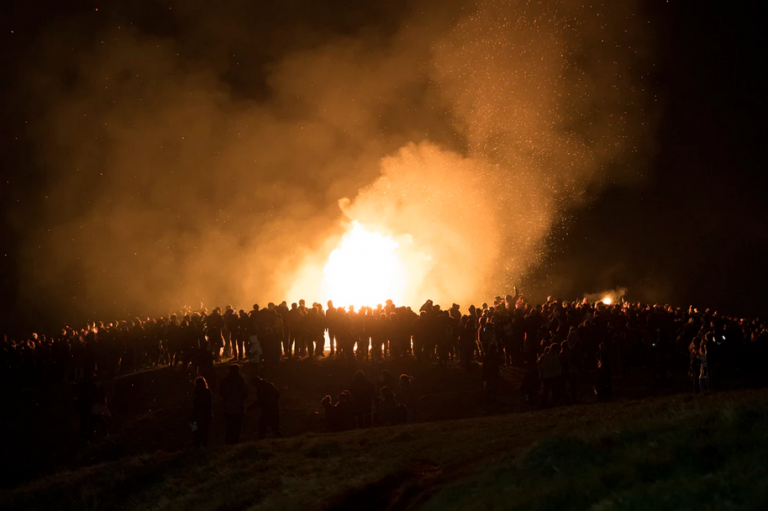
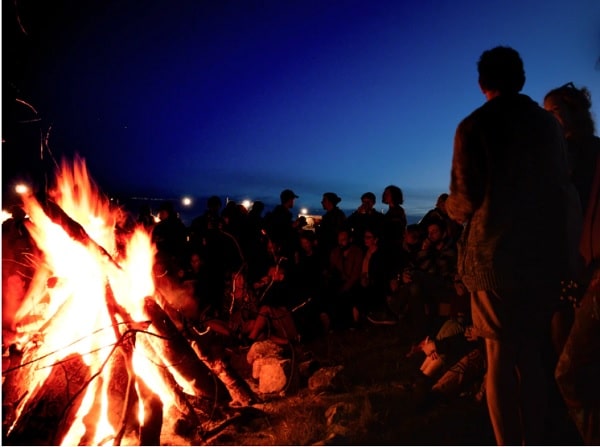
Lag B’Omer Bonfire

Reading Time: 2 minutes

Lag B’Omer bonfire safety – 10 general tips from the Society of Protection Nature in IsraeI.

Hebrew: מדורת ל”ג בעומר

lag bomer bonfire min

10 general bonfire safety suggestions from the SPNI

  1. The SPNI suggest that instead of lighting the traditional bonfire, you might want to celebrate the festival by going out on a night-walk.  Light your way with a lantern and let the children experience the wonders of nature by night.  Listen to the sounds of animals, tell your children about man’s responsibility in nature and preserving the environment, tell them about the origins of the holiday and the Bar Kokhba revolt.
  2. If you must light up, reduce the number of bonfires.  Schools should encourage lighting one bonfire instead of many. Not only will this reduce the risk, there will also be less pollution.
  3. Do not burn plastic, chemically treated wood and avoid the burning of tires.  This all greatly increase the level of air pollution as well as it being health hazard to the elderly, babies and small children.
  4. Do not cut down branches to light your fire or even dead trees, especially in desert environments, they are important in the ecological fabric; they serve as resting and nesting places for birds and hiding places for animals.  If you must burn, use wood that is no longer in use – old furniture etc.
  5. Choose the location of the fire carefully. An area that does not pose a fire hazard to surrounding areas is best. Fires that result from human negligence seriously damage plants and animals. Animals habitats are destroyed, and some, especially the small ones, are unable to escape the rapidly spreading fire.
  6. It is prohibited to build a fire under telephone lines, power lines or areas near fuel and other combustible materials.
  7. Prepare the location of your bonfire properly; dig a hole in the ground and surround it with small rocks and stones.  This will prevent the fire from spreading.
  8. Make sure you have plenty of water to extinguish the fire. The ashes must be thoroughly wet. Before you leave or fall asleep, check that there are no burning coals whatsoever 
  9. Avoid using plastic disposable crockery and cutlery. Lets save the environment, plastic, money and garbage collection. Bring utensils from home.  It take only a few moments to wash up.
  10. Clean up after yourselves! Left over waste should be placed in designated containers. Leaving your trash all over the place damages the ecosystem.

Lag B’Omer trivia

The word “Lag” is not really a word; it’s an acronym and  represents the number 33 in Hebrew.  It is a combination of the Hebrew letters Lamed -ל and Gimel – ג. The numerical equivalent of the Hebrew letter “lamed” is thirty. Similarly, the numerical equivalent of the letter “gimmel” is three. Together, they add up to 33 – Lag B’Omer is the 33rd day of the Omer.

Haifa Stairs Marathon

Reading Time: < 1 minute

The Haifa Stairs Marathon, Friday May 4th, 2018

Hebrew: מרוץ המדרגות חיפה


haifa stairs marathonImage credit: Haifastairs.co.il

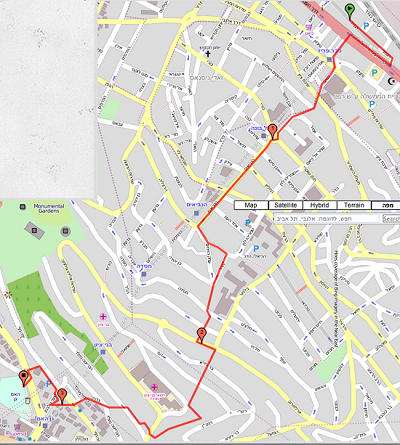
The Haifa Stairs Marathon is a particularly challenging experience for athletes combining running and climbing. The route starts at the Port Campus in downtown Haifa and continues up the stairs through the city until the finish line at Gan Ha’em (Mother’s Park) in the Central Carmel.

The Giro d’Italia cycling Marathon

Cricket, soccer, rugby in Israel – sporting activities that Anglos love

Free tourist attractions in Haifa

The route combines running and stair climbing in all conditions and surfaces; old uneven cobbled stairs to newly laid and perfectly flat stairs and pathways. Wind your way through the city and enjoy the breathtaking scenery from many different aspects.

Arrival time: 06:00am

Starting time: 08:00am

Sections

Section 1: The Port Campus until Hanevi’im St.

Section 2: HaNeviim St. up to Arlozorov

Section 3: Arlozorov up to Bnei Zion Hospital

Section 4: Bnei Zion Hospital to Yefe Nof Street

Section 5: Yefe Nof up to Gan Ha’Em

Fun facts

Route length: 3km

Ascending:  From sea-level to a height of 300m above sea-level

Number of stairs: 1,075 for beginners and 1,500 for seasoned athletes  (whew!!!)

Registration (Hebrew only)


Know who’s near. Locate English speaking, oleh-friendly professionals in your area

Join our newsletter for all our best stuff direct to your inbox

Big Start Giro d’Italia in Israel

Reading Time: 2 minutes

Giro d’Italia 2018 in Israel.

The Big Start; Jerusalem, Haifa-Tel Aviv, Beer Sheva-Eilat.  A must for cyclists and sports enthusiasts!

For the first time Israel is to host the first three stages of 2018 Giro d’Italia cycling event, beginning with an Individual Time Trial in Jerusalem.


Stage 1: Jerusalem

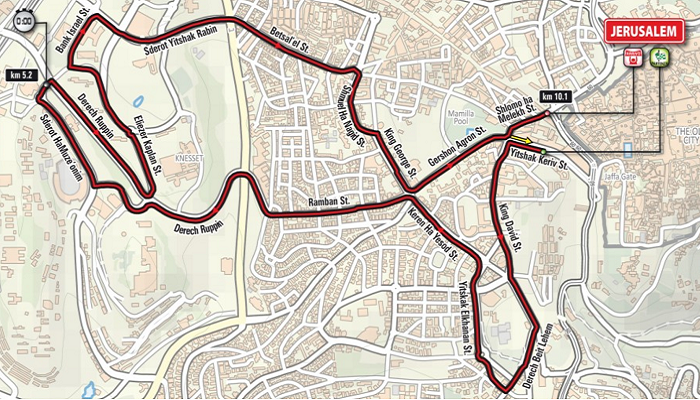
The 2018 Giro d’Italia will start on Friday 4 May with an individual, 10.1km, time-trial in Jerusalem finishing close to the walls of the Old City.

Starting time: 13:50 at Yitzhak Kariv St.

Check with your local municipality for streets that will be closed to traffic.

jerusalem giro map

Image credit: Giro d’Italia


Stage 2: Haifa – Tel Aviv


The second stage on Saturday, May 6th from the Sammy Offer Stadium, via the bay to the check-post, up Rd. No. 4 to Akko, down Rd. No. 70, through to Zichron Yaakov and from there all the way to Tel Aviv via Rd. No. 2 and finishing on the seafront.

Event starting time: 10am

Cycle starting time: 13:50pm

giro haifa to tel aviv 2

Image credit: Giro d’Italia


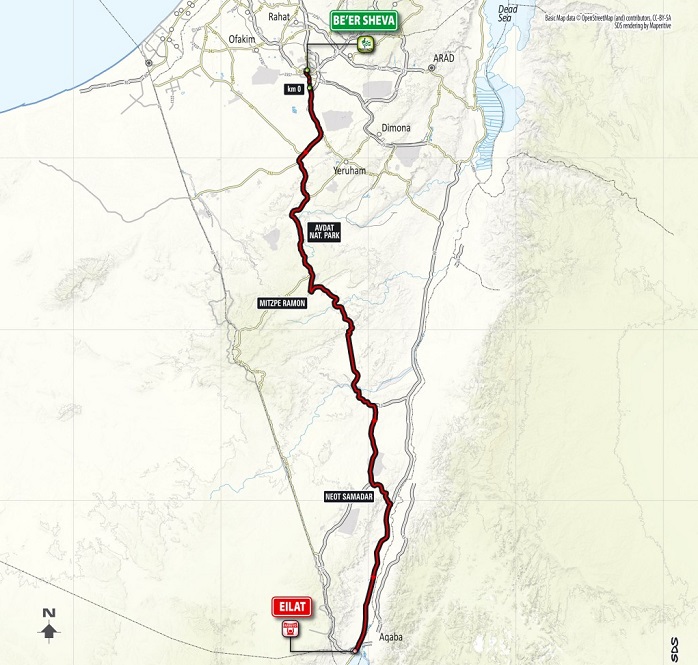
Stage 3: Beer Sheva – Eilat


The third and final stage in Israel, on Sunday May 6th, 2018, Be’er Sheva to Eilat is 226km. After passing Mitzpe Ramon there is a long descent down to the finish in Eilat.

Starting time: 12:30pm Beer Sheva City Hall

giro beer sheva to eilat


Image credit: Giro d’Italia

Giro d’Italia website

Rugby, cricket, football and other sporting activities for Anglos in Israel

Haifa Stairs Marathon


Know who’s near. Locate English speaking, oleh-friendly professionals in your area

Join our newsletter for updates and best deals direct to your inbox


Downtown, Haifa, May 5th, 2018

 https://www.youtube.com/watch?v=V0qLjiLsOpo&t=78s

Parshat Hashavua Emor

Reading Time: 8 minutes

Parshat Hashavua EMOR

Contributed by: Rabbi Nissim Mordechai Makor

Parshat Hashavua Emor in a nutshell: The Torah section of Emor begins with the special laws pertaining to the kohanim (“priests”), the kohen gadol (“high priest”), and the Temple service:

pareshat hashavua emor Rav Nissim Mordechai Makor

(The Priests, in Ezekiel’s vision of the future Temple) ‘…will instruct My people regarding the differences between holy and profane. They will inform them concerning the differences between spiritually unclean and clean. They will act as judges in disputes. They will judge the case according to My laws. They must keep My statutes and My teachings on My holy days, and they must sanctify My Sabbaths.’ (Ezekiel 44:23-4)

‘The Priests shall not eat any carcass or torn animal, of any bird or animal.’ (ibid. 44:31)

Guided Tour…

The prophet Ezekiel himself was a kohen – a priest who spent his earlier life in the Holy Land. His period of recorded prophecy, however, took place after his enforced exile to Babylon – during the period before and after the Destruction of the First Temple in 586 BCE. His Divine communications were addressed to both those Jews already exiled in Babylonia, and to the people of Jerusalem.

The Book of Ezekiel begins in drama, and climaxes to crescendo. It is a long message with powerful, vivid, and ultra-brilliant images. It starts with the excitement of storms, lightening and fire – the heavens open, and Ezekiel dramatically experiences G-d’s words and power. The Almighty calls on him to be a prophet to carry His message to the people through communications emanating from the celestial mobile angelic composition of His throne. The prophecy continues to warn the Jews in the darkest terms of His judgment on them, as a consequence of their having abandoned Torah teachings and basic morality, preferring false prophets, and an idolatrous and grossly self-indulgent lifestyle. It then leaves the Israelites, removing its focus to the doom of the various nations that misled them. By the time the prophecies of Ezekiel return to the Jews, they become warmer and more kindly. Words of threat are replaced with words of comfort and hope: promising a brighter future for the Israelites and their revival and unification within the Holy Land, with, after the defeat of the nation of Gog, a fully restored Temple and nation.

Indeed, the Haftara itself continues Ezekiel’s vision of the future Temple. The immediate preceding chapters describe its construction with striking precision, detailing the offerings that the Talmud (Menachot 45a) understands refer to the actual consecration of that Temple itself. The succeeding verses leading up to, and also forming, the content of the Haftara itself – a passage in many ways paralleling the opening sections of the Parasha – specify that many priests would be ineligible for any, but the most basic roles in Divine Temple service. That is because they had ‘previously distanced themselves from Me when Israel strayed… after their idols’. (44:1) By contrast, the Zakok line of priests (Samuel II 8:17 – listed in Chronicles I 5:30-41), who had been loyal to the Almighty would carry out the actual Temple service in the exemplary fashion detailed by the Haftara – emphasizing due dignity, modesty, and consistent adherence to its procedures. These involve its written laws in the Books of Exodus and Leviticus, and its oral traditions put in writing by Ezekiel (Talmud: Sanhedrin 22b, 83b; Taanit 17b). The latter include four rules, two of which are recorded in the Haftara. They are: a monument must be set up near an unburied corpse so that the priests should not actually defile themselves with contact with the dead (39:15), a priest who is uncircumcised – even where Halachically permitted, through health considerations – profanes the Temple service (44:9), the material used for making the future white priestly garments must be linen (44:18), and the priests themselves must have haircuts at regular intervals (44:20).

However, the whole text describing a future, G-d-centered society, clearly conveys the message that the worship of G-d must go together with common decency. That is exemplified by verses succeeding the Haftara. They state that the Prince is entitled to give part of his estate to his own sons as an inheritance, but he himself is subject to property laws like any other citizen. ‘The prince must not seize (land) from the common people’s portion, or rob their holdings. He may give his sons an inheritance only from his own holding, in order that My people will not be dispossessed of their holdings.’ (46:18)

To which Temple does the passage refer to? It cannot refer to the First Temple that was consecrated some four centuries before Ezekiel’s lifetime. It cannot refer to the Second Temple, because its consecration sin offering involved the male goat (Ezra 6:17), not the bull stated here (43:19). Thus R. Samson Raphael Hirsch expounds the view that the Haftara details the permanent Third Temple, which will be built in future Messianic times.

Hirsch, in his commentary on Emor’s sister Haftara, read on Parashat Hachodesh, explains why Ezekiel describes the construction and working of the Third Temple in such great detail. He states that it is ‘to ban even the slightest doubt as to the reality of that future (of redemption), and to make our confidence as firm as a rock in the absolute certainty that the Almighty Director of the history of the world will ultimately bring about the attainment. Thus every year on the Sabbath before Nissan, (we read) the word of the prophet Ezekiel, and (it) gives us Divine instruction of the service of the consecration of the Temple on that day. Even if there is much in those words that is beyond our present understanding and, according to the Sages, must wait for the arrival of Elijah, what is most important is that these words are given. The thought of it revives our courage and gives us fresh strength to make our efforts even more energetic to bring that distant day nearer.’

May that day approach soon, and in our times.

Candle Lighting Times for Shabbat Ki-Tisa

Parshat Hashavua Index

D’var Torah

Ezekiel lived in the generation before Ezra, the leader who started the era of the Men of the Great Assembly. This period formed a six-hundred year bridge between the Prophets and the Rabbis of the Talmud. The Great Assembly developed the growth of the Halacha by constructing ‘fences to Torah Law’ (Talmud: Avot 1:1), and it appears that that the Prophet Ezekiel, with his intense focus on Halacha including the stringencies stated in the Haftara, actually prepared the ground for their work.

However the Talmud (Shabbat 13b) records that there was an attempt to refuse to admit the Book of Ezekiel within the ranks of Biblical holy writ, because it appeared to contain contradictions to Torah law. For example, in the Haftara (44:22), ordinary priests may not marry widows, but the Torah limits this prohibition to the high priest only (Lev. 21:14). In addition, a priest may not defile himself by being in contact with a corpse unless it is that of a close blood relative – parent, child, brother, or unmarried sister (44:25). The Parasha makes the same point, but also allows him to contact a dead body under the category of ‘relatives closest to him’ – which would also include his deceased wife, a non-blood relative. Yet another example seems to bring an unnecessary prohibition. ‘The priests shall not eat any carcass or torn animal, of any bird or animal.’ (44:31) Why does Ezekiel prohibit the priests things already forbidden to the whole population? And yet, according to the Talmud (Menachot 45a), it not merely a repetition. For by Torah law, priests were allowed to consume the offerings of doves whose heads had been killed by melika – nipping and therefore actually tearing the throat (Lev. 5:8), and here Ezekiel specifically prohibited that, as he refers to both birds and animals. So again Ezekiel is laying down a law stricter that that of the Torah. Why is that so?

The Talmud (Shabbat 13b) states that the above, and similar issues, gave great concern to the early Rabbis. To this end it says:

‘Remember that man, Hanania ben Hizkia, for good. Had it not been for him, the Book of Ezekiel would have not been included in the Bible, for its words seemed to contradict the Torah. What did he do? Three hundred barrels of wine were brought up to him, and he sat in an attic and reconciled the contradictions.’

It does not, however, describe how the above, and similar issues were resolved. We do not have any details of Hanania’s solutions. However, we may ask the following. How would the spiritual state of the Israelite nation advance when this part of Ezekiel’s prophecy becomes reality? Within that context, where do the ‘changes’ fit into Torah practice?

In tackling the above issues, the Haftara brings a powerful statement about the role of the future priesthood. They will ‘… instruct My people regarding the differences between holy and profane. They will inform them concerning the differences between spiritually unclean and clean. They will act as judges in disputes. They will judge the case according to My laws. They must keep My statutes and My teachings on My holy days, and they must sanctify My Sabbaths.’ (44:23-4)

The Gaon of Vilna expounds that the above verses hint at the six orders of the Mishna. ‘Holy and profane’ refers to the Order of Holy Things; ‘unclean and clean’ to the Order of Purities; ‘Judges in Disputes’ to Damages, ‘My Teachings’ to the Order of Women; ‘My Statutes’ to the Order of Seeds; and ‘My Holy Days’ to the Order of Appointed Times.

Simplified, the Gaon’s statement means that the Priests will serve as spiritual leaders and teachers to the Israelite nation. They will present the Law of Moses and its traditions with the necessary appeal and dynamism that will make a deep impression on the Israelites of the time. The text implies that they would not stay all the time in the cloisters of the Temple worship, but also mix with the population.

That might even involve instituting new practices that would come under the general heading of Gezeirot – precautionary Halachic legislation. Indeed, much of Talmudic law is precisely that. Each case of Ezekiel’s vision of future Temple practice that differs from the Law of Moses imposes additional stringency. Nowhere is he actually more lenient.

Ezekiel’s vision gave an important dimension to the priesthood and Temple worship. The rebuilt Temple was not to be a mausoleum and a site of mere ritual, but a spiritual powerhouse from where the Torah would enter the hearts of those who attended. A person who visited the Temple would go away with the feeling that he had learnt something new that he sincerely resolves to put into daily practice. He would obtain a new perspective on life’s values, and personally connect with those who served G-d at the place where the Divine Presence was most intense. And the very fact that these priests were to meet the public in non-Temple contexts on all that the Torah is something to be lived at all times, and not for special occasions only. So the spiritually elevated Temple experience would permeate all walks of life among the Israelite nation.

That vision requires ideal standards of conduct from the priests at all times. Their very approach-ability means that their personal conduct must be all the more exemplary. Their deeds, and as a result, what they stand for, will be on constant, critical view from the public. A past history of less-than-holy activities would disqualify a priest. Their appearance, deportment and personal lifestyle must enhance their calling in the eyes of the public – and that would extend even to choice of marriage partner, and what food they may eat. Ezekiel’s vision gave a window into the future on what practices would promote the enhancement of Torah at the time the Temple would finally be rebuilt. To be effective in their roles, it was essential that the priests had to be most scrupulous in regard to their dress, their marriage partners, their contact with the dead, and indeed their diet. Only then would their leadership be a success and convey the appropriate messages to the people.

Acknowledgements to: Reb Jacob Solomon

Israel Train shutdowns – April 2018

0
Reading Time: 2 minutes

Temporary train shutdowns April 2018 – Wednesday/Thursday, Friday, Saturday

Hahagana Station

The Binyamina and Hof HaCarmel, Haifa line

The line between Binyamina and Hof HaCarmel Station in Haifa will be closed as follows:

  • From the night between Wednesday, 25.4.18 and Thursday, 26.4.18 at 00:01 until Friday, 27.4.18 at approximately 17:00.
  • It will also be closed between the end of Shabbat, Saturday, 28.4.18 until Sunday, 29.4.18 at approximately 05:00.

The Nahariya-Modiin/Modiin-Nahariya line

Thursday 26th, April

  • North to South – Train services will operate between Nahariya and Haifa Hof HaCarmel stations in both directions. Please note that if you are traveling to the Airport you will need to take the free shuttle from Hof HaCarmel
  • South to North – Train services will operate between Modi’in Central and Binyamina stations in both directions with an additional stop at Caesarea Pardes Hanna station.

Friday, 27.4.18 and Saturday, 28.4.18 after Shabbat

  • North to South – Train services will operate between Nahariya and Haifa Hof HaCarmel stations in both directions. Please note that if you are traveling to the Airport you will need to take the free shuttle from Hof HaCarmel
  • South to North – Train services will operate between Tel Aviv HaHagana and Binyamina stations in both directions with an additional stop at Caesarea Pardes Hanna station.  Attlit Station will be closed.

Ben Gurion International Airport Night Train

Thursday – Friday, 26 – 27.4.18 and Saturday, 28.4.18 after Shabbat

  • Train services will operate between Nahariya and Haifa Hof HaCarmel stations in both directions.  You will need to take the free shuttle from Hof HaCarmel to the Airport
  • Train services will operate between Be’er Sheva Central and Binyamina stations in both directions.

Friday 27.4.18 (the night between Thursday and Friday) and Sunday, 29.4.18 (The night between Saturday after Shabbat and Sunday)

  • Train services will operate between Nahariya and Haifa Hof HaCarmel stations in both directions. You will need to take the free shuttle from Hof HaCarmel to the Airport
  • Train services will operate between Be’er Sheva Central and Binyamina stations in both directions.

Free shuttle services

A free shuttle service will operate between Haifa Hof HaCarmel and Ben Gurion International Airport station in both directions.

Click here for shuttle times..

Interruptions to other lines

Thursday and Friday will also see interruptions on the following lines

  1. The Nahariya – Beer Sheva line
  2. The Carmiel – Beer Sheva line
  3. The Bet Shean – Atlit line

Please consult the Israel Railways website for details – https://www.rail.co.il/en (in English)

Parshat Hashavua Aharei Mot Kedoshim

Reading Time: 6 minutes

Weekly Torah Portion – Parashat Hashavuah Acharei Mot Kedoshim

Contributed by: Rabbi Nissim Mordechai Makor

Rav Nissim Mordechai Makor

What’s going on here?

One of the students of Rabbi Aharon zs”l, author of “Shomer Emunim,” sent his rebbe a deep question regarding his first work, “Shulhan Hatahor.” In his response, which was published in a collection of his letters, the sadik revealed something fascinating: “You should know, my son,” he wrote, “that when I wrote my book, I beseeched the Al-mighty that the answer to every question which arises in the book should be found on the same page as the question. Indeed, the answer to your question is found on that same page.” True, it is amazing, but this is not anything new. We have a tradition that the answer to any question can be found in the weekly parashah, as it will always offer insight into a Torah perspective on any issue.

The State of Israel is currently covered with flags in celebration of the 72nd anniversary of the founding of the state. Although 72 years is not all that much, still, something is happening here. Throughout this period we have not lived in peace, be it politically, strategically, or economically. The impression is that from every perspective the blanket is a little too small. When we finally got inflation under control, unemployment rose. As soon as we made progress securing our borders, we faced political crises. No matter where we go, something starts to crumble. It is not in our best interest to seal off the territories, nor is it wise to lift a closure. What’s going on here?

The answer may be found in the parashah, and is related to the following story of a wealthy man who had but one son. The father hired the most experienced teachers and tutors for his son, and he adopted an orphan boy to be his son’s friend.

At first, the orphan was very grateful for this opportunity, and he studied diligently. Gradually, however, he began feeling too comfortable in his new home, and his enthusiasm started weakening. He caused trouble for his tutors, his games became wild, he walked the streets and befriended the wrong crowds, and introduced vulgar speech into his benefactor’s home, threatening to drag the man’s son along with him.

Upon realizing what is happening, the man immediately drove the mischievous boy from his house, sending him to the streets whose inhabitants he had already befriended.

The orphan left the house, but the seeds of mischief which he implanted in his friend’s heart grew and flourished. He, too, began rebelling against his teachers, he behaved disrespectfully towards his parents and tutors, and, following his friend, joined the wild street-gangs.

Eventually, the father took his son by the arm into his room, grabbed the rod and hit him fiercely, until the boy’s shrieks filled the house. Only when the boy promised to improve his behavior did his father’s anger subside.

His servant asked him, “Why were you so much more angry with your son than that orphan boy, who was the one who incited your son to behave this way in the first place?”

The father responded, “That boy was a stranger – what do I have to do with him? As long as he helped my son, I kept him here. Once he left the proper path, I let him go. But my son is my own flesh and blood. How can I send him from my house? I will punish him until, whether he likes it or not, he returns to the proper mode of behavior.”

Similarly, we read in our parashah (chapter 18): “Speak to Benei Yisrael and say to them, I am Hashem your G-d.” As if to say, “You are my sons, and I cannot allow you to collapse!” The pesukim continue, “Do not do like the ways of Egypt which you left, and do not do like the ways of Canaan to which I am bringing you, and in their ways you shall not walk. You shall observe my statutes and laws to walk with them, I am Hashem your G-d.”

What follows is a series of warnings: “For all these abominations were done by the inhabitants of the land before you, and the land was defiled.” Perhaps you will think that if you behave this way you will be driven out, as well?

Wrong! “The land will not discharge you when you defile it like it discharged the nation before you.” They were like foreign children who were then sent away. But you are sons to the Al-mighty, and, whether you like it or not, you will be punished until you return to the proper path: “For anyone who does these abominable activities will be cut off from their nation.” Therefore, you will have no choice but to obey. “You will observe my warning not to do any of these abominable acts which were done before you so that you will not be defiled by them, I am Hashem your G-d.” I am your father who loves you dearly, and I will not leave you until you improve your ways and return to Me.

“You shall become holy, and you shall be holy”

Parashat Kedoshim opens with the directive, “You shall be holy.” The parashah concludes with the commandment, “You shall be holy to Me.” Likewise, we find in the middle of the parashah, “You shall become holy, and you shall be holy.” Explaining the significance for this repetition, the Midrash presents a story of a king who owned a large wine cellar. He hired watchmen to guard the wine. Among the watchmen were several “nezirim,” who are forbidden to drink wine, while the others were alcoholics. At the end of the day, when their shift ended and the king paid them for their work, he doubled the salary of the alcoholics. The nezirim asked him, “Your Majesty, didn’t we all guard the cellar together? Why did the others receive double pay?” The king answered, “They are drunkards, and therefore had a far more difficult struggle to overcome. They are therefore entitled to double salary.” Similarly, the angels, who do not have a yetzer hara, are described with only one expression of sanctity. Humans, who must constantly struggle with their evil inclination, receive the mention of two “kedushot” – “You shall become holy, and you shall be holy.” Their reward is doubled and tripled, as we fulfill a mitzvah each time we hold ourselves back from indulgence, each time we observe the proper degree of seni’ut and sanctity.

Similarly, we might add, in the earlier generations the lifestyle more closely resembled that of angels – the streets were clear of immodest dress and behavior, people were constrained. Nowadays, however, the opposite can be said. Therefore, with every limitation which we take upon ourselves, with every added degree of seni’ut which we observe, our reward will be multiplied again and again.

The wonders of the Creator

The Kiwi

Have you heard of the kiwi? No, we are not referring to the fruit which has become more and more common at our tables. Rather, we are dealing with a strange, winged creature, who shares the same name as the aforementioned fruit – the kiwi. The kiwi is an awfully strange bird which resides in New Zealand. Its wings are completely non-functional and thus it cannot fly. The Creator, in His infinite mercy, ensured that it will not have to fly. Most birds fly in order to run away from various enemies. Others need to travel vast distances in order to find food, while others need to travel to change climates. The kiwi, by contrast, lives in a comfortable climate on a permanent basis with no need to migrate. Furthermore, its food is easily secured and it faces no danger as it lives in thick forests and remote places, where there exists no threat to its life.

The most interesting question regarding this creature is, how does a bird which does not fly and whose vision is impaired find its food? The answer is just as interesting. At night, the kiwi goes out using its beak like a cane. Leaning on its beak, it walks around slowly in the dark. When its smells a worm, it thrusts its beak into the ground and waits. When it captures the worm, he raises it ever so carefully to ensure that it does not break on the way up. Apparently, the kiwi prefers its food whole and not cut.

Another interesting method of the kiwi to catch food is by stamping on the ground with its strong legs. The worms down below think that the rain season has begun and come out of their holes, right into the kiwi’s beak.

We see, therefore, how the Al-mighty provides for even a bird who cannot fly and whose vision is impaired, ensuring that it is nourished.

As Jews, we realize that the key to livelihood is held by Hashem alone, and we are therefore not only confident that we are in the best hands possible, but we are also careful not to violate any prohibitions, as we need merely to turn to the source of all wealth, since prayers are always helpful.

Parshat Hashavua Tazria

Reading Time: 5 minutes

Parshat Hashavua Tazria-Metzorah

By: Rabbi Nissim Mordechai Makor

Parshat Hashavua Tazria Rav Nissim Mordechai Makor

In a nutshell, Parshat Hashavuah Tazria continues to discuss the laws of purity and ritual impurity.

Upon the completion of the days of her purity for a son or for a daughter, she shall bring a sheep within its first year for an elevation – offering, and a young dove or a turtledove for a sin-offering. (12:6)

A yoledes, woman who has given birth, brings two korbanos: a sheep, as a Korban olah; and a fowl, as a Korban Chatas. Chazal explain that the Chatas, Sin-Offering, is brought because a woman who goes through childbirth suffers so much pain that she vows not to have more children. Such a vow is sinful. Breaking it, which is likely to occur, is more sinful. The reason for the Korban Olah, however, eludes us. The usual reasons that catalyze a Korban Olah do not apply to the yoledes.

Candle Lighting Times for Shabbat Tazria

Abarbanel explains that the Korban Olah is a form of gratitude to Hashem for granting her a child and for sparing her life through the ordeal of childbirth. This reasoning is supported by a number of Midrashim that obligate the woman to acknowledge Hashem’s beneficence during her involvement in the motherhood process. While all this is true, a Korban Todah, Thanksgiving-Offering, seems more appropriate than an Olah. Horav Avigdor HaLevi Nebentzhal, Shlita, addresses this question and suggests two approaches. He explains that; either the criteria for bringing a Korban Todah do not apply to a yoledes; or the demands of halachah which apply to the Jewish woman do not correspond with the halachic application of a Korban Todah.

The first approach is based upon the halachah that one must consume a Korban Todah in one day and one night, while one has two days and one night to consume the usual Korban Shelamim, Peace-Offering. The reason for this is that gratitude must be spontaneous. One must express gratitude amidst joy and enthusiasm with a heart filled with song. Once one waits and allows his obligation to fester, a significant component of the appreciation is diminished. Thus, as the time for consuming the Todah passes, the level of simchah, joy, is decreased. Therefore, the Torah shortened the time span allotted for its consumption, so that it would be eaten at the time of heightened joy.

This halachah concerning the Korban Todah creates a problem for the yoledes, who cannot bring a korban for forty days for a male birth and eighty days for a female birth. After such a lengthy time passes, the emotion that permeated the yoledes at the time the miracle of birth took place might have waned. Without a doubt, if she desires to bring a Todah, she may, but to say that every yoledes should be obligated to bring a todah does not seem consistent with the halachos that apply to that korban.

Second, another halachah which pertains to the Korban Todah does not coincide with the manner in which a bas Yisrael, Jewish woman, should act publicly. Together with the korban Todah, one must bring forty loaves, of which four are given to the Kohen. The Netziv, zl, explains why this korban necessitates so many breads. He says that since everything must be eaten in a short period of time, it behooves him to invite friends and relatives to share in the celebration of his good fortune. The greater number of participants involved in the celebration, the more magnified is the Kiddush Hashem, sanctification of Hashem’s Name, which is the underlying purpose of Todah – thanking Hashem.

This halachah, however, does not concur with the halachos of tznius, modesty, that are the hallmark of the Jewish woman. It is inappropriate for a woman to call attention to herself in front of a crowd. The impropriety becomes more grievous when it is a married woman, which is the case by a yoledes. Kol kevudah bas melech penimah, “The entire glory of the daughter of the king lies on the inside.” (Tehillim 45:14) This pasuk, which underscores much of the Torah’s attitude toward the role of a woman, has been used by Chazal as a statement describing the private nature of the female role as well as a panegyric on the private nature of the religious experience in general. Indeed, the private sphere should be the dominant area of a woman’s life. Implicit in the woman’s creation was the idea that she focus on a specific trait of the human personality – tznius.

While a woman may certainly offer a Korban Todah, to oblige her to do so after childbirth would not be consistent with the parameters of hilchos tznius. This statement will surely be cause for considerable discussion, especially in light of the influence of western civilization on contemporary Jewish society. Rav Nebentzhal cites two mitzvos that women do not usually perform, specifically because of constraints on them made by the laws of tznius.

Women do not light the Chanukah lights unless there is no man in the house. Why? The Chasam Sofer explains that because of the criteria of pirsumei nissa, publicizing the miracle, one should light the candles outside, in public. It is not the manner of a woman to stand outside of her house and publicly light the candles. It is not tznius. How far we are removed from the Chasam Sofer’s perspective on Jewish life!

Kiddush Levanah, sanctifying and blessing the New Moon, is a time-bound mitzvah. Yet, while women do recite a brachah upon performing a mitzvos asei she’hazman grama, time-bound mitzvah, they do not recite the Kiddush Levanah service. A number of reasons are cited. The Rama says that since this mitzvah should be performed publicly beneath the sky, preferably on the street, it is not consistent with the laws of tznius.

We have only to return to the sources to realize that to reverse a G-d-given role is to invite censure, both Divine and human. Regrettably, the effect of the society in which we live has somewhat distorted our perspective on what really is the G-d-given role of woman. Adam Harishon gave Chavah a name which he saw b’ruach Hakodesh, with Divine Inspiration, was to reflect her fundamental – though not necessarily exclusive – role in life: eim kol chai, mother of all life. Perhaps, if more people would accept this truth, there would be many fewer issues concerning our children’s educational development.

Candle Lighting Times for Shabbat Tazria

Parsha Index

He is to call out: “Contaminated, contaminated!” (13:45)

Rashi explains that the metzora must warn people to distance themselves from him lest his tumah, spiritual defilement, contaminate them. The following narrative indicates how far we are removed from reality and the definition of sin. Horav Elazar M. Shach, zl, related that his uncle Horav Issur Zalman Meltzer, zl, the venerable Rosh Hayeshivah of Eitz Chaim, would give a shmuess, ethical discourse, on Motzoei Shabbos, during the month of Elul. The words that came from his heart entered the hearts of his students and deeply inspired them. The emotion that was felt in that room was overwhelming.

One time, the Rosh Hayeshivah stood at the lectern. He looked at the crowd, declaring, “When a Sefer Torah is found to be pasul, invalid, we take a gartel, sash, and wrap and tie it around the outside of the Sefer. This way people will be aware that it is pasul, and they will not use it.”

Suddenly, the Rosh Hayeshivah burst out in heartrending tears and screamed, “If so, how many gartlech, sashes, should we be wrapped with, so that people will realize how pasul we are? Yet, we still do not learn from our actions!” As soon as these words left Rav Issur Zalman’s mouth, the entire assemblage broke down in bitter weeping. Rav Issur Zalman was a tzaddik. His students were talmidim of their revered rebbe. He was their religious role model. Yet, they all wept sincerely. What should we say?

Lyrics to the song ‘Hallelujah’.

Reading Time: 2 minutes

Lyrics to the song ‘Hallelujah’ – Eurovision winner, 1979.

Music: Kobi Oshrat

Lyrics: Shimrit Orr

Original performers: Gali Atari & Milk & Honey

To date there have been four Israeli Eurovision victories; Izhar Cohen and Alphabeta in 1978 with A-Ba-Ni-Bi. In 1979, Israel won again, this time with Hallelujah performed by Gali Atari & Milk and Honey. Israel’s third victory came in 1998 when Dana International sang the song Diva.  Israel’s fourth victory came in 2018 when Netta Barzilay sang Toy

Halleluja lyrics

Hebrew Transliteration English
Hallelujah la’olam
Hallelujah, yashiru kulam
Bemila achat bodeda halev male bahamon toda
Veholem gam hu: eize olam nifla

Hallelujah im hashir
Hallelujah al yom sheme’ir
Hallelujah al ma shehaya
Uma she’od lo haya, Hallelujah

Hallelujah la’olam
Hallelujah, yashiru kulam
Veha’inbalim hagdolim yehadhedu bahamon tslilim
Ve’itanu hem yomru Hallelujah

Hallelujah im hashir
Hallelujah al yom sheme’ir
Hallelujah al ma shehaya
Uma she’od lo haya, Hallelujah

Hallelujah al hakol
Halelu al machar ve’etmol
Hallelujah utnu yad beyad
Veshiru milev echad, Hallelujah

Hallelujah im hashir
Hallelujah al yom sheme’ir
Hallelujah al ma shehaya
Uma she’od lo haya, Hallelujah

Hallelujah al ma shehaya
Uma she’od lo haya, Hallelujah

Hallelujah to the world
Hallelujah, everyone will sing
With one single word the heart is filled with much gratitude
And it also pounds: what a wonderful world

Hallelujah with the song
Hallelujah for a day that shines
Hallelujah for all that has been
And all that is yet to come, Hallelujah

Hallelujah to the world
Hallelujah, everyone will sing
And the great bells will echo with many sounds
And with us they will say Hallelujah

Hallelujah with the song
Hallelujah for a day that shines
Hallelujah for all that has been
And all that is yet to come, Hallelujah

Hallelujah for everything
Praise tomorrow and yesterday
Hallelujah and hold each other’s hands
And sing from one heart, Hallelujah

Hallelujah with the song
Hallelujah for a day that shines
Hallelujah for all that has been
And all that is yet to come, Hallelujah

Hallelujah for all that has been
And all that is yet to come, Hallelujah