19.3 C
Jerusalem
Wednesday, May 13, 2026
Sample Page
Home Blog Page 71

Israel Rail Updates February 2019

Reading Time: < 1 minute

Israel Rail Updates for February 2019

Information supplied by Israel Railways

train FEBRUARY 2019

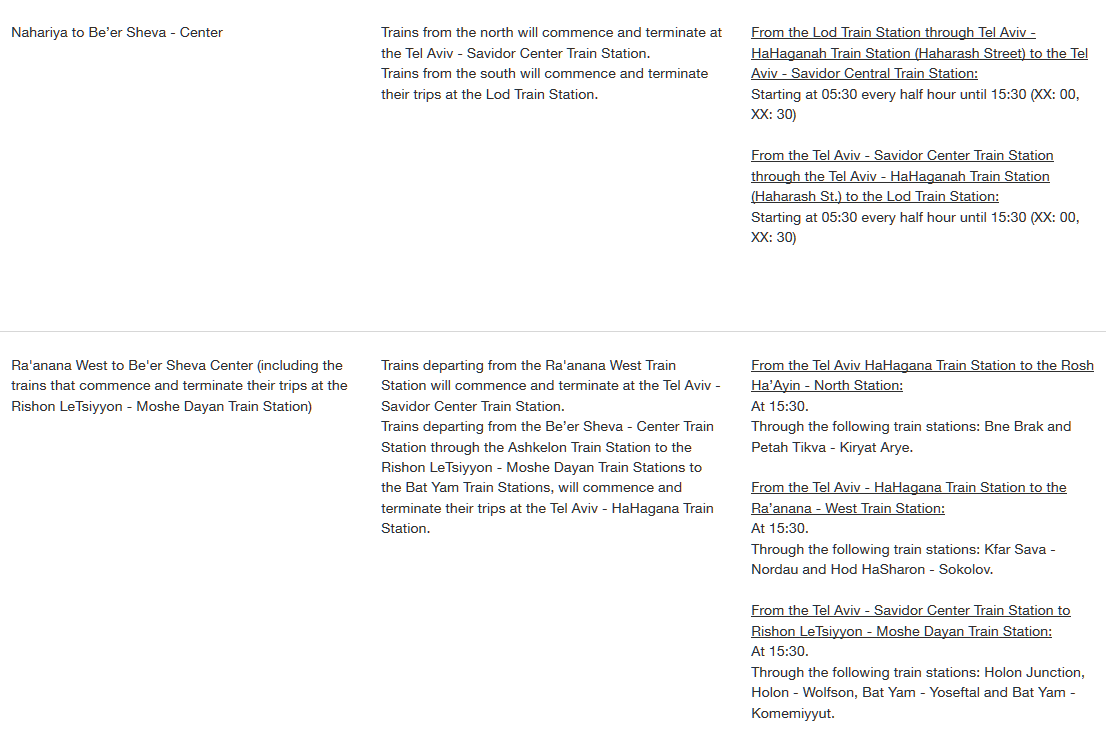
Changes to train schedule on Sundays to Thursdays From 21:00 to 05:00 am:

train1

Changes to Train Movements on Fridays from 00:01 to Conclusion of Service:

train2

train3

Note: ​The Tel Aviv – HaShalom Train Station will be closed on Fridays


Santa’s Story with Aviva Pelham

0
Reading Time: < 1 minute

Santa’s Story with Aviva Pelham. A Telfed charity benefit concert.

The story of Santa Pelham.

When 90 year old Santa Pelham was persuaded to write her fascinating life story, it was intended so that her memoir would be there for future generations.

PAST EVENT

But Santa’s story became something much more: a cathartic experience, an inspiration for song and recently, a one-woman show performed by her daughter, Opera Diva, Aviva Pelham. Aviva brings the moving text to life detailing her mother’s journey from Germany, to Spain, to France and then to Africa – punctuated by wonderful live Klesmer music.

Santa’s Story is directed by multi-award winning Janice Honeyman with designs by the acclaimed Mannie Manim and Dicky Longhurst who round up a heavy-weight artistic and creative team.

Santa’s Story has run in Cape Town where Aviva received a Fleur du Cap nomination, to capacity audiences and more recently completed a sold-out season in Johannesburg.

Santa’s Story is coming to Israel

Santa’s Story with renowned South African singer Aviva Pelham is coming to Israel soon with two benefit concerts for Telfed and Keren Beth Protea on 25 and 26 March 2019. Don’t miss out on this evocative and moving tribute to survival which became an inspiration for song, performed as a one-woman show with highly successful tours of South Africa, USA, UK, Germany, Finland and Australia. Early bird ticket discounts are availablecall Telfed 09 7907801 Mon-Wed 09:30-12:30 to book by phone.

The Hebrew Month of Adar

0
Reading Time: 5 minutes

The Hebrew month of Adar aligns with Pisces.

The Hebrew month of Adar: Remember that astrology is all about learning what the energy of each month is, as you cannot act the same way every month. Every month has its own unique energy and if you don’t know what that energy is, the month can become problematic. 

hebrew month of adar

The month of Adar is a very special month. It says about Nissan that it is the head of the months, the first month of the year if we start to count from Nissan. If Nissan is the first month then Adar is the last month. What is special about being the last month. The last of anything is always the manifestation of it, therefore, in Adar we have the manifestation of the previous eleven months. It is said, “everything goes after the end”.
The two main events in the month of Adar, are Purim and the Yarzheit of Moshe Rabeinu.

What is so special about a Yarzheit?

The word for Yarzheit in Hebrew is Hilulah, which means a day of joy. On the Yarzheit we must be happy as this is the best day to connect to the soul of the deceased because it comes back to the physical world to visit. If the person was a Tzaddik, during the year it is very difficult to connect to that soul because it is on such a high level that it is very far away from the physical level. On the seventh of Adar we can connect to Moshe Rabeinu.
There is a story about a father who used to gather his kids around the table on the Yarzheit of a big Tzadik and ask each kid what present they were going to send to the Tzadik. Some said they would learn in his honor, some said that they would do other Mitzvot like visiting the sick etc. This is a very beautiful way to honor a Tzadik or parent, by sending them presents. Do some extra Mitzvah in their honor and I guarantee that they will come and help you. For Jews, Moshe Rabeinu was the person who took us out of Egypt, so on his Yarzheit we connect to that energy of freedom. Also Moshe was the most humble person. Let’s learn from him and try to let go of our egos.
To understand the Hebrew month of Adar, we have to look at the two letters connected to this month (from Sefer Yitzirah). The letter, Kuf, is the letter that created the month of Adar-Pisces. We know that the Hebrew letters are the building blocks of creation and the Kuf is the only letter in the alphabet that goes below the line. What does this mean to us?  This month is the only month of the year where we can go head to head with the evil inclination/yetzer hara. All other months we have to fight the yetzer hara with gorilla tactics. We attack and then run and hide. With the power of the Kuf which goes into his domain, we confront him head on and have the power to overcome our yetzer hara this month. The other letter connected to this month is Gimmel, which is the letter that controls the planet Jupiter, which is the planet of miracles. Jupiter controls two months, Adar-Pisces and Kislev-Sagittarius. No wonder that Purim and Chanukah took place in these two months.
The whole point of Purim is the war against Amalek (Haman). The battle with Amalek is more of an inner battle than a physical battle and is all about getting rid of doubt which is the root of all man’s problems. (‘Doubt’ in Hebrew is Safek which has a numerology of 240 which is the same as Amalek).
This is a never ending quest. Don’t let your guard down. Fear, panic, anxiety etc. are the biggest weapons of Amalek. Fight this battle with all your might because it is the main battle in life. The opposite is complete bitachon and emunah in Hashem.
In the Megillah, 9:1, the words “Venahafoch hu (it was totally reversed) are used)”. This is pivotal point in the Purim story and a big secret. The whole verse is: “On that day the enemies of the Jews hoped to have control over them, venahafoch hu (it was totally reversed), that the Jews themselves had control over their rivals”. Things were turned from one extreme to the other, 180 degrees. Not only were they saved from the deadly decree, rather it was an absolute and total turnaround from the bleakest predicament to the pinnacle of joy. Their enemies were totally destroyed and wiped out. This is the power of Purim and this month.
Megillah 9:22: “From sorrow to gladness, and from mourning to a festival”. This is the reason for the great and tremendous simcha on this sacred holiday of Purim. What appeared to be the greatest threat and the worst dilemma, itself became the greatest salvation and gift. Thus we celebrate a double simcha on this unique holiday of Purim. Both the salvation and the victory over our enemies.

Rabbi Gamliel Rabinowitz, Shlita on Purim.

This is the power of Purim and this month, to completely destroy Amalek (Haman) doubt.
Also we don’t realize but there is a very big connection between Purim and Pessach. Purim in a way is paving the road for us to Pessach, freedom. Many people don’t realize that the parties of Esther, the fasting of the Jews and the hanging of Haman took place on Pessach. It was only eleven months later that the battle of Purim took place on the 13th Adar.
People born in the month of Adar are very easy going and sharing. This can be their Tikkun in that they are so easy going many times they allow people to take advantage of them. They always have to push themselves to take action.
The name of Hashem connected to this month is all upside down and this month should be a month of judgement, however, Hashem out of kindness turned this month around to one of mercy with endless joy and happiness. We have to increase our joy in this month. Bnei Yisrael is ruled with Divine mercy in this month and their mazal thrives in this month. There is a great flow of Shefa from the upper worlds. In this month the main work is to strengthen our love for our fellow Jews and to be in unity. That was what Haman was trying to destroy, the unity between the Jews. Chazal inform us that by Achashveirosh removing his signet ring and giving it to Haman(3:10), it accomplished more than the forty eight neviim (prophets) and the seven neviot. The prophecies of the prophets and prophetesses did not cause Klal Yisrael to mend their ways, yet the “removing of the ring” brought them back to the proper path, Megillah 14a.
The essential foundation of emunah and unity that we learn from Purim is a lesson for us to integrate this into our consciousness for the entire year.
Chodesh Tov.

Rav Nissim Mordechai Makor

May this article be an Ilui Neshamah for Chaim ben Moshe Aaron.

The 2019 Israel legislative elections

0
Reading Time: < 1 minute

Make sure you are registered for the next round of the 2019 Israel legislative elections – the 22nd parliament.

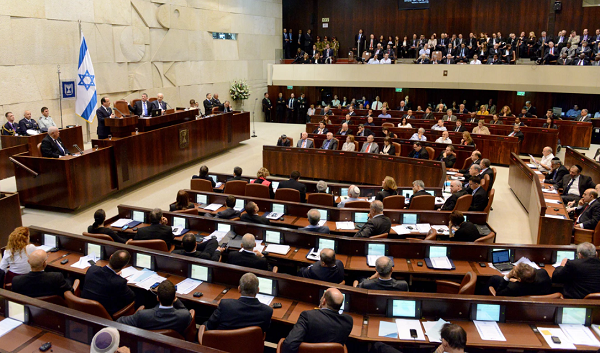
israel parliament knesset 

Knesset Members elected after the Israel Legislative Elections – Unsplash


In case you were not on the voters roll for the April elections, in preparation for the next round of the 2019 Israel legislative elections (17 September, 2019) and to ensure that you and every eligible Israeli citizen is able to vote, the Ministry of Interior requests that the public verify their personal details in the Voter’s Registry.

You can do this:

1. By calling: 1-800-222-290

Sunday – Thursday 8:30-22:00, Friday 8:30-13:30

This service is available in Hebrew, Arabic, Russian, Amharic and English.

2. By sending a text message from your mobile phone

Send your Teudat Zehut Number along with the date it was issued. to telephone +972 50-8085500

3.  By fax:

Send your details to 1-800-222-291

If you need to update your address, changes can be made through the government’s website: www.piba.gov.il

Updates and changes to the information listed in the Voter’s Registry will not be accepted after 25th July, 2019.


{module [624]}


Continuing Power of Attorney

Reading Time: 9 minutes

The Continuing or Enduring Power of Attorney for Israel.

By: Adv. Jay Hait

continuing power pof attorney jay haitIn Israel the Continuing Power of Attorney is also referred to an Enduring Power of Attorney but it shouldn’t be confused with a Living Will.

According to a survey of adults aged 60 and over by the United States National Council on Aging, two of the items that aging adults are most concerned about are financial security and the maintenance of their physical and mental health.

Here in Israel, up until recently, when a person’s mental health started to fail them (i.e. they were unable to manage their own affairs), the standard procedure was to have a court appointed guardian (apotropos) put in charge of their affairs. This guardian makes both financial and other decisions for that person.  Some of these decisions require further court approval, and some do not.  All of this is done in accordance with the Israeli Law of Legal Capacity and Guardianship of 1962 (חוק הכשרות המשפטית והאפוטרופסות, תשכ”ב – 1962).  However, the bottom line is that the process is not friendly (many people have even defined it as demeaning) and does not always take into account what the person would have wanted to be done had he or she had the legal capacity to make decisions.

From 2016 to 2018 amendments were made to the Israeli Law of Legal Capacity and Guardianship of 1962, which have gone into effect, and which bring Israel into line with many Western countries regarding decision making facilities for people who no longer possess legal mental capacity to make decisions for themselves.  These amendments allow for the creation of three new legal tools that people can avail themselves of:  the “Continuing Power Of Attorney” (ייפוי כוח מתמשך), the “Decision Making Supporter” (תומך בקבלת החלטות), and the “Expressed Decisions Document” (מסמך הבעת רצון).

jay hait law offices

Many people in Israel have heard about the Continuing Power of Attorney and mistakenly believe that it is the equivalent of what is commonly known in Western countries as a “living will” or an “advance health care directive”, but this is a misnomer. The Continuing Power of Attorney addresses many facets of these types of documents, but when done correctly it can address much more.

My name is Jay Hait.  I am an attorney licensed in the United States (New York) and Israel, and have offices in Jerusalem, Tel Aviv, Haifa, and Raanana.  My practice and the attorneys who work for me focus solely on family law related matters – pre-nuptial agreements, divorce, return of children to home countries pursuant to the Hague Convention, estates, wills, and guardianship issues.

In this article I will look at the “purpose”, the “players”, and the “procedure” of the Israeli Continuing Power of Attorney.

The Purpose of the Continuing Power of Attorney

Many people are under the impression that the Continuing Power of Attorney is a tool for the making of health care decisions when they are no longer able to make such decisions by themselves.  It is that, but it is also much more.

The two main underlying assumptions behind the Continuing Power of Attorney (which I will sometimes refer to as the CP”A) are: A. that people would rather have people that are close to them, and that they trust, making decisions for them when they are no longer able to manage their affairs (i.e. instead of a court appointed guardian); and B. that it is preferable to have a system in place that, for most decisions that have to be made when a person is no longer able to manage his or her own affairs, does not require the whole legal procedure involved in having a Guardian appointed by the court and the regular court involvement thereafter.

When a person follows the procedures and has made a valid Continuing Power of Attorney, then once that person has been medically determined to be unable to make decisions for his or herself, the CP”A becomes effective.  The CP”A enables the person appointed to make the decisions (the legal representative appointed – I refer to this person as the POA – in Hebrew the (“מיופה הכוח” to make decisions for the person who appointed them (I refer to this person as the Maker  – in Hebrew the “ממנה”) – but only in accordance with the instructions listed in the CP”A.

This is important – because a good attorney will make sure that there are instructions that address each person’s individual situation when they make the Continuing Power of Attorney.  For example – some people may not want their POA to make financial decisions, or some people may want two different POAs who will make decisions on different things – like one for health related issues and one for monetary related issues, etc.  Also, even though the idea of the CP”A is to enable decision making over three main areas (health, financial, and personal issues – like having their hair cut, purchasing clothing, etc.) and gives the POA general power to make such decisions, there are certain things that can only be done by the POA (or POAs if multiple people are appointed) if they are expressly listed – e.g. giving gifts, or making a specific loan to somebody, etc.; and even then there are even things that cannot be done at all without court approval – e.g. if the total of all the transactions allowed is over 100,000 NIS; real estate transactions; estate related transaction, etc.  Finally, there are some things that just can’t be done by the POA no matter what – like making a will in the Maker’s name or changing the Maker’s religion or adopting a child, etc.

The POA is supposed to make decisions for the Maker of the Continuing Power of Attorney in the following order: if the Maker’s desires are known, then in accordance with those desires; if they are unknown then in accordance with any directions in an advance directive statement; if there is no advance directive statement, then if the Maker has a current opinion (remember – he or she is now unable to manage their own affairs) then in accordance with what the Maker wants once it has been ascertained that he or she understands on this particular point; if the Maker cannot understand then in accordance with what the POA knows and believes would have been the Maker’s desires; and finally if the POA has no clue what the Maker would want, then in accordance with the best interest of the Maker (i.e. taking into account his or her religious, cultural, social, familial, etc. beliefs and if need be talking to friends and family members to ascertain what he or she would have wanted).

It is worthwhile noting that the Maker can elect in the CP”A to have the POA make decisions in accordance to what the Maker would have wanted before his mental incapacity, but in any case will not be able to make a decisions of a significant personal or medical issue which opposes that which the (now mentally incapacitated Maker) wants to be done.

Finally, the Continuing Power of Attorney offers a mechanism to ensure that people who the Maker wants to be updated with regards to his or her situation are indeed notified.  This is important because it enables the Maker to determine who will know and what they will now about what is happening to him or her and / or his or her assets etc. once he or she has become mentally incapacitated.

The “Players”  in the Continuing Power of Attorney regime

There are six main players (or more correctly – six categories of people) involved in the making and implementation of a CP”A.  Each of them has a different role, and if you are considering making a CP”A it is important that you know who each of these categories of people are, and what their role is.

  1. The Maker (in Hebrew הממנה).  This is the person who makes the CP”A.  It is important to understand that the Maker must be of sound mind at the time that the CP”A is drawn up and executed.  This is typically done by having the appropriate medical professional fill out a form on the day you execute the CP”A.
  2. The POA (in Hebrew מיופה הכוח).  This is the person (or people) who you will appoint to making decisions in the Maker’s stead.  Generally, when you make a CP”A, this should be somebody that you trust and that is close to you, and has been kept abreast of how you manage your affairs and how you want them to be managed in the future.  Please note that not every person will be able to be appointed as a POA – for example a minor, or somebody who is bankrupt, are excluded from the pool of potential POAs.
  3. Informed Persons (in Hebrew אדם מיודע).  This is a person (or people) that you want to be given information about what the POA is doing in your name.  You can specify in you Continuing Power of Attorney which information which people are given.  This is a very good tool to use in situations such as when the POA does not have a good relationship with the Informed Persons, or when the Maker has children who live in other countries and for that reason are not listed as one of the POAs.
  4. The Attorney (in Hebrew עורך הדין).  In the Continuing Power of Attorney regime in Israel, the attorney is really the gate keeper.  Remember, the point here is to avoid having the court appoint guardians, and the POA is really acting like a guardian in a situation which would otherwise have had to been court appointed.  It is the attorney’s job to ensure that all of the rules have been complied with – including verifying the Maker’s mental capacity when the CP”A is executed.   Only attorneys who have undergone special training and are approved by the General Guardian’s Office are qualified to draft and submit the CP”A (currently there are less than 5,000 attorneys who are able to do so).  A good attorney will work with you to make sure that your CP”A is as specific as possible and is tailored to your particular needs and situation.
  5. The General Guardian’s Office (in Hebrew האפוטרופוס הכללי).  When a CP”A has been properly prepared and executed, it is submitted to the office of the General Guardian’s office and put into a special database that they keep which is supposed to be accessible by medical professionals.  The Attorney submits both soft copy and executed hard copy of the CP”A and the idea is that once approved and put into the database by the General Guardian’s Office, medical care givers will be able to see that there is a Continuing Power of Attorney for a person when he or she becomes mentally incapacitated, and the CP”A will then become legally effective and the POA will be able to take actions on the Maker’s behalf therefrom.
  6. The Court (in Hebrew בית המשפט).  You may be saying “Hey – I thought the idea of the CP”A is to avoid going to court!”, and you are right.  However, as with any new legal regime or tool, there has to be an address to go to both when issues that haven’t been addressed arise, and when people have disagreements with regards to the implementation and interpretation of both the law and the legal regime or tool itself.  If issues arise (say for example that one of the Informed Person’s thinks that the POA is doing things that the Maker didn’t want to be done) then the sides (and potentially the General Guardian’s Office as well) will have to go to the court which, via the law, is enabled to make decisions regarding and in certain situations to change or limit the CP”A.

Contact Jay Hait for an appointment on all aspects of family law in Israel

The Procedure

Implementing a Continuing Power of Attorney is a relatively straight forward procedure, but it is important that you know what this procedure is so that you can understand what happens in each stage.

The first stage is having an approved Attorney draft the CP”A for you.  A good Attorney will generally want to meet with both the Maker and the POA(s) in order to this, and will have to meet with them at the time of execution.  The POA will have to be executed by the attorney, the Maker, and any POA.

Once the CP”A has been executed it is submitted by the Attorney to the General Guardian’s Office, both in soft copy and in original executed hard copy within fourteen days of execution.  After the CP”A has been reviewed, the General Guardian’s Office will then send the attorney a notification that the CP”A has been received and is in effect (in my experience, in the Tel Aviv area this can take up to three months).

In the future, generally when a medical care provider realizes that the Maker is unable to make decisions, the POA is to be notified.  The POA gives notice connected to an affidavit containing a medical opinion to the General Guardian’s Office that the CP”A should be going into effect, and the General Guardian’s office reviews the notice.  When the General Guardian’s Office approve the notice, they issue an affirmation that the CP”A has gone effective (and update the database so that persons with access can see it as well) and, paperwork in hand, the POA is thereafter able to make the relevant decisions for the Maker.

 

Parting and Crossing the Red Sea

Reading Time: < 1 minute

Parting and Crossing the Red Sea.

Shared by: Rav Nissim Mordechai Makor

The Crossing of the Red Sea (or Sea of Reeds) is part of the biblical narrative of the Exodus (Heb: Yitziat Mitrayim), the escape of the Israelites, led by Moses, from the pursuing Egyptians in the Book of Exodus (Heb: ‘Shemot’) – the second book of the Torah which forms the basis for the Jewish festival of Pesach (Passover) Moses holds out his staff and the Red Sea is parted by God. The Israelites walk on the dry ground and cross the sea, followed by the Egyptian army. Once the Israelites have safely crossed Moses lifts his arms again, the sea closes, and the Egyptians are drowned.

In Parshat Hashavuah Beshelach from The Book Shemot (Exodus: Chapter 14 verses 19-21) it says “…and these are the letters and names that Moshe Rabeinu used to part the Red Sea so that the Israelites could cross to the other side...”  (The Torah Portion – Beshelach, is also read during the Tu B’Shevat Seder)

This is the name chart:
parting the red sea

Accommodation for Eurovision 2019 in Tel Aviv

Reading Time: 3 minutes

Accommodation for Eurovision 2019 in Tel Aviv; Hotels, Cruise Ship, B&Bs, Camping, Hostels and Couch Surfing…

Dare to dream! The slogan for Eurovision 2019.

Accommodation for Eurovision 2019 in Tel Aviv eurovision logo

Are you looking for advice on accommodation for the Eurovision 2019 in Tel Aviv? Look no further!

Tel Aviv has to be one of the most vibrant cities in the world.  Nick-named “The city that never sleeps” – 24/7; people are attracted to the pubs, fabulous restaurants, golden beaches, shopping, museums and culture, Bauhaus and modern architecture and many other attractions. 

Thanks to Israel’s contestant Neta Barzilai who won the 2018 Eurovision contest, Israel is proudly hosting the 2019 Eurovision event consisting of 3 shows; 2 semi-finals on May 14th and 16th and the finals on May 18th, 2019.

Tel Aviv is easily accessible for tourists – just a 30 minute drive from Ben Gurion Airport.  Israel’s transport infrastructure includes trains and buses (also a special night line) connecting to every corner of the country, a metered taxi service, shared taxis (Hebrew: sherut) and rental bicycles. 

If you are looking for accommodation, there are plenty of options; luxury hotels like The Hilton, Sheraton, Crowne Plaza and Dan Hotels along the beachfront and plenty of cheaper hotels further back.  

A novel and innovative approach this time to help solve the accommodation crisis – The Tel Aviv Municipality are planning on having a cruise ship docked along the coast providing accommodation for tourists.  Tel Aviv municipality also recently approved that a section of HaYarkon Park will be allocated to campers  (best camping tips for Israel).  The ground is planned to hold 2,000 campers.  Three levels of camping accommodations will be provided; basic camping, ‘glamping’ and luxury caravans.  Tel Aviv Mayor Ron Huldai said “Tourists staying at the camping ground in ‘The Central Park of Tel Aviv’ will benefit from affordable accommodation and will be able to enjoy the Eurovision vibe just steps away from Expo Tel Aviv.”

Location: Expo Tel Aviv

The 3 shows will be held at the Expo Tel Aviv (also called Tel Aviv Convention Center or Tel Aviv Fairgrounds) which is located in Northern Tel Aviv at;

Rokach Blvd 101, Tel Aviv-Yafo Google Maps  

Closest train station: “Tel Aviv University” 

Cheap Accomodation in Tel Aviv

On AirBnB you will find hundreds of apartments, suites and accommodation for every pocket. Like Airbnb, Tellavista.com is another online short-term accommodation website. 

For back-packers, affordable hostel accommodation is also available.

For couch surfers, sign up on the website www.couchsurfing.com – this is a great way to meet locals and experience the Israeli lifestyle firsthand.

Best travel tips for Israel

Booking a vacation online

Need a car while you are in Israel?  Try car sharing! If your prefer a traditional car rental, here’s how

Eurovision fast facts

  • The total budget for the contest is estimated at €28.5 million.
  • Supermodel Bar Refaeli, TV personalities Erez Tal, Assi Azar and Lucy Ayoub will host the Eurovision 2019.
  • Tel Aviv is ranked as one of the top LGBT destinations in the world.
  • 42 countries will participate in the Eurovision Song Contest 2019. Bulgaria has withdrawn its participation.

How to get tickets for Eurovision 2019

The tickets for Eurovision 2019 will go on sale in February 2019.  Tickets will only be sold through the official ticketing company for Eurovision 2019, Leaan.

Barry Braun, an immigrant from South Africa entered the contest, read his incredible story.


{module [626]}


Learn Hebrew – Drink or eat soup

Reading Time: 2 minutes

Learn Hebrew: Do we drink or eat soup?

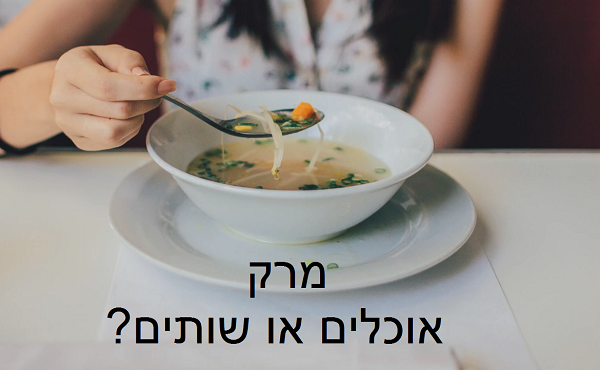
אוכלים או שותים מרק

hebrew drink or eat soup

It’s winter and time to enjoy a hot bowl or cup of your favorite soup.  What is the correct Hebrew? Do we eat or do we drink soup?  The Academy of Hebrew Learning shared this Hebrew lesson with us.

Although you generally drink liquids, you eat with a spoon, so would you drink a cup of soup and eat a bowl of soup? Like in English, in Hebrew the word drink is most commonly used when you don’t use an utensil. So in Hebrew, you would drink a cup of soup (without a spoon). However if you need to chew some of the ingredients and used a spoon, you would eat the soup.

Here are some useful Hebrew soup words

Hebrew Transliteration English
מרק Marak Soup
שותים מרק Shotim Marak Drink soup
אוכלים מרק Ochlim Marak Eat soup
מרק עוף Marak Of Chicken soup
מרק ירקות Marak Yerakot Vegetable soup
כף Kaf Spoon (noun)
מצקת Matzeket Ladle (noun)
קערה Ke’ara Bowl
אטריות Itriyot  Noodles
קרוטונים Krutonim Croutons
בתאבון Betayavon Bon apetite!

Did you know that Ashe Mast is a soup of Persian origin. This thick yoghurt soup is still popular throughout Iran. Traditionally, Ashe Mast is served as an entrée.  The Ashe Mast when cooked, slightly resembles a risotto. Great idea for the Shavuot dairy meal.  Here is the recipe…


כל מה שאתם צריכים לדעת לפני שאתם מזמינים אינסטלטור

0

Reading Time: 3 minutes

כל מה שאתם צריכים לדעת לפני שאתם מזמינים אינסטלטור בחיפה

טוני סוקרמן – אינסטלטור מוסמך – חיפה

אינסטלציה היא חלק חשוב של הבית. הצינורות שלך ומערכות האינסטלציה חייבים להיות בנויים היטב, ומתוחזקים. עם זאת, בעיות עדיין עשויות להתעורר גם אם אתה מטפל טוב במערכות האינסטלציה שלך. ואתה לא יכול להיות מוכן למצבי חירום כאלה
באופן אוטומטי עולה על הדעת היא להתקשר אינסטלטור מקומי. אבל לפני שאתה עושה את זה, עליך לוודא תחילה מי האינסטלטור המומחה שיעשה בישבילך את העבודה הטובה ביותר

טוני איסטלטור חיפה

אז הנה המדריך להזמנת אינסטלטור בישראל

בדוק אם השרברב מורשה ואמין. רשיון לבדו אינו מספיק. אתה גם צריך להסתכל על מוניטין השרברב. אתה יכול לעשות זאת על ידי קריאת ביקורות. אבל לא לבסס את ההחלטה שלך על ביקורות לבד. פשוט להשתמש בזה כדי לקבל רקע מהיר לגבי המוניטין של השרברב ואת הכישורים.

קבל הערכות מחיר זה יעזור לך לקבל מושג את עלות העבודה. אין להשוות את איכות העבודה עם המחיר של עבודות האינסטלציה. אבל אל תצפו שהשרברב הטוב ביותר יהיה הזול ביותר

השרברב חייב לא רק להיות מנוסה ומיומן; הוא חייב להיות גם אמין. לראות שאתה הולך להפקיד את הבית שלך בידיי מקצוען שאתה יכול לסמוך עליו. הנח לאינסטינקט שלך להכתיב לך את זה. ושוב, לקרוא כמה ביקורות ולקבל המלצות.

בדוק אם השרברב מציע אחריות על העבודה. האם הוא מוכן לתקן כל עוול למקרה שמשהו יעלה בגלל עבודתו? האם הוא מכובד כשמדובר בעבודה והתקנה? שאל את עצמך שאלות אז אתה יכול לשאול את השרברב הפוטנציאלי

זה הכי חשוב. שאל את עצמך אם אתה באמת צריך אינסטלטור. האם העבודה נדרשת לשרברב או שמא מומחה אחר יהיה מתאים יותר? זכור שיש דברים שרברבים לא יכולים לעשות. להעריך את המצב לפני שאתה קורא אינסטלטור. רוב הסיכויים, ייתכן שלא צריך אינסטלטור אחרי הכל, אלא מומחה שיקום.

אלו הם סוגי הדברים שעובד מומחה לשיקום יכול לעשות: (בעל רשיון בין לאומי לאינסטלציה) יעריך את הנזק לביתך. הם יבדקו אם יש נזק מים רציני עקב הצפה, צינורות או בעיות אחרות. אז אם בעיות “אינסטלציה” כביכול הרסו את השטיחים שלך, רהיטים ודברי ערך אחרים, אתה צריך מישהו מיומן ומקצועי , הנקרא מומחה לשיקום אינסטלציה. צוות השחזור יסיר את המים מהבית שלך ויבש את כל הדברים שלך כדי לנסות להציל את החפצים שלך. משמעות הדבר היא כי הם יכולים לפתור הן שלך אינסטלציה בעיות ייבוש. מומחי שחזור מבינים סוגים רבים של נזק מים. . בפעם הבאה שתיתקל בבעיה “אינסטלציה”, שאל את עצמך תחילה את חמשת הדברים שהוזכרו במאמר הזה. זכור מה שרברבים לא יכולים לעשות את זה כנראה שמומחי אינסטלציה בין- לאומיים יכולים להתמודד.

?האם האינסטלטור שאתה מזמין הוא מוסמך

חבר שלך אשר לפעמים עושה קצת אינסטלציה בצד הוא לא תמיד הבחירה הטובה ביותר לנסות לחסוך כסף על ביקור אינסטלטור. זאת מהסיבה שהחבר או אתה בעצמך יכולים להפוך את הבעיה לגרועה הרבה יותר הארוך יותר מאשר אם היית רק מתקשר לאינסטלטור מקצועי ישירות. כאשר אתם מתקשרים לשרברב שלכם, לפני שאתם שואלים שאלות אחרות, ודאו שאינסטלטור הוא מקצוען בלע במוניטין גבוה ועדפות לאחד שיש לו רשיון בין-לואמי

?מהי מצלמה תרמית

מצלמה הדמיה תרמית (הידועה בשם הוא סוג של מצלמה תרמוגרפית המשמשים כבאים ואינסטלטורים. על ידי מתן קרינה אינפרא אדומה לאור גלוי, מצלמות כאלה מאפשרות בעלי מקצוע לראות אזורי חום דרך קירות, חושך או מחסומים חדירים בחום

!תתקשרו

טוני איסטלטור חיפה

Israel Winter Hike in Nahal Refaim

0

Reading Time: 6 minutes

A perfect hike in Israel’s Nahal Refaim.

Guest contributor: Susannah Schild from her blog HikingInTheHolyLand.com

I promised myself that this winter, I’d walk along a river that only flows in the rainy season.  So this past Friday, when we woke up to pouring rain, I forced myself to get all bundled up and head out on a hike nearby.

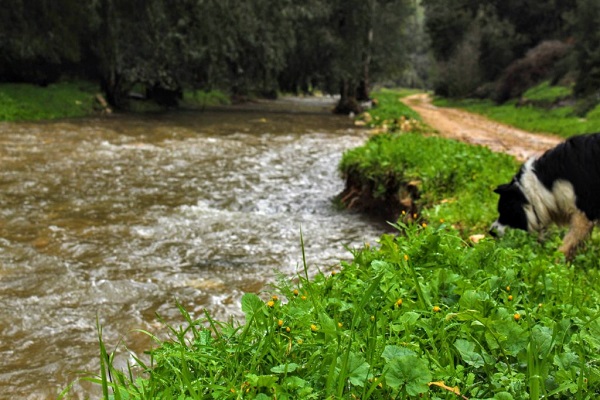
israel winter hike nahal refaim

Nahal Refaim is a river right near our home – only about fifteen minutes away.  But somehow, we had never actually seen it in all the years we’ve lived here.  We weren’t sure what it would look like – would it be a little trickle running through some rocks?  Would it be pretty?  Or would it be completely dried up like so many riverbeds in Israel?

We made a backup plan.  If it was too rainy as we walked, we would just take a short 1 kilometer hike down to the river at Kobi Bridge, then turn around and go back (and head out for breakfast at Pat Bamelach in Efrat- yum.)  So we packed up our bags and were off to see Nahal Refaim.

Turns out that not only was Nahal Refaim an incredible surprise, but the hike itself and the weather that day surprised us too.   Needless to say, we never made it to breakfast.

Here’s what we did instead:

The Benefits of Being Abnormal

The trail starts in Begin Park, right next to Ein Kobi.  This is the same place we parked for the Kobi Ruins walk.  From here, we took the red trail down into the rocks and trees.

Within a few minutes, we were warm and toasty.  The rain had subsided to a faint drizzle, and the cloudy sky turned everything around us to a rich, saturated, green color.  The moss and clover grew thick on stones on the trail.  And we splashed through the puddles under a close canopy of oak trees.

Although we knew it would happen, it was a little bit funny all over again to see how nice it felt outdoors after being cooped inside.  The weather was really bad that Friday (at least at home in Gush Etzion).  Nobody normal would have dreamed of venturing on an outdoor excursion on a day like that.  But here we were. And it was so much better than spending another day inside, watching the rain drip down through the window.

Climbing Through a Secret Tunnel

We continued down the rocks and through the trees until we reached the first crossroads – a paved asphalt path which crossed right through our trail.  At this point we crossed the road and followed our path onto the Israel Trail -also marked green, yellow, green.

This part of the trail was similar to the first part, only steeper.  We carefully made our way down the boulder path, passing by reflective puddles, piles of leaves, and a patch of little brown mushrooms growing between the rocks.  It wasn’t cold there, and it wasn’t particularly rainy.  It was just a secret little tunnel through the trees where we knew we wouldn’t meet another soul.

Down, down we hiked until we hit another crossroad.  At this asphalt road we made a right onto the green trail.

From here it wasn’t much further.  Before long, we could see a big Jerusalem stone bridge in front of us and hear the sounds of a river coming from that direction.  As we approached, Nahal Refaim revealed itself through the archway.

It was like nothing we ever imagined we’d see so close to home.

A Rainy Season River and Waterfall

The stream poured down a whitewater fall right before our eyes.  On each side, the roaring river stretched further than the eye could see.  The banks were green and covered with grass and wildflowers.  Eucalyptus trees grew tall on the river’s path.

This was a real river – but formed completely by rainwater.  All of the runoff from flash floods and little rivulets came together to create this sizeable force of nature  There was even a low “bridge” in the middle.  It was underwater, and we dared not try to cross for fear of being swept away by the oncoming current.

After taking in the majesty of the waterfall, we decided to walk up the path along the Nahal Refaim for a little while.  The weather had definitely improved, and it now seemed like the perfect day for a hike – cool and comfortable.   We walked for a long time, just enjoying the novelty of a hike along a river.

At some point, we decided to turn around.  Next to the bridge we had noticed the perfect flat rocks for sitting.  We headed back and broke out our thermos full of coffee (which had of course been deemed a necessity, even if it had been only a two kilometer walk.)

Fifteen minutes later we were on the move again, this time to explore the river in the other direction.  It wasn’t long before we reached the end of the path.

Actually, both at this point and near Kobi bridge, the path continued over a bridge on the other side of Nahal Refaim.  But the bridges were flooded. Those paths are unreachable by foot when the river is flowing strong in the wintertime.

It was time to head back to Kobi Bridge and continue our hike back in the direction of the trailhead.

Mountainside Scenery

For the hike back, we decided to take a different, longer path.  The green trail travels in a much more circuitous route, but we figured it would be nice to change things up a little bit. So we followed it.

We wandered along the road, weaving back and forth up the mountain.  It started to rain again, but the drizzle only kept us cool as we ascended.  There were beautiful views alongside the trail.  We could see the river, and the train tracks winding through the forest below.

We took this green trail all the way back, once more passing the trail we took coming down.  On our way, we saw a mountainside full of almond trees in bloom.  And a short shrub still showing its fall color which partially blocked the view of the white blossoms.  The hills were green and lush in the rainy drizzle.  The contrast of the scene was mesmerizing.

A little bit further and we were back at the trailhead.  Our two kilometer walk had turned into a seven kilometer trek.  Our chance to go out for breakfast was long gone.  But we had no regrets.

Carpe diem, as the old Latin aphorism goes.  Seize the day.  This beautiful winter river will disappear come summer.

Hiking Tips

  • So whether you make this a short hike to the river and back (a little over two kilometers) or turn it into a nice long seven kilometer outing – please go visit this river during the rainy season! You won’t believe that this beautiful body of water is so close to Jerusalem, Beit Shemesh, and Gush Etzion.
  • Just make sure to go a day or two after a good rain (or while it’s raining). If too much time has passed since the last rainfall, there won’t be a river to see. It’s still a beautiful walk, though!
  • You could easily take this walk with kids. I would recommend just doing the two kilometer there and back with little ones. Just remember that it is downhill and then a significant climb back up. The total ascent was 200 meters! But it’s a fun hike with good rock scrambling and lots of things to see.
  • If you want to make it stroller friendly, you could probably do that too (as long as you have a jogging stroller). Just park in the same place and take the green trail there and back instead of hiking on the red trail/Israel Trail. It’s a less interesting walk (and a bit longer), but the road is mostly even (again, there’s still a 200 meter ascent back up.) You could also drive down – with a 4×4 or a good car.
  • Disclaimer: Hiking on wet rocks can be slippery. Be careful while you climb!
  • You can use the Google Earth file in the table up top to follow your path on the trail.
  • It should be super easy to follow the path we took, or make up your own using the instructions above. The path going down to the bridge is bright yellow on the map, but at the site it is marked red until the first intersection (green) and Israel Trail for the rest of it.
  • Another note: After you park at the Ein Kobi lot you may not see where the trail begins. Go past the old building and picnic benches. There is a signpost with a red trailmarker marked Nahal Kobi. Picture in the gallery below. Follow that trailmarker downhill!
  • Gear, gear gear! I can’t say enough about how the right gear enhances your hikes during rainy season.  Make sure to fill up a thermos with something hot.

You can read more of Susannah’s adventures in her blog www.hikingintheholyland.com