26 C
Jerusalem
Friday, June 19, 2026
Sample Page
Home Blog Page 112

L’égalité des chances en matière d’emploi – Israel’s Equal Opportunity Law

Reading Time: < 1 minute


L’égalité des chances en matière d’emploi

Cette information fut rendue possible grâce au don généreux d’un bienfaiteur anonyme.

jobs in israel for english speakers


L’égalité des chances en matière d’emploi a été implémentée en Israël en 1988. La loi interdit la discrimination contre les employés ou candidats à l’emploi sur la base d’un ou plusieurs des critères suivants :

  • L’âge
  • Le sexe
  • La grossesse ou la parentalité
  • Le statut familial
  • Le handicap physique
  • L’orientation sexuelle
  • La race, religion ou nationalité
  • Le pays d’origine
  • Les opinions politiques ou affiliations

La loi s’applique au recrutement, à la mise en place des conditions de travail, à la formation ou à l’avancement, au licenciement ou à l’indemnisation, ou encore à la retraite.

Point important

Il est interdit aux employeurs de demander accès aux données militaires d’un employé ou candidat à l’emploi ou de discriminer sur la base du profile militaire.

Ressources et informations complémentaires


Anglo-List Business Directory


Le préavis de départ – Notice of dismissal

Reading Time: 2 minutes

Le préavis de départ en Israël

Cette information fut rendue possible grâce au don généreux d’un bienfaiteur anonyme.

notice of dismissal

Du côté de l’employeur

Pour mettre fin à votre contrat de travail, la loi oblige votre employeur à vous donner un préavis. Les règles changent selon que les salariés sont payés mensuellement ou à la journée comme suit :

Un employé payé mensuellement – pendant sa première année d’embauche, a le droit à un jour de préavis pour chaque mois pendant les six premiers mois d’activité, après quoi on passe à 2,5 jours pour chaque mois suivant avec un maximum de 3 semaines. Après une année complète de travail l’employé a le droit à un préavis d’un mois.

Les travailleurs journaliers ont le droit à un jour pour chaque mois pendant leur première année d’embauche. Après une année complète de travail, l’employé a le droit à deux semaines. Durant la deuxième année d’embauche, l’employé a le droit à deux semaines plus un jour supplémentaire pour chaque deux mois travaillés dans cette année. À partir de la troisième année d’embauche, un employé a le droit à un mois de préavis.

Du côté de l’employé

Un employé qui souhaite donner son préavis doit le faire comme stipulé ci-dessus.

Note : il se peut que votre contrat de travail contienne des conditions différentes. Sauf avis contraire, les conditions ci-dessus s’appliquent.

Le préavis

Du côté de l’employeur

Au cas où l’employeur ne vous donnait pas votre préavis, comme la loi le stipule, alors vous, l’employé, êtes en droit de recevoir un salaire égal à celui que vous auriez reçu pour la période du préavis.

Du côté de l’employé

Au cas où l’employé manquerait à donner son préavis, l’employeur est autorisé par la loi à déduire de votre salaire une somme correspondant à la période du préavis.

Confirmation écrite

Un employeur doit donner confirmation par écrit d’un licenciement. Cette confirmation écrite doit contenir les dates du début du contrat et celle du licenciement. Cette confirmation écrite doit vous être adressée à vous, l’employé, pas plus tard que 15 jours après votre dernier jour de travail. En cas de refus de votre employeur d’obtempérer, vous êtes en droit de vous adresser au bureau de l’emploi. Votre employeur peut se voir infligé une amende pour refus de soumettre son accord écrit.

Les allocations chômage en Israël – Unemployment

Reading Time: 2 minutes

Les allocations chômage en Israël

Cette information fut rendue possible grâce au don généreux d’un bienfaiteur anonyme.

expat banner

Pour pouvoir bénéficier des allocations chômage en Israël, versées par Bituach Leumi – L’institut d’assurances national – vous devez :

1.Être résident en Israël et âgé entre 20 ans et l’âge de retraite officiel pour les hommes et les femmes.

2. Être un soldat démobilisé ou un engagé volontaire du service national à un an de sa démobilisation.

3. Être un salarié d’une entreprise légale avant d’être au chômage.

4. Être inscrit au bureau national de l’emploi.

5. Être prêt à travailler dans votre secteur d’activité ou dans tout autre secteur si un emploi vous est proposé par le service de l’emploi.

6. Vous avez accumulé un nombre suffisant de jours travaillés – la période qualifiante – comme stipulé par la loi.

Que dois-je faire si j’ai été renvoyé, licencié ou fait l’objet d’un licenciement économique ?

1. Assurez-vous que votre employeur vous remet un document confirmant votre statut. Ce document doit faire état de la raison de votre licenciement, de la date d’embauche et celle de votre licenciement.

2. Allez immédiatement au bureau de l’emploi et inscrivez-vous. Ne pas vous inscrire peut nuire à vos droits.

Le bureau de l’emploi vous donnera alors un jour et une heure à laquelle vous êtes tenu de vous présenter une fois par semaine ou comme demandé. Ne pas se soumettre à ce règlement aura pour résultat de vous voir refuser votre allocation chômage.

La période maximum de droit au chômage dépend de l’âge et du nombre de dépendants.

N’oubliez pas

que lorsque vous allez au bureau de l’emploi pour la première fois, vous devez présenter les documents suivants :

  • Teudat Zehut
  • Les documents de démobilisation de l’IDF si besoin.
  • Une lettre de confirmation de votre employeur avec les dates de votre période d’emploi, la raison de votre licenciement, la signature et tampon de votre employeur.
  • Les copies de vos bulletins de salaire – tlush maskoret. Servez-vous de notre bulletin de salaire traduit de l’hébreu en anglais.

Le droit du travail en Israël – Employee Rights

Reading Time: 3 minutes

Le droit du travail en Israël

Cette information fut rendue possible grâce au don généreux d’un bienfaiteur anonyme.

En Israël, les lois du travail règlementent tout ce qui touche à l’emploi. Le code du travail procure des droits aux salariés et les protège contre les employeurs. Le code du travail couvre différents aspects des droits du travail dont : les relations salariés – employeurs, la liberté syndicale, les conventions collectives du travail, la règlementation de la liberté syndicale, les conventions collectives, les contrats de travail, les grèves, les conflits du travail, la cessation d’emploi et les indemnités.

Les droits du travail sont aussi appelés droits de protection, ce sont des droits que toutes les parties signataires d’un contrat de travail ne peuvent diminuer. Ces lois constituent un seuil minimum.

Le tribunal du travail a été créé afin de régler les conflits du travail et autres litiges. Le code du travail stipule que les tribunaux du travail ont la compétence exclusive dans la gestion des litiges du travail de façon à pouvoir les résoudre au mieux.

Alors, quels sont mes droits ?

Le droit à un salaire minimum

En Israël, les salariés ont droit à un salaire minimum en échange de leur travail. Le code du travail stipule que, dès l’âge de 18 ans, toute personne qui travaille jusqu’à 186 heures par mois a le droit au salaire minimum.

Le droit à un paiement régulier du salaire

Le code du travail a établi le règlement des salaires sur une base mensuelle. Les employeurs sont obligés de verser à leurs employés leur salaire mensuel pas plus tard que le 9eme jour du mois suivant. Un paiement en retard au-delà du 9 constitue une violation des droits du salarié et ce dernier est en droit de réclamer une indemnité pour pallier à ce manquement.

Le droit à un contrat de travail

D’après le code du travail, tout employé doit recevoir une confirmation (contrat) stipulant les termes et conditions de son emploi dans les 30 jours qui suivent son embauche. Cette confirmation doit inclure la date de commencement du contrat, le rôle du salarié, la description de poste, le nom de son supérieur hiérarchique, le salaire, les heures de travail, les congés et autres avantages tels que les cotisations de pension ainsi que la durée du contrat de travail s’il s’agit d’un contrat à durée déterminée.

Le droit à la récupération/réhabilitation – Dmei Havraa

En Israël, les lois du travail stipulent qu’un employé qui a plus d’un an d’ancienneté a le droit à des jours de congé supplémentaires de la part de son employeur, ce qu’on appelle Dmei Havraa – récupération/réhabilitation. Les salariés ont le droit à un minimum de cinq jours de ces congés supplémentaires. Si vous décidez de ne pas prendre ces congés, vous pouvez prétendre à une compensation financière. Celle-ci est calculée selon un barême. Par exemple, dans sa septième année d’emploi, un salarié a le droit à sept jours de récupération.

Le droit aux heures supplémentaires

Le code du travail stipule que les employés qui travaillent plus que le nombre d’heures prescrit, doivent être rémunérés pour chaque heure supplémentaire travaillée.

Les salariés qui travaillent 6 jours par semaine travaillent 8 heures par jour.

Les salariés qui travaillent 5 jours par semaine travaillent 9 heures par jour.

Le temps de travail des salariés avec au moins 2 heures de travail de nuit (après 22h) est de 7 heures.

Le salaire global

D’après la loi israélienne, il n’y a que deux conditions pour lesquelles un salaire global est autorisé – maskoret globali

  1. Pour des postes de confiance à l’exécutif : poste de direction, directeur financier, chef d’exploitation etc.
  2. Un employé dont les heures sont impossibles à comptabiliser ou vérifier – par exemple les agents de voyage…

Dans tout autre cas, il est illégal de mettre en place un système de paiement global.

Le droit aux congés payés

Les lois du travail stipulent que les salariés ont le droit à des congés rémunérés. Le nombre de jours stipulé par la loi du travail varie en fonction de l’ancienneté et de la nature du poste. La loi établit un quota minimum : 10 jours de travail si vous travaillez 9 heures et 5 jours par semaine et 12 jours de travail si vous travaillez 8 heures, 6 jours par semaine. Comme il est dit plus haut, l’ancienneté confère plus de jours de congé. Des jours de congé supplémentaires peuvent être négociés dans votre contrat de travail.

Tips for Olim

Reading Time: 2 minutes

My Israel Aliyah Tips

By: Isaac Ben

My name is Isaac Ben and I am a Canadian who made Aliyah in 2004, and love Israel and all it has to offer. I work in hi-tech and live on a kibbutz. Along with the helpful and essential tips and lists of things to do from Nefesh B Nefesh and the UJA and this site, I’ve written these tips for anyone who made Aliyah recently or is thinking of doing so. I wish everyone the best of luck.

Preparation

  1. Most things can only be done once you’re in Israel. Be prepared but there are limits.
  2. You are about to embark on an adventure of a lifetime. For better or for worse. Accept the possible anxiety you may feel.
  3. Print out the Hebrew alphabet on cue cards, and learn to pronounce the letters.
  4. Pack light. You probably won’t need half of what you are bringing.
  5. Get in shape. Being overweight in the Israeli heat is difficult, and dangerous to your health.

You’ve made Aliyah!

First few years

  1. Expect nothing from anyone, then everything will seem like a treat.
  2. Don’t sign anything. If you feel you must, double check the contract terms, then check again and again. Don’t rush.
  3.  If you’re a nice polite person, stay that way. Don’t try to be someone you’re not.
  4.  Prepare to work a job you may never have back home. If you find good people to work with, you should be happy.
  5.  If you have to quit a job in Israel, and you probably will more than once, try do so on good terms. References are important.
  6.  You will be asked why you made Aliyah an infinite amount of times. Get a quick reply ready.
  7.  You may be told many Israelis that you made a huge mistake for making Aliyah. Smile and carry on.
  8.  Travel around this beautiful country as often as you can.
  9.  Go to an Ulpan. It’s common for Israelis to speak to you in English, try to answer back in Hebrew as best you can.
  10.  Write a blog or keep a journal. Should make a great memory one day.

After five years

  1. Congratulate yourself for staying this long, and buy yourself something nice.
  2.  If you haven’t yet, fly back for a visit to see old friends and family you left behind.
  3.  Your Hebrew has probably improved to a basic level, take private lessons to get even better.
  4.  Politically, take a peek at the opposite views of your own once in awhile.
  5.  If you feel frustrated and want to leave, try to stick it out as best you can. Stay positive.
  6.  If you still feel you are being treated like an immigrant, or feel like an outsider. Try not to feel unhappy about it.
  7.  Many Israelis may assume you are rich and intelligent because your English is perfect. Use it to your advantage.
  8.  Volunteer, help someone who recently made Aliyah.
  9.  Eat healthier, like most Israelis do.
  10.  Try your best to avoid taking a big loan from the banks.


Israel Car Ownership -Survey Results

Reading Time: 2 minutes

Owning a Car or Vehicle in Israel – Survey Results

Having a vehicle means not waiting for hours for local public transport. It means the freedom to come and go as you please. Even with immigrant rights (your Aliyah benefits – ‘Zchuyot Oleh’), owning a car in Israel is expensive and many olim never manage to buy a car – new or even 2nd hand.

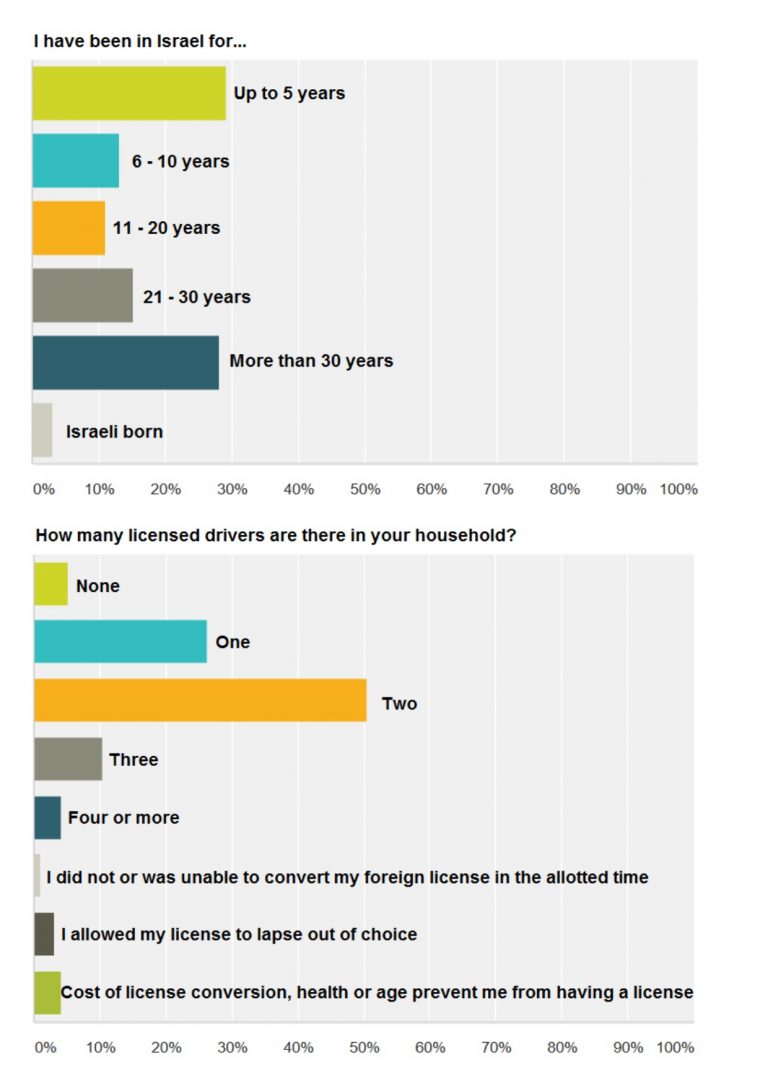
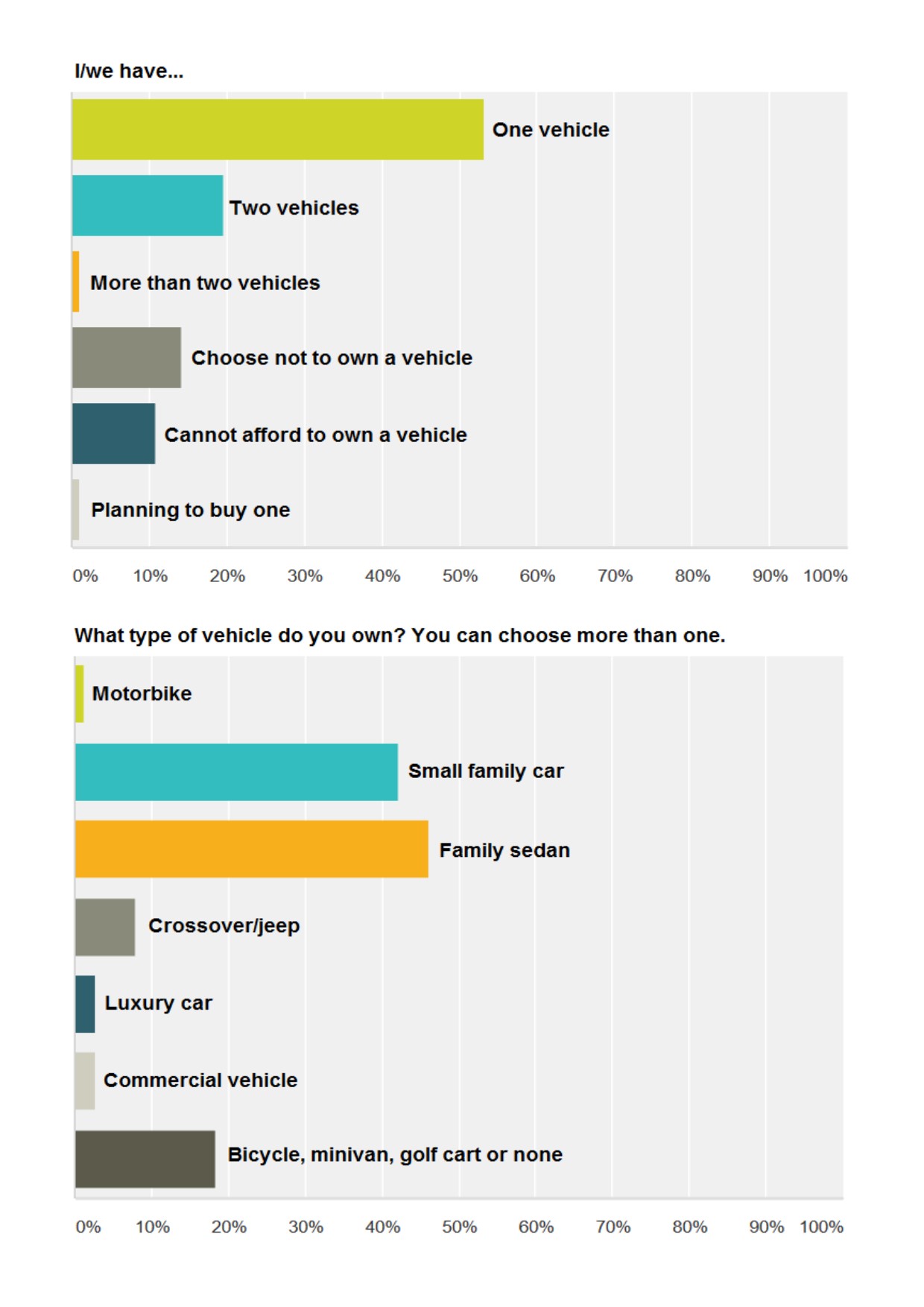
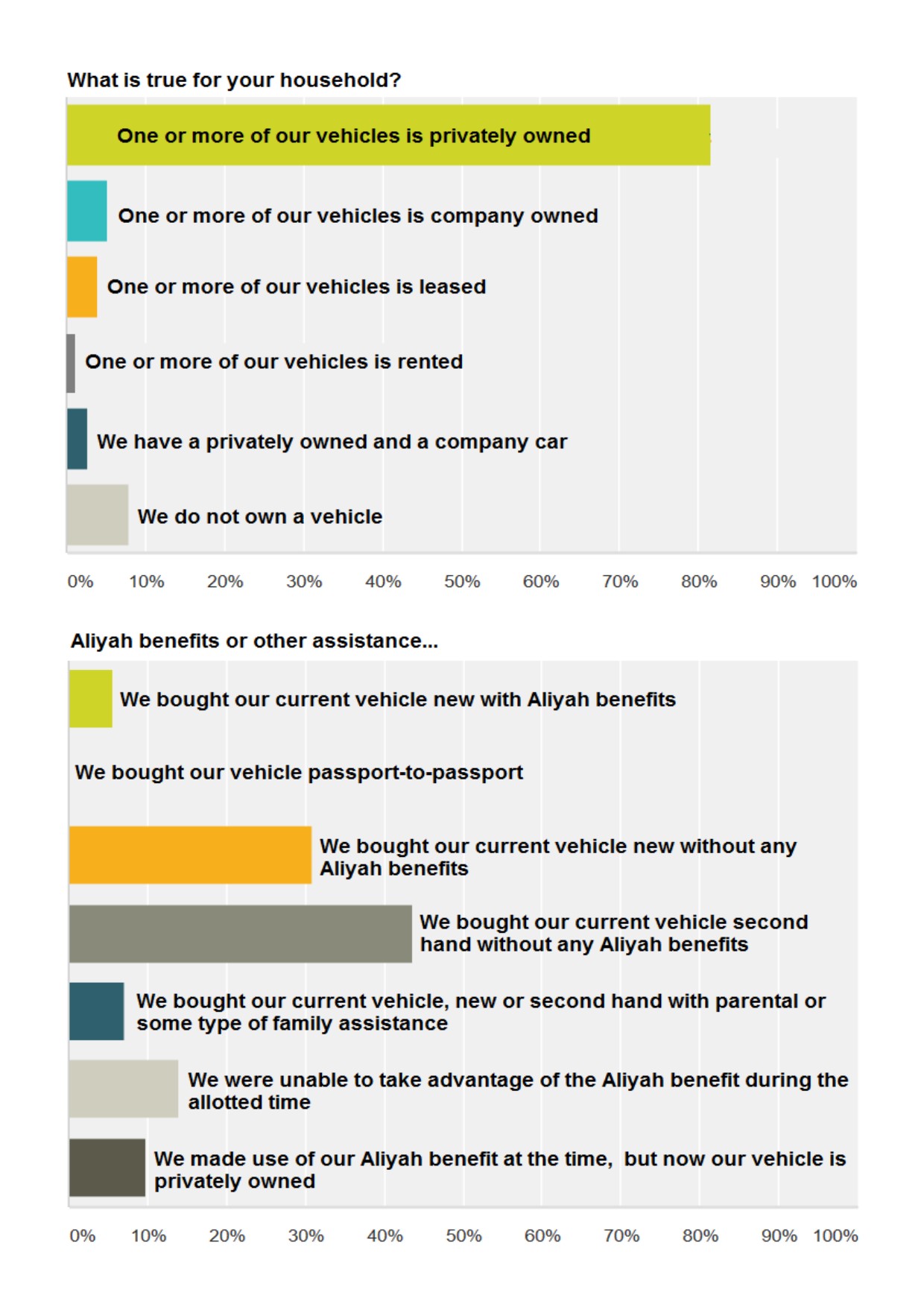
Our latest survey explores car ownership in Israel among the Anglo community.

In previous surveys and from analytical data, we know that 50.5% of our audience are women and 49.5% are men. We also know that 67% of our audience are in the 25 – 64 age range (updated 2021). We also know that the average household income in Israel is 14,000 shekels (2018). We therefore did not ask these questions in this survey.

This survey was promoted on the local list serves as well as on various Facebook groups.  Members of these groups live all over the country, have various religious beliefs and financial and other resources. 192 respondents participated in the survey.

Survey Results

vehicle survey results 1

vehicle survey results 2

vehicle survey results 3

Israel Police & Law Enforcement.

Reading Time: 3 minutes

The Police & Law Enforcement

Hebrew: משטרת ישראל 

Police Emergency Telephone Number – 100

The Israel Police is responsible for public security, law enforcement, maintaining order, fighting crime and ensuring the smooth flow of traffic.

A list of the main police stations in Israel

Location Address Phone Number
Afula Hanassi 5, Afula 04-6524444
Akko HaHaganah 16, Akko 04-9876808
Arad Yehuda 45, Arad 08-9551222
Ashdod Yitshak Hanassi, Ashdod 08-8547710
Ashkelon Hanassi 80, Ashkelon 08-6771444
Ayalon Sub-District Fichman 18, Holon 03-5027911
Ayarot Shoket Junction, Beer Sheva 08-6292444
Bat Yam Raziel 9, Bat Yam 03-5555222
Beer Sheva Herzl 30, Beer Sheva 08-6271154
Beit She’an Shaul HaMelech 1, Beit She’an 04-6067444
Beit Shemesh Route 38, Naham Junction 02-9902222
Binyamin Shaar Binyamin industrial zone 02-9706444
Carmiel HaHaroshet 11, Carmiel 04-9901444
Central District 80 Sderot Herzl , Ramla 08-9279535
Coastal District Natan Elbaz 1, Haifa 04-8648444
Dan Sub-District Jabotinsky 122, Ramat Gan 03-6104444
David Sub-District Omar Caatab Square Old City, Jerusalem 02-6226100
Eilat Sub-District Hameyasdim Square 1, Eilat 08-6362444
Givatayim Weitzman 76, Givatayim 03-5724444
Glilot Shefayim 1, Herzlia 09-9704444
Golan Sion 34, Katzrin 04-6968222
Hadera Route 4, Police Square Junction 04-6327444
HaGiv’a HaTzarfatit Lehi, Idelson Residences, Jerusalem 02-5816878
Haifa Natan Elbaz 1, Haifa 04-8648811
Har HaZeitim Mount of Olives, Jerusalem 02-9668427
Harel HaMaapilim 20, Mevaseret Zion 02-5339200
Hatmar Binyamin Bet El, Jerusalem 02-9706777
Hebron Sub-District Givat Haavot, Kiryat Arba 02-9969444
Iron Route 65, Wadi Ara 04-6158444
Jerusalem District Hashin 1, Russian Compound, Jerusalem 02-5391100
Kedem Sub-District Shua’fat 118, Jerusalem 02-5690400
Kedma Road 444, Tirat Junction 09-7612401
Kfar Sava HaSharon Road 1, Kfar Sava 09-7473555
Kiryat Gat Sderot Lachish 2, Kiryat Gat 08-6872222
Kiryat Malachi Moshe Sharet 19, Kiryat Malachi 08-8608444
Kiryat Shmona David Salinger 8, Kiryat Shmona 04-6958444
Lachish Sub-District Hanassi 80, Ashkelon 08-6771444
Lev Habira Heleni Ha-Malka 12, Jerusalem 02-5391550
Lev Tel Aviv Dizengoff 221, Tel Aviv 03-5454444
Lod Katzenelson, Lod 08-9782444
Ma’ale Adumim Agan HaSahar 1, Ma’ale Adumim 02-5358444
Ma’alot Tarshiha Close to Ma’alot 04-9578444
Mate Yehuda Route 38, Naham Junction 02-9902223
Messubim Or Yehuda, Derech Lod 03-5384444
Migdal HaEmek Zippori 1, Migdal HaEmek 04-6447444
Misgav Misgav Regional Council 04-9904444
Modi’in HaHashmonaim 2, Modi’in 08-9726444
Moriah Sub-District Hatnufa 17, Jerusalem 02-5683222
Nahariya Sderot Ben Zvi 5, Nahariya 04-9518444
Natbag (Tel Aviv Airport) Sub-District Natbag, Terminal 1 03-9715444
Nazareth 219 Street, Moscovia Building, Nazareth 04-6028444
Nazareth Illit HaMelacha 1, Nazareth Illit 04-6029444
Negev Sub-District Tuviahu 5, Beer Sheva 08-6464220
Netanya Nechama Viner 6, Natanya 09-8864444
Netivot Malchei Yisrael 1, Netivot 08-9937444
Northern District Road 219, Moscovia Building – Nazareth 04-6028444
Ofakim Herzl 1, Ofakim 08-9928222
Oz Aler Street, Armon Hanatziv, Jerusalem 02-5685444
Petach Tikva Stampfer 57, Petach Tikva 03-9393444
Rahat Route 1, Rahat 08-9913888
Ramla Herzl 80, Ramla 08-9279444
Rehovot Herzl 206, Rehovot 08-9371444
Rishon LeZion Jabotinsky 106, Rishon LeZion 03-9609444
Rosh HaAyin Tzahal 20, Rosh HaAyin 03-9004444
Sadot Herzl 40, Kadima 09-9617201
Samaria Sub-District Ariel 03-9065444
Schunot Haim Bar Lev 100, Tel Aviv 03-6304444
Sderot Herzl 61, Sderot 08-6620444
Shafat Leah Goldberg 1, Neve Ya’akov, Jerusalem 02-5848222
Shai District Agan HaSahar 1, Ma’ale Adumim 02-5358444
Shalem Salah e-Din 1, Jerusalem 02-6207459
Sharet Levinsky 95, Tel Aviv 03-6893600
Sharon Sub-District HaSharon Road 1, Kfar Sava 09-7473444
Shfaram Alswar Neighborhood, Shfaram 04-9059444
Southern District Tuviahu 5, Beer Sheva 08-6464444
Tel Aviv District Salameh 18, Tel Aviv 03-6802222
Tiberias HaZionut 14, Tiberias 04-6728444
Tirat Carmel Hadekel 12, Tirat Carmel 04-8579000
Tzfat HaGalil 1, Tzfat 04-6978444
Umm al-Fahm Kahawesh Neighborhood, Umm al-Fahm 04-6115000
Yarden – Rosh Pina Rosh Pina 04-6809444
Yarkon Sub-District Raoul Wallenberg 10, Ramat HaChayal, Tel Aviv 03-7697444
Yiftach Sub-District Salameh 18, Tel Aviv 03-6802222
Zevulun Hahistadrut 271, Haifa 04-8464444
Zikhron Ya’akov Route 4, Zikhron Ya’akov 04-6299444
Zion Sub-District Koresh 12, Jerusalem 02-6225550

Firearms & Gun Control

At times, residents of Israel are feel the need for added personal protection.  Many of you have asked how to go about getting a firearm.

The Firearm Licensing Department (FLD) issues firearm licenses to residents of Israel, agencies and organizations; in compliance with the Firearm Law of 1949, and based on the Minister of Public Security’s policy.

The first step is to schedule an appointment with the FLD via their telephone service at: 03-5117111.

Should you decide to become a licensed gun and firearm owner, please make sure you follow all safety precautions and guidelines.  As you know, many tragic accidents could have been avoided if proper safety precautions had been followed.

Hebrew English: Shavuot

Reading Time: < 1 minute

Learn new Hebrew Shavuot words and phrases with English & transliterations.

shavuot words

Shavuot symbols and traditions
Seven species Shivat Haminim שבעת המינים
Cheesecake  Ugat Gvinah עוגת גבינה
Blintzes  Blintchez בלינצ’ס
Dairy products  Motzrei Halav מוצרי חלב
Counting of the Omer (49 days)  Sfirat Ha’Omer ספירת העומר
Hebrew month –Sivan Sivan סיון

Shavuot Festival Names

Festival of weeks Chag HaShavuot חג השבועות
Festival of the first fruits Chag HaBikurim חג הביקורים
Festival of the harvest Chag HaKatzir חג הקציר
Time of giving the Torah Zman Matan Torah זמן מתן תורה

How much does cheesecake cost in Israel?

0
Reading Time: 3 minutes

Price-check: How much will it cost to make a cheesecake for Shavuot? 

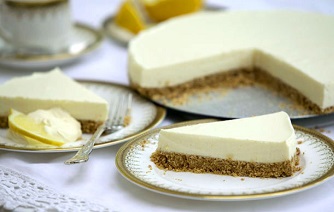
cheesecake


We’ve always been about sharing practical tips for new olim and this year more than ever as we come out of the coronavirus, we’re more committed to sharing good advice with you.  In spite of the supermarkets’ promise not to raise prices, the prices of some food items have risen considerably. Just today in the Haifa shuk – the fresh produce market – peaches were selling for 32NIS/kg and grapes were similarly priced.

With Shavuot on the horizon, we wanted to know how much would it cost, to bake a cheesecake at home. After a year of lockdowns, and time on our hands, most of us are  back at work. So, is it worth the effort or should we just buy ready-made?

Our price-check is based on our classic, baked cheesecake recipe, and my all-time favorite, which includes the following basic ingredients: white cheese, sugar, eggs, cornflour, lemons, biscuits, butter and sour cream.  We did not investigate the price of cheesecake toppings but fresh strawberries are around 10NIS/kg right now (in Haifa shuk)..

We did an online-shopping comparison between 3 of Israel’s the leading supermarket chains; Shufersal, Rami Levy and Victory

Obviously you cannot buy 1 cup of sugar or 3 eggs so the prices shown here are based on the assumption that your pantry was bare and you had to purchases every item from scratch.  Wherever possible, I try to fill my cart with the house-brands which are usually a little cheaper but I will never, ever buy house-brand ‘Petit Bur’ even if I’m grinding them down to make a crumb base for my cheesecake – they are just awful. So, for our recipe stick with Osem.

We were quite surprised at the results:

  Shufersal Rami Levy Victory
500g smooth white cheese  (Ski) 9.50 9.40 9.50
Sugar – 1kg 4.50 3.90 3.90
Eggs L – 12 11.30 11.30 11.30
Cornflour – 200g 3.30 2.50 3.90
Lemons – 1kg 5.90 4.80 4.80
Osem Petit Bur biscuits (‘biskvitim’) – 500 g 10.90 8.90 7.90
Tnuva sour cream – 200ml 3.50 2.40 2.28
Butter – 200g (Tara or Tnuva) 7.88 7.80 7.80
The cost of our 2021 basket 56.78   51.00  51.38
The cost of our 2020 basket 60.98 55.28 61.98

This basket will cost more if you use organic ingredients or boutique cheeses and a lactose-free cheesecake will also cost more.

Accurate as at May 9th, 2021 it looks like the supermarkets kept their word.  There was an overall drop in the cost of the ingredients and mostly the price difference is in the cost of the lemons.  In 2020, just before Shavuot, the supermarket price of lemons was 9.90 NIS/kg and this week it is between  4.80NIS/kg – 5.90NIS/kg   

Overall there is a 10% drop in price.  Based on this, if you took 10 percent as a typical saving on a 2,000 shekel monthly food bill, it translates into a 200 shekel monthly saving. Multiply that by 12 and you could be saving a whopping 2,400 shekels a year on groceries just by shopping wisely or changing your supermarket. Think what you could do with that…

Would you travel from supermarket to supermarket looking for the cheapest deal? Based on results from an earlier shopping survey, 52% of our readers are not willing to travel more than 10km to do shopping even if the store is cheaper. Luckily most large supermarket chains in Israel have a delivery service and they charge around 30 shekels for delivery. 

Rating the online shopping experience

  1. Shufersal’s site is clear, mostly easy to navigate (if you know Hebrew), the search function yields accurate results but the website’s menu design is not as user-friendly as it could be.
  2. Rami Levy’s website has improved over the years.  The do not have an extensive range of products on offer on their website and we found that very frustrating.
  3. Shufersal and Victory’s site were user-friendly but Shufersal has loads more product information and nutritional value data

For the benefit of our readers abroad, this is what the cost of the classic cheesecake shopping basket, translates to, in your currency


NIS

US$

CAN$

AUS$

GBP

SA RAND

Shufersal cake 56.78 17.45 21.17 22.26 12.45 245.44
Rami Levy cake 51.00 15.68 19.01 20.00 11.18 220.45
Victory cake 51.38 15.79 19.15 20.15 11.26 222.10

Bakery prices

If you don’t have time to bake this year,  expect to pay between 85 – 150 shekels for a cheesecake from boutique bakeries like Shemo, Dudu Outmezgine and Roladin.

Chag Shavuot Sameach!

Sun protection tips for Israel

Reading Time: 2 minutes

Protect your skin from sunburn under the harsh Israeli sun.

Sun protection tips for Israel.


red sunIt’s beach weather again and fun-filled weekends hiking and being outdoors top the list of weekend activities for the family. The climate in Israel is harsh with hot dry summers from mid-May to mid-September.   Blistering heat-waves coupled with dust and sand-storms (Heb: Sharav or Arabic: Hamsin) are not uncommon.   Protecting your skin from sunburn must be a priority when you are outdoors or traveling around the country.  Keeping your body hydrated is just as important.

8 useful sun protection tips from Israel’s Ministry of Health

  1. Avoid being outdoors between midday and 4 p.m. – the hottest time of the day.
  2. Wear sunblock whenever you are sunbathing, hiking, playing sport or any outdoor activity. Apply sunscreen generously, and reapply it every two hours — or more often if you’re swimming or perspiring.
  3. Cover up.  Wear sun protective clothing.  Special clothing with a built in sun-protection factor is worth considering. Wearing a light weight, long sleeve, cotton shirt will also protect your bod from the vicious UV rays. You should start protecting your child from the sun when he or she is a baby. Because children spend a lot of time outdoors playing, they get most of their lifetime sun exposure in their first 18 years. It’s safest to keep babies younger than 6 months out of the sun altogether.
  4. Wear a hat whenever you are out in the sun.
  5. Don’t travel in Israel without water.  Summer temperatures in Israel can reach as much as 40 degrees Centigrade in some places.  Dehydration can be a real danger.  Drink at least 2 liters of water per day per person
  6. Offer your eyes the best protection outdoors by choosing the highest UV protection-rated sunglasses.
  7. Got sun burned? This is what you can do; Take a pain reliever. Cool the skin. Apply moisturizer, aloe-vera lotion or gel. Don’t pop blisters – it increases the risk of infection.  Continue to drink plenty of fluids especially water.  Ice-lollies will help re-hydrate a small child who is fed-up with drinking water. Continue to moisturize your skin even when it is peeling. Protect your sunburn from further sun exposure.
  8. Most sunburn can be treated at home but seek medical attention when; sunburn is severe – with blisters and covers a large portion of your body, if sunburn is accompanied by a high fever or severe pain, nausea or even chills, you’ve developed a skin infection as a result of scratching your skin, you have a severe sunburn that doesn’t begin to improve within a few days or if your child is unresponsive in any way.