

Learn Hebrew with this Bank Charges Statement Translated to English
Hebrew: פרוט תנועות ותשלומים

These could be useful too..

These could be useful too..

If you’ve recently moved to Israel, managing household bills may feel unfamiliar at first—including your water bill. The good news is that the system is straightforward once you understand how it works. Here’s what you need to know to stay on top of your payments.
Water services in Israel are managed by local municipal companies (often called “mei” corporations). Each city or region—such as Haifa or Tel Aviv—has its own provider, which is responsible for billing and customer service.
When you move into your new home, it’s important to register with the local water company so the bills are issued in your name.
Water bills are typically sent every two months and include:
Israel uses a tiered pricing system:
Your allocation depends on the number of people registered in your household—so make sure this is updated.
There are several convenient payment options:
Most water companies have websites where you can:
This is usually the easiest option, especially if you’re comfortable managing things online.
Setting up a hora’at keva (הוראת קבע) allows payments to be deducted automatically from your bank account or credit card.
This is ideal if you want to avoid missing payments while settling into life in Israel.
You can pay through your bank:
Many Israeli banks allow you to scan the barcode on your bill for quick payment.
You can also pay in person at a branch of Israel Post. Bring your bill and a payment method (cash or card).
Some providers offer payment via automated phone systems or customer service centers. This is tricky as there aren’t always English instructions.
Register your name: Make sure the water account is transferred to you when you move in.
Update household size: This affects how much water you receive at the lower rate.
Watch for these Hebrew terms:
מספר צרכן = Customer number
חשבון מים = Water bill
Pay on time: Late payments can result in fines or service disruption.
Check for leaks: If your bill seems unusually high, contact your provider—it could be a plumbing issue.
Need Help?
If Hebrew is a challenge, many water companies offer customer service in English or can assist via email. Don’t hesitate to ask for help—this is very common for new immigrants.
Final Thoughts
Adjusting to a new country comes with a learning curve, but paying your water bill in Israel doesn’t have to be complicated. Once you set up a convenient payment method, it becomes just another simple part of your routine.
Every water company supplies water to a specific area across the country and each has its own invoice. Yours may not be identical to the one shown below. This is a guide only.
More videos:
Water is a precious and limited resource, and even in recent years—when Israel has benefited from relatively strong winter rainfall—it remains essential that we continue to use it responsibly and conserve wherever possible.
Here are 10 best ways to save water in Israel…
You’ll find these translations useful too…
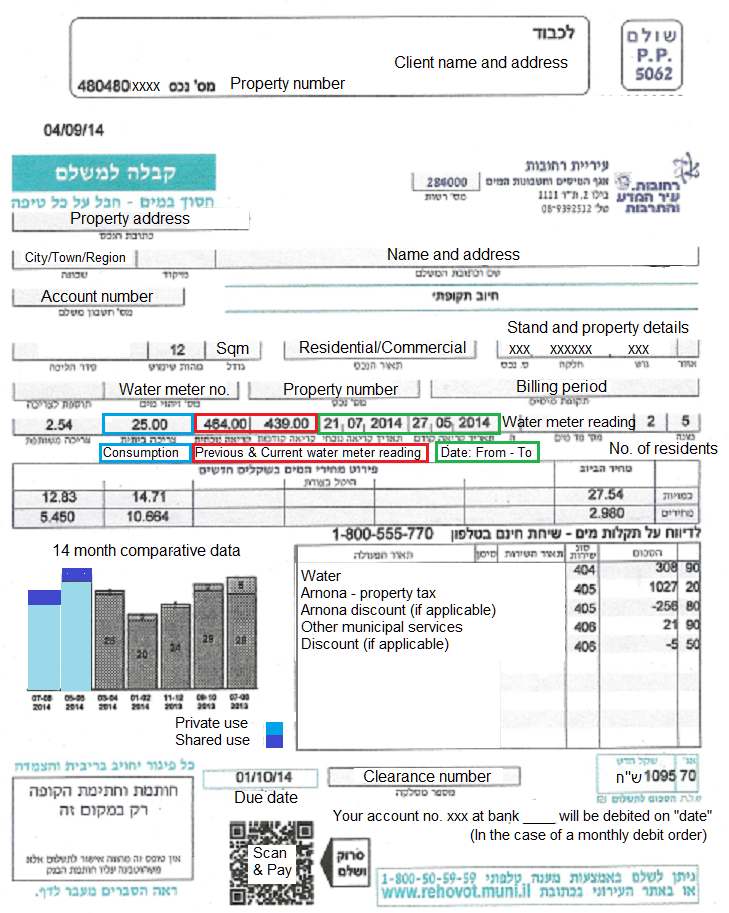
This is the Rehovot regional council Arnona bill. Your Arnona bill, and a digital version, might look slightly different to this one but there are certain similarities from municipality to municipality; all will include details of your property – stand number etc., the bill date and period, water meter reading and consumption. All bills use a clearing number – Heb: Mispar Mislaka – מספר מסלקה as well as a customer or client number – Heb: Mispar Meshalem – מספר משלם
Here is a translation of a combined Arnona and water bill (Note: some water and arnona bills are separate, not all are combined). If you are paying your household utility bills – in this case Arnona, online, watch our instructional, step-by-step video that will show you how to do so. Clear explanations and links to other useful information are also provided.
Useful Translations

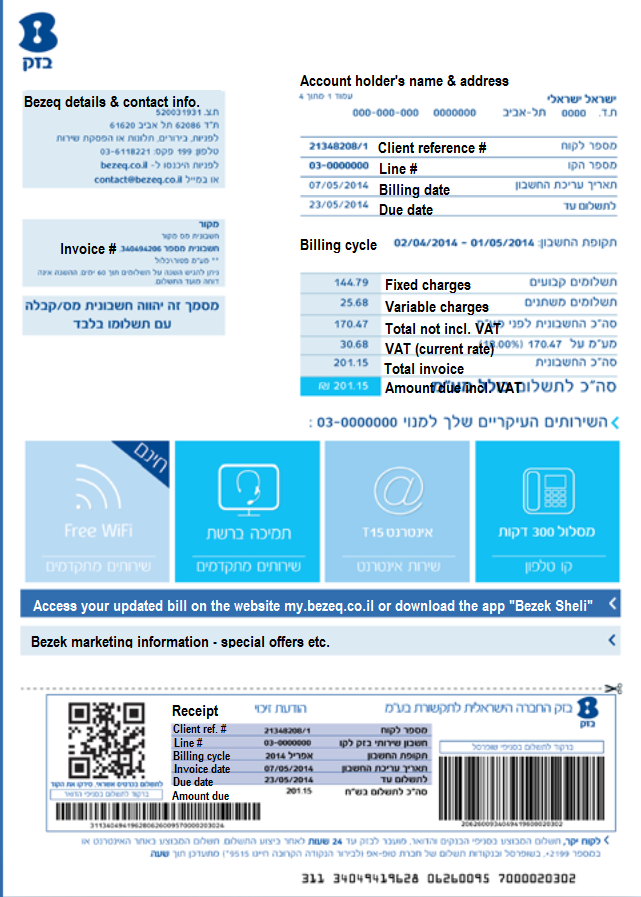
This is an Anglo-List translation of the bill as it appears on Bezeq’s website
Page1
Page 2
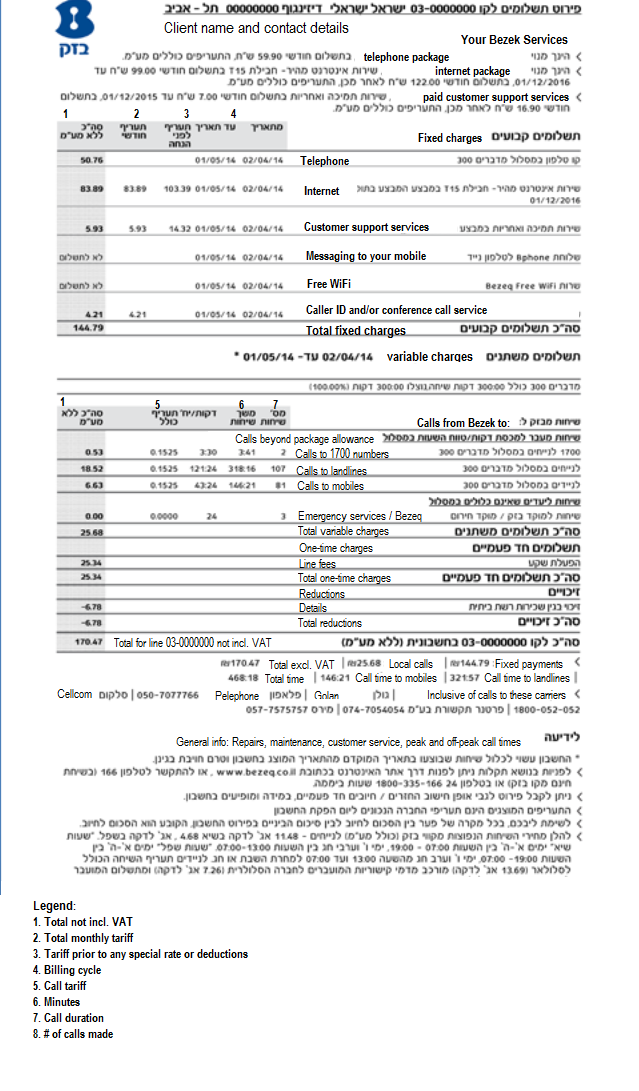
Other Useful Translations

The children make their debut at the seder with the singing of “Ma Nishtana”. They ask why is this night different? Tonight we only eat Matzah, we may not eat any bread.
On all nights we can eat any vegetables we prefer, tonight we are obligated to eat bitter herbs.
On all nights we have no obligation do dip our food, tonight we have to dip our food twice.
On all nights we may eat in any position we choose, tonight we recline.
The answer given to us immediately thereafter is “We were slaves to Pharaoh in Egypt, and G-d took us out with an outstretched hand, and had He not taken us out we would have still been slaves in Egypt.”
While this forms the basis for the holiday, this does not seem to be sufficient, particularly as much later in the Haggadah, we find the reasons for the eating of Matzah and bitter herbs spelled out explicitly.
The Abarbanel explains, that the children are not asking for the reasons for the above mentioned peculiarities, rather they are questioning the paradoxical nature of the evening. On the one hand we eat the matzah reminiscent of the bread we ate as slaves, we eat the bitter herbs to remind ourselves of the bitter time we had in Egypt, and yet on the other hand we conduct ourselves royally; we eat reclining, we dip our food. In a nutshell we are reliving slavery and conducting ourselves royally in the course of one evening.
The answer provided by the Haggadah goes back to the time we left Egypt. It was on this very night when we changed our status. At the beginning of the evening we were in bondage and during the course of the evening, we became free men. Thus when we relive this on the Seder night we retain both elements; our slavery and our freedom.
We say, we were slaves to Pharaoh in Egypt. This contains two elements 1) Pharaoh and 2) Egypt.
The Hebrew word for Pharaoh – “paro” is closely related to the Hebrew word “pa-rua” which means; wild, without boundaries and limitations. This was indicative of the social makeup of the Egyptian society. They were a totally decadent, permissive society. The Torah, when it wants to instruct us in morality, tells us: “Don’t be like the Egyptians” they were the example, par-excellence, of immorality.
The Hebrew word for Egypt, “mitzraim” is closely related to the Hebrew word “mei-tza-rim” meaning constraints or being closed in.
In Egypt, we were exposed on the one hand to a society of total decadence and promiscuity, yet on the other hand we were totally suppressed by a totalitarian despot. So tight were the borders of Egypt that no slave ever escaped.
The Gemara in Brachot records the following prayer of Rav Alexandri, “Master of the universe, it is clear and obvious to You, that it is our will to perform Your will, but we are held back by the yeast in the dough and the decrees of the nations. May it be Your will, to save us from them that we may be able to perform your commandments whole heartedly”.
The “yeast in the dough” is symbolic of a person’s bad inclinations and “decrees of the nations” refer to the influences and pressures from the outside.
Yeast, is necessary for the production of bread, however it has to be used exactly in the correct proportions and measures and for a precise amount of time. If not, the bread will spoil. Similarly, a person has many drives and instincts which have a place if correctly channeled. The problems all start when they are blown out of proportion.
The Rambam (Maimonides), when discussing how to mend faulty character traits, tells us that we have to start by first going to the opposite extreme, to break the negative trait and then to slowly work back to the middle of the road which is preferred. He brings as an example; somebody who is totally stingy, should first go to the opposite extreme to totally break this negative trait of miserliness and then go to the preferred middle of the road; holding back where need be and giving where need be.
Matzah, is bread without yeast: a situation which is symbolic of living without any bad inclination. Our going out of Egypt contained both these ingredients; firstly we left the decadence and immorality of Egypt – the yeast of the dough. Secondly, we also left the bondage of Egypt; the limitations placed upon us by being under the regime of Egypt.
The Balei Mussar tells us that each festival has an intrinsic relationship with the date in which it took place. We refer to Pesach as ‘Zman Heruteinu” the time of our freedom, because the date contained the roots from which our redemption could grow – it was not a mere coming together of time and event.
If this is the time we overcame Egypt, symbolic of outside pressure not to perform mitzvot, and Pharaoh – symbolic of immorality – this means that we have a special opportunity now, to overcome again.
Chag Sameach!
The Torah was given by G‑d to the Jewish people on Mount Sinai more than 3300 years ago. Every year on the Jewish holiday of Shavuot (The Festival of Weeks) we commemorate this event. The word Shavuot means “weeks.” It marks the completion of the seven week counting period – the Omer – between Pesach (Passover) and Shavuot.
One of my favorite songs on Seder night, which brings back many warm wonderful childhood memories, is Dayenu. I would like to focus on a line from the song, which seems to make no sense:-
“Had G-d brought us close to Mount Sinai, and even not given us the Torah, it would have been enough”.
If we read through the entire Dayenu it is clear that it does not mean that we could have done without the Torah, but rather that each act of G-d’s goodness, enlisted in the poem was so great that each one by itself, would have been sufficient cause for celebration.
One wanders though, what is the tremendous kindness manifested in merely bringing us to Mount Sinai if we did not receive the Torah?
The Gemara (Bava Metzia 59) recounts an interesting dialogue between Rabbi Eliezer and the sages. They were arguing about matters of ritual impurity when Rabbi Eliezer sought to back up his point with three very unusual types of argument.
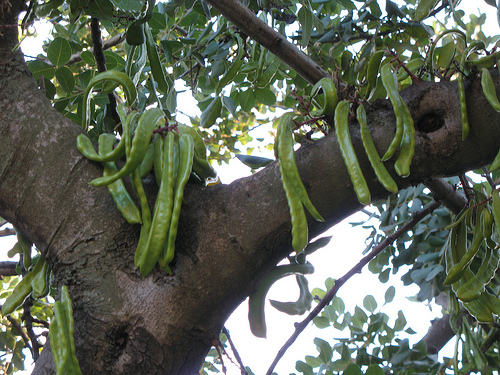
Rabbi Eliezer said: “If the law is like me, let this carob tree* prove my point.” Upon making this statement the tree miraculously uprooted itself.
The sages responded: “You can’t bring proof from a carob tree!”
He replied: “If the law is like me let the stream of water prove my point.” Upon making this statement, the stream miraculously changed the direction of its flow.
The sages replied: “You can’t bring proof from a stream of water.”
Rabbi Eliezer tried a third line of reasoning: “If the law is like me, let the walls of the Beit Midrash prove it.” Upon making this statement, the walls of the Beit Midrash started to cave in.
Rabbi Yehoshua yelled at the walls: “If Torah scholars are having a Halachic debate, why are you getting involved?” Upon this the walls remained suspended. They did not cave in out of respect for Rabbi Yehoshua, but on the other hand they did not straighten out, out of respect for Rabbi Eliezer.
At first glance this looks to be a puzzling piece of Gemera. It would seem that the sages who were arguing with Rabbi Eliezer were not interested in miracle proofs; rather they wanted hard legal logic. If so, why did Rabbi Eliezer keep on bringing new miracle proofs?
The Vilna Gaon explains: The Mishnah in Pirke Avot (Chapter 6, mishnah 6) lists the forty eight ways to acquire Torah knowledge. All these forty eight methods can be divided into three sub categories: – getting by with a minimum (having one’s priorities straight), refined character traits and diligence in learning.
According to the Vilna Gaon, Rabbi Eliezer wanted to show the sages that he had all the necessary qualities to be a Torah scholar. The carob tree symbolizes being “satisfied with the basics” (it was from a carob tree that Rabbi Chanina Ben Dosa – a Talmudic sage and miracle worker from the first century – lived on by eating a fixed measure of carobs, from week to week). The sages were not impressed. Rabbi Eliezer understood that they meant that having one of the three categories is not enough.
That is why he wanted to have the stream of water prove his point – a stream of water symbolizes humility, since water always flows to the lowest point.
He wished to show them that he also had the necessary character traits to be a true Torah scholar. The sages replied that this is not proof. He understood this to mean that two out of three categories is not enough.
Rabbi Eliezer then sought to bring his proof from the walls of the Beit Hamidrash who could testify to his true diligence in learning. He felt that he now had the proof that he had mastered all three required categories and therefore the sages would accept his point of view. The sages rejected this based on a legal rule that we always side with the majority opinion.
We see that in order to truly have Torah knowledge, is not only about studying, but also very much about the type of person one is. One needs to have correct priorities and be refined in character.
If so, we can suggest the following answer to our original question: What is the tremendous kindness manifested in merely bringing us to Mount Sinai if we did not receive the Torah?
The answer may be, the fact that, fifty days after being slaves and exposed to Egyptian society – the most decadent of its day – we were brought to Mount Sinai. The Israelites had acquired, in that short time, the necessary qualities to be given the Torah – that in itself merits a celebration.
Let us use this special season for getting involved in some Torah learning and acquiring some of the qualities necessary for its acquisition.
Did you know that the Carob Tree is a member of the pea family? It is also known as St John’s-bread or the locust bean.

The literal translation of Yom Kippur is the Day of Atonement. We are all hopeful that Hashem, in His kindness, will give us another chance, a new beginning with a clean slate. While we acknowledge Hashem’s tremendous kindness there is a huge lesson here for us.
The Gemara (Taanis 25b) relates the following story: There was once a drought. Rabbi Eliezer acted as the Chazzan and recited twenty-four Berachot, yet he was not answered. Rabbi Akiva replaced him as Chazan and said: “Our Father, our King, You are our Father! Our Father our King, We have no King other than You! Our Father Our King we have sinned before You! Etc. Rabbi Akiva’s prayer was immediately answered.
The people started to murmur, thinking that Rabbi Akiva was greater than Rabbi Eliezer. A heavenly voice came out and explained; it wasn’t because Rabbi Akiva is greater than Rabbi Eliezer; rather the reason is because Rabbi Akiva concedes and holds back from retaliating and Rabbi Eliezer doesn’t.
I believe we can understand this through the tremendous insight of one of the great Mussar giants; we say in Psalms – “Hashem is the shadow of your right hand”. A shadow always moves in the same way as us. If we move right, it moves right, if we move backwards, it moves backwards. Similarly, Hashem relates to us in the same way we relate to others. If we are strict and demanding on others and hold everyone to a fine line, that is the way Hashem relates to us; if on the other hand we are patient, forgiving and understanding; Hashem will relate to us in a similar fashion – just like our shadow follows us.
This is the explanation; when Rabbi Akiva prayed, his prayers were answered since he was not exacting with others and was forgiving in nature.
We are approaching Yom Kippur, let us reflect on how demanding or forgiving we are with our friends and acquaintances; make a resolution to be easy on others and forgiving in nature so that we can hopefully merit a similar relationship with Hashem and all be inscribed for a good healthy happy year.
Gmar Hatimah Tovah!
|
Did you know that we wear white clothes on Yom Kippur in emulation of the spiritual angels? |
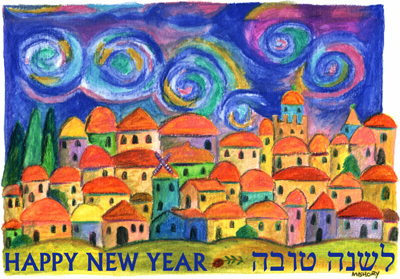
Hebrew – ראש השנה
By Rabbi Tzvi (Hilton) Wainstein
|
|
|
A short explanation of Rosh Hashanah – Rosh HaShanah, also called Yom Ha-Zikaron (Day of Remembrance) or Yom Teruah (Day of the Sounding the Shofar), is celebrated in the Hebrew month of Tishrei when Jews believed that the world was created and on the day when G-d created Man – the last and most precious creation. Each Rosh HaShanah we proclaim G-d as our one and true King. We reaffirm our desire to serve him every moment of our lives. At this same time, G-d reviews the status of his creation and determines if we will merit another year in this world.
After prayer services, we greet each other by saying “May you be inscribed and sealed for a good year.” On Rosh HaShanah, everyone is judged by G-d based on his or her actions during the previous year. The resulting judgment is inscribed by G-d and a person’s future is determined for the following year. Though that judgment is inscribed, it is not yet sealed and can still be changed at least for another ten days. G-d waits until Yom Kippur to seal the book for the year.
How can a person change their judgment for the better? “Repentance (Teshuva), Prayer (Tefillah), and Charity (Tzdaka) can remove the bad decree.” G-d looks at these three areas during the time between Rosh HaShanah and Yom Kippur (known as the Ten Days of Repentance). By examining your life and doing Teshuvah with true regret for the past and a real commitment for the future, a person can erase his misdeeds and improve his judgment before it is sealed on Yom Kippur. Similarly, by praying with greater concentration before G-d, and by giving charity with the proper spirit, one can also upgrade one’s status.
Rosh HaShanah is all about making peace in the community and striving to be a better person. It is a holiday filled with hope for the coming year. Jews believe that God is compassionate and just, and that God will accept our prayers for forgiveness.
May all of Israel be inscribed and sealed for a good year.

Reading Time: 2 minutes
The Jewish Festival of Hanukkah (Heb: חנוכה) begins on the eve of the 25th day of the Hebrew month of Kislev and is celebrated for 8 days. Hanukkah is known as the Festival of Lights, a Jewish holiday that commemorates the Israelites (the Maccabees) victory over the oppressive Syrian-Greek rule by the king, Antiochus and the re-dedication of the Second Temple in Jerusalem.
The Temple needed to be cleansed, a new altar needed to be built in place of the polluted one and new holy vessels to be made. When the Israelites went to light the Temple’s menorah (candelabra), they found just a single measure of olive oil that would burn for only one day. Miraculously, that one-day’s supply burned for eight days – enough time for new oil to be prepared so that it was suitable for this ritual.
At the heart of the festival is the lighting of an 8 branched menorah or Hanukkiah every night: a single flame on the first night, two on the second evening, and so on till the eighth night of Hanukkah, when all eight lights are kindled. A 9th branch and candle, called a shamash is also lit each night and its purpose is to light the other candles. It is given a distinct location on the menorah, usually above or below the others.
Hanukkah customs include eating fried foods; latkes (potato pancakes) and sufganiot (jam filled doughnuts); playing with a dreidel (a spinning top on which are inscribed the Hebrew letters nun, gimmel, hei and shin, an acronym for Nes Gadol Hayah Sham, “a great miracle happened there”); and the giving of money gifts to children or Hanukkah gelt.
We learn some timeless lessons from the story of Hanukkah: light triumphs over darkness, purity over desecration and freedom over oppression.
Chag Sameach!
Rabbi Tzvi (Hilton) Wainstein