26 C
Jerusalem
Monday, June 8, 2026
Sample Page
Home Blog Page 91

Parshat HaShavua Index

0
Reading Time: < 1 minute

Parshat HaShavua – Weekly Torah Portion Index

Contributed by Rabbi Nissim Mordechai Makor

Parsha Name
Bereishit בְּרֵאשִׁית
Noach נֹחַ
Lech Lecha לֶךְ-לְךָ
Vayeira וַיֵּרָא
Chayei Sarah חַיֵּי שָׂרָה
Toldot, תּוֹלְדֹת
Vayeitzei וַיֵּצֵא
Vayishlach – Part I & Vayishlach – Part 2 וַיִּשְׁלַח
Vayeishev וַיֵּשֶׁב
Mikeitz, מִקֵּץ
Vayigash, וַיִּגַּשׁ
Vayechi וַיְחִי
Shemot שְׁמוֹת
Va’era וָאֵרָא
Bo בֹּא
Beshalach בְּשַׁלַּח
Yitro יִתְרוֹ
Mishpatim מִּשְׁפָּטִים
Terumah תְּרוּמָה
Tetzaveh תְּצַוֶּה
Ki Tisa כִּי תִשָּׂא
Vayekhel וַיַּקְהֵל
Pikudei פְקוּדֵי
Vayikra, וַיִּקְרָא
Tzav, צַו
Shemini, שְּׁמִינִי
Tazria תַזְרִיעַ
Metzora, מְּצֹרָע
Aharei Mot, אַחֲרֵי מוֹת
Kedoshim, קְדֹשִׁים
Emor אֱמֹר
Behar, בְּהַר
Bechukotai בְּחֻקֹּתַי
Bamidbar בְּמִדְבַּר
Naso, נָשֹׂא
Behaalotecha, בְּהַעֲלֹתְךָ
Shlach, שְׁלַח-לְךָ
Korach, קֹרַח
Chukat חֻקַּת
Balak, בָּלָק
Pinchas, פִּינְחָס
Matot מַּטּוֹת
Masei, מַסְעֵי
Devarim דְּבָרִים
Vaetchanen, וָאֶתְחַנַּן
Eikev, עֵקֶב
Re’eh רְאֵה
Shoftim, שֹׁפְטִים
Ki-Teitze כִּי-תֵצֵא
Ki-Tavo כִּי-תָבוֹא
Nitzavim, נִצָּבִים
Vayelech, וַיֵּלֶךְ
HaAzinu, הַאֲזִינוּ
Vezot HaBracha, וְזֹאת הַבְּרָכָה

Shabbat and festival candle lighting times

Commentaries on the Hebrew months of the year

Parshat HaShavua Toldot

0
Reading Time: 5 minutes

Parshat Hashavua Toldot by Rav Nissim Mordechai MakorParshat HaShavua Toldot

By: Rabbi Nissim Mordechai Makor

Parshat hashavua Toldot in a nutshell: Jacob and Esau are born. Rebecca and Jacob successfully deceive Isaac, tricking him into giving Jacob the birthright intended for Esau – the blessings.

Parshat HaShavua Toldot: Each of the Patriarchs maintained a yeshiva in which he taught about the existence of Hashem and His will. Abraham’s academy had hundreds if not thousands of students and Yitzchak had one. His lone student was Yaakov whom he trained and appointed to teach others. This provides a clue to the way in which Yitzchak’s role contrasted from that of Abraham. Abraham could accept everyone into his circle, Yitzchak could not.

The Torah devotes much less space to Yitzchak’s life than to the lives of Abraham and Yaakov. On the one hand, Yitzchak seems to be but a bridge between his father and his son; on the other hand, he had the task of drawing the line between good and evil as represented by Yaakov and Esau, because the emerging nation of Israel could not be a mixture of good and evil. In contrast to Abraham whose primary characteristic was chesed, kindness, Yitzchak’s was gevurah, [strength].

One requires strength to differentiate between good and evil and then to purge the bad and nurture the good. Yitzchak and Rivka produced two sons, one became the personification of righteousness and the other the personification of wickedness, and it was the lot of the parents to make the distinction so that the nation of Israel would be pure.

One might think that Yitzchak discarded Abraham’s way in favor of his own. However, the Torah stresses at the very beginning of this week’s Torah portion that Yitzchak was the son of Abraham, Abraham was the father of Yitzchak. In the Jewish scheme of life, kindness and strength must go together. Kindness not tempered by strength can lead to self-indulgence and pleasure-seeking, strength without kindness can lead to selfishness and cruelty.

The Lakutei Halacha explains the verse 27:12:

Perhaps my father will feel me and I will bring upon myself a curse rather than a blessing. “My father” is Yitzchak, the attribute of judgment. Jacob was worthy of receiving the blessings, but because he had to obtain them in a stealthy manner, he was afraid that the attribute of judgment might “feel” him and detect a minor flaw that would make him unworthy. Rifka, who represents prayer, assured Yaakov that with prayer, one overcomes even the strictest judgment. Thus, she was willing to accept upon herself any curse that Yitzchak might pronounce.

Rashi explains verse 27:19 telling us that when Yaakov entered Yitzchak’s presence an aroma from the
Garden of Eden accompanied him. When Esau entered a whiff of Gehinnom accompanied him. The Likutei Halachot tells us that this happened specifically when they brought food to Yitzchak.  Yaakov’s intention in serving the food highlighted the spirituality of the food; therefore the Garden of Eden was present in his work. Esau’s preparation highlighted the material properties of the food; therefore Gehinnom could be sensed in it.

Later, it is written, “The voice is the voice of Yaakov, but the hands are the hands of Esau”. The “voice” represents the spiritual; the hands the material. This explains why kosher wine is rendered non-kosher when a non-Jew touches it. “Esau’s hands” lower the wine from a spiritual realm to a material one and bring with it the sufferings of the alcoholic.

Of the greatest questions that is asked is about when Yaakov came to his father Yitzchak and was asked “who are you, my son?” Yaakov then replied, “It is I, Esau, your first born.” The Me’am Loez masterfully explains that when Yaakov said, “it is I who am bringing you this good food. Your other son Esau, however is your firstborn.” The following paragraphs will explain that the actions of Yaakov were correct in saying what he said and doing what he did in receiving the blessings of Yitzchak.

Although Yitzchak misunderstood him and assumed that Esau was speaking, this is not a case of malicious deception, since Yaakov planned eventually to reveal the truth. Meanwhile, Yaakov was careful to word his reply so that it was not actually an untruth. Furthermore, since Esau had sold Yaakov the birthright, it was proper for Yaakov to say, “it is I [in place of Esau] your first born.” This if Yaakov had said, “It is I Esau,” it would have been a lie. But in wording his reply, “It is I Esau your firstborn,” Yaakov was actually speaking the truth.

The Ohr Chayaim HaKodesh quotes the verse “I am Esau your firstborn.” Yaakov meant that seeing he had purchased the birthright from Esau, he was now the legal Esau. He added “I have done in accordance with what you have said to me.” meaning that the reason you told Esau to hunt game, was because you assumed that he was your firstborn.

In explaining verse 27:23 where [Yitzchak] did not recognize him since his hands were like those of Esau.

Yitzchak rejected the doubt created by Yaakov’s voice since a person can change his voice or the listener may mistake a voice for that of someone else, whereas he cannot change the hairs on his hands, a very distinctive mark of identification.

Yitzchak blessed him – Before Yitzchak touched Yaakov and established that he was Esau, nothing had contradicted his first impression that it was Yaakov’s voice he heard and that therefore he was faced by a swindler. Yitzchak had begun to think along the lines Yaakov had been afraid of, i.e. that the swindler deserved to be cursed. Even though Yitzchak had not yet thought that far, he did begin to hate the person whom he thought was trying to swindle him. The Gemara in Baba Metzia 84 tells us that when the righteous are looking at someone with displeasure this brings a curse in its wake. The Torah reports Yitzchak as blessing Yaakov as a result of feeling his hands to teach us that he reversed his erstwhile intentions.

Yitzchak said in 27:24 that “You are indeed my son Esau” Yitzchak justified his bestowing the blessing. This verse is not a question. Yaakov’s reaction was a confirmation that Yitzchak was correct, of course. Inasmuch as Yitzchak had thought up to that moment that the voice indicated that Yaakov stood before him, he now pointed at the body of the person before him saying: “you are Esau.” When Yitzchak articulated the blessings, he concentrated on the person opposite him without regard to that person’s name. This actually made Yaakov the true recipient of the blessings, even though Yitzchak had made mention of Esau. At the time of the actual blessing Yitzchak concentrated exclusively on the person in front of Him and that was Yaakov.

Shabbat Shalom!

Yeshiva Pirchei Shoshanim

Parshat HaShavua – Chayei Sarah

0
Reading Time: 10 minutes

Parshat HaShavua – Chayei Sarah

Contributed by: Rabbi Nissim Mordechai Makor

Rav Nissim Mordechai Makor chayei sarah

Chayei Sarah in a nutshell:  Sarah dies and Abraham purchases the Cave of Machpela as a burial plot for his wife. Abraham’s servant travels to Aram to find a wife for Isaac. Isaac marries Rebecca. Abraham dies.

Sarah’s lifetime was one hundred years, twenty years, and seven years; the years of Sarah’s life. (23:1).

Rashi explains that the apparent redundancy of the “years” of Sarah’s life divides her life into three parts, each with its own distinctiveness. At the age of one hundred, her level of sin was equal to that of a twenty-year old – an age when a person does not yet suffer Heavenly retribution. At the age of twenty, she still possessed the wholesome and natural beauty of a seven-year-old. As an aside, Horav Moshe Feinstein, zl, adds that the Torah is not glorifying Sarah’s unusual physical beauty. Rather, it is expressing the idea that just as the beauty of a seven year old is pure and innocent and is never used to cause others to sin, Sarah’s breathtaking beauty as an adult manifested similar purity and innocence. All who beheld her felt a sense of reverence and awe.

Sarah is not the only righteous woman whose life and death is recorded in the Torah. Yet, she is the only one whose age is divided into three groups. We wonder why the Torah repeats itself when it says, “shnei chayei Sarah,” “the years of Sarah’s life.” This question is especially significant concerning Avraham Avinu, for whom the Torah does break his age into three groups – alluding to his purity from sin throughout his life – as the Torah does not end the narrative with the words, “shnei chayei Avraham,” “the years of Avraham’s life,” as it does with Sarah. Apparently, this “closing” has special meaning in the context of Sarah’s life.

Shabbat candle lighting times for Chayei Sarah

Parshat Hashavua Index

In a homily regarding the concept of yesurim, suffering, the Piazcesner Rebbe, zl, cites chassidic tradition: While a moderate degree of suffering may benefit an individual’s spiritual development, excessive tribulation is beyond endurance and, hence, unacceptable – and may even be harmful. His point of refrence is the famous Chazal that questions the juxtaposition of Sarah’s death upon the Akeidah, Binding of Yitzchak. Chazal say that she died as a consequence of the Binding of Yitzchak and her son’s near-death. This trauma was too much for her to handle.

One might argue, suggests the Rebbe, that Sarah’s taking the Akeidah so much to heart to the point that it killed her – was a deliberate act she performed on behalf of Klal Yisrael. It was her intention to supplicate the Almighty that her descendants would not be able to endure an excessive amount of suffering. For even if, by the grace of G-d, an individual were to endure the tribulation and live, nevertheless, a part of his strength, mind and spirit would be broken and forever lost. This is consistent with the Talmud in Bava Kama 65a which inquires, “What difference does it make if one is killed outright or beaten halfway to death?”

This concept explains the Torah’s repetition of the phrase, “these were the years of Sarah’s life.” Her life was unique. Every aspect of her life was exemplary. From her pristine physical beauty to her lofty spiritual purity, she stood out as the example of righteous womanhood. When one considers her sudden death and its underlying cause, it appears that Sarah might have sinned by shortening her own life span. Perhaps, had she not taken the Akeidas Yitzchak so much to heart, she might have continued to live. Since her action was taken on behalf of Klal Yisrael, the Torah reiterates, “These are the years of Sarah’s life,” Thus, the Torah is conveying to us that all the years of Sarah’s life were equally good – even those years that she might have lived beyond age 127. Even the willful sacrifice of those years was good.

This is a powerful statement, one that only an individual of the spiritual stature of the Piazcesner Rebbe can present. He understands Sarah’s death as a quasi-suicidal protest against excessive suffering. Accordingly, he feels that the Torah ratifies this protest specifically because it was taken on behalf of Klal Yisrael. This explains why Sarah Imeinu succumbed to the shock of almost losing her only child, while Avraham Avinu, who was on a lower level of nevuah, prophecy, withstood the test. The statement is that of an individual who, as Rebbe in the Warsaw Ghetto, was privy to the suffering and grief that goes beyond human endurance. In his merit and in the merit of all of those who have suffered throughout the millennia, may Hashem in His infinite compassion take pity on us and all of Klal Yisrael, speedily bringing about our spiritual and physical salvation.

And Avraham said to his servant, the elder of his household who controlled all that was his. “Place now your hand under my thigh.” (24:2)

Chazal tell us that Eliezer was not an average servant. He was “z’kan baiso,” defined by Chazal as having similar ziv ikunin, facial features, to Avraham. He was also “ha’moshel b’chol asher lo,” “ruled over everything” – even his yetzer hora, evil-inclination, just like Avraham. Others contend that he ruled over the Torah of his rebbe, Avraham. He was called Damesek Elizer, because he was doleh u’mashkeh, drew up the waters of Torah and gave others to drink. The Midrash goes so far as to state that Eliezer was one of nine people who did not die, who, rather, ascended to Heaven – alive.

In short, Eliezer was a special person. He was a scholar, pious and virtuous. Yet, Avraham felt the need to make him take an oath that he would assure that Yitzchak did not marry a pagan. Could he not just have simply asked him? Did he have to make him swear? Moreover, why does the Torah emphasize, specifically in reference to seeking a wife for Yitzchak, that Eliezer was a man of noble, saintly stature?

Horav Sholom Schwadron, zl, explains that essentially Eliezer was truly an individual of exemplary spiritual repute. Avraham Avinu trusted him with everything – well, almost everything. His son was a different story. He was to be the link to the next generation. Avraham was not simply looking for a shidduch, match, for his son. He was building the future of Klal Yisrael! Eliezer was to be believed in regard to all physical/mundane areas. When it pertained to the spiritual dimension of the future of the Jewish People, however, there was no room for error or compromise. It had to be a perfect match. Eliezer had to submit to an oath that he would execute his master’s request to the fullest extent.

Rav Sholom cites a practical analogy he heard from the Brisker Rav, zl: A person comes to a town in search of a place to stay. He stops at an inn whose owner also has a little restaurant. Hungry for a good meal, the traveler first must ascertain the kashrus of the restaurant. He goes out to the street to find a passerby and inquire if he knows his host. Is he trustworthy? As soon as he hears a positive response, he immediately returns to the inn and has a large meal. After all, the Rabbinic dictum of “eid echad nee’man b’isurim,” “one witness is sufficient regarding prohibitions,” i.e.: kashrus, apparently applies in this circumstance.

If we think about the situation, we note an apparent inconsistency in this individual’s “blanket trust.” Imagine if his host were to offer him a business deal whereby he must invest a sizeable sum of money, he would certainly not rely on the “man on the street” to check out his host’s integrity. He would probably spend days checking him out before investing his hard-earned money with him. Yet, when it involves his neshamah, soul, he has no compunction about trusting his kashrus, because the man on the street verified his reliability.

Interestingly, a similar incident occurred with Horav Yisrael Salanter, zl, when he was on a trip. He stopped in a community and was immediately asked by someone if he was proficient in the laws and practice of shechitah, kosher slaughtering. Rav Yisrael did not immediately respond. A few moments later, he asked the person if he could borrow five rubles from him. “How do you expect me to lend money to someone whom I do not know?” was the immediate response. Rav Yisrael looked at the person and said, “Listen to what you are saying. You are willing to let me shecht your animals, but when it comes to lending me money, you do not know me! Is this not a double standard? You seem to be more concerned about your wallet than your neshamah!” Avraham Avinu was different. When it came to matters of the household, he relied totally on Eliezer. He was his trusted servant and confidante, but only in the realm of gashmius, the physical/material aspects, the mundane matters of his life. When it concerned ruchniyos, spiritual matters; when the future of Klal Yisrael was at stake, Avraham did not simply “rely”; he demanded an oath from Eliezer to insure that his request would be executed to the letter. Selecting a wife for Yitzchak would determine the course of generations. The right wife would enhance Yitzchak’s spirituality. The wrong one would destroy him, undermining the foundation for the future of his descendants.

Avraham Avinu had his priorities – just as we all do. His spiritual dimension dominated everything else. Regrettably, many of us are far from this perspective. True, the world of spirituality has an eminent position in our lives, but it is secondary to our “other” interests. Rav Sholom cites a story that has become a classic: the story of Meirka. This narrative should underscore how we view things and their prioritization in accordance with what is important to us. One day Rav Sholom was sitting in his home in Yerushalayim. Suddenly, he heard a scream from the alleyway outside his window. In a moment, his rebbetzin ran into the house yelling that little Meir, the grandson of the gabbai, sexton of the shul, had fallen and was bleeding profusely from a gash over his eye. They both ran outside, Rav Sholom scooping up the child while his wife held a wet towel over the cut to stop the bleeding. Rav Sholom began running with the child in his arms through the alleyway to the main street, rushing as fast as his legs could carry him, on the way to get the child to a doctor. As they rushed up the hill, a pious elderly woman who was walking toward them called out in Yiddish, “Rav Sholom, Rav Sholom, ess iz nisht doh vos tzu daigin,” “There is nothing to worry about. You need not rush.” “Der Eibeshter vet helfen,” “The One Above will take care of him.” As soon as Rav Sholom and his wife passed directly in front of the elderly woman, however, she looked down and realized that the bleeding child was none other than her own grandson. She began to shriek uncontrollably, “Gevalt! Meirka! Gevalt!” And she fainted!
In his lectures over the years, Rav Sholom transformed that scream of “Meirka” into a catchword lesson. He would often say, “If it is not my Meirka, it is easy to say do not worry. Nothing is wrong. Hashem will help. When it is my Meirka, however, when the problem affects me personally, it is an altogether different story.”
People act similarly when it comes to their personal issues. For some, their spiritual dimension takes preeminence over everything. For others, regrettably, it does not.

And thus was Yitzchak consoled after his mother. (24:67)

Yitzchak Avinu could not be consoled over the loss of his mother, Sarah Imeinu. This is a remarkable tribute to the relationship between a son and his mother. He did not feel the void, however, because he missed her as a mother. If he had, Rivkah, the wife, would not have been able to replace Sarah, the mother. Rather, he intensely missed the unique virtues and attributes, the exemplary character traits and moral refinement for which Sarah, the Matriarch of the Jewish People, was known. Rivkah Imeinu manifested a moral/spiritual identity that replicated the virtues Yitzchak experienced in his mother. The void was filled and now Yitzchak could be consoled.

When an individual sustains the loss of a loved one, the duration and intensity of the grief is usually relative to the deceased: his age, and his relationship to those whom he has left behind. At times a grievance, and even anger, is coupled with the grief. For the most part, these emotions are undirected and unfocused. If the tragedy is especially great, some will lose themselves and unknowingly direct their criticism at the Almighty. Perhaps the following narrative might help ameliorate that criticism.

Due to his incredible brilliance and high moral/spiritual plateau, the Kotzker Rebbe, zl, had little tolerance for the mundane. His sterling character set the standard for emes, truth/integrity. Thus, he could not brook anything or anyone who deviated from the absolute truth. At first, for a number of years, he remained secluded, spending his days plumbing the depths of Torah and delving deeper into the profundities and secrets of the mystical and spiritual aspects of Torah. Yet, he found time to reach out, to guide, to respond, and to comfort those that came to benefit from his unique blend of practical advice and spiritual guidance.

Once, Rav Menachem Mendel, the rav of Zedunska/Walle, came to him, brokenhearted and forlorn over the tragic death of his young daughter. He could not reconcile himself with the terrible loss and he had a difficult time accepting the bitter Heavenly decree. The Kotzker gave him shalom, welcoming him to his home, and immediately proceeded to share with him a difficulty he had with a passage in the Talmud. Rav Menachem Mendel was quick to respond and elucidate the words of Chazal. The Kotzker then asked him a compelling question on Rashi’s exegesis. Once again, Rav Menachem Mendel presented a brilliant response to his query. The Kotzker then questioned Tosfos, which Rav Menachem Mendel continued to resolve.

When Rav Menachem Mendel concluded his explication of the entire passage of Talmud, Rashi and Tosfos, the Kotzker Rebbe looked at him with penetrating eyes and said, “If the Talmud is correct, and Rashi’s explanation is validated, and Tosfos’ comment is satisfactory, then surely Hashem is justified.”

Rav Menachem Mendel understood the profound message and was comforted. We are able to justify everything in life because we want to. It serves our needs. Why should we not do the same for Hashem? We should also give Him the benefit of the doubt, trusting that He knows and does what is ultimately for the good.

Shabbat candle lighting times for Chayei Sarah

Parshat Hashavua Index

Questions on Chayei Sarah

1. Why did Avraham bow down to Bnei Cheis? Was it not Efron who sold the property to him?
2. Who else made his son swear to him, similar to the way that Avraham made Eliezer swear to him?
3. Did Avraham have any daughters?
4. Why does the Torah enumerate the names of Yishmael’s twelve children and their dwelling places?

Answers

1. He bowed down in gratitude to indicate that it was in their honor that Efron agreed to accede to his request (Sforno).
2. Yaakov made Yosef swear to him that he would not bury him in Egypt.
3. “Avraham was blessed bakol.” According to one opinion in Chazal, “bakol,” – “everything,” refers to a daughter that was born to Avraham. A second opinion contends the opposite. The Ramban explains that Avraham would have been unable to find a suitable match for his daughter due to the harmful environment.
4. This is based upon the Chazal that only the descendants of Yitzchak are considered Avraham’s “seed.” Thus, the various prophecies that the Torah makes regarding Avraham’s “seed” inheriting Eretz Yisrael, do not apply to Yishmael (Brisker Rav).

Rabbi A. Leib Scheinbaum

Hebrew Academy of Cleveland

Oleh Olah Olim

Reading Time: 3 minutes

Oleh / Olah / Olim (What are olims?).

Learn the Hebrew language.

Oleh Olah Olim chalkboard

Oleh, Olah, Olim, Vatik, Vatika, Vatikim – without a doubt, Hebrew is a difficult language to learn and most Olim struggle to get it right.  English words have crept into the Hebrew lexicon.  Moses and the ancients never had to deal with mobile phones, fax machines and disk-on-keys but thanks to modern Hebrew educators real words are being added for new concepts and inventions.

When we get stuck with a Hebrew word, its plural or pronunciation we sometimes borrow the English word and turn it into a form of ‘pidgin Hebrew’ like television (Hebrew: televisiya) and cigarettes (Hebrew: sigariot).

In the last few years we have seen the incorrect use of a Hebrew word that has filtered into the vocabulary of Anglo olim and that word is ‘Olims’

Let’s get back to basics and learn the correct Hebrew words that relate to Aliyah.


English Hebrew Transliteration
Female immigrant עולה Olah
Male Immigrant עולה Oleh
Immigrants עולים Olim
Veteran immigrant (m/f) ותיק/ה Vatik/Vatika

What is Aliyah?

A person who makes Aliyah is called an “Oleh” – someone who goes up (in this case goes up to Israel). It refers to a single person. Two or more people, a family or a group who have made Aliyah are called “Olim” – the plural form of Oleh. As we said, Olim is already a plural word and the made-up word ‘Olims’ is a mistake.  Across social media, we have seen the use of the word ‘Olims’ used like this example;- We are a family of ‘Olims’ looking for an apartment in Tel Aviv.  The correct way of expressing this, should be: We are a family of olim and we are looking for an apartment in Tel Aviv.

Now let’s get back to the important Aliyah related words.

If you are a new immigrant you are an ‘Oleh Hadash’ or ‘Olah Hadasha’, Generally this title lasts for about 10 years.  The concept behind it is that you are still in the learning phase and finding your feet in Israel. If you have been here for a short time you might be referred to as “Mamash, Mamash, Oleh Hadash” – ‘Really, really new.’  Note that in Hebrew if you want to make a point and emphasize something, you use a double adjective like: hadash, hadash. There are many instances when this double adjective is practiced in conversation and here are two examples ‘Taim, taim’ – very tasty or ‘Naki, naki’ – very clean.

If you have been in Israel for more than 10 years, and less than 15, you graduate from being called an Oleh Hadash to being call a plain Oleh. You are now less likely to being called a “friar” – the Hebrew term for ‘sucker’.

Somewhere round the 20 year mark, you become a “Vatik” – a veteran resident. If you are a Vatik it is assumed that you have a full understanding of how things work in Israel. You are no longer a “friar”. If you have been in Israel for 30 years (give or take a few), you are a “Vatik, Vatik” – a very seasoned veteran Oleh. You are now fully integrated into Israeli society, you are experienced and can teach the next generation of ‘Olim Hadashim’ a thing or two.

Hebrew is a complicated language, with masculine and feminine words.Now;-

When Olim arrive in Israel, they are given a document called a “Teudat Oleh”. This document proves that you are an Oleh Hadash or an Olah Hadashah or a family of Olim Hadashim (take note – not Olims). As an Oleh Hadash or an Olah Hadashah, you have certain rights and are entitled to various benefits – these rights and benefits are called Zchuyot Oleh. Try to think of them as privileges rather than rights or entitlements. For the most part these privileges take the form of financial assistance. (Our grateful thanks to millions of Israeli tax-payers and the contributions of the Jewish community around the world whose money is used for this purpose!)

Heaven forbid, spit 3 times, tfu-tfu-tfu – you decide, after making Aliyah, to leave Israel, you will be called a “Yored”  and that process is called “Yerida” – going down.  Forget about the word ‘Olims’ it doesn’t exist in the Hebrew or English language.

Now that you understand this most important lesson, you are ready to  learn more everyday Hebrew with our free word-sheets, by topic, with English and transliterations.

We acknowledge the work of all the Aliyah organizations, groups and individuals who work tirelessly to help new Olim with their integration in every possible way.

This Day in Jewish History

Reading Time: < 1 minute

This day in Jewish history – 7 November

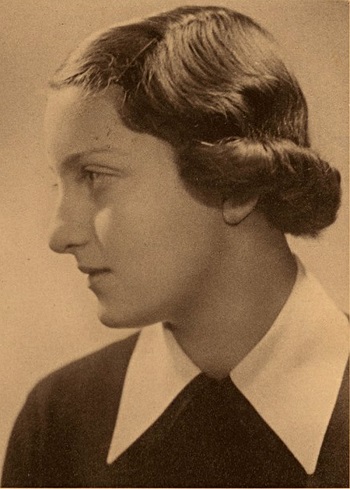
Hannah Szenes (Senesh)

Hannah Senesh
Image credit: The National Library of Israel

Born in Hungary on July 17th, 1921 and died on November 7th, 1944 at the age of 23Hannah Szenes became involved in Zionist activities and joined the British Army where, in 1944, she volunteered to be parachuted into Yugoslavia during the Second World War to assist in the rescue of Hungarian Jews about to be deported to the German death camp at Auschwitz.

Szenes was arrested at the Hungarian border, then imprisoned and tortured repeatedly, she refused to cooperate and reveal details of her mission even when the police threatened to harm her mother. She was eventually tried and executed by firing squad on November 7th. In 1950, Senesh’s remains were brought to Israel and re-interred in the military cemetery on Mount Herzl.

She is regarded as a national heroine in Israel, and her poetry is widely known. Her poems “Towards Caesarea,” “Eli, Eli,” and “Blessed is the Match,” have been set to music.

A museum – Hannah Szenes House on Kibbutz Sdot Yam was established in her honour where you can follow an audiovisual display presenting her life story, mission and death.

Several streets in Israel, are named after her.

Social security benefits for American citizens living in Israel

Reading Time: 4 minutes

US Social Security – Do you Qualify?

By: Norman H. Chait, CFA, Managing Principal at Nardis Advisors LLC

normanchait headshot

I recently returned to Israel after living in New York for 23 years. It is great to be back, and have felt warmly welcomed. Nevertheless, it does take time to get used to things, even as a fluent Hebrew speaker. Simply put, things operate differently here versus the US. Sometimes it is better and sometimes it can be frustrating. So, am happy to share experiences of making Aliyah for the second time.

In navigating Israeli bureaucracy, one may forget that “once an American always an American.” Unless you voluntarily give up your US citizenship, you have rights, benefits and obligations to consider back in the land of Uncle Sam.

Members of the American community in Israel have asked whether they are eligible to receive social security benefits. This is a complex subject, so let us focus on some key general principles to assist you in considering how to maximize your benefits.

Are you eligible for social security?

To qualify for social security benefits, you must have worked for at least 40 calendar quarters (ten years) in the US, or have paid US self-employment tax if you own a business outside the US. The quarters do not have to be consecutive. You may also be eligible even if you did not work for the minimum period, but are divorced or widowed from someone who did.

At what age can you claim social security?

While the full retirement age is between 66 and 67 depending on date of birth, one may claim reduced social security benefits at age 62 (up to 30% less dollars), or increased benefits if one delays up to age 70 (up to 24-32% more). Unless you really need the money immediately, you may indeed want to delay your initial claim date.

How much can you receive?

Here is a key fact people often miss. Social security determines your monthly benefit on an inflation-adjusted basis by averaging your highest 35 years of earnings. Assume this monthly payment is $1,500. If you worked only for 10 years, you will be paid only $429, or 28% of the full amount.

So, if possible we suggest contributing to social security as long as possible. To do in Israel, one will need to generate self-employment (Heb: Atzmai) income. And one can do so even through running a small home business, such as consulting, catering, tutoring and so on.

How much do you need to contribute to social security?

Social security payouts are regressive in that you get the highest matched payout on the initial dollars earned. At present, in round numbers, the first $10,600 earned annually has an 90% benefit payout ratio. This drops to 32% on the next $53,400, and thereafter to only 15% of additional earnings up to a cap of $127,200.

In other words, earning a few hundred dollars a month in self-employment income can translate to an almost similar amount in future monthly benefits, if one indeed does so for up to 35 years.

As of 2018, each lifetime quarterly social security credit will be $1,320. So, one will want to earn a minimum of $5,280 per annum in self-employment income to take full advantage.

How much would you have to save to receive similar annual income?

Social security benefits can also be compared to a financial nest egg. Taking our example of $1,500 per month (or $18,000 per annum), one would require $250,000 in savings to generate an equivalent amount assuming an ambitious 7.2% annual return, or $500,000 at a more realistic 3.6% annual payout. One can tweak the numbers, but this illustration aims to depict how much social security may be worth to you on a capitalized basis.

Two Caveats

If you are eligible to receive a pension from an Israeli or other non-US employer, it is possible that your monthly benefit may be reduced by up to 50% (Windfall Elimination Program). This does not include payments from Bituah Leumi (Israel National Insurance). Also, it is possible that in the future the Social Security Administration will not have sufficient capital to pay out all claims. At present the program is fully funded until 2034. However, we understand that few people maximize their social security benefits, often claiming too little too early. Therefore, we are optimistic that the program should be able to pay out most of the eligible benefits for many years to come.

Disclaimer: Nardis Advisors LLC (“Nardis”) is a Registered Investment Advisory Firm regulated by the U.S Securities and Exchange Commission in accordance and compliance with applicable securities laws and regulations. Nardis does not render or offer to render personalized investment advice through this medium. The information provided herein is for informational purposes only and does not constitute financial, investment or legal advice. Investment advice can only be rendered after delivery of the Firm’s disclosure statement (Form ADV Part 2) and execution of an investment advisory agreement between the client and Nardis.

Car Rental in Israel

Reading Time: 3 minutes

Cheap car rentals in Israel. Is there such a thing?

car hire

All the major international car rental companies are represented in Israel and some small local ones to;

  • Avis
  • Budget
  • Eldan
  • Hertz
  • Shlomo SixT
  • Thrifty

Smaller car rental companies include:

  • Suncar
  • Zvi Cars
  • Albar

Are any of them really cheap? Are there any great deals out there?  We researched 3 companies and didn’t find any significant price differences on short term rentals.  One company may charge less for the actual car hire but then they may give you a lower free mileage limit or their insurance premium may be slightly more.  If you are renting for two weeks or more, you might have some leverage as far as price is concerned or if you are a regular renter they may give you a slightly better rate.

Car rental policies and requirements

Car rental day

One car rental days is 24 hours (or part thereof) from the time of pickup. Some companies will give you one hour grace when returning the car, more than that you will be charged for an extra rental day.

If you are renting for 4 days you will be charged for 4 days – no waivers.  You will not be refunded if you return the car a day or two earlier than the contract period.  After a similar experience and an expensive mistake, our best tip, if you are not 100 percent sure that you need a rental car for an extra day or two, best to arrange a shorter rental and then request to extend the contract.

Except to/from the airports – there are no rentals on Saturdays – Sundays to Fridays only.  There is usually an additional surcharge for rentals to/from the airport.

Minimum rental driving age

This seems to vary from company to company.  Hertz offers rental cars from the age of 20 but there there is a surcharge for young drivers. Budget and ShlomoSixT have a minimum age of 21.  Most require you to be in possession of a valid driver’s license for at least 2 years.

Rental driver’s license requirements

Driving in Israel requires a valid driver’s license and the license must be valid for the entire rental period.

Vehicle categories

From 2 door, manual box cars to luxury sedans or even commercial vehicles, all car rental companies reserve the right to give you any vehicle from the category you have ordered.

Gasoline

The car will be handed over to you with a full tank of gasoline.  It must be returned with a full tank too.  Vehicles returned with missing fuel could be charged an additional service fee or a price per liter of fuel way above the current market price.

Remember to verify the correct gas type. Filling the tank with the wrong gasoline may mean you will be responsible for any repairs that might need to be incurred as a result of this mistake.

Insurance

Discuss details of the insurance policy with the agent.  There are many conditions and certain waivers too. Make sure you understand them all before you sign on the dotted line.

Extras

Baby car seats, booster seats, under rental age drivers, additional drivers etc. are all charged separately.

Parking tickets, traffic violations and toll roads

The lessee is responsible for traffic violations and toll road fees (Road No. 6 and Carmel Tunnels).  An additional service fee will be charged to your credit card for unpaid tickets ticket violations and toll road fees.

Credit card

You cannot hire a rental car without a valid credit card in the name of the lessee.  When you collect the vehicle an large shekel amount will be frozen on your credit card as a security deposit.  When you return the car, this security deposit will be released. Bear this in mind if you are planning large transactions during the rental period.

Ordering a vehicle on the internet is relatively simple and easy.  All rental companies have English options.  When requesting an online quote or placing an order, the English option default is set to US$.

Border Crossings

It is strictly forbidden to exit the country’s borders or to enter the Palestinian Authority territories with a rental vehicle.

Car sharing

Considered car sharing? What is it and how much does it cost?

Paul & May Arieli-Goldschmidt Memorial

Reading Time: 2 minutes

The Paul & May Arieli-Goldschmidt

Memorial & Dedication


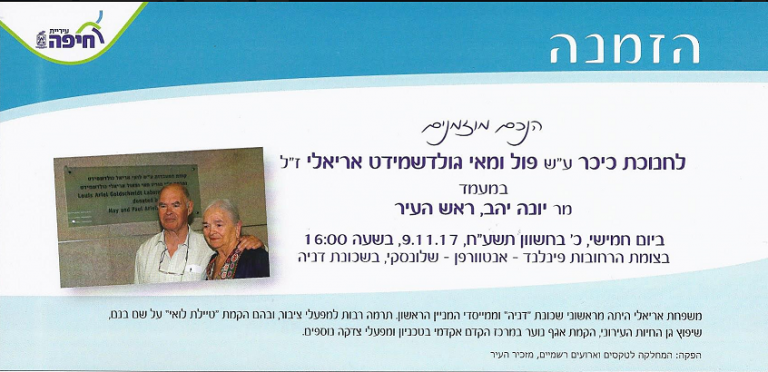
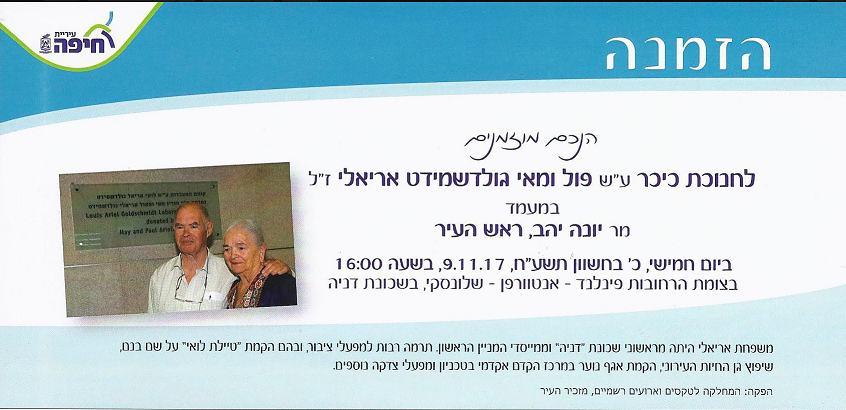
The Mayor of Haifa, Yona Yahav cordially invites you to attend a dedication ceremony in honour of Paul (z”l) and May (z”l) Arieli-Goldschmidt

Thursday, 9th November, 2017 at 16:00

The ceremony will be taking place in Denya, Haifa at the circle of Finland, Antwerp and Shlonski Streets, where the circle will be named in their honour.

Following the short dedication ceremony, a small reception will be held at the Denya Shul.

PaulMayArieli

You have probably walked along the promenade in the central Carmel and spent an enjoyable time at Haifa Zoo.  It was through the generous contribution of Paul & May Goldschmidt, that we and generations to come, will continue to enjoy these attractions.  A laboratory at the Technion, the Denya Shul and Bet Protea are just some of the many other large and small projects Paul and May contributed to.

South African olim who came to Israel, from Cape Town, in the early 1950s, Paul was a civil engineer and May was a pediatrician. They were among the very first residents of Denya, a suburb of Haifa and much of its development was as a result of their activities.

Tragically, at the age of 18, their only child, Ariel (Louis) was killed in a motor vehicle accident and it was then that Paul and May Goldschmidt decided to honour the memory of their beloved child in every possible way including changing their surname from Goldschmidt to Arieli-Goldschmidt.

Family and friends of Paul & May, fellow South Africans and other members of the community who would like to honour their memory, are invited to attend.

To facilitate catering and other arrangements, please confirm your attendance in the comment box below.

If you would like to share a memory or some thoughts, please feel free to do so.


{jcomments on}


Dial 106 for your local municipal office public service center.

Reading Time: < 1 minute

Calling 106 for the public service center of your local municipality or regional council.

old telephone106

Did you know, that in Israel, you can call your local municipality or regional council just by dialing 106?

106 provides accessible support services for residents, business entrepreneurs, and tourists in your city or region. The 106 call center is available 24 hours a day for inquiries regarding all aspects of city life or regional council life. Someone is always supposed to be available to provide you with information.
Mostly the call centers respond in four languages: Hebrew, Arabic, English and Russian.
Useful Links

Israel Television: List of HOT Cable Television Channels

Reading Time: 4 minutes

List of HOT cable television channels.

Hebrew: רשימת ערוצי הטלוויזיה של הוט

An up-to-date list of Israel HOT cable television channels as at August 2018 including a new Israel English news channel – i24.

Hot cable television channels israel

HOT Israel Cable Television Channels 1 – 30

Channel Channel name Extra Information
0 Food Network
1 HOT VOD
2 HOT VOD Young
3 HOT3
4 HOT HBO
5 HOT Zone
6 HOT Comedy Central HD
7 HOT Israel Entertainment
8 HOT8 Documentaries
9 Channel 9 HD Russian
10 VOD
11 Kan 11 English
12 Keshet 12 HD
13 Reshet 13 HD
14 10 HD
15 HOT VOD Movies English
16 HOT Gold HD English
17 HOT Action HD English
18 HOT Fun HD English
19 HOT Drama HD English
20 Channel 20 Hebrew
21 The Shopping Channel
22 HOT 3
23 Kan Education Hebrew
24 Channel 24 Music
25 Channel 25 Mediterranean music
26 Big Brother Channel
27 Viva Spanish
28 Viva+ Spanish
29 AMC HD English
30 HALA TV Arabic local channel

HOT Israel Cable Television Channels 31 – 60

Channel Channel Name Description
31 E! Entertainment news & reality
32 Reality English
33 Makan 33 Arabic
34 i24 English news from Israel
36 Home+ Mostly English
37 Good Life Channel Mostly English
38 The Food Channel Mostly English
39 Health Channel Mostly English
40 The Travel Channel Mostly English
41 DIY
42 Fashion
43 History
44 Discovery Channel HD
45 Nat Geo Wild
46 National Geographic
47 Discovery Science
48 Food Network
49 Travel
50 ONE HD  Sport
51 Sport 1
52 Sport 2 HD
53 Sport 3 HD
54 Sport 4 HD
55 5 SPORT
56 5 PLUS
57 5 GOLD
58 5 LIVE HD
59 Eurosport 1
60 Eurosport 2

HOT Israel Cable Television Channels 61 – 90

Channel Channel Name Description
61 One 2
62 Barely Legal Adult
63 Ego Adult
64 Blue Hustler Adult
65 Penthouse HD Adult
66 Penthouse Naughty Nights Adult
67 Penthouse After Midnight Adult
68 Adult
69 Adult
71 Daystar  Evangelism
72 Young
73 A+ Kids
74 JimJam Children
75 BabyTV Children
76 HOT Luly Children
77 Hop! Children
78 Hop! Yaldut Israeli Children
79 Disney Junior Children
80 The Kids’ Channel Children
81 Teen Nick Children
82 Disney Channel Children
83 Zoom Children
84 Nickelodeon Children
85 Nick Jr. Children
86 Junior Channel Children
87 HOT Music Music
88 MTV HD Music
89 Bollywood
90 Bombay

HOT Israel Cable Television Channels 91 – 120

Channel Channel Name Description
91 Bollywood HD
92 CBS Reality
93 Ginx Music
94 Fun TV
95 BBC Entertainment
96 The Kabbalah Channel
97 Hidavrut
98 Channel 98
99 The Knesset Channel
100 Search Service
101 Channel One Russian
102 RTR-Planeta Russian
103 RTVi Russian
104 NASHE KINO Russian
106 Viva Russian
107 History Russian
108 DOM KINO Russian
109 Dom Kino Premium
110 Music Box Russian
111 VREMYA Russian
112 HOT VOD Russian Russian
113 TNT Comedy TV Russian
114 CTC Russian
115 TVCI Russian
116 O! Russian
117 Carousel Russian
118 JimJam Russian
119 Telecafe Russian
120 Russian Travel Guide Russian

HOT Israel Cable Television Channels 121 – 150

Channel Channel Name Description
121 Fine Living Russian
122 Outdoor Channel HD Russian
123 GTV Georgian
124 Shanson TV Russian
125 Muzika Pervogo Russian
126 Inter+ Ukranian
127 1+1 International Ukranian
128 RTVC Russian
129 RAIN Russian
130 NTV MIR Russian
131 NTV PRAVO Russian
132 NTV SERIAL Russian
133 NTV STYLE Russian
134 Domashny Russian
135 STIL
137 STV
138 Jordan TV Arabic
139 MBC Arabic
140 IETV Amharic
141 CGTN Chinese
142 BFM TV
143 France 24 French
145 TV5MONDE French
146 Arte French
147 France 2 HD French
148 France 3 French
149 France 5 French
150 METV Middle East TV

HOT Israel Cable Television Channels 151 – 180

Channel Channel Name Description
151 Sat.1 German
152 3Sat German
153 RTL International German
154 Telefe Internacional Spanish
155 Rai Italia Italian
156 Mediaset Italia Italian
157 TVE Internacional Spanish
158 Canal 24 Horas Spanish
159 TRT 1 Turkish
160 Euro Star Turkish
161 Zee TV Hindi
162 Duna TV Hungarian
163 PRO TV International Romanian
164 TVR International Romanian
165 NHK World
167 RTM French & Arabic
168 Tunis Arabic
169 Egyptian Satellite Channel Arabic
171 Hala TV Arabic local channel
172 France 24 Arabic
173 Al Mustaqbal Arabic
175 Rotana Music Arabic
176 Saudi Arabia Arabic
177 LBC Arabic
178 Al Jezeera Arabic
179 Rotana Cinema
180 Sonlife

HOT Israel Cable Television Channels 180 – 210

Channel Channel Name Description
181 Angel TV
183 Dog TV
184 FTV HD
185 FTV
186 MTV
187 HOT Music
188 Greek Music Channel
189 MTV Music
190 VH1
191 VH1 Classic
192 MTV Hits
193 MTV Rocks
194 MTV Dance
195 Mezzo
196 Mezzo HD
197 Mezzo Live HD
198 Vintage
200 i24 English news from Israel
201 France 24
202 Fox News
203 Sky News
204 BBC World News English news
205 CNN English
206 Fox Business English business
207 Bloomberg Television English business 
208 DW News German news
209 DW News Deutsch German news
210 Euronews

Rest of the HOT Israel Cable Television Channels

Channel Channel Name Description
221 HOT Games Interactive
222 HOT Active Interactive
236 Weather Forecast
239 5 SPORT i
302 Galgalatz Radio
303 88FM Radio
304 Reshet Alef Radio
305 Reshet Bet Radio
306 Reshet Gimmel Radio
307 Kol Hamusika Radio
308 Emtzah HaDerech Radio
309 Jerusalem Radio
310 eco 99fm Radio
312 Reka Radio
313 Pervoe Russian Radio
314 Tel Aviv 102fm Radio
315 103fm Radio
316 Radius Radio
317 Radio Darom Radio
318 Lev Hamedina Radio
319 Radio Haifa Haifa
400 myHOT
450 Service Channel
554 Sport 1
555 5 SPORT HD
568 Motorsport
570 TRACE
571 Extreme sports
871 Test Channel