13.2 C
Jerusalem
Monday, April 20, 2026
Sample Page
Home Blog Page 86

12 советов по экономии электроэнергии во время израильского лета

0

Reading Time: 2 minutes

12 советов по экономии электроэнергии во время израильского лета

На ирите: עצות לחסוך בחשמל בקיץ

Electricity Rates

Данные советы созданы, чтобы помочь вам выбрать эффективные способы снизить стоимость ваших счетов за электричество, в зависимости от вашей климатической зоны (Иерусалим, Эйлат), года постройки дома, улучшения, которые вы делали, и используемая вами техника. которая влияет на ваш счет на электроэнергию.

Тратите ли вы 3500 шекелей в год или 10 000 шекелей в год на электроэнергию, вы можете снизить свои счета за электроэнергию и сделать свой вклад в экономию окружающей среды.

12 советов

  1. Установите солнечный бойлер и солнечную панель. Хотя первоначальные затраты могут показаться дорогостоящими, вы можете полагаться на израильское солнце, которое может обеспечить вас горячей водой около 8-9 месяцев в году.
  2. Нет ничего более энергоэффективным для приготовления пищи, чем ваша микроволновая печь. Она использует энергию на две трети меньше, чем электрическая плита. Мы не рекомендуем вам сжигать еду, но использовать микроволновку для быстрого подогрева. Использование плиты летом может сильно нагреть воздух в кухне. Учитывая среднестатистическую планировку израильских домов, можно утверждать, что жар перейдет из кухни в жилые помещения, что может быть не самым лучшим эффектом летом.
  3. Сюрприз! При использовании посудомоечной машины расходуется меньше воды, чем при ручном мытье. Если не использовать режим сушки, а дать посуде просохнуть на воздухе, можно сэкономить еще и электричество!
  4. Пустой холодильник прогревается быстрее, когда дверь открыта.  Не оставляйте дверь холодильника открытой на длительный период.
  5. Летом также можно сэкономить на электрической сушилке для одежды, достаточно вывесить одежду на обычную сушилку или на специальную сушилку за окном.
  6. Зимой или летом, если вы используете сушилку, запускайте полные нагрузки и убедитесь, что вы очищаете сушилку после каждого использования.
  7. Максимальное потребление электроэнергии в домашних условиях в Израиле приходится на промежуток от 5 до 9 часов вечера. Если возможно, запускайте стиральную и сушильные машины после 9 часов вечера.
  8. Запускайте посудомоечную машину только, когда она полностью заполнена.
  9. Грязные фильтры для кондиционеров ограничивают поток воздуха и могут привести к увеличению длительности его работы, увеличивая потребление энергии. Регулярно проверяйте и заменяйте фильтры.
  10. Установите потолочный вентилятор и меньше используйте ваш кондиционер.
  11. При необходимости и, если возможно, замените старые приборы новыми и энергоэффективными.
  12. Убедитесь, что двери и окна правильно запечатаны, чтобы при охлаждении (или обогреве) дома, воздух не убегает.

Будьте экономны!

Отключайте электроприборы, свет и оборудование, когда они не используются. Это позволит сэкономить около 2%

Отключайте электронные устройства и зарядные устройства, когда они не используются.

Отключайте компьютеры и принтеры, когда они не используются.

Сначала безопасность!

Убедитесь, что ваша электрическая система правильно подключена и заземлена.

Используйте квалифицированного электрика для ремонта и обслуживания.

Учите новые слова и фразы на ирите

Иврит, русский и транслитерация

Русский  Транслитерация  Иврит
Электроприборы Machshirei hashmal מכשירי חשמל
Электрик Hashmala’i חשמלאי
Электричество Hashmal חשמל
Счет за электричество Heshbon hashmal חשבון החשמל
Потребление электроэнергии Tzrichat hashmal צריכת חשמל
 Нагрев (инфинитив)  Lechamem  לחמם
 Платить счет за электроэнергию  Shalem et heshon ha’hashmal  שלם את חשבון החשמל
 Сбой питания  Hafsakat hashmal הפסקת חשמל
 Сохранить (инфинитив)  Lachsoch לחסוח
Лето Kayitz קיץ
Солнечный бойлер Dud shemesh דוד שמש
Техник Techna’i  תכנאי
Зима Horef חורף


Parshat Hashavua Tzav

Reading Time: 5 minutes

Weekly Torah Portion – Parshat Hashavua TZAV

By: Rabbi Nissim Mordechai Makor

Rav Nissim Mordechai Makor

TZAV in a nutshell: This week’s Torah reading, Tzav, continues describing the various sacrifices offered in the Tabernacle and Temple — a topic started in last week’s reading. This is followed by an account of the seven-day inaugural of the Tabernacle.

When Hashem told Moshe to gather the people before the Communion Tent’s entrance, Moshe said to Hashem, “Lord of the universe, the whole area in front of the entrance is only fifty [seventy-five feet] by fifty cubits.” The Torah had said earlier, “The length of the courtyard shall be one hundred cubits and its width shall be fifty by fifty” Shemos 27:18. The Me’am Loez tells us that Moshe then said, How can such a small area hold all of Israel? There are 600,000 adult men and at least that many women and children.”

“Do not wonder about this,” replied God. “I can take the firmament, which is like the membrane of an eye, and spread it out from one end of the earth to the other. I will tell My prophet, “He spreads out the heaven like a curtain and spreads it out as a tent to live in” [Isaiah 40:22]. Also, millions of angels came to Mount Sinai, yet they all stood on the mountain. [This was a great miracle; God commanded that the mountain stretch out.] Here too, through My Word, the place will stretch to hold them all.”

With Hashem’s help, this will also happen at the resurrection Everyone, from Adam until the end of time, will come back to life, and they will stand in Yerushalyim, yet Yerushalayim’s area will increase at Hashem’s command, as it is written, “Expand the place of your tent and the curtain of your Tabernacle; spread out; DO NOT STOP. “[Isaiah 54;2].

The Torah informs us that when the dawn of that morning [of redemption] finally looms, G-ds anger will burn and consume all those who have tortured us during the many years of our exile and especially the Western nations [i.e. the inquisition, pogroms’ and Holocaust]. The words “and the fire of the alter” are an allusion to the many afflictions we have endured at the hands of the merciless Gentiles who did not have pity on us seeing G’d had already punished us for so many years. The word also recalls the self-sacrifice exhibited by Yitzchak when he lay bound on the alter. The word “alter” always conjures up the attribute of Justice in our minds.

The thanksgiving-offering symbolizes the union of opposites. It was brought with both matzah and chametz, hinting that one should try to join these opposites together, creating a cause for true thanksgiving. On Pesach, we eat only matzah; on Shavuot, we bring two loaves of bread (referred to as “thanksgiving loaves”) as a Temple offering. These “opposite” holidays are linked through the Torah portion of Parashat Tzav, which details the thanksgiving-offering and is usually read before Pesach to remind us that the main goal of the Exodus on Pesach was to attain the Torah on Shavous.

Verse 7:23 SAYS “Do not eat any of the fats of an ox, sheep or goat.” Fats represent pride and haughtiness, as in “they enclosed themselves in their fats; their mouths spoke arrogantly” Psalms 17:10. Therefore the fats must be place upon the Alter, for all pride belongs to God, as in “God has reigned, in pride He has dressed.” By sacrificing the fats, one elevates blemished haughtiness to God.

The fats lie adjacent to, and conceal, the kidneys. The fats represent the enticements and materialistic desires of this world, which negatively affect one’s ability to determine the correct path in life. Therefore, the fats are forbidden. However, the fats are permitted indeed, required to be placed upon the Alter when a sacrifice is brought. This action rectifies wrong advice and elevates it to the realm of holiness.

Fats, which are whitish, represent Laban [whose name literally means “white”]. Blood represents Esau [whose complexion was red, see Genesis 25:25]. Both fats and blood are forbidden, yet the second is conceptually worse than the first.

Though Laban was a deceitful person who used his cunning for evil, his root source lay in the lofty levels of holiness. He represents the kelipah of nogah, which contains both good and evil. Thus, Yaakov worked to marry Laban’s daughters in order to reveal the holiness that was present in Laban in the form of his daughters and he worked an extra six years in order to elevate the sparks of holiness in Laban’s wealth. Esau, in contrast, represents total evil. Therefore, Yaakov avoided Esau entirely for 22 years and when they met again, he refused Esau’s offer to travel together and instead parted ways.

The Lakueti Halachat teaches us that Laban and Esau also represent two types of sinners. Laban is like the person who commits an accidental sin because he finds himself caught up in a situation that leads to sin. It is as if the situation itself deceives and traps him. This type of sin is very difficult to avoid. But Esau is like the person who commits an intentional sin because of his “hot blood.” This type of sin is easier to battle, simply by confronting it head on.

By eating, a person nourishes his blood and adds to his bodily fats. By fasting, a person stops his blood and his fats from increasing. Both the blood and fats of a sacrificial animal are placed upon the Altar. Therefore, through the act of fasting, a person is regarded as if he sacrifices himself to Hashem.

The verse 7:37 “This is the Torah of the burnt-offering, to bring their sacrifices.” Man’s primary mission is to elevate all levels of creation mineral, vegetable and animal to the highest level, that of the “speaker” [i.e. man himself]. One who merits the level of “speaker” can bring forth all the good found in others by judging them favorably and elaborating on that good in articulated speech. Similarly, the sacrifices were meant to elevate creation by bringing mineral, vegetable and animal components upon the Alter to God. In the absence of the Temple sacrifices today, our Sages teach: “When a person studies the laws of the sacrifices, it is as if he has offered all the sacrifices” [Menachos 110a]. Thus, our speech has the power to elevate to God.

The Shem Mishmuel leads us to a discussion of the nature of accidental sin. Why does it happen at all? At a simple level, for example, a person forgets that it’s Shabbos or that a particular action is prohibited, and during this period of forgetfulness breaks a law of Shabbos.  Since his act was accidental, we treat him accordingly, obliging him to bring a chatas offering to atone for it.

Candle Lighting Times for Shabbat Tzav

Parsha Index

But why does this happen?  We may suggest that when a person accidentally sins, there is more to it than mere chance. In reality the person concerned has a strong desire to do a particular act but refrains from actually doing it because he knows that the Torah prohibits it. He doesn’t actually hate the idea of doing the act but his consciousness of God’s will prevails, holding him back from fulfilling his desires. This means that despite the fact that he is controlling himself, his desire for the act is creating a connection between his psyche and the deed. The consequence of this is that he is controlling himself, his desire for the act is creating a connection between his psyche and the deed.  The consequence of this is that while he would never consciously do the sin, when his guard is down, that is when he isn’t thinking, his reflex will be to do it. This is the true accidental sin one which he has a desire to do and controls, but when he isn’t mindful it just slips out.

The connection between the olah and the chatas should now be clear.  Quite unexpectedly, both are offered for sins for the mind, for inappropriate, sinful thoughts. In the case of the OLAH, the thoughts remained thoughts, but in the case of the chatas, they resulted in accidental sin. As such, the atonement for this is very similar. And, given that they are both sins of the mind they are both slaughtered in the north, which as we have seen, symbolizes the power of the intellect.

Shabbat Shalom

Yeshiva Pirchei Shoshanim

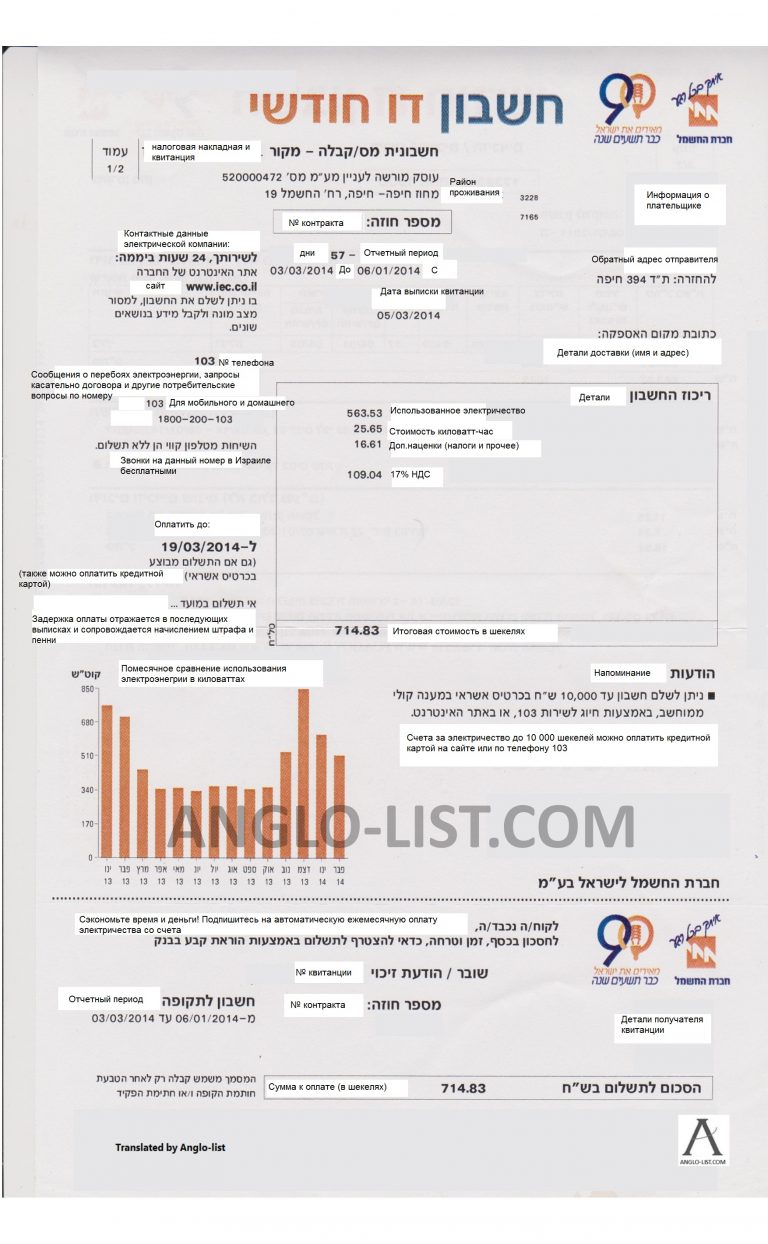
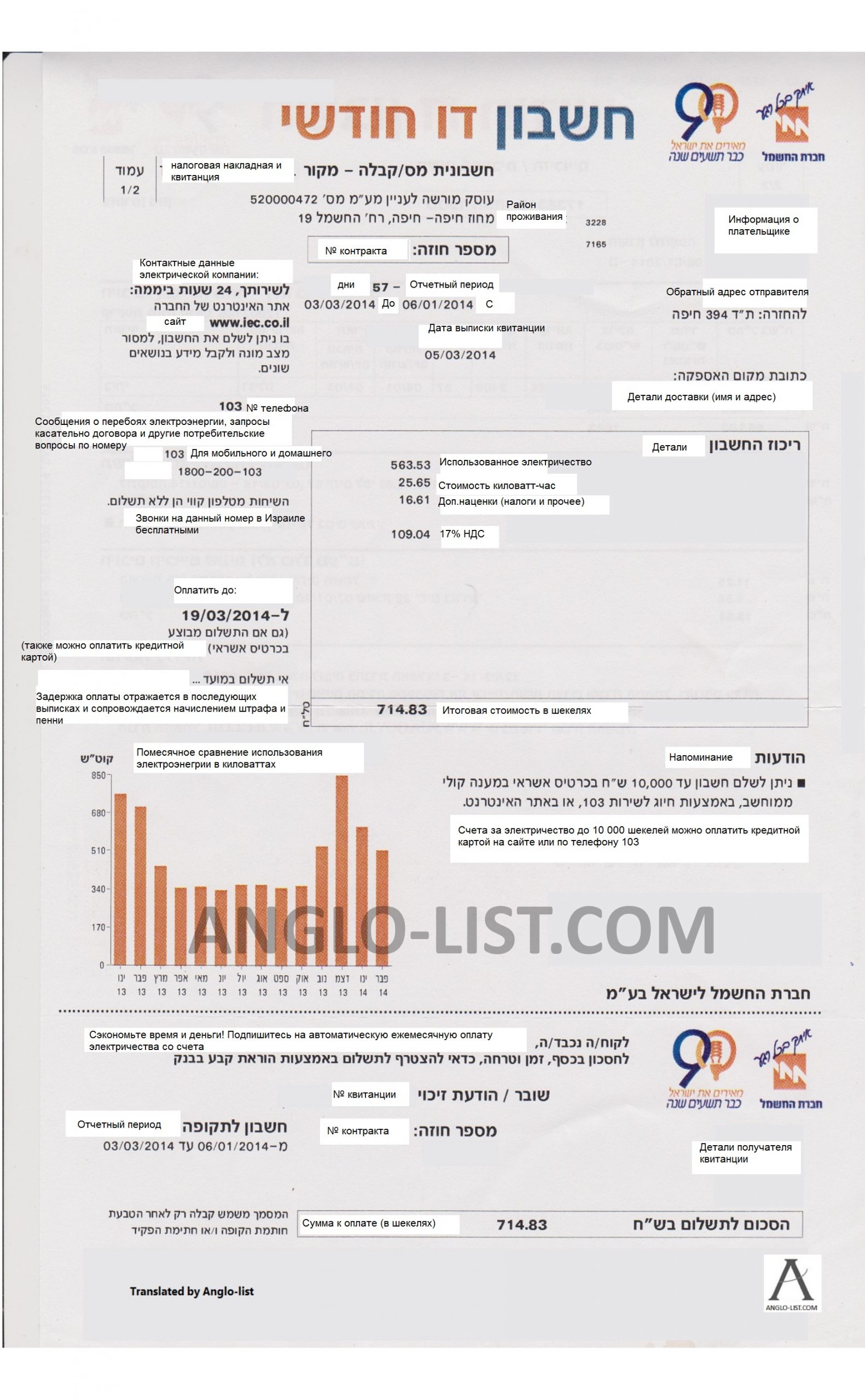
חברת חשמל – חשבון דו חודשי מעברית לרוסית

0

Reading Time: < 1 minute

חברת חשמל – חשבון דו חודשי מעברית לרוסית

Перевод иврита на русский перевод счета за электроэнергию

electricity bill with watermark russian


{module [495]}


Pesach Communal Seders 2018

0

Reading Time: 2 minutes

Communal Seders in Israel

Pesach 2018 – Nissan 15, 5778

seder

No need to be alone this Pesach! A list of communal seders around the country. 

This list is being updated all the time.  If you know of a communal seder in your area, please share details with us.

Keep Olim in Israel

No Oleh Left Alone for Seder Night

Chabad in Baka

Community Seder with Chabad of Baka. Join Chabad of Baka for a Five Star Community Passover Seder! Gourmet Three-Course Meal, Savory Wines, & Shmurah Matzot. Experience a meaningful seder with the warmth of community. A Project of The Jerusalem Municipality

Address: Pninat Haosher Hall, 2 Poalei Tzedeck St. (behind AACI)
**Registration is necessary at www.chabadofbaka.com/ 054-830-5799**

Yiboneh

The Yiboneh Community Pesach Seder with Rabbi Aaron Dovid Poston in Bakaa ​(next to the German Colony/Talpiot), Jerusalem

Friday night March 30, 2018 8:00 pm

Nitzanim Shul (ground floor) Asher Street 3 Baka, Jerusalem

REGISTRATION REQUIRED

https://www.yiboneh.com/pesach-seder-2018.html

Freed for Lone Soldiers

Student discounts available

Chabad in Tel Aviv

An interactive & inspiring Seder.  Chabbad is offering a three-course, catered dinner where you can meet and interact with people from all over the world. Details:
Friday night, March 30 Services will be held at 18 Bar Kochba at 6:50pm and the Seder will be at 86 Ben Yehuda at 8:00pm
Tickets: Community Members/ Tel Aviv Residents Adult – 160 NIS Child – 80 NIS Visitors/Tourists Adult – 360 NIS Child – 200 NIS
Lone Soldier Tickets: FREE RSVP at ChabadontheCoast.com/Events
Address: 86 Ben Yehuda, Tel Aviv
  1. The White City Seder (do you know why Tel Aviv is fondly known as the White City?)
  2. White City Young Jews
  3. ITV young professionals Seder

Communal Seder in Haifa

To be announced

Chabad Seders

To find a Chabad Seder in your area just Google ‘Chabad seder ‘location’ and you’ll get what you are looking for

Parshat Hashavua Vayikra.

Reading Time: 6 minutes

Parshat HaShavua – VAYIKRA

Contributed by: Rabbi Nissim Mordechai Makor

parshat hashavua vayikra Rav Nissim Mordechai MakorThis week’s Torah reading, Vayikra, begins the third book of the Torah, Leviticus. Last week we completed the reading of the book of Exodus, which concluded with a description of the construction of the Tabernacle. This week’s portion provides a description of the various sacrifices offered by the priests in the newly constructed Sanctuary.

The basic concept which we must contemplate is inherent in the word for offering: korban. This word finds its root in the letters kuf, reish, and beis, which form the root word to draw near. At a simple level, this indicates that the animal is sanctified and brought close to God through the sacrifice produce. At a deeper level, the whole sequence of the sacrifice, in which the owner of the offering selects the animal, brings it to the Beis HaMikdash, confesses over it (if appropriate), watches as the Kohanim offer it on the altar, and then easts some parts of it, brings the owner closer to God. Indeed, this is the whole idea of an offering: it deepens the relationship between the owner and God; it brings them closer together.

Shabbat Candle Lighting Times for Shabbat Vayikra

Just as the achievement of closeness between man and God is the force behind all offerings, so too, opposite forces exist in the world which try to pull apart this special bond. These are known as “the Four Kingdoms.” Each of the four nations, the kingdoms of Babylon, Media, Greece, and Edom, who at various stages in Jewish history have oppressed klal Yisrael, represent in one way or another an attempt to destroy the relationship between us and God. The function of Klal Yisrael is to be a vehicle for the Divine Presence in the world through their observance of Torah and Mitzvos. The primary opposing nations of the world [the above mentioned four] attempted, in different ways, to frustrate this holy aim. Each nation tried to prevent klal Yisrael from performing the mitzvos.

The Shem MiShmuel writes that klal Yisrael are essentially the agents of God and that the primary nations oppose this, is fundamental to our worldview. In fact, according to Kabbalistic, the four letters of the name of God, yod, hei, vav, and hei, are opposed by the four nations. This clearly expresses the idea that the nations’ resistance to klal Yisrael is really opposition to God. The four greatest specimens of humanity, the Avos [Avraham, Yitzchak and Yaakov) and David haMelech are also said to be the antithesis of these wicked nations.

We can understand this a little more deeply by examining one further correspondence. There are three cardinal sins, murder, sexual Immorality, and idolatry, which one must never transgress, even on pain of death. Lashon hara (evil talk about others) is considered, in some ways, worse than all of these.

Each of the four nations “specialized” in one of these four cardinal sins and was the root and primary source of it in this world. In contradistinction, Klal Yisrael is built upon great people whose very nature It was to oppose and overcome these cardinal transgressions. Avraham excelled at overcoming sexual immorality. When he approached Egypt (the most sexually immoral nation of the ancient world) he said to his wife Sarah.

Avraham was so holy in these matters that until it was essential for external reasons he didn’t realize that his own wife was beautiful. We see that Yitzchak excelled at overcoming idolatry by the fact that he was prepared to sacrifice himself for God. This represents sacrifice for God’s will rather than to the alternative idolatry. Yaakov overcame the evil of murder. We see this from the fact that he was exceptionally careful with his own procreative activities. Failure in this is considered by the great Rabbi’s to be akin to murder. Finally, David Ha Melech excelled at correct use of his power of speech, for he is best known as the composer of Tehillim [Psalms], the most comprehensive and beautiful set of praises to God.

Shabbat Candle Lighting Times for Shabbat Vayikra

Parsha Index

In fact, David was the last stage in the process of rectification begun with Avraham, had everything continued according to plan, the final stage of history would have been reached, in which man and God would live in perfect harmony, the barriers erected by sin finally removed. In fact, Chazal tell us:

Had David not listened to lashon hara, the kingdom of the House of David would not have been divided, and had Yisrael not committed idolatry, we would not have been exiled from our land. [Shabbos 56b].

Although David’s sin was very slight, in order to effect a total rectification, he needed to be absolutely perfect and utterly devoid of lashon hara. Alas, he was not and so the quest for perfection continues to this day.

When a person mediates on what is done to the sacrifice, his heart becomes contrite. He says, “I am the one who deserved all these punishments, but in His great compassion God had mercy on me and did not want to kill me. This animal is coming in my place.”

The person bringing the sacrifice will then regret all that he has done and change his ways.

The Me’am Lo’ez teaches us that the majority of things that people do involves three faculties; THOUGHT, SPEECH AND DEED.

When a person wants to do something, he first thinks about it in his mind. Then he expresses his thought in speech. Only then does he actually do it. Therefore, when a person brings a sacrifice he must do the 3 things that he did when he sinned.

First he must do a deed: press his hands on the animal’s head. This parallels his action.

Then he must recite the confession (viduy). He must confess before G-d the sin that he has done.  This parallels the speech involved in his sin.  This parallels the speech involved in his sin.

The portions of the animal that are burned are those which involve thought and emotion, the inner organs and kidneys. This parallels the thought that he had when he committed the sin.

This is one reason for the sacrifices. They are designed to make a person’s heart contrite, to arouse him to repent.

The second explanation that some give is that G-d commanded us to bring the sacrifices so that the Cohen-priests would have a livelihood. The priests therefore needed some income so that they could live with their minds to serve God. The sacrifices were thus like giving hidden charity to the priests.

Furthermore, there is judgement when one brings a sacrifice. As a result of the sacrifice a person’s heart becomes contrite and he repents. This is what is desired by G-d, not the sacrifice itself.

The third reason that some cite is that the sacrifice is like a fine imposed against a sinner, causing him to spend money. If he has a monetary loss because of his sin, he will not do it again. He will realize that the sin has been very expensive for him.

The fourth reason given by some authorities is that a person should meditate and have his heart aroused. When the animal is brought as a sacrifice, the person sees that it is slaughtered and burned and reduced to ashes. When he contemplates this, he realizes that this is the final end of man. When a person meditates on this, he will not follow worldly enjoyments.  He will realize that it is all vanity.  A person brings nothing to the next world the observances of commandments and good deeds and the charity that he does in this world. When a person meditates on the day of death, his heart becomes contrite. His dedication to Judaism is then renewed. This is why the Torah mandates that 3 parts of an animal be burned. The fat, the kidneys and the lobe [or diaphragm] of the liver. The following 3 things that cause a person to sin. 1) The fat causes a person to sin.  2) The kidneys are responsible for advice and emotion. These emotions bring a person to sin. 3) The liver makes a person lose his temper, it makes him feel important and proud. This causes him to be drawn after worldly desires and not be destroyed by them. These 3 particular parts of the body are burned on the alter to teach that a person must remove all bad traits and worldly desires and not be destroyed by them. What God really desires as a sacrifice is that a person’s heart should become contrite when he sees how the sacrifice ends up. He must realize that his end will be the same as that of the sacrifice. When a person contemplates this he will be sure to repent.

The fifth reason given by some authorities is that God commanded us to bring sacrifices to wean the Israelites away from idolatry. God complains to the Israelites who worship idols, “I commanded your fathers to bring sacrifices not because I receive any benefit from them, rather, I commanded them to bring sacrifices to keep you away from idolatry. I did not want you to think there is any substance to these pagan gods. You would then worship Me and listen to My voice and allow Me to be your God. The only reason for sacrifice is to keep you from idolatry.”

Shabbat Shalom

Yeshiva Pirchei Shoshanim

Parshat Hashavua Pikudei

Reading Time: 5 minutes

Weekly Torah Portion -Parshat Hashavua PIKUDEI

By: Rabbi Nissim Mordechai Makor

parshat hashavua pikudei Rav Nissim Mordechai Makor

Pikudei in a nutshell: This week’s portion, Pikudei, describes the manufacture of the vestments of the priests and high priests — which were already described in the portion of Tetzaveh, where G‑d instructs Moses how these garments are to be assembled. The Tabernacle is erected, and G‑d’s presence dwells therein

The purpose of the Mishkan was intended to be a location where the Divine Presence rested and was more palpable than in any other place in the world. The very name Mishkan means “dwelling place,”, and indeed, in introducing the concept of the Mishkan, the Torah proclaims: In Shemos 25:8. The Shem Mishmuel teaches us that every aspect of the Mishkan contributed to this aim, the building itself and each vessel within it needed to be designed to receive and transmit the Divine Presence. This is not dissimilar to the relationship between the body and soul within each person. The body is a vehicle for the soul’s existence in this world; so too, were the details of the Mishkan the means by which God’s Presence could be perceived on earth.

The right of the Jewish Nation to benefit from this wonderful Mishkan was a great gift from God. For after the sine of the eigel [the golden calf], they were in a spiritually bereft state and hardly suited to such a tremendous manifestation of the Divine. However, God granted them the Mishkan, enabling them to perceive Him even while they were in a spiritually inferior situation. At this stage they had been spiritually animated enough to realize that they were dissatisfied with the mere hope that God would rest among them. Instead, they knew that their task in life to be, like the vessels in the Mishkan, vehicles for the Divine.

This was symbolized by the order of construction that we have mentioned. For the lower coverings were spread before the beams were put underneath to support them. This represents the people who, after the sin of the eigel, were given a Mishkan before they were really able to support the spiritual level it represented. Only after the curtains had been spread could the beams be put underneath. So, too, after the spiritual life provided by the construction of the Mishkan the people could support the level they had been granted by God.

The Likutey Halachat teaches us that the Mishkan [tabernacle] shares the same root as Shakhein [neighbor].  For the purpose of the Tabernacle, like the Temple that succeeded it, was to draw people together to serve Hashem.

The verse 38:21 tells us that the Mishkan is mentioned twice, because whether it is erected or destroyed, it always remains with us.  The Tabernacle was dismantled every time the Israelites journeyed and rebuilt every time they encamped to reach us that it accompanies us always. The Jews were able to travel through the desert a place of serpents, poisonous snakes and scorpions, a place devoid of faith and serenity, a place filled remained with them. [Likutei Halachot].

Rashi, adds that the repetition of the word Mishkan [Tabernacle] alludes to the two Temples that were eventually destroyed. Mishkan connotes haMShakah (drawing close to Hashem). The Tabernacle radiated Godliness in the desert. The Temples illuminated holiness to the Diaspora. Nowadays, sanctity is drawn wherever people gather in synagogues. By building the Tabernacle in the desert, Moshe prepared for the eventuality that the Jews could invoke Godliness even in a place devoid of Godliness and be able to sanctify a synagogue.

The Talmud in Shabbos 73a tells us that thirty-Nine Acts of Labor were involved in building the Tabernacle. Whenever a person works for the sake of God, even if he is engaged in mundane tasks, his actions are considered to be analogous to building the Mishkan. Such activity is beneficial for everyone, because it draws down the “dew of blessing”, i.e. tal, has the numerical value of 39.

Conversely, if a person works solely for material benefit, his 39 acts correspond to the 39 lashes meted out by a Jewish court for certain offenses [Devorim 25:3] and to the 39 curses that Adam, Eve and the SNAKE incurred after Adam ate from the Tree of Knowledge. Therefore, the word Mishkan is mentioned twice in this verse, once representing the 39 acts when they are properly carried out and lead to blessing and the building of the Tabernacle, and once representing the Thirty-Nine acts where they are improperly carried out and lead to suffering and the destruction of the Mishkan. Likutei Moharan

The Ohr HaChaim teaches us that Moshe’s ability to erect the Tabernacle was not due to supernatural help but that his intellectual powers were equal to the challenge to put together and erect the Tabernacle. The Torah therefore adds in the next verse that Betzalel son of Uri made everything G’d had commanded Moshe to do. Our sages deduce from this verse that Betzalel even carried out details which Moshe had not told him about and that Moshe subsequently expressed his approval.

The Torah goes on to say that Betzalel’s assistant Oholiov also contributed to his knowledge, our sages in the above quoted Midrash Shemos Rabbah 52 stated that even all the combined wisdom of these two architects of the projects did not suffice to enable them to erect the Tabernacle. There really had been no need to tell us once more of Betzalel’s contribution to the project.

If the Torah nonetheless mentioned it again it may have been to exclude the assumption by the reader that in the end the Tabernacle was erected without supernatural assistance, Ice. to remind us that Moshe had a divine assist. Once the erection of the Tabernacle by Moshe is accepted as demonstrating divine assistance, his accounting may certainly be considered as approved by G-d.

R’ Moshe Feinstein zt’l comes to teach us some profound lessons that can be applied to every aspect of our lives at every moment of our existence. Just as the artisans had to account for their use of every ounce of material that was donated for the construction of the Mishkan and its furnishings, so also we must be able to give an accounting for all the bounty with which Hashem has blessed us with.

Candle Lighting Times for Shabbat Pikudei

Parsha Index

This includes our time. Do we devote the days and years Hashem allots us to Torah and mitzvos or do we, Heaven forbid, squander them on frivolities.  This also pertains to our money and possessions. Not only will we asked whether we used them for tzedakah and other aspects of helping people, we will also be asked if we were careful to use them wisely and productively for these purposes.

We should not think that the resources Hashem gives us are ours to use as we desire. On the contrary, the Torah, gives detailed rules governing the use of property. To give but one example, it is forbidden to destroy even one penny unnecessarily. Moreover, when the institution of Yovel [Jubilee year] is in force, there are laws regulating the transfer of property, although a buyer and seller may both wish to do so, it is impossible to sell an inherited field in perpetuity, since the Torah states [Vayikra 25:23], for the land is Mine. Similarly, each of us will be called to account as to whether he has utilized all the abilities and talents Hashem granted him to fulfill Hashem’s will through Torah and mitzvos.

Shabbat Shalom

Yeshiva Pirchei Shoshanim

Jerusalem Marathon Traffic Updates

Reading Time: 2 minutes

2018 Jerusalem Marathon Traffic Updates

Special transportation and traffic arrangements on the Marathon Day 9.3.18.

Traffic arrangements

Starting on Thursday, the 18th of Adar, 16.3.17, from 23:00 until the end of the event on Friday, the 19th of Adar, 17.3.2017, Ben Zvi Avenue will be closed to vehicular traffic.

On the day of the marathon, the following streets will be closed to vehicular traffic from 05:30: Rupin Avenue, Hebrew University Campus, Netanel Lorch, Rabin Avenue, Haim Hazaz Avenue, Tchernichovsky, HaPalmach, HaNasi, Keren HaYesod, King George, Yafo Street, Tzahal Square, HaTzanhanim, Haim Bar Lev Avenue, George Adam Smith, Lehi, Martin Buber, Binyamin Mazar, Churchill, Kariv, Sha’ar Yafo, The Armenian Patriarchate, Sha’ar Zion, Hativat Yerushalayim, King David, Jabotinsky, Chopin, Dubnov, Gretz, Emek Refa’im, Derech HaRakevet, Derech Beit Lehem, David Remez, Derech Hebron, Yanovsky, Yehuda, Pierre Koenig, El’azar HaModa’i, Kovshei Katamon, Yehoshua Yavin, Sacher Park.

Traffic disruptions are also expected on the streets tangential to the routes of the race.

Parking arrangements

Vehicles parking along the marathon routes will not be permitted to leave until the event has ended and the routes have been opened. Parking on either side of Yehuda Street will be prohibited starting on Thursday, the 18th of Adar, 16.3.17, from 20:00 until the next day, when the marathon ends. The HaLeom Parking Lots, the museums and the Government Complex will serve only participants in the race.

Light rail

The light rail will operate on two routes: Route 1 – from Hel Ha’Avir to Giv’at HaTahmoshet.
Route 2 – from Central Station to Mount Herzl.
For information: CityPass Information – *3686.

Public transportation

Giv’at HaTahmoshet Station and Central Station will be connected by public transportation lines: 66, 66A, 45, 25, which will pass through the city center and Mahane Yehuda Market.
There will be changes to some of the public transportation lines. For information: Egged Information – *2800.

Educational institutions

Schools and education system institutions will (as much as possible) operate normally.
Information regarding the school day at every educational institution will be provided to parents and students by school managements and kindergarten teachers.
Parents and students are advised to keep track of publications regarding changes to traffic arrangements and directions to alternative routes.

Shuttles

Shuttles (free of charge, round trip) will depart from the Mount Herzl Plaza, the Sha’arei Tzedek Hospital parking lots and the Eastern Gallery Plaza of Teddy Stadium to the Israel Museum Plaza between the hours 05:30 – 13:30.

Buses

Egged route 5a or Kavim route 13 from Ben-Gurion Airport to El-Al Junction
Egged route 947 from El-Al Junction to the central bus station in Jerusalem

Train

All information about train schedules and routes can be found on the Israel Railways website.  

Open main routes

North – Uzi Narkis Avenue, Road 9, Golda Meir Avenue, Eshkol Avenue
Center – City Entrance, Herzl Avenue, Begin Avenue South/North, Bar Ilan/Yirmiyahu route
South – Dov Yosef Road, Golomb Route, Ein Kerem Route
Information at the municipal call center – 106, on the website:
www.jerusalem-marathon.co.il and on the Jerusalem Municipality app.


Information courtesy of the Jerusalem Marathon Website

Marathon map…

Jerusalem Marathon athletes can run for a special cause…


Public transport resources


{module [397]}

Pesach Cleaning Checklist

0

Reading Time: < 1 minute

Pesach cleaning downloadable checklist.

A few days left to get the house Chametz free.

The Pesach countdown has begun. We are in’ frenzy’ mode preparing for family and friends who might be joining us for Seder night.

Downloadable Pesach spring cleaning checklist

Cleaning never ends, and it goes beyond the festival, but we’ve got just days now to get the house chametz free. I always try to remember which nooks and crannies I should clean, but I only sometimes do. Here is a list of all the areas in a typical household you could check, clean, and scrub. Remember, kitchen and dining areas are most important for Pesach, but you cou do a thorough spring clean while you are at it. 

You can download the printable version of our checklist that incorporates Pesach and general spring cleaning. Pesach cleaning can be backbreaking, so follow these tips to keep your back healthy and strong.

Once you’ve finished your cleaning, you can get cracking with the shopping – we’ve also put together a downloadable and handy Pesach shopping list.

Download our useful Pesach lists

1.  A handy Pesach cleaning checklist

download button

2. The ultimate master Pesach shopping list