19.3 C
Jerusalem
Tuesday, June 9, 2026
Sample Page
Home Blog Page 108

Tips for Coping During Terrifying Times

0
Reading Time: 3 minutes

Coping During Terrifying Times

Skills we can use to stay calm and grounded

By Sara Jacobovici

There is a difference between living IN terror and living WITH terror. Neither is a choice we make but one takes control away from us and the other allows us to regain some control.

The current wave of terror that is sweeping our nation is leaving fear, doubt, despair, anger, and frustration, in its wake. As we are trying to deal with it, the impact on body and mind is strong.

We’re being asked to cope and adapt. What does that mean and how do we do it?

Cope is defined as:

1. to struggle or deal, especially on fairly even terms or with some degree of success

2. to face and deal with responsibilities, problems, or difficulties, especially successfully or in a calm or adequate manner

Sounds great but how do we put it into practice?

Coping skills are things we’ve developed over time; some work for us and some work against us. First thing to ask ourselves is; are these coping strategies helpful or just familiar? Don’t hesitate to ask others for help to cope with what is happening now.

Staying calm is a way of regaining control. How to find that sense of calm means understanding that it is a sense, sensory based, and influenced by our senses. It’s difficult to stay calm when we are vigilant; looking around us for anything threatening, hearing sounds that may signal a danger and so on. The way to calm our senses is to give those senses as many short breaks as possible.

When things feel out of control internally, focus externally by using your senses. Find a safe spot and look around you, identify all you see as familiar and comforting. Listen to some favorite music or just enjoy some quiet time in silence. Enjoy the smell of a favorite food cooking or baking, a lighted scented candle or incense, buy some fresh cut flowers and place them in your favorite spot. Work with your hands and touch the materials you’re using; cooking/baking, working with plants, using art materials or being involved in a project like building something. Enjoy the taste of your favorite food; spicy, sweet.

Remember to breathe. Stop often during the day to just take in a couple of deep breaths; in through the nose, hold for a couple of seconds and slow release through the mouth.

We are not in the norm and so we have to redefine it and create a new one. It’s called adaptation.

It is a chicken and egg situation; in order to adapt, one has to cope, in order to cope one needs to adapt. Where do we find the strength and wherewithal to do what is needed?

The two pillars of adapting to our current crisis are:

1. Making necessary changes to our routine while maintaining as much of it as possible.

Routine is a crucial structure in which we can continue to function. Common safety strategies prevail but activities, although modified, need to happen. 

2. Finding outlets for the strong feelings that are raging inside of us.

Don’t stop having meeting with friends and having coffee together.

Don’t stop doing the things that give you pleasure and make you laugh.

Give your thoughts and feelings a creative outlet. Write; in a personal journal, blogs, letters to the editor.

Form or join support groups in your neighborhood or community.

You’re not in this alone. If you are experiencing any anxiety about physical symptoms, make an appointment with your family doctor and check it out. For the emotional tension, seek professional counselling support, either individual or group.

What all this means is you need to stay proactive. Keep doing, keep thinking, keep feeling, but most of all KEEP GROUNDED.

Words of Inspiration – Andi Shenker Saitowitz

Reading Time: 3 minutes

Words of Inspiration

By Andi Shenker Saitowitz

andi saitowitz

Originally from South Africa, Andi is is a Life Coach and Motivational Speaker.  She lives with her gorgeous family in Raanana and can be reached via her website at http://www.andisaitowitz.com

Yesterday I felt scared and helpless, so I prayed. Because I can.

Today I volunteered to be the crossing patrol parent at the school so the 6th grade kids do not have to be outside alone. Because I can.

My husband took time off work to do additional police duty and guard the streets and schools with his team. Because he can.

At the site of the recent brutal terror attacks across our homeland, beautiful children, men and women danced and sang and prayed all wrapped together in Israeli flags with massive stars on their backs pouring their hearts out for better more peaceful days. Because they can.

The Israeli government and leaders met all day yesterday to implement new security policies and procedures. Because it can.

Every time I see my blue and white flag, a lump forms in my throat. Because it can. Because I am home.

There is something about that star…

Whether it’s sadly folded at half-mast in the depth of sorrow or proudly blowing in all its fullness, glory and wonder on a windy day. There is something about that star…

Whether I see it on a uniform, on a sports team, on a soldier or on a badge – it is worn with pride and integrity. It symbolizes a strength of a nation, tiny in size, mighty in heart and spirit. Small in kilometers, epically massive in ability, potential and possibility. There is something about that star…

Whether I see it on the tail of a plane where the sky is the limit or being paraded by a group of brave climbers who have conquered a mountain or youth from around the globe in March of the Living: the feeling of accomplishment and reassurance, significance and purpose, the comfort of safety and protection. The star of faith and survival against all odds. There is something about that star…

Whether I see it on a piece of machinery, a website or a tiny new piece of technology. It means therein lies innovation and creativity. A blend of brilliant minds, attitude and unprecedented opportunities. There is something about that star…

Whether it joins the space quest, the Olympic Games, or the first to run and save a life in another place miles away.
Because that star knows hope.
That star knows suffering.
That star knows war.
That star knows humanity.
That star knows the value of life. All too well.

There is something about that star that sometimes shines clearly in broad daylight because it can, and then sometimes only shines bright when it’s dark enough outside to truly be taken by its beauty and magnificent light. And sometimes only in the pitch of night, we get to see it illuminate the universe.

Be it in times of natural disaster or saving refugees, in times of war and conflict surrounded by imminent threat and in times of unity when that single lone star is sometimes the only thing we have in common.

There is something about that star that brings a sense of safety despite danger, hope despite despair, life despite death, help despite devastating loss.

There is something about that star that embraces the paradox of me and you, us and them, all of us. Mankind.

There is something about that star whether it’s slowly drawn by a little child learning to color, or whether it is warn by a group of youth dancing their hearts out at the site of a terror attack, praying to Hashem for better times, never losing faith.

There is something about that one single blue star that rests on a pure white bed, guarded and protected from above and below by stripes of Hashem’s greatest miracles and difficult messages we will most likely never fully understand or comprehend.

I can’t quite explain it. But there is something peacefully reassuring about that star that sometimes loudly roars and sometimes quietly whispers the very same message: “I have your back. It will somehow be ok. You’re not alone. You’re home”.

A friends told me yesterday that the letters of דקר and רקד are the same.

Under our star – we will live.
We will dance.
We will pray.
We will defend.
We will have faith.
We will remain strong.
We will unite.

Until we are all dancing home.

Because we must.

Because we can.

עם ישראל חי

How do I call Israel’s emergency services?

Reading Time: 4 minutes

Calling Israel’s emergency services is not that hard if you know what to say.  Here’s how…

Information you will need to provide the emergency services with – Hebrew, English and transliterations.

 WHATS YOUR EMERGENCY3

How do I contact the emergency services with my limited Hebrew skills? Hopefully you will not have to call the local Israeli Emergency Services any time soon but if you do, it is important to make sure you have the right information on hand to pass onto the operator or dispatcher on duty. To help you through what could be a traumatic experience, we have put together key information, questions and answers you might be asked to provide.

Emergency service hotlines – contact numbers

POLICE

Mishtara משטרה

AMBULANCE

Ambulans אמבולנס

FIRE

Mechabay Eish מכבי אש

100 101 102
 

HOME FRONT COMMAND

פיקוד העורף Pikud HaOref

 
  104  

Chances are when you make the call to the emergency services, you will be nervous and stressed. You could be short of breath, crying or in a state of shock or panic that might impede your speech and communication skills. Now you can practice the conversation with our guide below.

Have this information when you call the emergency services

  1. Your location and the precise location of the emergency (these could be different). If you do not know the exact address of the incident take note of any landmarks in the area.
  2. The type of emergency
  3. A concise description of the emergency. What happened? What do you know? Who was involved?
  4. Your telephone number – the operator may need to call you back for more information
  5. Your name and address

The conversation in English, Hebrew with transliterations

The conversation with the dispatcher might go like this


Hello, I want to report an emergency situation / terrorist attack / an accident / crime

Shalom, ani rotzeh/rotzah le daveyach al irua / pigua / teunat drachim / irua plili

שלום , אני רוצה לדווח על אירוע / פיגוע / תאונת דרכים / אירוע פלילי


There has been a stabbing / kidnapping / explosion / burglary / attack / flood

Haya po irua dekira / hatifa / pitzutz / pritza / tkifa / hatzafa

היה פה אירוע דקירה / חטיפה / פיצוץ / פריצה / תקיפה / הצפה


In Jerusalem / Haifa / Tel Aviv on Jabotinsky Street, at the bus stop opposite the main Post Office / at the beach / downtown

B’Yerushalayim / Haifa / Tel Aviv b’rechov Jabotinsky al yad tachanat ha’otobus mul ha’doar / b’hof hayam / b’ir hatachtit

בירושלים / חיפה / תל אביב ברחוב ז’בוטינסקי על יד תחנת האוטובוס מול הדואר / בחוף הים / בעיר התחתית


One person is badly wounded and others are lightly injured / people are in shock

Yeish po ish echad patzua kasheh ve kama p’tzuim kal / yeish po anashim b’helem

יש פה איש אחד פצוע קשה וכמה פצועים קל / יש פה אנשים בהלם


There has been an explosion and a car/house is on fire

Haya pitzutz ve’oto/bayit alah b’esh

היה פיצוץ ואוטו/בית עלה באש


There is a person with a knife / gun / weapon running through the street

Yeish po ish/isha im sakin / ekdach / neshek sh’ratz b’rechov

יש פה איש/ה עם סכין / אקדח / נשק שרץ ברחוב


We are trapped in our car / apartment and the water is rising

Anachnu lekudim b’oto shelanu / b’dira shelanu v’hamayim olim

אנחנו לקודים באוטו שלנו / בדירה שלנו והמים עולים


My name is _______ my telephone number is ______ my address_______ my identity number is______

Korim li ________ hamispar telefon sheli __________ ha’ktovet sheli _________ mispar teudat zehut________

קוראים לי________ המספר טלפון שלי _________ כתובת _______________ מספר תעודת זהות________


Listen carefully to the dispatcher’s questions and instructions

These are some questions you may be asked:


Where are you located?

Ayfo ata nimtza

איפה אתה נמצא


What is the location/address of the incident?

Ayfo ze kara / mikum ha’irua

איפה זה קרה / מיקום האירוע


What happened exactly?

Ma bidiyuk kara

מה בדיוק קרה


Who was involved in the incident?

Mi haya m’urav b’irua

מי היה מעורב באירוע


Is anyone injured?

Ha’im yeish p’tzuim

האם יש פצועים


What can you let us about the condition of the victims?

Ma ata yachol lesaper al matzav ha p’tzuim

מה אתה יכול לספר על מצב הפצועים


Can you describe the perpetrator – terrorist / thief?

Ha’im tuchal la tet li ti’ur al ha mechabel / ganav

האם תוכל לתת לי תיאור על המחבל / גנב


Can you describe the vehicle?

Ha’im tuchal le’ta’er eich nirah ha rechev

האם תוכל לתאר איך נראה הרכב


Please stay on the line

Tish’aer al hakav bevakashah

תישאר על הקו בבקשה


Thank you, you can hang-up the phone now

Todah, ata yachol le’natek et ha’sicha

תודה אתה יכול לנתק את השיחה


Your friends found this security and safety information useful


First Aid for Stab Wounds

Reading Time: 6 minutes

First Aid & Attending to a Stab Wound.

Ari Fuld z”l, this article dedicated to his memory.  Murdered on September 16th, 2018 he was a devoted husband, father, activist, Assistant Director at Standing Together and a member of Israel’s Anglo immigrant community.

Painful, gory, and potentially deadly, a stab wound requires immediate treatment to alleviate the bleeding and pain and stabilize the victim until he can be examined by medical professionals. Attending to a stab wound requires quick action and a level head in order to effectively provide the first aid needed to control the bleeding and save the victim’s life.

1. Survey the area

A stabbing often occurs within a volatile incident and the assailant(s) may still be in the vicinity, which could be dangerous for you and the stabbing victim. Avoid making yourself a potential victim by intervening with or going near the assailants. Only approach the victim once you have determined it is safe for you to do so.

  • Although waiting until the assailants have left the scene does entail lost precious time for the stabbing victim, having more people injured is hardly conducive to rescuing anybody.

2. Call for emergency help immediately

  • If the person is bleeding out a lot, get someone else to call emergency services while you help the victim.
  • If you are the only person around, use your phone to call for assistance. If you don’t have a phone with you, try to find a passersby or a nearby shop.

Calling Israel’s emergency services with step-by-step instructions in Hebrew, English and with transliterations

3. Lay the person down

  • Before you do anything else to attend to the stab wound, get the person to lie down on the ground. This will make it easier to help stabilize the victim, particularly if he starts to get dizzy or fall unconscious. You don’t want the person to risk aggravating the injury if he falls while fainting.
  • For comfort, place a jacket or backpack under the victim’s head. Alternatively, if there are other people around, ask one of them to sit with the person’s head in her lap and talk to him. This will be soothing to the victim and help him keep calm.

4. Inspect the person and determine the extent of the injury

  • Examine the person and try to determine the extent of his injuries. Is there more than one stab wound? Are there slashes? Where is the blood coming from?
  • You will probably have to part the person’s clothing to properly identify the wound(s). Try to look for all wounds before starting your treatment.
  • However, if you notice one obviously severe wound that needs urgent treatment, you should deal with this immediately. A severe wound would be one that is bleeding steadily and profusely or one that it spurting out blood like a geyser. Spurting blood is usually a sign that the wound has hit an artery.

Attending to the Stab Wound

1. Wear disposable gloves if you have them

Alternatively, you can also put some plastic bags over your hands. Though this step is not required in order to tend to the stab wound, it is important in order to reduce the risk of infection to yourself or the victim.

  • If available, nitrile or other non-latex gloves are preferable. These types of gloves minimize the possibility of an allergic reaction to latex, which can complicate treatment. Nitrile and other non-latex gloves are usually blue or purple and are rapidly replacing the white latex gloves that were previously the standard.
  • If you don’t have gloves with you, try to wash your hands or even use a hand sanitizer quickly. If you have nothing available to you, try to use layers of cloth to keep a barrier between yourself and the victim’s blood.
  • Remember, you do not have to touch the person if you believe that you are in danger of contracting an infection or are otherwise uncomfortable. Wait for emergency assistance if you are in doubt.If you choose to treat the victim, do your best to minimize contact with the victim’s blood.

2. Check the victim’s ABCs, Airway, Breathing and Circulation

  • Make sure the person’s airway remains unobstructed.
  • Listen for the sound of breathing and watch the person’s chest for movement.
  • Check the victim’s pulse to make sure the heart is still beating.
  • If the victim has stopped breathing, perform CPR.
  • If the person is conscious, begin working but also talk with him to keep him calm and help slow his heart rate. If possible, try to keep the victim’s eyes averted so he cannot see the wound.

3. Remove the victim’s clothing around the affected area

This will enable you identify the precise location of the stab wound and then apply treatment. Stab wounds can sometimes be obscured by both clothing and blood or other fluids and even dirt or mud, depending on where the victim is found.

  • Use care in removing the victim’s clothing since he is likely in considerable pain.

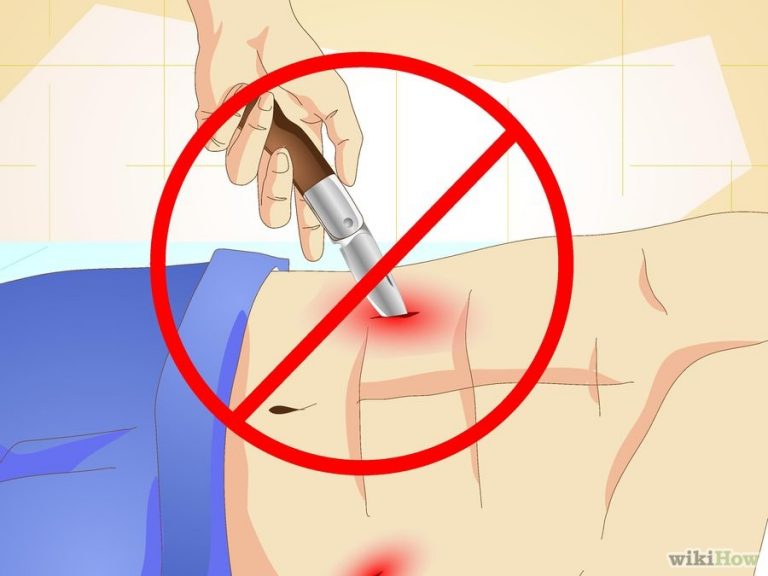
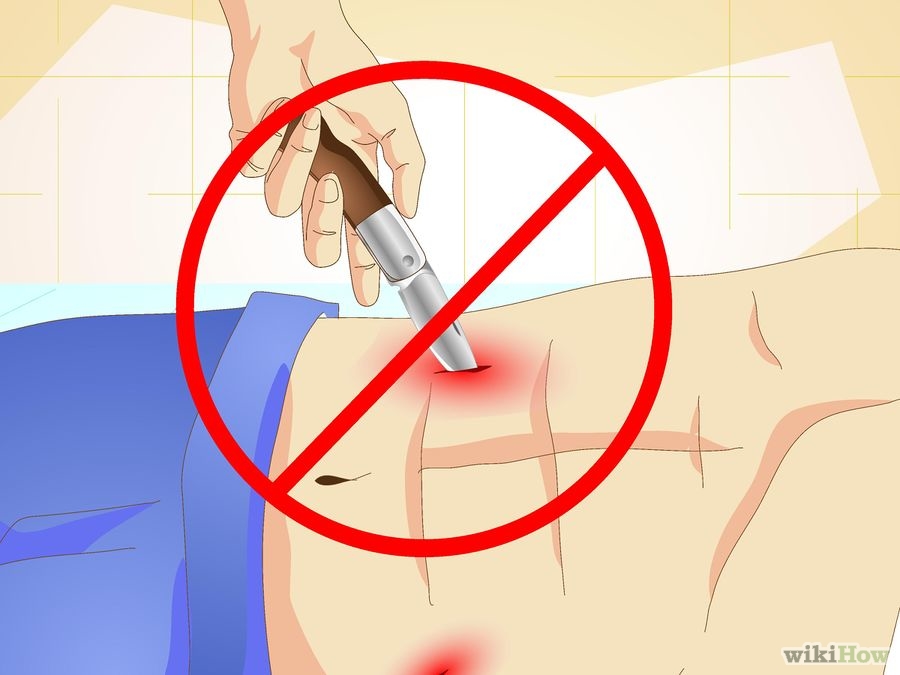
do not remove the knife

4. Do NOT remove the stabbing object if it is embedded

Leave the object in the wound if it is still there. The object is actually helping to stem the blood flow. Pulling it out will actually increase blood loss, while pushing it in may cause further injury to the internal organs. You’ll need to apply pressure and dress the wound around the object as best you can. Medical professionals will be better able to remove the object without damaging any internal organs or causing massive blood loss in the process

Stop the bleeding. Apply pressure on the wound with a clean and absorbent material (like a shirt or towel), or preferably, a clean dressing. If the object is still in the wound, press firmly around it. Applying pressure to the wound will help to slow the flow of blood.

  • Some first aid training suggests using the edge of a credit card to “seal” the wound, an item that’s handy because so many people have one on them. Not only does this stem blood flow, but it may also prevent lung collapse (by keeping air out of the wound) if the wound is in the chest.
  • If the wound is bleeding profusely, apply pressure to the major artery leading to the area with your hand, while your other hand continues to apply pressure on the wound. These areas are called “pressure points”. For example, to slow bleeding in the arm, press the inside of the arm just above the elbow or just below the armpit. If the wound is on the leg, press just behind the knee or in the groin

5. Re-position the victim so the wound is above the heart

This will help reduce blood loss. If the victim can sit, get him to move himself into an upright position; if not, then help the victim if possible.

6. Cover the dressing

If you happen to have first aid materials with you, fasten the dressing in place using a bandage or tape. Do not lift or remove the dressing as this will disrupt clot formation and re-start the bleeding. If the dressing becomes soaked with blood, add more cloth material on top of it.

  • If you don’t have any materials to fasten the dressing in place, simply continue to apply pressure. This will help the blood clot.
  • For a chest wound, be careful. Cover the wound with something like kitchen foil, a plastic bag or cling-film and only cover three sides of the wound and leave one un-taped or bandaged down. Air needs to be able to escape from one side of the bandage to prevent it from entering the pleural cavity in the chest. If air enters the pleural cavity, the lungs can collapse.
  • Never use a tourniquet except as the last resort to save a life. Know how and when to use a tourniquet. If a tourniquet is applied incorrectly, it may lead to an unnecessary serious injury to or loss of the affected limb.

7. Continue to apply pressure to the wound until help arrives

While waiting for emergency help, continue to monitor the ABCs: airway, breathing, and circulation.  Look for and treat symptoms of shock. Symptoms of shock include cool, clammy skin, paleness, rapid pulse or breathing, nausea or vomiting, dizziness or fainting, and increased anxiety or agitation. If you suspect the victim may be in shock, loosen any tight clothing and cover them with a blanket to warm him. Try to get the victim to stay still.

8. Check the victim’s consciousness

If the victim falls unconscious, you’ll need to act quickly. Place the victim in the recovery position, on his side with the head tilted back and the hand further away from the ground under the head and the arm closet to the ground either bent or straight out. The leg further away from the ground (the top leg) should be bent for stability and to keep the victim from rolling forward. Do not put someone in the recovery position if you suspect he has a spinal injury. Monitor the person’s breathing. If the unconscious victim stops breathing, perform CPR.

9. Keep the victim warm and comfortable

Both shock and loss of blood can cause the victim to suffer from lowered body temperature. Throw a blanket, coat, or some other warm item over the victim to keep him warm.  Keep the victim as still as possible. Whether lying or sitting down, the person should be kept still and calm. It is important that someone remains with the person constantly to both reassure him and to monitor his condition.

Article provided by wikiHow, a wiki that is building the world’s largest and highest quality how-to manual.

Wiki license https://creativecommons.org/licenses/by-nc-sa/3.0/

Israel’s Emergency Services

Police

100

Ambulance

101

Fire

102

Related articles

Consumer Info: Israel New VAT Rate from 1st October 2015

0

Reading Time: < 1 minute

Consumer Info: Israel New VAT Rate from 1st October 2015

By: Binyamin Radomsky, CPA,  binyamin@aboulafia.co.il

The decrease in the rate of VAT (from 18% to 17%) is coming into effect on 1 October 2015. Prices need to be updated at that time.

How does this affect a business’ reporting requirements?

With regards to expenses, ensure that you take the VAT as shown on the tax invoice (חשבונית מס) – there are some situations whereby a single invoice will have both the lower and higher rates of VAT charged. The most likely examples are your electric and telephone bills.

Onto income reporting

For those businesses reporting on a monthly basis, nothing really changes as your income for the month of October will all be charged at the lower rate….

Continue to full article…

Instructional video: Pay your Israel electricity bill online

Reading Time: 3 minutes

Step-by-step instructions for paying the Hevrat HaHashmal (Israel Electric Corporation) household electricity bill online.


Transcript

Welcome to another Anglo-List  video – Paying your Israel electricity bill online. 

We know how difficult it can be to navigate digital services like this, so we are delighted to be able to share our step-by-step English instructions with you.  Make sure you have your latest electricity bill on hand as well as your identity details, your teudat zehut and your credit card details.


We begin the process with a Google search using the keyword string ‘israel electric corporation’ and the first result is the web address: w w w dot  i e c dot co dot il – that’s the website you need and so just click on the link to enter the site

The website has two language options – Hebrew and English.  The English site, like other websites of this nature, only includes corporate information and all digital and other services are executed via the Hebrew site.

Make sure you are on the Hebrew home page to pay your bill and If not, click on the Hebrew language option on the top left-hand-corner of the English web page.

Once you are on the Hebrew home page, you will notice Live chat options are available and the chatbox can be found on the left-hand-side of the web page.  Hevrat Hahashmas’s Chatbox is only provided in Hebrew.

Hevrat Hahashmal offer a host of digital services which we will cover in a separate video.  In the meantime, there is an article with instructions on how to do this on the Anglo-List website and we’ll post a link for this and other useful links in the comment section.  The digital services menu is on the right-hand-side of the web page.

In the center of the web page, you will see three blue blocks and one orange block, each leading to a separate service.  You need to click on the middle blue block as illustrated here.

You will be taken to a new web page and now the first step in the payment process begins…


Into the first space provided you need to enter your 9-digit contract number as it appears on your last electricity bill.

Into the second space provided you need to enter the last 4 digits of the invoice number which can be found directly under the Hevrat Hashmal logo on your electricity bill.

Enter the information and then click on the orange ‘continue’ button


In Step 2 of the payment process, you will be providing your credit card details, your teudat zehut details  and your personal contact information.  The system automatically fills in the shekel amount due.

All fields marked with an asterisk are mandatory and must be filled in.

The field is the antispam, once you’ve filled that in, click  on the orange ‘continue’ button as  illustrated.


You will now move onto the receipt and confirmation section of your digital payment

Your Hevrat Hahashmal reference number, the credit card reference number and payment details are reflected on the receipt.  With that, you have completed the digital payment process. 


Remember, that when you provided your personal details, you filled in your email address.  You can now expect to receive an email confirmation directly to your mailbox from Hevrat Hahashmal as shown on this screen.


Just a point of interest…

New olim and those considering making Aliyah often ask us what their monthly budget for electricity should be.  Well as you can see, this particular bill was 350 shekels.  Bear in mind that electricity is paid in two-month cycles.  This bill reflects the summer consumption of a two-person household, using standard household appliances, some air conditioning and the daily use of a washing machine and dishwasher which are energy efficient.  In the winter months expect your electricity bill to be at least double.  Air conditioners and heaters running full time and dryers will add to the bill.  Also, if your apartment has a solar water system (a dud shemesh in Hebrew), you can expect to have hot water for at least 7-8 months of the year without having to switch over to the electric boiler or geyser.  That’s a huge saving in itself.

Your heating and cooling bills will also be dependent on your specific location in Israel and the climate in that area.  Heating and cooling costs in Jerusalem for example, will be different to those in Eilat.

We hope you’ve found this video useful and if you’ve enjoyed it, don’t forget to subscribe to our channel and give us a thumbs up.   If you have a comment or question, feel free to share it in the comments section below.  See you again soon.


You can also pay your electricity bill these ways


Your friends found these useful…


From 1-5 (worst to best), how useful was this information?

Shabbat Candle Lighting Times

0

Reading Time: 2 minutes

Candle lighting times and information for Shabbat and festivals

Welcome to our Shabbat and holiday candle-lighting section where you will find candle-lighting times, blessings, instructions, practices, traditions, greetings and expressions.

shabbat candles 6

Shabbat candle lighting times

Jerusalem, New York, Toronto, London, Johannesburg, Sydney, Paris, Tel Aviv…

This week’s Torah reading and Portion of the Law – KI TAVO

Shabbat Lighting Shabbat Ending
16.9.22 17.9.22
Jerusalem 6.04 7.19
Tel Aviv-Yaffo, Netanya, Raanana 6.24 7.21
Haifa & Modi’in 6.15 7.21
Beer Sheva 6.26 7.20
Eilat 6.14 7.19
International
New York City 6.45 7.42
Toronto 7.08 8.07
London 6.55 8.00
Johannesburg 5.54 6.36
Sydney 5.29 6.25
Paris 7.44 8.47

Candle lighting resources

Shabbat Greetings & Expressions

In Israel, on Thursday, you will already hear people wishing each other a ‘Shabbat Shalom’

Shabbat Shalom – שבת שלום – A peaceful Sabbath

When the Sabbath comes to an end on Saturday after sunset, it is customary to wish each other ‘Shavua Tov’

Shavua Tov – שבוע טוב – Have a good week

In loving memory of my mother Rachel bat Shimon z”l, an ‘Eshet Chayil’ in every sense of the word, who passed to her eternal rest on January 22nd, 2021 – Shevat 10, 5781

Hebrew-English: Yom Kippur

Reading Time: < 1 minute

Learn Hebrew fast with this free word sheet.

22 Hebrew, English & transliterated words and phrases for Yom Kippur – The Day of Atonement

Hearing the sound of the Shofar

English Transliteration Hebrew
General
Book of Life Sefer HaChayim ספר החיים
Charity Tzdakah צדקה
(10) Days of Awe Yamim noraim ימים נוראים
(10) Days of Repentance Aseret Yemei Tshuva עשרת ימי תשובה
Fast Tzom צום
High Priest Kohen Gadol כהן גדול
Prayer Tefilah תפילה
Pre-fast meal Seudat Mafseket סעודת מפסקת
Ram’s horn Shofar שופר
Repentance Tshuva תשובה
Sin Chet חטה
Holiday Greetings
A good signing/sealing Gmar Hatimah Tovah גמר חתימה טובה
An easy fast Tzom Kal צום קל
Next year in Jerusalem Beshana Haba’a B’Yerushalayim בשנה הבאה בירושלים
Yom Kippur Prayers
Prayers for repentance Kapparot כפרות
All vows Kol Nidrei כל נדרי
Evening service Maariv מעריב
Confessions Vidui ודוי
Morning service Shacharit שחרית
Memorial service Yizkor יזכר
Additional service Musaf מוסף
Afternoon service Mincha מנחה
Closing service Neilah נעילה

Your friends in the community read these too…

Hebrew-English: Rosh Hashanah

Reading Time: < 1 minute

hebrew word for apple

Learn Hebrew

Hebrew, English & transliterated words & phrases

Free Rosh Hashanah word sheet

More free, Hebrew, English and transliterated word sheets, by topic…

TransliterationHebrew
The last month of the year – Elul.  It is a time when we prepare ourselves spiritually and emotionally for the New YearElulאלול
The first month of the Hebrew calendar.  Rosh Hashanah, Yom Kippur and Sukkot are celebrated in the month of TishreiTishreiתשרי
Prayers for forgiveness recited during the month of Elul and on the Shabbat preceding Rosh HashanahSlichotסליחות
A ram’s horn is sounded during the month of Elul, on Rosh Hashanah, and at the end of Yom KippurShofarשופר
The 10 days of awe between Rosh Hashanah and Yom KippurYamim Nora’imימים נוראים
The 10 days of repentance – another name for the 10 days of aweAseret Yemei Tshuvaעשרת ימי תשובה
Symbolic foods eaten on Rosh HashanahSimanimסימנים
“May you be inscribed (in the Book of Life) for a good year”  is a traditional Rosh HaShanah greeting, and wishing each other a good year.L’shana Tova Tikatevuלשנה טובה תכתבו
The New YearRosh Hashanahראש השנה

Your friends read these…

Educational Assessment: Ivchun

0

Reading Time: 2 minutes

The Ivchun – The Israel Educational Assessment

אבחון פסיכודידקטי

frustrated boy

Image: indianolakids.org


Approximately 10 percent of Israeli schoolchildren have some type of learning disability.  Class rooms are overcrowded and many students, who require some form of special attention, fall through the cracks.  ADD and ADHD is being diagnosed more frequently.   Diagnosing learning disabilities is not part of the regular education system.  Mostly parents are responsible for the costs in getting a professional and private assessment and evaluation.

Ivchun is the Hebrew word for the Israeli Educational Assessment.  An Ivchun can cost anywhere in the region of 800 NIS – 3,000 NIS – and that is just the beginning.  Extra lessons and other special programs are an extra expense.  This means that children whose parents have limited resources are at risk of not being diagnosed, may miss out on many opportunities and may not reach their full academic or scholastic potential.

It should be noted that even if you have done an assessment at an early age, this assessment is not likely to be valid in high school.  An assessment from the 7th grade will remain in force until the 12th grade.  Some schools may only recognize an assessment from a particular institute.  It is important to verify all these details before you run off and make an appointment.  If your school will accept the assessment of your local municipal or regional education department, try arrange for an assessment through them.  It is much cheaper than going privately.

How it works

The assessment takes a few hours.  Make sure your child has a good nights sleep before and eats a nourishing meal in the morning.

Once the assessment is done you will receive a written report, in Hebrew, which you will need to hand over to the school.  It may take a few weeks for the report to be ready. Make sure you make copies of the assessment for your personal records as well.


Learning & Educational Resources


{module [395]}