

Last Updated on April 15, 2026
When I finally reached the point where spare hoses for my beloved Hoover wet‑and‑dry vacuum were no longer available—and my duct‑tape patch jobs became more trouble than they were worth—I had to accept that it was time to replace the Hoover wet-and-dry barrel model that had served me faithfully since before our Aliyah in 1989. True to form, I dove into the world of vacuum cleaners with my usual thoroughness. My family joke that I don’t need to write a full thesis for every major purchase, but I can’t help myself. Now that I’ve done the research, I’m sharing what I learned with fellow olim who might find themselves in the same situation.
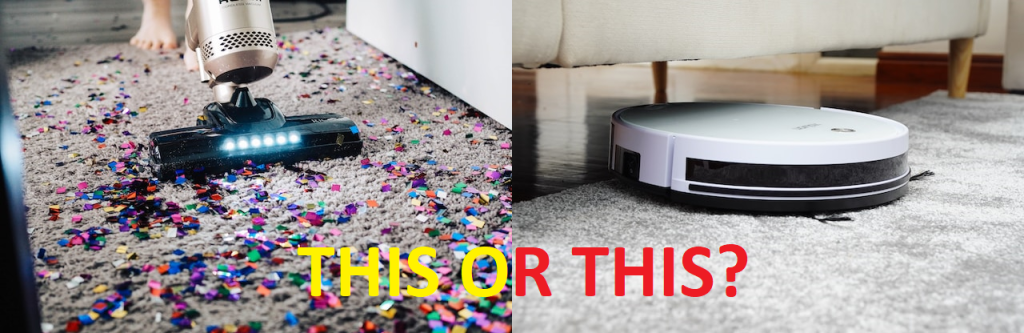
As I get older and bending down becomes more of a mission, the idea of an upright vacuum cleaner makes more sense. And lo and behold, I discovered that the upright vacuum world has come a long way since my 1989 purchase. They no longer weigh a ton, they don’t use bags—paper or otherwise—to collect the dust bunnies, and they’re portable, lightweight, cordless, and nothing like the workhorses of years gone by.
But, like most of us in Israel, I work full-time, and housework does not appeal to me, so after looking into state-of-the-art upright vacuum cleaners, I discovered the robot vacuum, or iRobot, as it is often referred to. The iRobot is smart, and some models can be controlled remotely through an app. Even if I were willing to settle for a not‑so‑smart model that I operate manually, the idea of sitting on the couch with a cup of coffee and not having to walk behind a vacuum cleaner is pretty appealing.
I’m comparing both:
What are the advantages of an upright vacuum cleaner?
- It’s upright – no bending
- Lightweight and therefore portable
- Not too noisy
- It has a small ‘dust-bunny drum,’ an advantage, as it means you must empty the drum regularly.
- The drum is transparent, so you can see if you have sucked up an earring or precious object.
- The flexible hose has been replaced by an extendable rigid pipe, so less wear and tear
- The rigid pipe can be removed and the appliance can be used as a hand vacuum–you can vacuum countertops, the car, or small, less accessible areas
- It’s rechargeable – so no long electrical cables or extension cords
Price point – from 700 shekels to 3,000 for a top-of-the-range Dyson
Disadvantages of an upright vacuum cleaner
- If you don’t keep it connected to a power supply, an emergency will arise, and you’ll discover that the vacuum has no power.
- The vacuums are intended to be wall-mounted and connected to a power supply nearby. For me this is a nuisance–the mount is just another thing that needs to be fitted and drilled into the wall. If you’re not drill-handy, you’ll need a handyperson to attach the bracket to the wall which set you back 150 shekels or more for the call-out fee.
Now, the iRobot
- Don’t think of an iRobot as a powerful vacuum cleaner—it’s really more of a sweeper. I made that mistake myself. But its great advantage is that you can be doing something else, or even out of the house entirely, while it gets on with the job.
- You need to ensure that your couch legs are sufficiently high enough for the iRobot to get underneath. We had to get new couch legs for this.
- It cannot be used in small, less accessible places.
- It isn’t quiet, and takes a fair amount of time to sweep the entire house. Having to listen to the noise while the iRobot completes, is annoying.
- The dust-bunny-drum is very small and needs to be emptied each time.
- Original parts are expensive; the brushes and filters, but I ordered a set of from AliExpress and have not had any quality-related issues.
- The iRobot needs to stay plugged in at all times, and since I don’t have another suitable spot, mine sits connected in the living room—not exactly the most decorative feature.
Price point: 500 shekels upwards
Wet-and-dry vacuums
Over the past few years, wet‑and‑dry upright vacuums and robot vacuum‑mop hybrids have taken off in Israel. This feature saves a ton of effort and pretty much eliminates the need for old‑school mops — the kind that tend to turn into germ‑collecting tools if they’re not cleaned properly.
They’re great for sticky spills, cleaning up after pets, and everyday upkeep. The dirty water tank needs to be emptied and rinsed after each use. I’m not sure whether they can clean carpets, but since most Israeli homes don’t have much carpeting, it’s not a major concern. Of course, the larger the water tank, the heavier the vacuum is.
The Dreame upright vacuum retails for around 3,000 shekels while the Bissell is one-third of the price.
Wet-and-dry robots retail from 1,500 shekels (Xiaomi) to almost 6,000 for the Dreame.
Could I manage with only one of these appliances?
Yes, I could manage with the upright vacuum, but my life is easier with the iRobot.
I bought an iRobot Roomba and, although it was one of the cheaper models in their lineup, it was still quite expensive at the time. Looking back, I realize I could have chosen a far cheaper brand. And even if the quality of the budget option had been lower, I could have bought four of them for the price of that one Roomba.
I’ve had mine for about eight years and it has never needed a single repair. But when it eventually reaches the end of its life, I plan to treat myself to a wet‑and‑dry model.
I have a personal rule: whatever appliance I buy, I never go for the top‑of‑the‑line model. I made that mistake once, and I was constantly dealing with a finicky digital panel and overly sensitive electronics. These days, I stick to a simple on/off switch and the basic features I actually need.
I hope this article is helpful. Do a price check on Zap or Zabilo before you buy. There is no shame in purchasing last year’s model to save your hard-earned money.
